
Instead of manually asking whether an arriving executive has cleared customs, use a traveler-confirmed clearance message, desk acknowledgment, and an agreed meeting point to coordinate the chauffeur meet-and-greet. This 2026 workflow separates flight tracking from passenger readiness so a landing alert never becomes an instruction to collect someone still inside arrivals processing.
- For customs clearance chauffeur meet and greet, use traveler confirmation—not flight arrival—as the readiness trigger.
- Chauffyr suits executive assistants who need airport transfers coordinated through one 24/7 desk.
- Confirm the permitted meeting point before travel; a clearance message does not establish chauffeur access.
- Keep flight tracking, clearance confirmation, and chauffeur acknowledgment as separate checkpoints.
Why this matters
A landed flight does not mean a passenger is ready to meet a chauffeur. Immigration, baggage collection, customs, and the walk to the agreed meeting point remain separate parts of the arrival.
Your workflow needs to answer different questions: Has the aircraft arrived? Is the traveler ready? Has the transport desk acknowledged the handoff? Combining those questions creates instructions nobody can reliably act on.
For your 2026 arrival procedure, connect itinerary planning to the booking before adding readiness messages. The flight itinerary to multi-city chauffeur booking workflow covers the upstream planning task; this guide addresses the final handoff from arrivals processing to the chauffeur.
The method below is a communication procedure, not a connection to a government customs system. Any automation should route messages and reminders—not infer that an individual has cleared border formalities.
Before you start
- Booking and arrival details: Have the confirmed booking reference, arrival airport, flight number, arrival date, destination, and agreed meeting instructions. Confirm airport-specific arrangements with the transport provider before travel.
- Message access and ownership: Choose an organization-approved communication channel. Record 2 operational contacts: the traveler or authorized coordinator, and the transport desk. Assign someone to monitor acknowledgments.
- The access gotcha: Customs clearance does not authorize a chauffeur to enter a restricted area. Confirm where the meeting can occur, who sends the readiness message, and what happens if the traveler has no working phone.
Keep your 2026 procedure independent of any particular messaging application. The field names below are suggested worksheet labels, not existing buttons, settings, or features in a booking platform.
Arrival record
Create a single reference for the handoff
- Create an arrival record in your approved travel worksheet or booking notes. Use Booking reference to connect messages to the confirmed reservation. Keep 1 booking reference consistent throughout this handoff; record any separate supplier references alongside it.
- Add Arrival details: flight number, arrival date, airport, destination, and the local date and time of the planned meeting. Include the time zone when coordinating across offices.
- Add Meeting instructions: the confirmed public meeting location, traveler contact method, desk contact method, and agreed identification method. Ask the provider to resolve vague directions before departure.
- Add Readiness sender and Acknowledgment owner. Identify the person authorized to report readiness and the person responsible for checking the desk's response.
Expected result: Someone who did not arrange the trip can identify the booking, find the meeting instructions, and understand who owns the next message.
Record the last confirmation date for the meeting instructions. For a 2026 trip, do not reuse an old terminal or pickup note without reconfirming it with the provider.
Keep the operational record narrow. Do not place passport images, immigration documents, confidential meeting agendas, or unnecessary personal details in a chauffeur handoff message. Share only what the recipient needs to perform the transfer.
Readiness trigger
Separate arrival status from passenger readiness
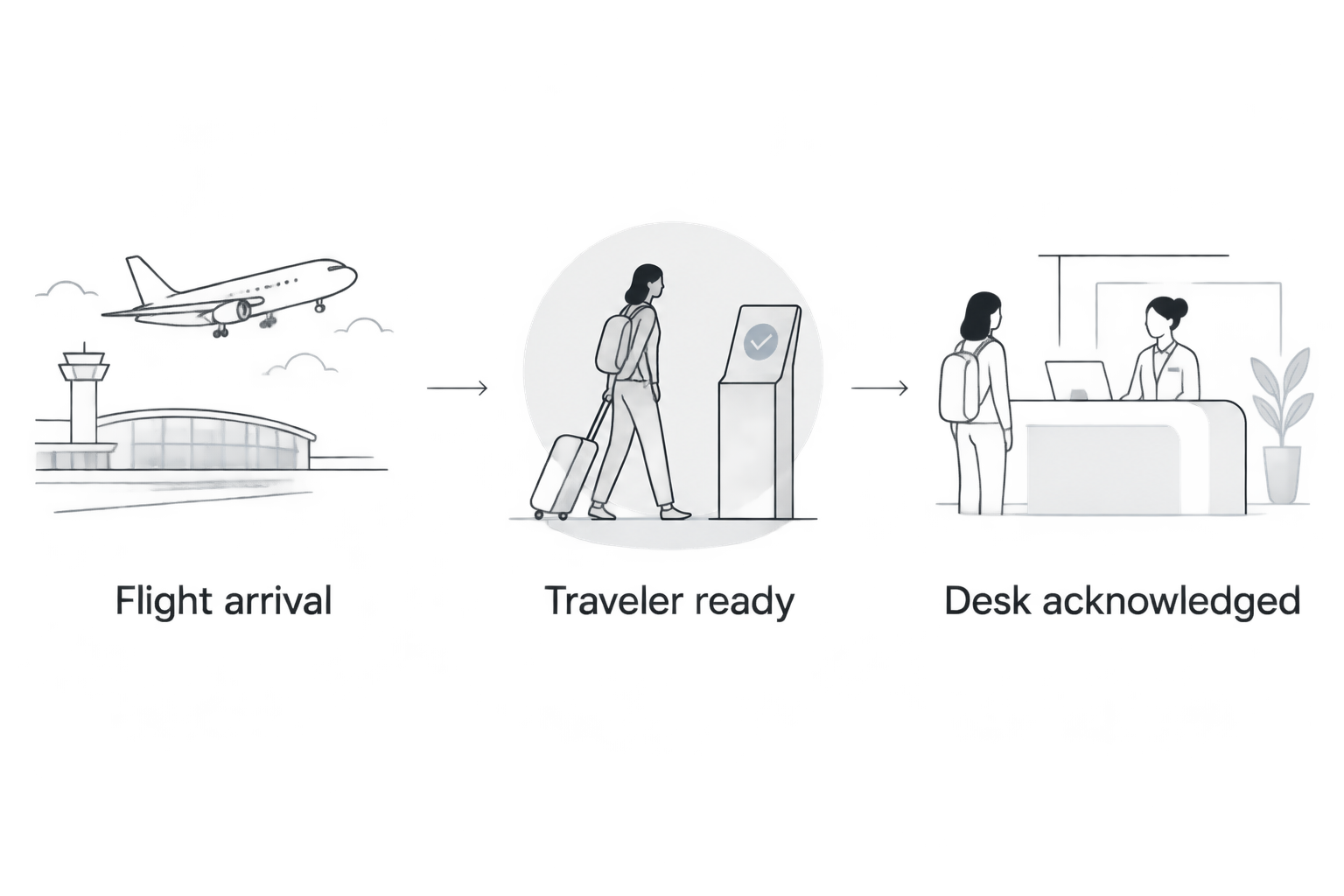
Use 3 checkpoints: Flight arrival, Traveler ready, and Desk acknowledged. These are workflow labels you define, not claims about a provider's software.
- Mark Flight arrival when the flight's arrival status is confirmed. Use flight tracking to inform coordination, but do not let this checkpoint send a passenger-ready instruction.
- Ask the authorized sender to mark Traveler ready only after the traveler confirms completion of required arrival formalities and baggage collection, or confirms an agreed exception such as leaving without a delayed bag.
- Include the booking reference and any change affecting the meeting: a different exit, unresolved baggage issue, accessibility requirement, or separation from the rest of the party. Do not treat silence as clearance.
- Route the readiness message to the agreed desk channel. If your organization uses an approved messaging automation, configure it to forward the explicit readiness message rather than interpret flight data as passenger status.
Expected result: The desk receives a deliberate readiness instruction tied to the correct booking, rather than an ambiguous landing notification.
Use a message template with the booking reference, readiness status, current location, and callback contact. Write the actual details into the message; do not ask the desk to identify the booking from the flight number alone.
For a diplomatic party or legal team, have the authorized coordinator send the operational update. The chauffeur does not need the reason for a delay or details of a principal's discussions with officials.
Desk acknowledgment
Close the communication loop before movement
- Ask the desk to acknowledge the readiness message against the booking reference. A sent message is not confirmation that someone has acted on it.
- Request confirmation of the current meeting point and the next action. Establish whether the traveler should remain where they are or proceed to the previously agreed location.
- Have the desk relay instructions to the assigned chauffeur or affiliate through its established process. Do not create a parallel dispatch channel unless the provider agrees to it.
- Record Desk acknowledged only when you receive a response. If no acknowledgment arrives, use the agreed fallback contact method rather than repeatedly sending the same instruction.
Expected result: The traveler, coordinator, and transport desk have matching instructions about where the meeting will happen and what happens next.
Never direct a traveler toward a vehicle solely because a message was delivered. Confirm the meeting instructions and the identification method agreed for that booking.
Set the escalation interval with the provider before arrival. Do not impose an arbitrary response deadline after the traveler has landed, and do not present your internal reminder interval as a provider service commitment.
Meeting confirmation
Finish the handoff and preserve the record
- Ask the traveler or authorized coordinator to confirm the meeting using the agreed identification method. Resolve a mismatch through the desk before proceeding.
- Record Meeting completed when the traveler and chauffeur have connected. If the party is split across vehicles, record the status of each assigned group separately.
- Update the destination or onward instructions only through the agreed change process. Ask the desk to acknowledge any change that affects the booked journey.
- Retain the operational timestamps and relevant booking correspondence according to your organization's retention policy. Remove unnecessary arrival-status messages when that policy requires it.
Expected result: The arrival record distinguishes a completed meeting from a sent readiness message, and the coordinator knows whether any travelers remain uncollected.
For finance teams, preserve the booking reference with the travel record so the eventual billing can be reconciled. Do not put detailed billing instructions into the traveler's arrival message when the desk can handle them separately.
When clearance or meeting details change
A second workflow is needed when the traveler sends a readiness message and then encounters another delay or a different exit. Treat a change as a new instruction requiring acknowledgment, not as an edit everyone will notice.
Choose the message path before travel:
| Message path | Best for | Advantage | Limitation |
|---|---|---|---|
| Traveler-confirmed update | An individual executive managing their own arrival | Reports readiness directly from the traveler | Depends on the traveler having a working communication channel |
| Coordinator-confirmed update | Delegations or travelers whose assistant manages communication | Keeps operational messages with an assigned coordinator | Requires the coordinator to verify the traveler's actual status |
Neither path replaces provider confirmation of the meeting arrangements. Both require an identified sender and an acknowledged instruction.
- Send an explicit Readiness withdrawn update if the traveler is no longer ready. Include the booking reference and the operational effect, such as remaining inside baggage reclaim.
- Ask the desk to acknowledge the revised status and confirm whether the existing meeting instructions still apply.
- Send a fresh readiness message when the traveler can proceed. Do not assume the earlier message becomes active again automatically.
Keep the previous message in the conversation where your policy permits. A visible correction preserves the sequence; silently editing an earlier instruction leaves recipients working from different versions.
Troubleshooting
The flight has landed, but the traveler is unreachable
Keep readiness unconfirmed. Contact the authorized alternate and follow the no-contact procedure agreed before travel. Do not interpret an inactive phone, a read receipt, or an expected processing time as evidence of clearance.
The readiness message has no acknowledgment
Use the agreed fallback channel and identify the booking immediately. Ask who is handling the arrival and request the next instruction. Do not send competing directions to the traveler while the desk is resolving the handoff.
The traveler exits somewhere different
Ask the traveler to remain at a clearly described, permitted location while the desk confirms revised instructions. Share the actual exit or landmark rather than a guessed terminal designation. Do not assume a chauffeur can stop at every curb.
Baggage is delayed after clearance
Ask the traveler whether they are remaining to resolve the baggage issue or proceeding without the bag. Relay that decision to the desk and request confirmation of any effect on the booking. Review waiting terms against the confirmed reservation rather than assuming flight tracking covers every delay.
Several travelers report readiness separately
Match each update to the assigned group and booking reference. Keep unready travelers visibly unresolved, and ask the authorized coordinator whether the party should remain together. Do not release a vehicle on the assumption that everyone on the flight has arrived together.
Customize your workflow
Extend your 2026 procedure by adding destination changes, onward meeting notifications, or separate group-readiness records. Keep each addition attached to a named owner; more notifications do not replace accountability.
Chauffyr is best for executive assistants who need airport transfers coordinated through one 24/7 desk. Its US-based coordination supports worldwide service through vetted chauffeurs and affiliates; it does not mean every chauffeur is an employee or every vehicle belongs to the company.
For Chauffyr airport transfers, flight tracking supports arrival coordination, but traveler readiness still needs a separate handoff. Confirm the airport-specific meeting point, communication channel, identification method, and applicable waiting terms when arranging travel.
Use the contact page to discuss the arrival procedure and request a quote. Ask the desk to confirm the proposed message sequence rather than assuming a messaging integration or customs-status connection exists.
FAQ
What triggers a customs clearance chauffeur meet and greet?
An explicit readiness message from the traveler or authorized coordinator should trigger the handoff. Confirm completion of required arrival formalities and the agreed baggage arrangements, then obtain the transport desk's acknowledgment.
Does flight tracking tell a chauffeur that I have cleared customs?
No. Flight tracking reports flight status, not an individual traveler's completion of immigration, baggage collection, or customs. Keep passenger readiness as a separate confirmation.
Can a chauffeur meet me inside the customs area?
Do not assume a chauffeur can enter a restricted customs area. Confirm the permitted meeting location and any applicable access arrangements with the provider for the specific airport.
Can my executive assistant send the clearance message for me?
Yes, an executive assistant can act as the designated readiness sender in this procedure. The assistant should verify your actual status and identify the booking before sending the instruction.
Does this workflow need a connection to a government customs system?
No. This workflow uses traveler or coordinator confirmation through an agreed communication channel. Message-routing automation must not be presented as access to official passenger clearance records.
What should I do if I cannot use my phone after landing?
Use the fallback arrangement agreed before travel. Designate an authorized coordinator or another confirmed contact method, and establish what the desk should do when readiness cannot be confirmed.
Can Chauffyr coordinate the chauffeur side of an international arrival?
Chauffyr provides executive airport transfers with flight tracking and one 24/7 desk. Agree on the airport-specific meeting arrangements and readiness communication process before travel; do not assume restricted-area access or an automated customs connection.
One last thing
Test the correction path, not just the readiness message. Before the next arrival, rehearse what happens when someone reports readiness and then withdraws it. A workflow that can stop an outdated instruction is more useful than one that only sends a successful arrival alert.


