
Yes—a chauffeur can meet you inside the public international arrivals hall when the airport permits it and an indoor meet-and-greet is confirmed. That normally means after immigration, baggage reclaim, and customs, not at the aircraft door or inside restricted processing areas; for your 2026 itinerary, request the exact meeting point in writing.
- Can a chauffeur meet me at international arrivals? Yes, in the public arrivals hall when airport rules permit.
- An indoor greeting does not automatically include immigration assistance, baggage handling, or vehicle access beside the terminal exit.
- Confirm the meeting point, identification method, passenger contact, and delay procedure before departure.
- Chauffyr suits executive assistants coordinating international airport transfers through one 24/7 desk.
Why this matters
An international flight arrival is not the same event as a passenger becoming ready for pickup. Immigration, baggage collection, and customs sit between landing and the public arrivals hall. Your meeting instructions must distinguish those stages.
The operational question is not simply whether someone will meet the passenger. It is where the greeting happens, who provides it, and how the passenger reaches the vehicle. When arranging airport transfers, request those details together rather than treating an indoor greeting as an assumed part of the booking.
For an executive assistant, a clear handoff also removes a decision from the traveler. The passenger should know what to do after customs without having to interpret a vague instruction such as “driver waiting at arrivals.”
Can a chauffeur meet me at international arrivals?
Yes, provided the meeting point is in an accessible public area and the arrangement complies with the airport’s rules. A standard chauffeur booking does not itself authorize entry into immigration, customs, or other restricted areas. Confirm the location for the specific airport and terminal.
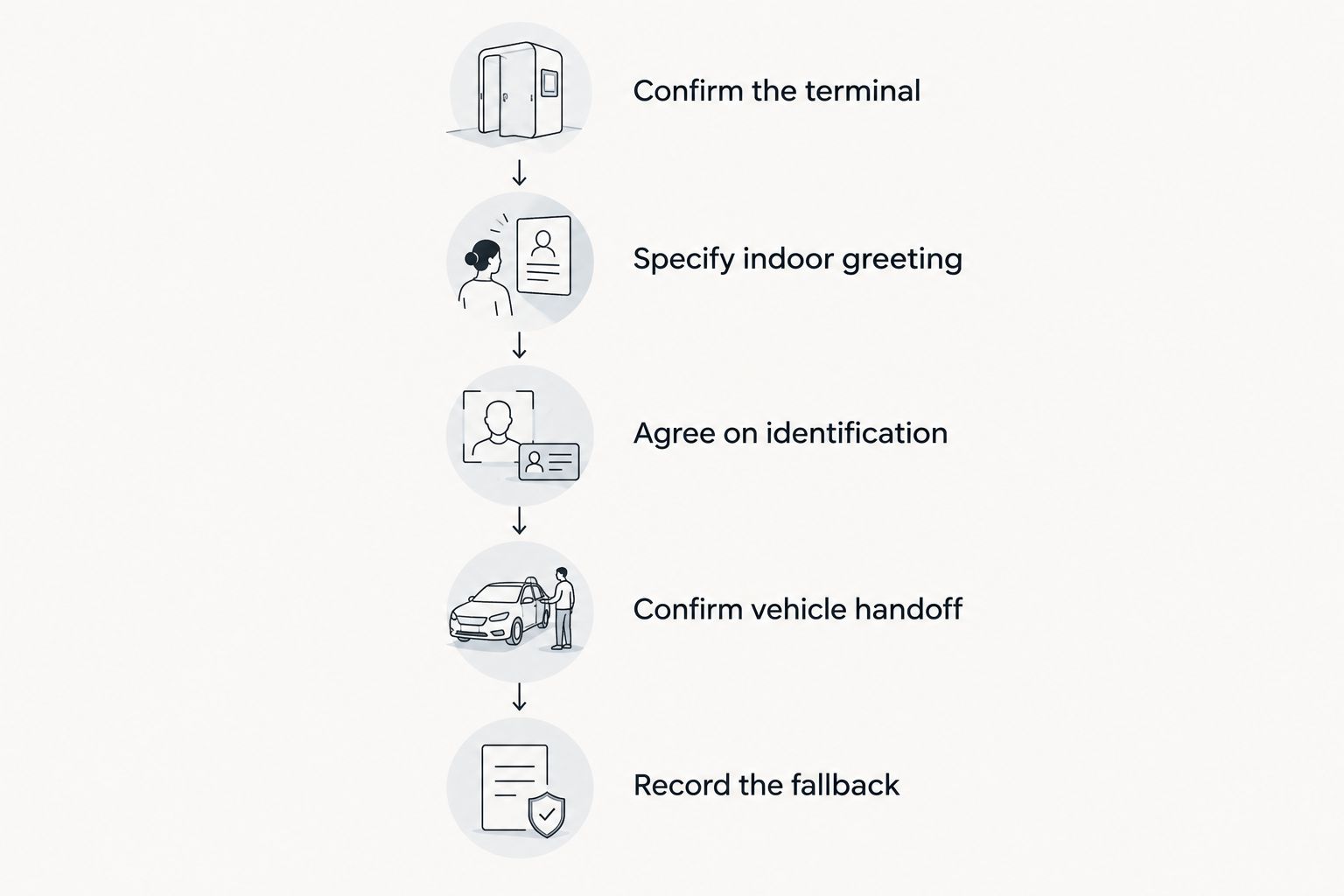
Use this sequence when booking an international arrival:
- Confirm the terminal. Supply the operating flight number and arrival date, including the local date if the journey crosses time zones.
- Specify indoor greeting. Ask whether the chauffeur meets the passenger inside the public arrivals hall rather than at an external pickup area.
- Agree on identification. Confirm the sign wording or another recognition method before travel.
- Confirm the vehicle handoff. Establish whether the greeting chauffeur escorts the passenger to a parked vehicle or coordinates its arrival separately.
- Record the fallback. Give the passenger a desk contact and an alternative instruction if the expected meeting point is unavailable.
These details make an indoor greeting actionable. A booking confirmation that says only “international arrivals” leaves the most important part unresolved: the precise place where the passenger and chauffeur find each other.
Indoor greeting versus curbside pickup
Choose the meeting format according to the passenger’s needs and the airport’s permitted arrangements. Neither format removes the need for a precise location. The table below compares the practical trade-offs, not a particular airport’s policy.
| Meeting format | Best for | Practical advantage | Limitation to confirm |
|---|---|---|---|
| Public arrivals-hall greeting | Travelers who want a named person to find after customs | Creates a defined handoff before leaving the terminal | Requires a permitted indoor meeting location and clear identification |
| Curbside pickup | Travelers comfortable finding a designated exterior pickup area | Places the handoff at the vehicle collection point | Requires the passenger to reach the correct curb, door, or zone |
Choose an arrivals-hall greeting when a clear personal handoff matters more than meeting directly at the vehicle. Choose curbside pickup when the traveler knows the airport and prefers to proceed to the designated collection area.
Do not describe either option as a guaranteed shorter journey. The indoor meeting point, vehicle location, terminal layout, and passenger’s progress determine how the handoff works. Ask for the walking route and any separate vehicle-positioning step when those details affect accessibility or timing.
Where does the chauffeur wait inside arrivals?
The useful answer is a named public meeting point after the passenger exits controlled arrival processing. That might be a designated meeting area or another airport-approved location. The precise location must come from the confirmed arrival instructions, not a generic description of the terminal.
Ask for a landmark that the passenger can identify without specialist airport knowledge. A door designation or named meeting point is more useful than “near the exit,” especially when the terminal has several exits.
For your 2026 travel brief, include the meeting point as a complete instruction: where to go after customs, what identification to look for, and whom to contact if the chauffeur is not visible. Keep the same wording in the passenger’s copy and the coordinator’s copy.
An indoor greeting also does not establish where the car waits. Confirm whether the passenger walks with the chauffeur to parking or follows another agreed handoff arrangement. That distinction matters when the traveler has luggage, reduced mobility, or an accompanying group.
Why international arrivals meeting arrangements vary
Airport access and the booking’s scope determine what an indoor greeting includes. Check these factors before confirming the passenger instructions:
- Airport access rules. Public meeting areas and authorized vehicle pickup locations are airport-specific. Request the arrangement for the actual arrival airport.
- Terminal and exit configuration. The correct terminal is essential, but it is not always a sufficiently precise meeting point. Add the designated location within it.
- Passenger processing. Immigration, baggage reclaim, and customs occur before the public-area meeting. Do not use touchdown as the instruction to proceed to the vehicle.
- Vehicle positioning. An indoor greeting and a car waiting immediately outside are different arrangements. Confirm how the passenger gets from the greeting point to the car.
- Booking scope. A chauffeur greeting does not automatically include luggage assistance, airport escort services, or assistance inside restricted areas. Request each required service explicitly.
- Passenger requirements. Mobility needs, luggage, companions, and identification preferences change the brief. Share the relevant requirements before the journey.
A clear confirmation addresses each applicable factor. If the passenger’s needs change, update the arrival instructions rather than relying on a note attached to an earlier itinerary.
What should an executive assistant put in the arrival brief?
Create a single arrival brief that the passenger, chauffeur coordinator, and receiving office can use. Separate confirmed instructions from requests that still need acceptance. The passenger should never have to determine which version is current.
Include these fields in your 2026 arrival brief:
- Flight details: operating flight number, arrival airport, arrival date, and terminal when confirmed.
- Passenger details: traveler name, traveling companions, and a working contact method for arrival.
- Greeting instruction: indoor public arrivals-hall meeting or designated curbside pickup.
- Identification method: approved sign wording or another agreed recognition method.
- Meeting location: the exact public meeting point and a usable landmark.
- Luggage and mobility: information needed to confirm the vehicle and assistance arrangements.
- Destination: the full address and any relevant entrance or receiving contact.
- Contingency contact: the coordinating desk and the person authorized to approve itinerary changes.
Keep sensitive information out of the general instruction sheet unless it is needed to deliver the journey. For a business traveler, a useful arrival brief is short enough to consult after a flight and precise enough to follow without another explanation.
Before departure, ask the passenger to save the contact details somewhere accessible without relying on a particular messaging application. Confirm the preferred communication channel rather than assuming the traveler will receive every message immediately after landing.
What happens if immigration or baggage collection takes longer?
Flight tracking identifies the flight’s progress; it does not establish that the passenger has cleared customs. A landing update is therefore not a substitute for a passenger-ready message. Agree on how the traveler or coordinator will communicate that the passenger is approaching the public arrivals area.
Before booking, confirm the waiting arrangement and the procedure for an extended delay. Ask who monitors the situation, which contact the passenger should use, and how a revised pickup is communicated. Do not assume that every delay is handled under the same terms.
If baggage is missing, the traveler should complete the required airport process and update the coordinating contact when practical. The ground transport plan needs to reflect the passenger’s actual position, not merely the flight’s arrival status.
For a 2026 delegation itinerary, designate a coordinator to communicate changes. Conflicting instructions from the passenger, assistant, and receiving office leave the chauffeur without a clear decision. State who can authorize a changed destination or departure arrangement.
How do you arrange a discreet greeting?
Discretion starts with the identification method. Confirm what appears on any meeting sign, who receives the passenger’s contact information, and which coordinator handles changes. A full name or organization name should not appear by default if the traveler has requested another arrangement.
A less public recognition method still needs to be practical. The traveler and chauffeur must share enough confirmed information to identify each other without ambiguity. Agree on that method before departure rather than improvising in a crowded arrivals hall.
For government, diplomatic, or legally sensitive travel, keep ground transport instructions distinct from formal access or protective arrangements. A chauffeur booking does not create authorization to enter controlled airport areas, and an indoor greeting is not a security service.
Give the transport coordinator the operational requirements that affect the handoff. Keep unrelated itinerary details out of the greeting instructions. This makes the brief easier to execute without making unsupported assumptions about confidentiality or special airport access.
Can a chauffeur meet me before passport control?
A standard chauffeur arrangement does not authorize a meeting before passport control. Any service inside a restricted arrival area requires separate confirmation of the provider, permissions, and scope.
If your itinerary requires assistance before the public arrivals hall, treat it as a separate airport-access requirement. Ask exactly where that service ends and where the chauffeur handoff begins. Do not let the phrase “meet-and-greet” stand in for both services.
Will the chauffeur carry my luggage to the car?
Luggage assistance must be confirmed as part of the booking; an indoor greeting alone does not establish what assistance is included. Give the coordinator the luggage requirements and ask how the transfer from the meeting point to the vehicle will work.
Confirm accessibility arrangements separately as well. Escorting a traveler through the public arrivals hall is not the same service as providing airport mobility assistance.
What should I do if I cannot find my chauffeur?
Use the agreed contact method and verify your terminal and exact location before moving elsewhere. Tell the coordinating desk which public landmark or exit you can see, and request a clear instruction.
Avoid repeatedly changing locations while the chauffeur searches for you. Once a revised meeting point is agreed, confirm it back so both parties follow the same instruction. If communication fails, follow the fallback recorded in your arrival brief.
Arranging the international airport transfer
Chauffyr is best for executive assistants who want international airport transfers coordinated through one 24/7 desk. The US-based service works with vetted chauffeurs and affiliates worldwide, with coverage at 120+ airports across 50+ countries.
Chauffyr provides flight tracking, but the booking still needs a confirmed passenger meeting point and a clear contact procedure after customs. Worldwide coordination should not be confused with ownership of a fleet in every destination.
When requesting an airport transfer from Chauffyr, specify an indoor public arrivals-hall greeting and ask for the airport-specific instructions. Confirm the sign wording, luggage requirements, vehicle handoff, and delay procedure before sharing the final brief with the traveler.
Arrange your international arrival
Request an airport transfer and confirm the public arrivals meeting point before travel.
FAQ
Can a chauffeur meet me at international arrivals in 2026?
Yes, a chauffeur can meet you in the public international arrivals hall when airport rules permit and the indoor greeting is confirmed. Request the exact meeting point after immigration, baggage reclaim, and customs.
Does an international airport pickup automatically include meet-and-greet?
No, do not assume an airport pickup includes an indoor meet-and-greet. Ask whether the confirmed arrangement is inside the public arrivals hall or at a designated exterior pickup location.
Can my chauffeur wait at the aircraft door?
A standard chauffeur booking does not authorize access to the aircraft door or restricted arrival areas. Any restricted-area assistance needs separate confirmation of permissions and service scope.
Will flight tracking tell the chauffeur when I have cleared customs?
No, flight tracking does not establish that you have cleared customs. Agree on a passenger-ready message or another contact procedure for the public arrivals handoff.
Can I request a greeting without my full name on a sign?
Ask for an alternative identification method before travel and have it confirmed. The passenger and chauffeur need the same recognition instructions.
Is an indoor greeting better than curbside pickup?
An indoor greeting is better when the traveler wants a defined personal handoff after customs. Curbside pickup suits travelers comfortable reaching the designated exterior collection point themselves.
What should I confirm with Chauffyr before an international arrival?
Confirm the airport, terminal, public meeting point, identification method, passenger contact, and vehicle handoff with Chauffyr. Include luggage requirements and ask how delays or changes will be handled.
One last thing
The most useful arrival instruction describes what the passenger does after customs, not what the chauffeur does after landing. Those are different milestones. In your final 2026 travel brief, make the passenger’s next action unmistakable.
Before departure, verify the meeting point, recognition method, and fallback contact together. A traveler who has those details can follow the plan without knowing the airport. That is the practical purpose of an indoor greeting: a defined handoff, not a promise of access everywhere inside the terminal.


