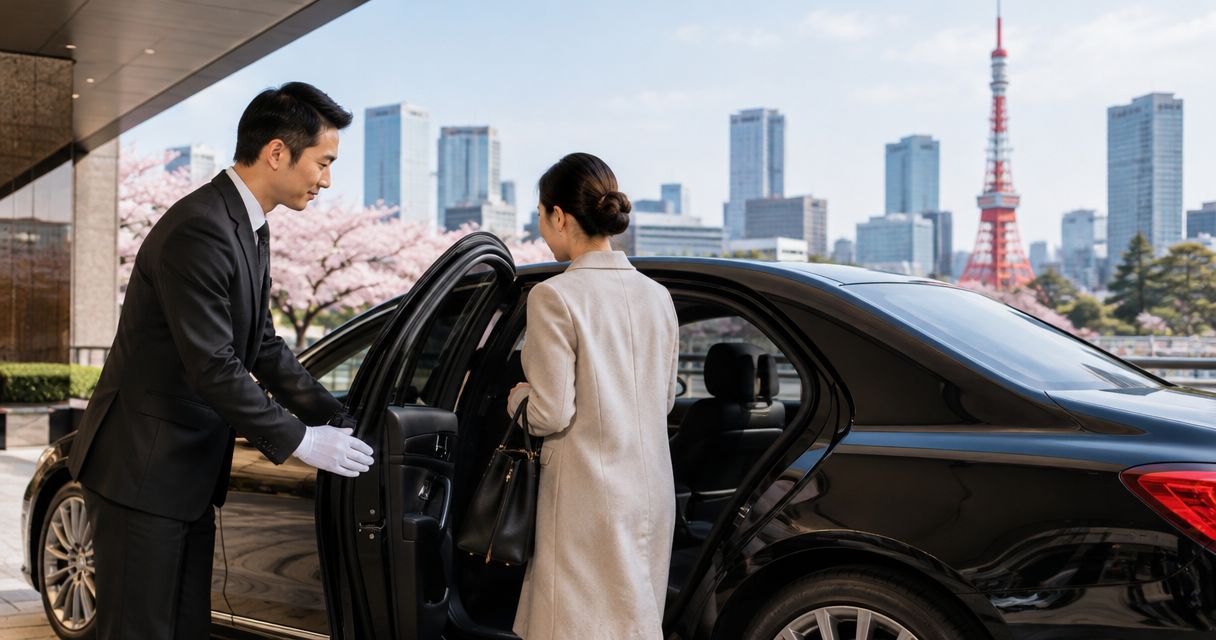
Yes. You can arrange a Tokyo chauffeur for airport transfers, scheduled journeys and a vehicle retained around your itinerary. For a 2026 business trip, confirm the airport, meeting point, service format and change procedure before treating the ground plan as complete.
- Tokyo chauffeur bookings should specify Haneda or Narita, the destination entrance and the passenger contact.
- Choose airport transfers for arrivals, point-to-point service for fixed journeys and hourly charters for changing meeting schedules.
- Request written confirmation of language requirements, luggage capacity, waiting terms and itinerary changes.
- Tokyo airport transfers need separate instructions for flight delays and delays after landing.
Why this matters
A reservation is not a complete arrival plan. Your traveler still needs to know where to meet the chauffeur, whom to contact and what happens if the flight or meeting schedule changes.
For executive assistants and travel managers, the useful distinction is between reserving a journey and coordinating the handoffs around it. Use the calendar-to-chauffeur booking workflow to organize those details before sending instructions to the traveler. For your 2026 itinerary, keep the confirmed ground arrangements alongside the flight and meeting records rather than in a separate message thread.
Is chauffeur service available in Tokyo?
Yes. Chauffeur services operate in Tokyo, including journeys involving Haneda Airport and Narita International Airport. The correct booking format depends on whether you need an arrival transfer, a defined journey or a chauffeur retained between appointments.
Choose the service around the itinerary, not the vehicle description alone. A suitable vehicle does not resolve unclear pickup instructions, an unspecified final destination or an unconfirmed language requirement.
| Service format | Best for | Practical advantage | Limitation to clarify |
|---|---|---|---|
| Airport transfer | An arrival or departure with a defined destination | Keeps flight details and the airport handoff together | Meeting point, waiting terms and post-landing delays need confirmation |
| Point-to-point service | A scheduled journey between known addresses | Gives the traveler a defined pickup and destination | Extra stops and schedule changes need separate agreement |
| Hourly charter | Meetings with changing finish times or several stops | Allows you to plan around an itinerary rather than isolated journeys | Retained time, service boundaries and extensions need confirmation |
Before approving any format, obtain written confirmation for your travel date, route and passenger requirements. General destination coverage is not a substitute for an accepted reservation.
Airport transfers: best for a defined arrival or departure
For an airport pickup, specify Haneda or Narita rather than writing only Tokyo airport. Include the flight number, arrival date, passenger name, destination and a working contact method. Copy airport details from the confirmed flight itinerary instead of reconstructing them from memory.
Ask the operator to state the meeting arrangement precisely. An arrivals-hall meeting, a designated pickup location and instructions to contact the chauffeur after baggage collection are different arrangements. Do not let a general meet-and-greet description stand in for actual directions.
Separate flight monitoring from passenger readiness. Flight tracking addresses changes to the flight; it does not tell the chauffeur when your traveler has completed immigration, collected bags or resolved a baggage problem.
For a departure, work back from the airline's check-in requirements and the operator's route assessment. Do not reuse an arrival journey estimate as a guaranteed departure transfer time. Give the operator the terminal and flight details, then request a recommended pickup time for that specific journey.
Point-to-point service: best for a fixed journey
Choose point-to-point service when the pickup time, destination and route requirements are defined. A hotel-to-office journey or a scheduled transfer to a dinner venue fits this structure when you do not need the vehicle retained afterward.
Specify the destination entrance, not just the building name. Ask your host or hotel to confirm the appropriate vehicle approach and share those instructions with dispatch. For a large property, a street address alone does not tell the chauffeur which entrance your traveler expects.
The limitation is scope. Do not assume that an additional meeting, an unscheduled stop or a delayed departure is already included in the original arrangement. Send changes to the coordinating desk and request acknowledgment before relying on the revised plan.
If your executive's finish time remains uncertain, compare the operational fit of an hourly charter before confirming separate journeys. The decision is about whether you need the vehicle retained, not whether the itinerary contains several addresses.
Hourly charters: best for changing meeting schedules
An hourly charter suits a day built around meetings, site visits or appointments whose finish times are not fixed. Define when the service starts, where it ends and how the traveler will request each departure.
Retaining a chauffeur does not remove the need for instructions. Share the planned stops, identify the person authorized to change them and ask how the chauffeur will receive updates. Confirm whether the proposed itinerary falls within the agreed service area.
Clarify extension procedures before the day begins. Ask whom to contact if the final meeting runs late and how a revised end time is approved. Do not assume that retaining a vehicle gives you an unrestricted schedule.
For a delegation, distinguish the principal's movements from those of accompanying staff. If groups separate, describe the separate movements explicitly rather than expecting a shared vehicle to cover conflicting departures.
Why Tokyo chauffeur arrangements vary
The right arrangement follows the traveler and itinerary. Use these factors to define the booking request rather than relying on a general executive-car label:
- Airport and destination: Identify Haneda or Narita, the terminal when confirmed, and the exact hotel or venue entrance.
- Schedule certainty: Distinguish fixed departures from meetings with uncertain finish times. That determines whether separate journeys or retained service fits your plan.
- Passenger and luggage needs: Declare the traveling party, bags and any equipment. Request confirmation that the proposed vehicle accommodates the complete load.
- Communication requirements: State the required language, traveler contact method and coordinator contact. Do not assume a language requirement is included.
- Access and assistance needs: Describe mobility requirements, child restraints or assistance requests before confirmation. Ask for an explicit response to each requirement.
- Approval and billing: Identify who can authorize changes and what information must appear on the invoice. Keep operational contacts distinct from payment approvers.
These details establish what you are requesting. They should also appear in the confirmation wherever they affect the journey.
How do I arrange a Tokyo chauffeur?
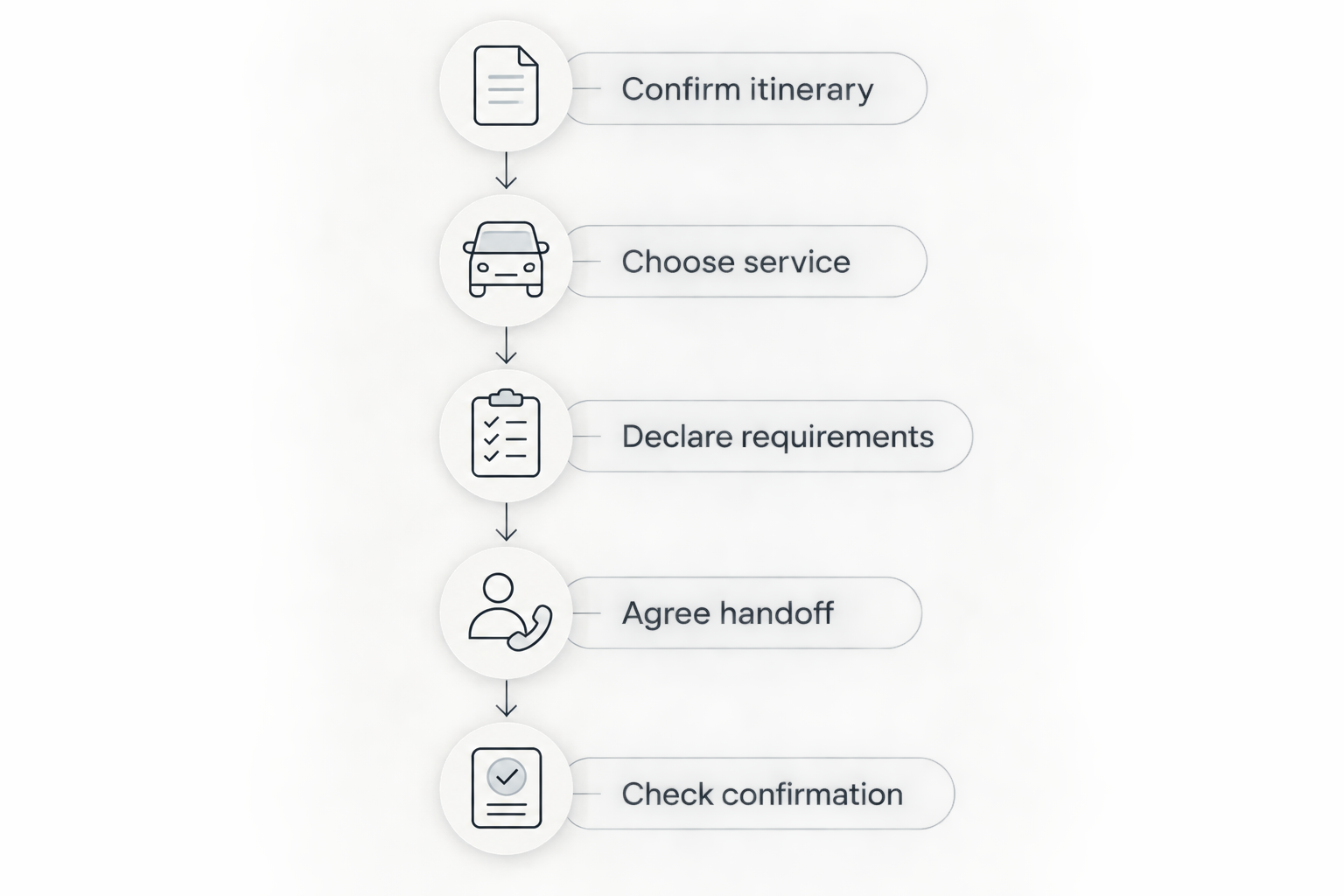
For a 2026 trip, build the booking from the itinerary outward. Resolve the following steps before distributing the final travel brief.
- Confirm itinerary. Record the local travel date, flight details, pickup address, destination and essential arrival deadlines. Mark provisional meetings clearly so dispatch does not mistake them for confirmed stops.
- Choose service. Select an airport transfer, point-to-point journey or hourly charter. Explain whether you need the vehicle to remain between appointments.
- Declare requirements. Provide passenger and luggage details, language requests and assistance needs. Share operationally necessary information without circulating confidential meeting content.
- Agree handoff. Confirm the meeting point, contact method and escalation route. State how the passenger will identify the chauffeur and what to do if contact fails.
- Check confirmation. Compare the accepted booking with the latest itinerary. Resolve discrepancies before sending the passenger brief, and record who can approve later changes.
Keep the passenger brief shorter than the booking record. The traveler needs the pickup instructions, contact details and immediate contingency action; the coordinator needs the full itinerary and approval history.
What should I confirm before an airport pickup?
Confirm the airport, flight, meeting location and contact procedure in writing. Then ask what the passenger should do if they cannot find the chauffeur or cannot use their usual mobile connection.
A useful airport brief answers these questions without requiring the traveler to search earlier messages:
- Which flight and local arrival date does the booking cover?
- Where exactly should the passenger go after completing arrival formalities?
- What identifying information will the passenger receive?
- How should the passenger report a baggage or immigration delay?
- Who handles an unresolved meeting-point problem?
- What should happen if the passenger's contact method fails?
For your 2026 travel brief, distinguish confirmed instructions from requests awaiting a response. A requested meeting arrangement is not an agreed meeting arrangement. Distribute the final version only after the operator acknowledges it.
Can I request an English-speaking chauffeur in Tokyo?
State English-language communication as a booking requirement and obtain written confirmation. Do not treat an English-language booking website or reservation conversation as proof of the assigned chauffeur's language ability.
Ask separately about the chauffeur and the coordinating desk. If your traveler needs to discuss changing stops directly, that is a different requirement from having an English-speaking contact available to relay instructions.
Provide addresses in the form supplied by the hotel, venue or host. Include the entrance instructions and a host contact where appropriate. Clear destination information remains useful even when everyone shares a language.
How should I handle delays and itinerary changes?
Assign an approval contact before travel and send changes through the agreed coordinating channel. Ask for acknowledgment so the executive assistant, traveler and chauffeur are working from the same version.
Distinguish a flight delay, a delay after landing and a meeting overrun. Each changes a different part of the plan. A flight update does not communicate a baggage problem, and a revised calendar invitation does not establish that dispatch has accepted a new departure time.
For a 2026 delegation itinerary, identify movements by traveler or group as well as location. When a principal changes plans, check whether accompanying staff still need the original movement before canceling or replacing it.
Choosing a coordinating partner
Chauffyr is best for executive travel teams seeking US-based chauffeur coordination across countries. Its stated network covers 120+ airports across 50+ countries, with vetted chauffeurs and affiliates and one 24/7 desk.
Chauffyr's executive chauffeur services include airport transfers, hourly charters and point-to-point travel. Its worldwide service uses affiliates; do not interpret the network as an owned fleet in every city. For Tokyo, request confirmation of the specific route, date, vehicle requirements and local operating arrangements before making a commitment.
The practical advantage is a coordinating contact across the itinerary. The boundary is that network coverage does not establish every local service detail. Review the chauffeur services and submit the actual itinerary rather than assuming that a general service description confirms your request.
For finance teams, Chauffyr offers consolidated billing through corporate accounts. For your 2026 travel record, request the invoice fields your organization needs, including the traveler reference, entity name and cost-center details, and confirm how changes will be documented.
FAQ
Can I book a chauffeur for Haneda or Narita Airport?
Yes, chauffeur services operate for journeys involving Haneda and Narita. Confirm the exact airport, flight, destination and meeting arrangement with the operator before treating the booking as complete.
Is an hourly chauffeur better than separate transfers in Tokyo?
An hourly charter fits an itinerary that requires a retained vehicle between meetings; separate transfers fit defined journeys. Confirm the charter boundaries and extension procedure before choosing.
Can I request an English-speaking chauffeur?
You can request English-language communication, but you need written confirmation for the assignment. Confirm the chauffeur's language capability separately from the coordinating desk's support.
Will flight tracking cover a delay at baggage claim?
Flight tracking does not establish when a passenger is ready to leave the airport. Agree how the traveler will report baggage, immigration or other post-landing delays.
Can a Tokyo chauffeur booking accommodate a delegation?
Request a coordinated plan that states each group's passengers, luggage and movements. Obtain confirmation of the vehicle arrangements and identify who can authorize changes.
Can Chauffyr coordinate a Tokyo chauffeur request?
Chauffyr provides US-based coordination for worldwide executive chauffeur services through vetted chauffeurs and affiliates. Submit the Tokyo itinerary for confirmation of the route, date and local arrangements.
One last thing
The passenger brief and the dispatch brief serve different readers. Give your traveler concise meeting instructions and an escalation contact; give dispatch the complete operational record. Before travel, check that both documents show the same pickup location, local date and approved destination.


