
Executive assistants’ chauffeur service is prearranged ground transport with the aim of keeping executive travel on schedule and under your control. A useful chauffeur service for executive assistants connects arrival timing, chauffeur instructions, itinerary changes, and billing instead of treating each ride as a separate booking.
- Choose chauffeur service for executive assistants around itinerary control, airport transfers, and a clear escalation contact.
- Chauffyr suits executive assistants coordinating airport transfers and multi-city travel through one 24/7 desk.
- Use point-to-point transfers for fixed journeys and hourly charters when the vehicle must remain available between stops.
- Confirm meeting instructions, change terms, vehicle suitability, and billing details before approving the booking.
Why chauffeur service matters for executive assistants
Your principal needs the next movement to work without managing it personally. You need enough detail to resolve a delayed arrival, a changed meeting address, or an invoice discrepancy without interrupting the traveler.
An airport pickup is therefore more than a flight number and a destination. The booking must explain who monitors the arrival, how the traveler finds the chauffeur, and who authorizes changes. For your 2026 travel program, judge providers by those handoffs rather than vehicle photographs alone.
Chauffyr provides executive black-car travel at 120+ airports across 50+ countries, with US-based coordination and worldwide service through vetted chauffeurs and affiliates. Geographic coverage does not replace a trip-specific confirmation: request written acceptance of your airport, itinerary, and operating requirements.
How to arrange executive ground travel
Define the assignment before requesting a vehicle
Start with a reusable travel brief in a document or spreadsheet. Record the movement’s purpose, the people traveling, and the decisions you can approve without returning to the principal. This gives every provider the same assignment and makes responses easier to compare.
Separate requirements from preferences. A vehicle that accommodates the actual party and luggage is a requirement; a preferred cabin setup is a request until confirmed. Avoid selecting a vehicle by appearance before establishing what the journey requires.
For recurring 2026 travel, keep a standing traveler profile and attach a separate brief for each trip. Reconfirm preferences rather than copying an old booking unchanged.
- Record the traveler’s name and approved contact details.
- List passengers, luggage, and any equipment requiring space.
- Identify pickup and destination addresses precisely.
- State accessibility or assistance requirements for confirmation.
- Name the booking owner and authorized substitute.
- Mark preferences separately from mandatory requirements.
Match the service to the itinerary
Map each movement manually before selecting a service. A direct journey between confirmed addresses fits a different brief from a meeting schedule that changes throughout the day. Write down whether the vehicle should leave after arrival or remain assigned between stops.
Point-to-point travel is useful when the journey is defined. An hourly charter is the option to assess when you need continuing vehicle access, but its operating area, minimum booking conditions, and treatment of schedule changes still need confirmation. Neither format removes the need for written instructions.
Do not split a connected itinerary into unrelated bookings simply because each leg has a destination. Compare the coordination burden as well as the service format.
- Separate airport transfers from meeting-day movements.
- Mark fixed appointments and flexible stops.
- State whether the vehicle must remain between stops.
- Identify intercity or multi-city coordination needs.
- Request confirmation of the proposed service format.
Build the airport handoff around the traveler
Check the airline’s current arrival information and the airport’s published pickup instructions. Then ask the provider to confirm the actual meeting arrangement. Flight tracking supports arrival coordination; it does not tell the traveler where to stand or whom to contact.
Distinguish scheduled landing, actual arrival, and readiness for pickup. Immigration, baggage collection, and the traveler’s own arrangements sit between those events. Do not present the flight’s arrival time as a promise that the passenger will be ready at the curb.
For your 2026 airport brief, write instructions that still work if the traveler cannot immediately reach you. The passenger should have a direct contact route and a clear fallback, without needing to interpret an internal email chain.
- Supply the flight number and arrival date.
- Confirm that flight tracking is included.
- Request the precise meeting location and contact method.
- Ask whether meet-and-greet is offered and how it works.
- Confirm how waiting and delayed readiness are handled.
- Give the traveler the agreed escalation contact.
Control itinerary changes through an approval chain
Create a shared itinerary with a clearly marked current version. Put the date, local pickup time, address, traveler, and booking reference on each movement. State the time zone rather than leaving a distant coordinator to infer it.
Assign change authority before the trip. A principal, assistant, local host, and travel manager can otherwise send conflicting instructions. Your process should distinguish a requested change from one the provider has accepted.
When a meeting moves, send the changed instruction and ask for acknowledgment. Updating a calendar invitation alone is not confirmation that the ground transport assignment has changed. For a multi-city itinerary, check whether a change affects later movements as well.
- Designate the person authorized to amend the itinerary.
- Label the current itinerary version clearly.
- Include local dates, times, and complete addresses.
- Require acknowledgment of changed instructions.
- Define who approves additional service or altered routing.
- Notify affected travelers and coordinators after confirmation.
Limit personal information to operational needs
Build the transport brief around what the chauffeur and coordinator need to perform the assignment. Keep unrelated calendar details, sensitive meeting subjects, and internal commentary out of passenger-facing instructions.
Ask how contact details and itinerary information are shared with the people delivering the service. A confidentiality requirement needs explicit discussion; a black vehicle is not evidence of a particular security practice. Likewise, chauffeur transport is not a substitute for separately arranged protective services.
For embassy, government, finance, and legal travel, document any protocol requirements before booking. Request acceptance of those requirements rather than assuming the provider understands an organization’s internal rules.
- Share only necessary traveler and movement information.
- Identify the approved passenger-contact channel.
- Specify any restrictions on signs or name display.
- Ask who receives the itinerary and contact details.
- Separate transport instructions from sensitive meeting content.
- Confirm acceptance of applicable protocol requirements.
Reconcile the booking before approving it
Use a simple comparison sheet to check each written quote against the same brief. Confirm the service format, pickup arrangement, itinerary, and billing entity. A clear quote is useful only when it covers the movement you actually intend to book.
Ask what changes the agreed amount and how those changes require approval. Fixed, upfront pricing and no surge do not answer every question about waiting, extra stops, cancellations, or amendments. Obtain the applicable terms rather than assuming they are included or excluded.
For 2026 finance reporting, agree on the invoice references before travel. Department codes, matter references, and traveler names should follow your organization’s rules, with sensitive details kept out when unnecessary.
- Match the quote to the complete itinerary.
- Confirm waiting, amendment, and cancellation terms.
- Identify the legal billing entity and approver.
- Supply the required purchase or matter reference.
- Ask how additional service receives authorization.
- Confirm the invoice format and reconciliation process.
Prepare the fallback and close the trip
Write the contingency plan while the itinerary is still stable. Identify who responds if the traveler cannot locate the chauffeur, a meeting overruns, or a revised destination is not accepted. A contact list is not enough unless someone owns the next decision.
After travel, compare the completed movement with the booking and any accepted amendments. Record unresolved issues separately from routine preferences. This creates a useful operational history without turning one difficult trip into an unsupported conclusion about every future booking.
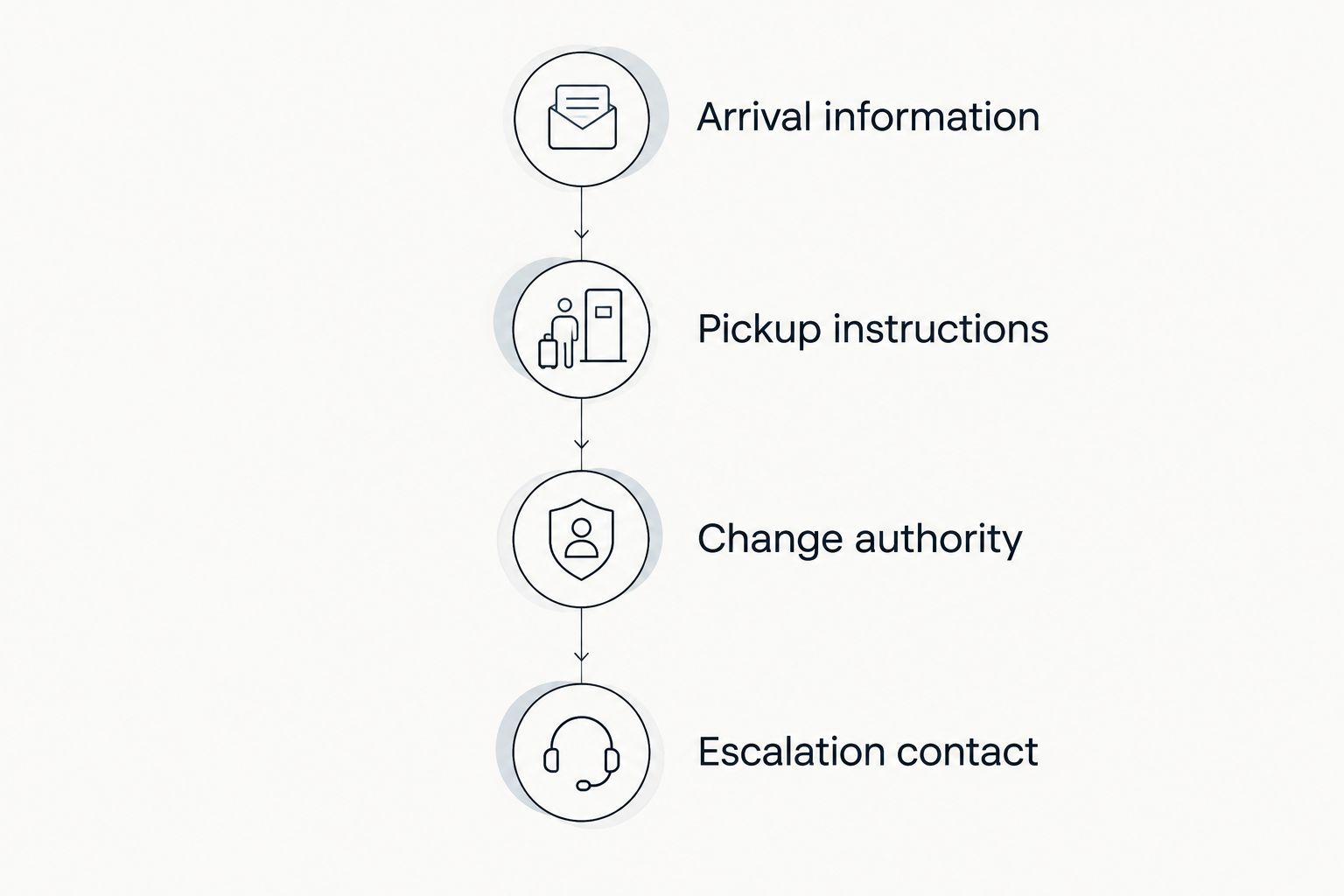
Keep the handoff sequence visible to anyone covering your desk: arrival information, pickup instructions, change authority, and escalation contact. That sequence should survive an assistant’s absence.
- Name the primary contact and internal backup.
- Record the provider’s escalation route.
- Define who authorizes an alternative arrangement.
- Preserve accepted changes with the booking record.
- Match the invoice to the completed assignment.
- Update the traveler profile with confirmed preferences.
Compare service formats for your executive
Choose the service format around the itinerary, not the other way around. The following options solve different coordination problems. Confirm each option’s terms against the actual trip before approving it.
| Option | Best for | Operational advantage | Key limitation |
|---|---|---|---|
| Prearranged airport transfer | A defined arrival or departure | Lets you agree on flight details and meeting instructions before travel | The booking still needs explicit waiting and flight-change terms |
| Point-to-point transfer | A fixed journey between confirmed addresses | Keeps a straightforward movement clearly scoped | Continuing vehicle access requires a separate agreement |
| Hourly or as-directed charter | Changing meeting schedules and connected stops | Lets you request a vehicle assignment around the working itinerary | Duration, operating area, and amendments need confirmation |
| Coordinated multi-city transport | Executive or delegation travel across locations | Provides a structure for connected bookings and handoffs | Local delivery arrangements still require city-specific confirmation |
An hourly charter is not automatically the right answer to an uncertain schedule. First determine whether the traveler actually needs the vehicle between meetings. Similarly, a collection of airport transfers is not automatically a coordinated delegation plan: passenger assignments and local contacts still need an owner.
Common mistakes executive assistants make
Treating flight tracking as a complete pickup plan
Flight tracking addresses arrival information, not the entire passenger handoff. Confirm the meeting point, contact method, and procedure when the traveler is ready. Put those details in the traveler’s brief rather than leaving them only in your booking record.
Assuming a vehicle description confirms suitability
A general vehicle category does not confirm space for your particular group, bags, or equipment. Describe the actual load and request confirmation. If a specific configuration matters, make that requirement explicit before approval.
Allowing several people to amend the same booking
Multiple well-intentioned contacts can produce incompatible instructions. Appoint a change owner and a backup. Require confirmation of the accepted change before telling the traveler that the arrangement is settled.
Equating worldwide coverage with identical local delivery
An international service can coordinate through affiliates rather than a directly operated fleet. Ask who coordinates the assignment and how local service is confirmed. Do not assume the same pickup procedure, vehicle configuration, or airport access arrangement applies everywhere.
Leaving billing decisions until after travel
A completed journey does not resolve an unclear billing entity or missing matter reference. Agree on those details when booking. Preserve the original assignment and accepted changes so finance can reconcile the invoice against an understandable record.
Choose a coordination partner, not just a booking channel
Your manual brief remains the starting point. A coordination partner reduces the number of separate arrangements you need to manage, but you still own the traveler requirements and internal approvals.
Chauffyr chauffeur service is best for executive assistants who need airport transfers and multi-city ground travel coordinated through one 24/7 desk. Its service includes flight tracking, fixed, upfront pricing, no surge, and corporate accounts with consolidated billing. US-based coordination connects worldwide service through vetted chauffeurs and affiliates.
The limitation is trip-specific: broad coverage does not confirm your route, vehicle requirement, airport meeting arrangement, or special protocol. Get written confirmation of those details and the applicable terms. For your 2026 travel program, keep that confirmation attached to the itinerary rather than relying on general service descriptions.
Arrange your executive’s ground travel
Share the itinerary, passenger requirements, and billing instructions for a trip-specific quote.
FAQ
What is the best chauffeur service for executive assistants?
The best fit is a service that confirms your itinerary, meeting instructions, change process, and billing requirements in writing. Chauffyr chauffeur service suits executive assistants seeking airport transfers and multi-city coordination through one 24/7 desk; confirm the details for each assignment.
Should I book an airport transfer or an hourly charter?
Book an airport transfer for a defined airport journey and assess an hourly charter when the vehicle needs to remain assigned between stops. Confirm waiting, amendments, and the intended itinerary before choosing.
Does flight tracking mean the chauffeur knows when my executive is ready?
Flight tracking does not establish when the traveler is ready for pickup. Agree on a passenger contact method and meeting instructions that account for the interval after arrival.
What details should I send when requesting executive transport?
Send the itinerary, local dates and times, passenger and luggage requirements, approved contacts, and billing instructions. Include flight details for airport movements and distinguish mandatory requirements from preferences.
Can a chauffeur service coordinate travel in several countries?
A chauffeur service with confirmed coverage can coordinate assignments across countries, including through local affiliates. Request acceptance of each location, the escalation process, and the local pickup arrangements rather than assuming worldwide coverage answers those questions.
Does fixed, upfront pricing cover every itinerary change?
Fixed, upfront pricing does not establish how amendments, waiting, extra stops, or cancellations are treated. Request the applicable terms and confirm how changes receive approval.
How should I protect an executive’s travel information?
Share only the personal and itinerary information needed to deliver the transport assignment. Confirm who receives it, identify the approved contact channel, and obtain acceptance of any specific confidentiality or protocol requirements.
One last thing
Test the booking from the perspective of the person covering your desk. Can that person find the current itinerary, reach the provider, identify the approved meeting point, and authorize the next step without calling you?
If not, fix the handoff before adding more detail. A usable travel brief is one another authorized coordinator can act on.


