
Yes, you can arrange a Geneva car service for airport transfers, scheduled journeys, and travel between meetings. For your 2026 itinerary, confirm the exact pickup location, passenger and luggage requirements, service scope, and change terms before treating any journey as booked.
- Geneva car service suits planned airport transfers and business itineraries; confirm each journey before travel.
- Choose an airport transfer for an arrival, point-to-point travel for a defined journey, and hourly service for linked appointments.
- Confirm the meeting point, flight tracking, luggage fit, and change terms in writing.
- Diplomatic transport requires separate confirmation of protocol instructions; a chauffeur booking does not establish security capabilities.
Is chauffeur service available in Geneva?
Yes. The important distinction is between finding a chauffeur service and confirming the right operating plan for your visit. An airport arrival, a hotel-to-office journey, and a changing meeting schedule require different instructions.
Start with the itinerary rather than the vehicle. The calendar-to-chauffeur booking workflow provides a useful structure for turning appointments into pickup instructions.
| Service format | Best for | Main advantage | Main limitation to resolve |
|---|---|---|---|
| Airport transfer | An arrival or departure linked to a flight | Connects the ground journey to flight details | Landing time alone does not establish when the passenger reaches the meeting point |
| Point-to-point travel | A defined journey between addresses | Keeps the transport brief focused on a specific movement | Additional stops and waiting need explicit agreement |
| Hourly charter | Linked meetings or an itinerary with changing departure times | Provides a framework for as-directed travel within an agreed scope | You must confirm the service window, geography, and treatment of extensions |
These are booking formats, not interchangeable promises. Ask the provider to identify which format applies and record any exceptions in the confirmation.
Why this matters
An executive assistant needs more than a reservation reference. You need to know who receives updates, where the passenger meets the chauffeur, and who approves a change when a meeting runs late.
A useful 2026 travel brief separates the passenger's instructions from the coordinator's working details. The traveler needs a clear meeting point and contact method. The coordinator needs the full itinerary, escalation contact, and authority to approve changes.
Do not treat a vehicle description as an operating plan. A suitable vehicle does not resolve an incorrect address, an unclear meeting point, or conflicting instructions from several people.
Airport transfers: confirm the handoff, not just the flight
Best for: an airport arrival or departure with a defined onward destination. Supply the airport name, flight number, travel date, passenger name, destination address, and a working contact number. If the itinerary names Geneva Airport, retain the airport identifier exactly as shown on the flight booking.
Ask whether flight tracking forms part of the arrangement. Then confirm how the provider handles the gap between landing and passenger readiness, including baggage collection and border formalities where applicable.
Settle the meeting method before departure:
- Request the exact meeting location and instructions for finding it.
- State whether you need an arrivals-hall meeting or another agreed pickup arrangement.
- Confirm how the passenger receives chauffeur contact details.
- Ask what action to take if the passenger and chauffeur cannot locate each other.
- Confirm the waiting terms and the procedure for reporting an extended delay.
The advantage is a flight-linked plan. The limitation is that flight information does not tell the chauffeur when the passenger has collected baggage or reached the meeting point. Give the traveler a simple way to report readiness.
Point-to-point travel: define the journey precisely
Best for: a scheduled movement between confirmed addresses. Use this format when you know the origin, destination, and required arrival time. Include the building entrance or reception point when an address alone leaves room for confusion.
Tell the provider whether the time in your brief means departure or arrival. An appointment time is not a pickup time. Request a proposed departure time for the route rather than inserting an unsupported journey estimate into the principal's calendar.
Record any intermediate stop in the request. A hotel departure followed by an office visit and a final destination is not the same instruction as a direct transfer.
The advantage is a tightly defined brief. The limitation is reduced clarity when plans change: waiting, extra stops, or a new destination require agreement rather than assumption. Ask how those changes are authorized and reflected in the booking record.
Hourly charters: agree the boundaries of flexibility
Best for: a sequence of appointments with uncertain finishing times. Share the planned stops even when the purpose of the charter is flexibility. The provider still needs enough information to assess the requested operating area and schedule.
For a 2026 meeting program, define the service start, expected finish, first pickup, final destination, and contact responsible for updates. Ask whether the chauffeur remains assigned throughout the agreed period and how an extension is requested.
Confirm the practical details:
- Where the chauffeur should wait between appointments, subject to local access rules.
- Whether the passenger expects to leave belongings in the vehicle.
- How revised departure instructions reach the chauffeur.
- What happens if the program extends beyond the agreed service window.
- Whether every planned destination falls within the accepted scope.
The advantage is itinerary control within an agreed assignment. The limitation is that an hourly booking does not mean unrestricted travel or an undefined finish. Put the boundaries in writing before approval.
Why Geneva car service arrangements vary
The right booking depends on the work the transport must perform. Use these factors to explain your requirements rather than asking for an unspecified executive car.
- Arrival details. A flight-linked collection needs flight information and a passenger handoff plan; a hotel departure needs a precise address and readiness time.
- Itinerary structure. A direct transfer and an afternoon of changing appointments require different instructions and service scope.
- Passenger and luggage needs. Provide the actual passenger count and luggage description so the provider can confirm suitability.
- Coordination requirements. An individual traveler, a legal team, and a delegation need different contact and approval arrangements.
- Special requests. Language preferences, accessibility needs, and protocol instructions require explicit acceptance, not a general acknowledgment.
- Changes and billing. Confirm who can authorize amendments and which invoice details the organization requires.
Do not infer a local fleet, a particular vehicle model, or a security capability from the phrase “executive transport.” Each is a separate fact to establish for the assignment.
How do I book a Geneva chauffeur for a business trip?
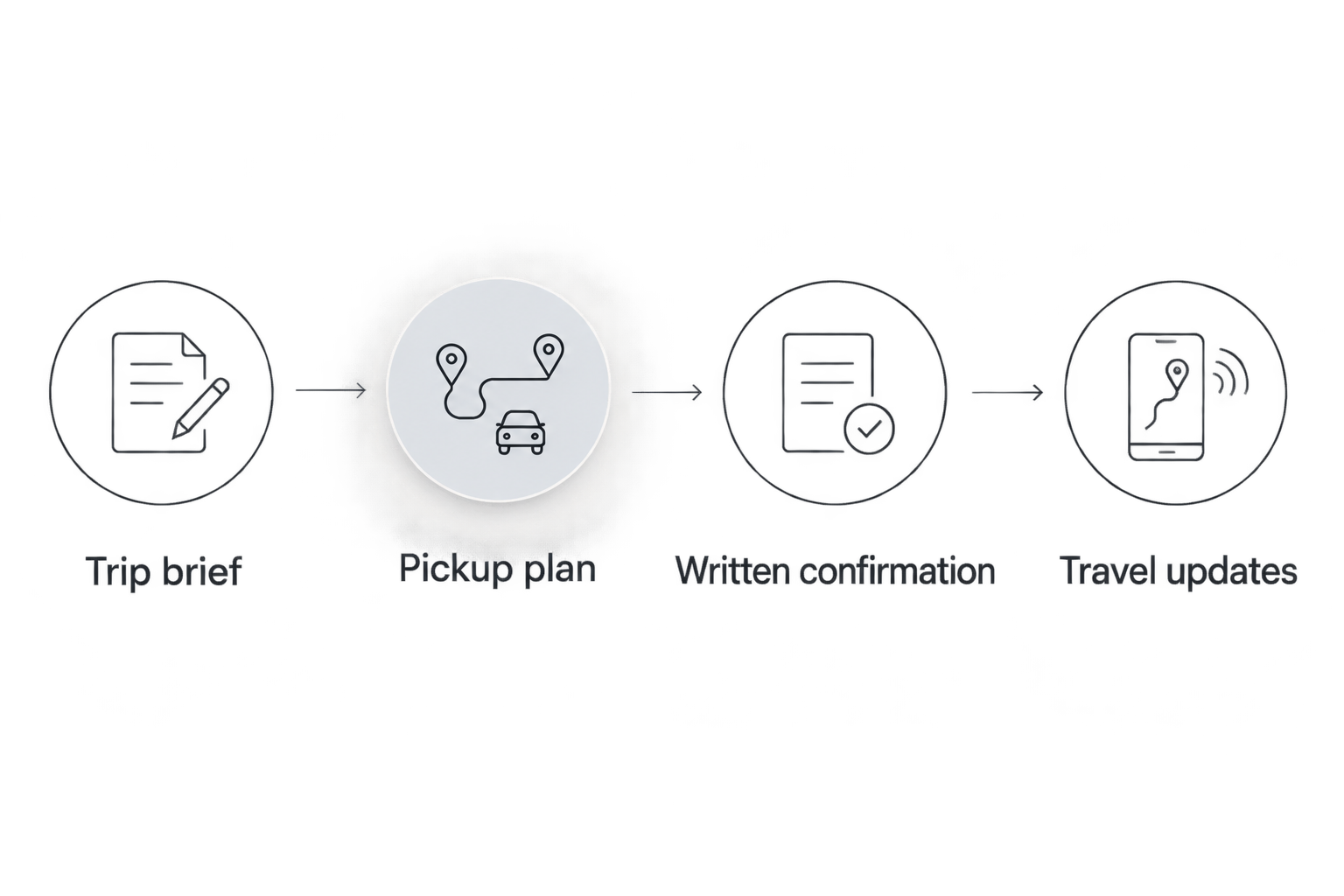
Use a single written brief and request a confirmation that answers it. For 2026 bookings, keep the approved version accessible to both the travel coordinator and the person managing the journey locally.
- Trip brief. Record the date, flight or appointment details, exact addresses, passenger requirements, and preferred service format. Distinguish confirmed movements from tentative ones.
- Pickup plan. Agree the meeting point, passenger contact method, and proposed departure time. Include instructions for a missed connection between passenger and chauffeur.
- Written confirmation. Check the accepted itinerary, vehicle requirements, waiting terms, change procedure, and billing details. Resolve unanswered requests before approval.
- Travel updates. Nominate the person who sends amendments and receives acknowledgment. Circulate the final instructions without creating competing versions.
A booking request describes what you want. A confirmation establishes what the provider has accepted. Keep that distinction visible when several assistants, hosts, or departments contribute to the itinerary.
What should I send if the itinerary is not final?
Send the confirmed movements and mark the remaining details as provisional. Identify the person who will approve the final schedule and ask which information the provider needs before confirming the assignment.
Do not present an unfinished itinerary as final simply to secure a reservation reference. That creates a document that looks authoritative without giving the chauffeur usable instructions.
What should diplomatic and delegation coordinators confirm?
A chauffeur assignment is a transport arrangement, not evidence of protective security or official access. Keep protocol, access permissions, and any specialist security requirement separate from ordinary pickup instructions.
Provide the principal's preferred form of address, the operational contact, passenger groupings, and any approved vehicle presentation requirements. Share only the personal information needed to execute the journey.
For movements involving several vehicles, issue a consistent movement list. Identify which passengers belong in each vehicle, who authorizes departure, and where changes are reported. Request acknowledgment of the latest version rather than assuming every participant received it.
Confirm language requirements explicitly. Do the same for restricted entrances, credentialed locations, or special vehicle requests. A general acceptance of “delegation transport” does not answer those individual questions.
What should finance and legal teams put in the brief?
Set the billing instructions before travel. Include the invoicing entity, billing contact, purchase reference if required, and the way journeys should be identified on the invoice.
Keep confidential meeting descriptions out of operational instructions unless they are necessary. An exact address, passenger name, and responsible contact can explain a movement without describing the underlying transaction or matter.
For your 2026 travel records, retain the accepted itinerary alongside subsequent amendments. This gives the person reconciling the invoice a clear record of what changed and who approved it.
What happens if the flight or meeting schedule changes?
Send the change to the agreed operational contact and request acknowledgment. A revised calendar invitation does not establish that the transport provider has accepted a new pickup time or destination.
For a flight change, send the replacement flight details and confirm whether the existing collection instructions still apply. For an extended meeting, report the revised readiness time and ask how it affects the agreed assignment.
If the passenger is unreachable, the coordinator needs an escalation path. Decide before travel who can amend the journey and who can approve instructions on the principal's behalf. Do not leave that decision until the chauffeur is waiting.
Where Chauffyr fits into the planning process
Chauffyr is best for executive assistants and travel teams seeking coordinated chauffeur travel through one 24/7 desk. Its US-based coordination supports worldwide service through vetted chauffeurs and affiliates; that does not imply ownership of a fleet in every destination.
Chauffyr describes coverage at 120+ airports across 50+ countries. Treat that network scope as context, not as confirmation of a particular Geneva assignment. Submit the actual route, dates, passenger requirements, and service format for confirmation.
The chauffeur services overview covers airport transfers, hourly charters, and point-to-point travel. The operational benefit is a shared coordination contact; the boundary is that local arrangements, special requests, and assignment-specific terms still require written acceptance.
FAQ
Can I arrange a Geneva car service for an airport arrival?
Yes, you can arrange a Geneva car service for an airport arrival. Confirm the flight details, meeting point, passenger contact method, and waiting terms before travel.
Is an hourly chauffeur better for meetings around Geneva?
An hourly charter is the better fit when linked appointments need flexibility within an agreed service window. Confirm the operating area, waiting arrangements, and extension procedure.
Can my executive assistant make the booking?
Your executive assistant can coordinate the request and booking instructions. Identify the passenger, the operational contact, and the person authorized to approve changes.
Does flight tracking replace contacting the chauffeur?
Flight tracking does not replace passenger communication. Confirm how to report baggage delays, readiness, or difficulty finding the agreed meeting point.
Does Chauffyr own vehicles in every destination?
Chauffyr coordinates worldwide service through vetted chauffeurs and affiliates. Do not interpret its global coverage as ownership of a fleet in every city.
Can Chauffyr confirm my Geneva itinerary?
Chauffyr can receive your itinerary request for review and confirmation. Send the exact route, dates, passenger and luggage requirements, and any special instructions rather than relying on general network coverage.
One last thing
Put the passenger's meeting instructions in the passenger's hands. A complete confirmation in an assistant's inbox does not help a traveler who has landed without the meeting point or contact method.
Send a short travel-day brief containing the pickup location, contact route, destination, and escalation instruction. Keep internal billing references and tentative itinerary discussion in the coordinator's copy.


