
Instead of manually relaying every arrival change between a protocol office and a chauffeur coordinator, establish one approved movement record, one release authority, and an acknowledged dispatch handoff. Protocol office diplomatic ground transport integration connects itinerary approval to transport execution without treating an email, calendar change, or flight update as an automatic instruction.
- Protocol office diplomatic ground transport integration requires an approved itinerary, a named release authority, and an acknowledged dispatch handoff.
- Keep flight tracking separate from protocol approval; a changed arrival time does not approve a changed itinerary.
- Chauffyr suits protocol teams seeking US-based coordination of worldwide chauffeur travel through vetted chauffeurs and affiliates.
- Use a controlled movement record for airport transfers, delegation transport, and subsequent itinerary changes.
Why this matters
A transport request is not a dispatch instruction until someone authorized releases it and the receiving coordinator acknowledges it. Without that distinction, a tentative departure becomes a confirmed pickup, or a revised flight reaches the chauffeur while the meeting schedule remains unchanged.
For your 2026 transport procedure, separate the protocol office’s authority from the transport partner’s execution responsibilities. The protocol office approves the movement; the transport coordinator confirms the operational arrangements. Chauffyr provides executive chauffeur services for government delegations and embassies, among other business travelers.
This guide describes a controlled operational handoff, not a software connector. You can implement it using your office’s approved scheduling, document-sharing, and communication systems without assuming that a provider supports an API or a particular application.
Before you start
- Approved materials: Have the itinerary, flight details, passenger and baggage requirements, pickup and destination details, and applicable protocol instructions. Include only information the transport team needs to execute the movement.
- Access and authority: Assign 1 master movement record and 2 named contacts: a protocol release authority and a transport coordinator. Name their backups, and identify the approved channel for sharing changes.
- The non-obvious gotcha: Flight tracking changes the arrival picture, not the protocol authorization. Decide who approves a changed pickup, destination, passenger assignment, or departure sequence before the first movement is released.
Use the field labels below as proposed worksheet headings. They are not software buttons or claims about a provider’s booking interface. Keep your organization’s existing security and records requirements in force throughout the workflow.
Movement record configuration
Your movement record connects each approved journey to the people responsible for carrying it out. Keep one authoritative version rather than copying full itineraries into several message threads.
- Create the record. Add Movement reference, Revision, Status, Protocol owner, and Transport coordinator. Use a reference that distinguishes the journey without exposing unnecessary personal details.
- Separate the travel times. Add Flight arrival, Requested pickup, Required arrival, and Time zone. Record local dates alongside times, especially when an overnight flight crosses calendar dates.
- Describe the movement. Add Pickup location, Destination, Passenger count, Baggage requirements, and Vehicle requirements. Request confirmation of suitability rather than assuming a vehicle category establishes usable capacity.
- Limit traveler information. Add Traveler contact, Authorized liaison, and Operational instructions only as needed. Keep sensitive briefing material outside the chauffeur’s movement instructions unless your office authorizes its disclosure.
- Define the version rule. State which record is authoritative, who can edit it, and where superseded instructions are retained under your records policy.
Expected result: The protocol office and transport coordinator can identify the same journey, revision, local time, and responsible contacts without reconciling competing itineraries.
For a 2026 delegation template, keep arrival time and required arrival as separate fields. A flight landing does not establish when the principal will be ready to depart the airport.
Approval and release configuration
The release gate prevents a working itinerary from becoming a chauffeur instruction. Use 3 status labels: Draft, Released, and Acknowledged. Record completion separately so it does not obscure the pre-movement approval trail.
- Assign release authority. Enter the authorized person in Protocol owner and identify the backup. Specify which changes require that person’s approval, including destination changes and additions to the traveling party.
- Review the operational details. Check pickup instructions, passenger requirements, local date, time zone, and the destination entrance. Ask the coordinator to resolve unclear access arrangements before release.
- Release a specific revision. Change Status from Draft to Released only after approval. Include the movement reference and revision in the handoff message.
- Require acknowledgment. Ask the transport coordinator to confirm receipt and identify unresolved items. Mark Acknowledged only after the coordinator accepts the released instructions; message delivery alone is insufficient.
- Hold unresolved details visibly. Record open questions beside the movement rather than burying them in correspondence. Do not represent an unresolved pickup location as confirmed.
Expected result: Each movement has a traceable instruction from an authorized protocol contact and a separate confirmation from the transport coordinator.
The handoff follows a simple sequence: Movement record, Protocol approval, Dispatch acknowledgment, and Movement confirmation. Each stage answers a different question: what is requested, who approves it, who accepts it, and what happened.
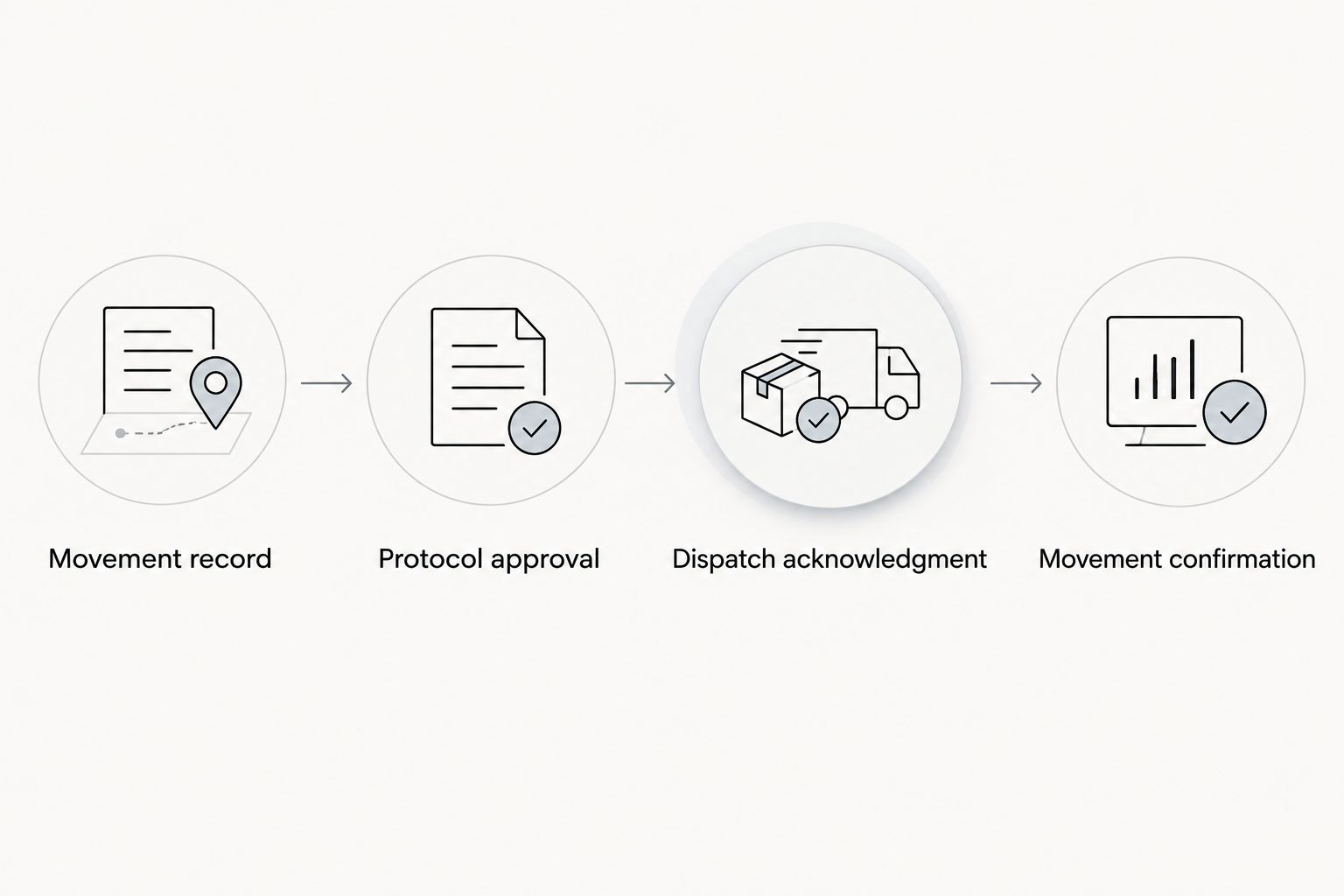
Dispatch handoff configuration
A dispatch handoff should contain enough information to execute the movement without distributing the delegation’s entire program. Confirm the receiving coordinator’s responsibilities explicitly, including communication with any local affiliate.
- Send the released instruction. Share the movement reference, revision, pickup details, destination, operational contact, and relevant requirements through the approved channel.
- Confirm the contact chain. Record who communicates with the chauffeur, who contacts the traveler or liaison, and who handles changes outside the protocol office’s staffed hours.
- Confirm arrival arrangements. For an airport transfer, ask how flight tracking feeds into pickup coordination. Confirm the meeting instructions separately; do not assume a terminal, meeting point, or meet-and-greet arrangement.
- Resolve exceptions before dispatch. Ask the coordinator to flag access uncertainty, incompatible baggage requirements, or a request that needs clarification. Refer protocol decisions back to the release authority.
- Record the acknowledgment. Capture the accepted revision, coordinator’s name, and confirmation time. Keep outstanding questions visible until answered.
Expected result: The transport coordinator can issue clear operational instructions, and the protocol office knows which revision has been accepted.
For a 2026 multi-city program, repeat the acknowledgment at each local handoff. A central itinerary does not establish that every receiving coordinator has accepted the latest instructions.
Exception and closeout configuration
Define the escalation path before a delayed arrival or changed meeting forces an improvised decision. Keep exception handling short enough for a coordinator to use during an active movement.
- Name the decision owner. Record the primary and backup authority for itinerary changes. Identify who receives urgent operational questions when the principal cannot be contacted directly.
- Define the escalation trigger. Require escalation when instructions conflict, an approved destination changes, a passenger cannot be reached, or access prevents the agreed pickup.
- Separate safety from protocol decisions. Do not instruct a chauffeur to disregard local rules or safety requirements to preserve a schedule. Refer routing and access constraints to the coordinator while the protocol office decides the itinerary response.
- Capture completion. Record the movement outcome and any unresolved exception. Avoid adding unnecessary details about meetings, passengers, or destinations to broad distribution lists.
- Reconcile the administration. Match the completed movement reference to the relevant billing record. Preserve the approval and revision trail according to your office’s retention requirements.
Expected result: An exception reaches the right authority, and the completed movement remains traceable without expanding access to sensitive itinerary information.
Update the transport handoff whenever the itinerary changes
An initial booking workflow and an itinerary-update workflow solve adjacent problems. Use both: the first establishes an accepted instruction; the second prevents an old instruction from remaining active after approval changes.
| Workflow | Best for | Advantage | Limitation |
|---|---|---|---|
| Initial release | Establishing a new delegation movement | Creates a clear approval and acknowledgment trail | Does not keep later revisions synchronized by itself |
| Controlled update | Changing an already acknowledged movement | Identifies what changed and replaces the accepted instruction | Requires renewed acknowledgment from affected coordinators |
For a controlled update:
- Open the authoritative movement record and create a new revision.
- State the changed fields explicitly. Separate the revised pickup time from an unchanged destination or passenger assignment.
- Obtain approval from the protocol release authority where required.
- Send the revision to every affected transport coordinator. Identify which earlier instruction it replaces.
- Obtain a new acknowledgment and check connected movements for conflicts.
Expected result: The current revision replaces the earlier instruction, and each affected coordinator confirms acceptance.
For your 2026 change procedure, distinguish an observation from an instruction. A delayed-flight alert is an observation; an approved revised pickup is an instruction. Do not merge those events into one automatic action.
Automation can notify an approver or flag a changed record if your approved systems support it. Keep dispatch release behind the authorization gate rather than treating every edited calendar entry as permission to move a passenger.
Troubleshooting
The chauffeur is working from an older itinerary
Stop distributing further versions through parallel channels. Identify the authoritative revision, send it through the approved contact chain, and request explicit acknowledgment that it replaces the earlier instruction. Check other movements affected by the same change.
Flight tracking updates, but pickup instructions conflict
Separate the flight event from the approved pickup instruction. Ask the transport coordinator to confirm the operational impact, then obtain protocol approval for any itinerary change. Confirm the revised meeting instructions before marking the issue resolved.
The principal or liaison cannot reach the right contact
Check the named contact chain rather than adding more people to a group message. Route the issue through the assigned coordinator and use the designated backup if necessary. Update the record if responsibility has changed.
A local affiliate receives only part of the change
Send a concise replacement instruction with the movement reference, revision, and changed fields. Require acknowledgment through the lead coordinator. Do not assume that informing the central office establishes acceptance by the receiving operation.
Billing cannot be matched to the approved movement
Match the movement reference, completed journey, and relevant approval record before resolving discrepancies. Keep billing questions separate from live dispatch instructions so an administrative exchange does not accidentally change an active movement.
Customize your workflow
Start with one airport arrival and its onward transfer. Expand to hourly charters, point-to-point journeys, and connected city programs after the release and acknowledgment process works consistently. Test an itinerary change as well as an initial request.
Chauffyr is best for protocol teams seeking US-based coordination of worldwide chauffeur travel. Chauffyr’s diplomatic ground transport coordination uses vetted chauffeurs and affiliates, flight tracking, and one 24/7 desk; worldwide service does not mean an owned fleet or directly employed chauffeurs in every city.
The benefit is a central coordination contact across a wider travel program. The operational limit remains the handoff: Chauffyr’s diplomatic ground transport service does not replace the protocol office’s approval authority. Confirm route-specific arrangements and the division of responsibilities before releasing the itinerary.
Arrange delegation travel
Discuss airport transfers, hourly charters, and coordinated delegation movements.
FAQ
What is protocol office diplomatic ground transport integration?
Protocol office diplomatic ground transport integration is a controlled handoff from an approved itinerary to acknowledged transport instructions. It connects the movement record, release authority, coordinator, and change process without requiring a software connector.
Do we need an API to connect a protocol office with a transport provider?
No. A shared authoritative record and an approved communication channel can support the workflow. Confirm technical capabilities separately before designing any automated connection.
Who should approve a diplomatic transport itinerary change?
The protocol office should name an authorized release authority and a backup. The transport coordinator identifies operational constraints, but an operational update does not itself grant permission to change the itinerary.
Does flight tracking automatically authorize a new pickup time?
No. Flight tracking supplies arrival information; authorization determines the accepted transport instruction. Follow the agreed change process when a delay affects the pickup or subsequent itinerary.
What information should a chauffeur receive?
A chauffeur should receive the operational information needed for the assigned movement. Share pickup instructions, destination, relevant requirements, and an authorized contact while keeping unrelated briefing material outside the dispatch handoff.
Can one workflow cover a delegation traveling through several cities?
Yes. Use a shared movement reference structure and repeat release and acknowledgment for each affected local handoff. A central itinerary alone does not confirm that every coordinator has accepted the current revision.
How should a protocol office handle a last-minute destination change?
Obtain approval from the named release authority, issue a revised movement instruction, and secure acknowledgment from the transport coordinator. Check connected movements before treating the change as complete.
One last thing
Test your 2026 procedure with a cancellation, not just a new booking. Ask the receiving coordinator to acknowledge that the old instruction is withdrawn. A revised itinerary that never explicitly cancels the earlier movement leaves the central operational question unanswered: which instruction is still active?


