
To set up a corporate chauffeur account, contact the provider with your company details, authorized bookers, expected travel needs, and billing requirements, then confirm the account terms before booking. Account approval does not replace trip confirmation: agree on who can authorize changes, how travelers receive pickup instructions, and how finance receives invoices.
- To set up corporate chauffeur account arrangements, define booking authority, traveler requirements, and consolidated billing before the first trip.
- Chauffyr corporate chauffeur accounts suit executive travel teams that need consolidated billing and coordinated ground transport.
- Confirm each journey separately; an account agreement does not confirm an individual reservation.
- Request written terms for itinerary changes, waiting, cancellations, and billing disputes before authorizing travel.
How do I set up a corporate chauffeur account?
Start with a written account brief, not a list of passenger names. For your 2026 account setup, separate standing instructions from details that change with each journey. The calendar-to-chauffeur booking workflow provides a related planning framework for turning scheduled commitments into transport requests.
- Name the account owner. Assign responsibility for provider communication, account changes, and internal policy questions. Name a backup who can act when the owner is unavailable.
- Identify authorized bookers. List the executive assistants, travel managers, or coordinators permitted to request journeys. State whether travelers can book directly and who approves exceptions.
- Describe the travel program. Outline the cities, airports, recurring routes, passenger requirements, and types of service you expect to request. Distinguish recurring travel from occasional delegation movements.
- Agree on billing requirements. Supply the legal entity name, billing address, invoice recipient, and required allocation references. Ask the provider to confirm payment terms and invoice arrangements in writing.
- Set communication rules. Identify who receives booking confirmations, chauffeur details, traveler messages, and disruption updates. Keep the traveler's contact separate from the booking coordinator's contact.
- Confirm account terms and review an initial booking. Check the written terms, submit a representative journey, and inspect its confirmation. Resolve gaps before extending the process across the organization.
An account is ready for use when your team understands both the booking process and the exception process. A saved company profile alone does not answer who approves an added stop or resolves an invoice query.
Why this matters
A corporate account should connect the assistant arranging travel, the passenger taking the journey, and the finance team paying for it. Each needs different information. Sending the same message to everyone is not a substitute for assigning responsibilities.
For a 2026 travel program, define these handoffs before the first airport arrival. A traveler needs clear pickup instructions; an assistant needs confirmation that the itinerary is correct; finance needs a recognizable reference on the invoice. Build the account around those tasks rather than around a single frequent traveler.
What information should you prepare before applying?
Prepare a concise account brief that the provider can review and your team can maintain. Record requirements as requests until the provider confirms support; an internal preference does not become a service commitment simply because it appears in a profile.
| Account information | What to include | Why your team needs it |
|---|---|---|
| Company identity | Legal entity, trading name if relevant, billing address | Identifies the organization responsible for the account |
| Account ownership | Primary coordinator and backup contact | Gives account questions a clear destination |
| Booking authority | Approved bookers and exception approvers | Defines who can request or change travel |
| Travel scope | Expected cities, airports, journey types, and recurring patterns | Gives the provider a brief to assess |
| Traveler requirements | Contact preferences, luggage, accessibility requests, and relevant privacy instructions | Gives the provider requirements to confirm |
| Billing instructions | Invoice recipient, allocation references, and purchase-order requirements | Connects journeys to internal finance records |
Send only information needed to arrange the service. Ask how traveler details are submitted, accessed, updated, and removed before sharing sensitive information. Do not put confidential meeting purposes into routine pickup notes when a neutral internal reference will do.
For diplomatic or legal travel, distinguish discretion requests from security requirements. A request for discreet communication does not establish protective transport, secure communications, or a security credential.
Choose the booking arrangement that matches your team
Decide whether your account needs central control, traveler-led booking, or event-specific coordination. These are internal operating choices to discuss with a provider, not assumed account features.
| Arrangement | Best for | Practical advantage | Limitation to address |
|---|---|---|---|
| Centralized booking | Executive assistants and travel desks managing shared itineraries | Keeps booking instructions with a designated coordinator | Requires backup cover when that coordinator is unavailable |
| Authorized traveler booking | Travelers permitted to arrange their own journeys | Lets travelers communicate trip requirements directly | Requires clear approval and expense-allocation rules |
| Event-led coordination | Delegations, board meetings, and multi-stop programs | Places related movements under a program coordinator | Requires a process for distributing itinerary revisions |
Use centralized booking when itinerary control matters more than traveler autonomy. If travelers book directly, require the same company reference and confirmation checks used by your travel desk.
For event-led coordination, keep the account owner and event coordinator distinct when they have different responsibilities. The account owner handles the standing relationship; the event coordinator controls the current movement plan. Confirm which person can approve changes during the event.
Define the handoffs before the first journey
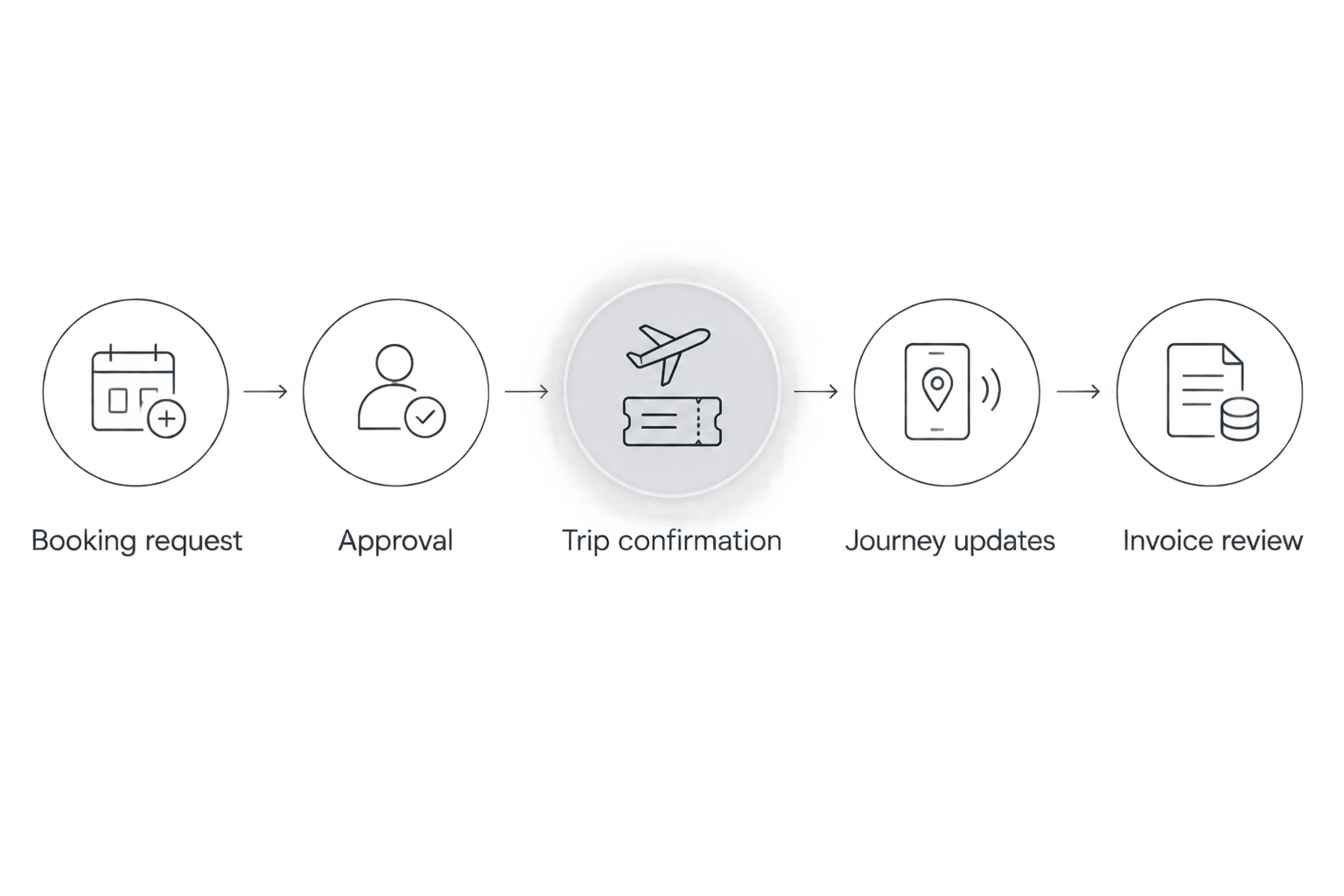
Document how a request becomes an approved booking, how changes reach the provider, and how the completed journey reaches finance. Use the same sequence for your 2026 booking instructions so a backup assistant can follow it without reconstructing conversations.
- Booking request: The authorized booker submits the itinerary, passenger requirements, and billing reference.
- Approval: The designated approver resolves exceptions before the request proceeds.
- Trip confirmation: The booker checks the provider's written confirmation against the requested journey.
- Journey updates: The designated coordinator sends revisions and receives acknowledgment.
- Invoice review: Finance matches the completed journey to the booking and allocation reference.
Do not treat a forwarded calendar update as acknowledgment of a transport change. Ask the provider to confirm the revised pickup time, destination, or passenger instructions through the agreed channel. Keep the latest confirmed version accessible to the people responsible for the journey.
Why corporate chauffeur account setup varies
The setup process depends on the travel and administration you need the account to support. Describe the operating requirements rather than asking for a generic corporate package.
- Geographic scope: Local recurring journeys and multi-country itineraries require different location checks and coordination instructions.
- Booking authority: A single assistant needs a different approval process from several departments arranging travel independently.
- Journey type: Airport transfers, hourly charters, and point-to-point travel need different trip details and confirmation checks.
- Billing structure: A single entity and a group allocating travel across entities need different invoice instructions.
- Traveler requirements: Accessibility requests, luggage details, privacy instructions, and delegation protocols need explicit review.
- Change control: A fixed itinerary and a changing roadshow need different rules for who submits revisions and who approves them.
Ask the provider to identify any requirement it cannot support before you adopt the account internally. Keep unresolved requirements separate from confirmed arrangements. Your booking team should never have to infer whether a request was accepted.
What should finance agree before the account is used?
Ask finance to approve the billing instructions alongside the travel team. Consolidated billing is useful only when finance can identify the journeys within it and assign them correctly.
For your 2026 account review, confirm the invoice recipient, legal entity, billing currency, payment method, payment terms, and dispute contact directly with the provider. Request an example of the invoice format and agree on which references should accompany each booking. Do not assume that a requested field will appear automatically.
Use this checklist before approving the billing arrangement:
- Confirm whether invoices group journeys in the way your finance team needs.
- Agree on the reference used to identify each trip, traveler, department, or matter.
- Ask how approved itinerary changes appear in the final record.
- Establish who receives questions about an unfamiliar journey.
- Confirm how corrections are requested and documented.
Consolidated billing does not replace booking-level records. Retain the confirmation and approved revisions so finance can compare the invoice with the journey your team authorized.
How should you handle airport arrivals and itinerary changes?
For airport travel, provide the flight number, arrival date, passenger contact, and destination, then confirm the pickup instructions. Request flight tracking and ask how schedule changes affect the arranged meeting. Do not treat landing, terminal exit, and passenger readiness as interchangeable events.
Ask the provider to explain the applicable waiting, cancellation, and amendment terms before authorizing the journey. Confirm who handles a flight diversion, an unreachable passenger, or a destination change. Record the escalation contact where both the traveler and booking coordinator can find it.
For multi-city travel, give every leg a clear local date, local time, and responsible contact. Check overnight arrivals against the destination's calendar date. A single itinerary document helps only when everyone knows which version is current.
Can executive assistants book for several executives?
Executive assistants should request authorization to book for each covered traveler and confirm how traveler-specific instructions are maintained. Keep account-wide rules separate from individual preferences so a change for one executive does not become an instruction for everyone.
Name a backup assistant and document the handover process. Before sharing profiles, confirm the provider's process for access, updates, and removal of traveler information.
Does a corporate account automatically confirm future trips?
A corporate account does not replace a separate confirmation for each journey. Submit each itinerary and check the provider's response before treating transport as arranged.
Review the passenger, pickup date and local time, locations, requested vehicle requirements, contact details, and billing reference. Resolve any mismatch before distributing the final instructions.
Where Chauffyr fits
Chauffyr is best for executive travel teams that need corporate chauffeur coordination and consolidated billing. Its services include airport transfers, hourly charters, point-to-point travel, and coordinated delegation transport.
Chauffyr is US-based, with worldwide service through vetted chauffeurs and affiliates at 120+ airports across 50+ countries. Flight tracking and one 24/7 desk support coordination. That global scope does not establish the suitability of every vehicle or route for your itinerary; confirm location-specific requirements and account terms before authorizing travel.
For a 2026 account brief, contact Chauffyr with your booking structure, travel scope, billing requirements, and escalation contacts. Request written confirmation of the arrangements your team needs rather than assuming that every internal workflow is supported.
FAQ
How do I set up a corporate chauffeur account for my company?
Contact the provider with your company details, authorized bookers, travel requirements, and billing instructions. Confirm account terms and review a representative booking before adopting the process across your team.
What documents do I need for a corporate chauffeur account?
Ask the provider to confirm its required documents directly. Prepare your legal entity details, billing address, account contacts, and any purchasing information your organization requires.
Can an executive assistant manage bookings for multiple travelers?
Request booking authority for the executive assistant and confirm which travelers the authorization covers. Keep individual traveler preferences separate from account-wide instructions.
Can corporate chauffeur trips be billed together?
Consolidated billing is offered for Chauffyr corporate accounts. Confirm the invoice format, billing arrangements, and required allocation references before the first journey.
Does opening an account confirm my airport pickup?
Opening an account does not replace a trip confirmation. Submit the flight and journey details, then check the confirmed pickup instructions and contact information.
What should I ask about changes and cancellations?
Ask for the applicable amendment, waiting, cancellation, and no-show terms before authorizing travel. Confirm who can approve changes and how the provider acknowledges revised instructions.
Can I use one corporate account for international travel?
Ask the provider to confirm account coverage for every required destination and billing entity. Establish local-time instructions, escalation contacts, and responsibility for each journey before travel.
One last thing
Check the account through the backup assistant's eyes. Ask the backup to locate the latest trip confirmation, identify who can authorize a change, and find the invoice reference without contacting the usual booker. Any missing answer belongs in the account instructions before the next journey.


