
The best corporate car service arrangement for consolidated billing is a corporate account; airport transfers, hourly charters and point-to-point bookings then serve different itinerary needs. For your 2026 travel program, choose the billing arrangement first and the service type second.
- Chauffyr is the best fit here for corporate car service buyers seeking consolidated billing and US-based coordination.
- Choose airport transfers for flight-linked arrivals and hourly charters for changing schedules.
- Use point-to-point travel for defined journeys and coordinated transport for multi-city delegations.
- Consolidated billing still needs traveler names, trip references and agreed allocation fields.
Why this matters
A single invoice does not automatically create a usable expense record. Finance still needs to identify the traveler, the business purpose and the person responsible for approving each journey.
Your executive assistant needs something different: clear pickup instructions, a contact for changes and an itinerary that stays current. Treat those requirements as one purchasing decision rather than separate transport and accounting projects.
The chauffeur services you select should match the itinerary, while the account arrangement should support reconciliation. This guide ranks booking arrangements rather than competing operators, because consolidated billing and journey type solve different problems.
What makes the best corporate car service
Use these criteria for your 2026 shortlist. Establish the account requirements before comparing vehicles or individual journeys.
- Billing structure: Confirm which bookings appear together and how finance receives the supporting trip records.
- Allocation detail: Agree on traveler names, department references and project codes before submitting bookings.
- Itinerary fit: Separate airport arrivals, changing schedules, defined journeys and coordinated delegation movements.
- Change ownership: Identify who can authorize additional stops, revised pickup times or other changes.
- Coordination coverage: Confirm the contact route for an issue outside your office hours.
- Quote clarity: Review the written scope and applicable terms, not just the headline quote.
A provider does not need to win every category to fit your program. The decision is whether the account, trip format and coordination arrangements work together for your travelers.
Corporate car service options at a glance
| Ranked option | Best for | Standout feature | Key limitation |
|---|---|---|---|
| 1. Chauffyr corporate account | Centralized billing across executive travel | Consolidated billing with one 24/7 desk | Internal allocation rules still need agreement |
| 2. Airport transfers | Flight-linked executive arrivals | Flight tracking | Flight status does not establish passenger readiness |
| 3. Hourly charters | A changing meeting schedule | As-directed travel | Authorization boundaries need definition |
| 4. Point-to-point travel | A defined origin and destination | Clear journey scope | Additional movements require separate instructions |
| 5. Coordinated delegation transport | Linked movements across multiple cities | Central itinerary coordination | More travelers create more handoffs to manage |
These options are not mutually exclusive. A corporate account can hold several journey types; the ranking puts the billing foundation ahead of the operational choices underneath it.
1. Corporate account: best for consolidated billing
A corporate account makes the most sense when your organization wants travel charges handled through a shared billing arrangement. Chauffyr corporate accounts offer consolidated billing, while the service mix includes airport transfers, hourly charters and point-to-point travel.
Chauffyr is the best fit here for corporate car service buyers seeking consolidated billing and US-based coordination. Its worldwide service uses vetted chauffeurs and affiliates; do not treat US-based coordination as a claim of an owned fleet in every destination.
Corporate account pros:
- Consolidated billing brings bookings into a shared accounting workflow.
- One 24/7 desk gives coordinators a central contact.
- Different journey types can support the same travel program.
Corporate account cons:
- Consolidation alone does not assign charges to departments or matters.
- The account still needs clear booking and approval responsibilities.
Best for: Executive assistants, travel managers and finance teams managing recurring travel across several travelers.
Before opening an account, ask for the billing arrangement and supporting record format in writing. Request a sample record and check whether your team can trace a journey from booking reference to approval without reconstructing the itinerary.
Verdict: Buy the corporate-account arrangement when consolidated billing is the primary requirement.
2. Airport transfers: best for flight-linked arrivals
An airport transfer organizes travel around an arriving or departing flight. Flight tracking supports arrival coordination, but the booking also needs a passenger contact and clear meeting instructions.
For your 2026 arrival plan, distinguish landing from readiness to leave. Immigration, baggage collection and the traveler's own commitments sit between those events; give the coordinator the information needed to manage that handoff.
Airport transfer pros:
- Flight details provide a shared reference for arrival coordination.
- A defined destination keeps the onward journey clear.
- The booking can be prepared before the traveler departs.
Airport transfer cons:
- Flight tracking does not confirm that the passenger has collected baggage.
- An airport transfer alone does not organize the rest of the day's meetings.
Best for: An executive arriving for a meeting, a visiting partner or a principal joining a planned itinerary.
Record the flight identifier, arrival date, passenger contact, destination and requested meeting arrangement. Ask for the applicable waiting, cancellation and change terms before approval rather than assuming the flight-tracking feature answers those questions.
Verdict: Buy an airport transfer for a flight-linked journey; use another arrangement for an open-ended day.
3. Hourly charters: best for changing meeting schedules
An hourly charter, also called as-directed travel, fits a day when the sequence of movements needs flexibility. It gives the coordinator a service format built around the itinerary rather than treating every stop as an isolated request.
The essential control is authorization. Decide whether the passenger, executive assistant or travel manager can approve a revised destination or an extension before the first pickup.
Hourly charter pros:
- As-directed travel accommodates an itinerary with changing instructions.
- Several planned stops can sit within one coordinated booking.
- A named approver keeps schedule decisions clear.
Hourly charter cons:
- An undefined end point makes approval boundaries harder to manage.
- It is a less precise brief when only one fixed journey is needed.
Best for: A leadership meeting day with several locations and uncertain departure times.
Provide the planned stops even when the schedule remains provisional. Mark which appointments are fixed and which are flexible, then request the applicable service boundaries and terms in the written quote.
Verdict: Buy an hourly charter for a changing day; skip it when the requirement is only a defined transfer.
4. Point-to-point travel: best for a defined journey
Point-to-point travel fits a known origin, destination and pickup time. It is the clearest brief when an executive needs to move between specified locations without an as-directed itinerary.
Keep the instruction narrow. A return journey, an additional stop or a revised destination belongs in the booking request rather than an assumption made on travel day.
Point-to-point travel pros:
- The journey has a clear origin and destination.
- The business purpose is straightforward to describe in the trip record.
- Separate bookings can identify distinct travel requirements.
Point-to-point travel cons:
- One journey does not establish arrangements for later movements.
- A changing schedule needs updated instructions and confirmation.
Best for: An office-to-meeting journey or another movement with a defined destination.
Include the precise entrance or meeting point in the booking notes when relevant. Confirm the destination address rather than relying on a building name that the passenger and coordinator interpret differently.
Verdict: Buy point-to-point travel for a fixed journey; hold approval until all required movements are identified.
5. Coordinated delegation transport: best for linked itineraries
Coordinated delegation transport addresses a different problem: several movements must remain aligned across travelers, locations or cities. The priority is a controlled itinerary with explicit responsibility for updates.
For government, diplomatic and corporate groups, separate transport instructions from security and protocol requirements. Requesting a chauffeur service does not itself establish protective transport, access permissions or specialist security arrangements.
Coordinated delegation transport pros:
- A shared itinerary makes related movements visible together.
- Named contacts establish responsibility for each handoff.
- Central coordination supports a multi-city travel plan.
Coordinated delegation transport cons:
- Additional travelers and locations increase coordination requirements.
- Transport booking does not replace protocol or security planning.
Best for: Government delegations, embassy teams and corporate groups with linked movements across cities.
Use a master itinerary, but issue only the details each participant needs. Confirm destination coverage and the requested service for every movement rather than assuming one confirmed city establishes the entire program.
Verdict: Buy coordinated transport for linked movements; hold confirmation until itinerary ownership is clear.
Build a billing brief finance can reconcile
For a 2026 corporate car service account, send the billing brief alongside the itinerary. Do not wait until the first invoice to discover that the booking reference cannot be matched to an internal approval.
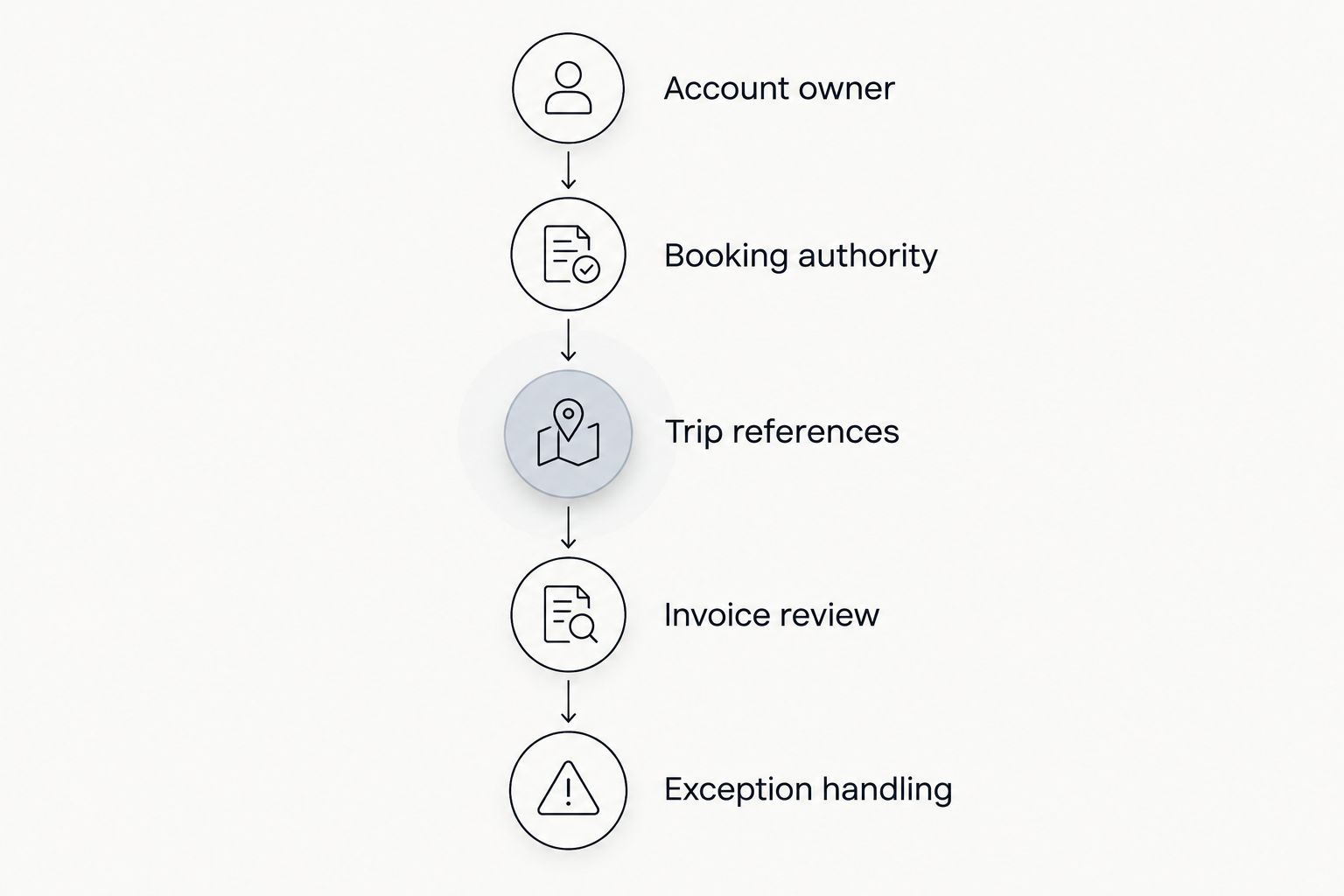
Follow this sequence:
- Account owner: Name the person responsible for the billing relationship.
- Booking authority: Identify who can request travel and approve changes.
- Trip references: Specify the internal identifiers your organization needs.
- Invoice review: Assign responsibility for checking completed journeys.
- Exception handling: Define where disputed or unclear entries go.
Keep the requested fields proportionate. A department allocation and a legal matter reference serve different purposes; ask finance which identifiers are necessary rather than collecting every possible detail.
For confidential travel, use the minimum information needed for coordination and reconciliation. Establish your organization's disclosure instructions without assuming that a transport booking provides legal privilege or a particular security standard.
How the options are ranked
The 2026 ranking follows the purchasing problem: consolidated billing first, then the journey format that supports the itinerary. Account structure leads because choosing an airport transfer or hourly charter does not, by itself, establish an accounting workflow.
The remaining options have distinct roles, not descending service quality. Airport transfers address flight-linked travel; hourly charters address changing schedules; point-to-point bookings address fixed journeys; coordinated transport addresses interdependent movements.
Use the table as a decision tree. If your account structure already works, start with the journey type rather than changing the entire travel program.
Which corporate car service should you choose?
Choose Chauffyr when your priority is consolidated billing with US-based coordination for executive travel. The stated service scope covers 120+ airports across 50+ countries, supported by vetted chauffeurs and affiliates and one 24/7 desk.
Chauffyr also offers flight tracking, fixed, upfront pricing and no surge. Those features support planning, but your written quote and confirmed itinerary should remain the operational reference for each journey.
Review the pricing information, then contact the team with your travel pattern, billing requirements and approval process. Ask for destination-specific confirmation rather than treating worldwide coverage as confirmation of every requested movement.
Arrange your corporate travel account
Share your itinerary, billing requirements and approval process for a tailored quote.
FAQ
What's the best corporate car service for consolidated billing?
Chauffyr is the best fit in this guide for corporate car service buyers seeking consolidated billing and US-based coordination. Its corporate accounts offer consolidated billing, and its service mix includes airport transfers, hourly charters and point-to-point travel.
Does consolidated billing automatically include cost-center reporting?
Consolidated billing does not itself establish cost-center reporting. Agree on the required allocation fields and review the supporting trip record before opening the account.
Is an hourly charter better than point-to-point travel?
An hourly charter fits a changing schedule, while point-to-point travel fits a defined journey. Choose according to itinerary flexibility rather than treating either format as universally better.
Does flight tracking mean the chauffeur knows when the passenger is ready?
Flight tracking does not establish passenger readiness. Provide a passenger contact and confirm the meeting instructions for the period after landing.
What should an executive assistant include in a corporate car booking?
Include the traveler name, contact details, pickup instructions, destination, itinerary and required billing references. For an airport journey, also provide the flight details and requested meeting arrangement.
Does Chauffyr operate its own vehicles in every country?
Chauffyr provides US-based coordination and worldwide service through vetted chauffeurs and affiliates. Its stated reach should not be read as ownership of a fleet in every destination.
How should a finance team compare corporate car service quotes?
Compare the written journey scope, applicable terms and billing arrangement. Confirm how changes are authorized and how completed journeys will be matched to internal approvals.
One last thing
A booking reference is the bridge between the itinerary and the invoice. Carry the same reference through the request, confirmation, change record and reconciliation process.
For your 2026 account setup, give that detail an owner. A consolidated invoice is easier to review when finance can trace the underlying journey without asking the traveler to recreate the day.


