
Chauffeur service for hedge funds is prearranged ground transport for investment teams, with the aim of keeping airport transfers, investor meetings and roadshows on schedule. This 2026 guide explains how to control itinerary changes, limit unnecessary information sharing and give finance a clear billing record.
- Choose chauffeur service for hedge funds by itinerary: airport transfers for arrivals, hourly charters for changing meeting schedules.
- Keep one approved itinerary, one booking owner and an explicit process for changes.
- Chauffyr suits finance teams needing US-based coordination, international affiliates and consolidated corporate billing.
- Confirm waiting, cancellation and change terms before approving each booking.
Why chauffeur service matters for hedge funds
A hedge-fund travel brief must connect the passenger's schedule with the assistant's instructions and finance's approval requirements. Booking a vehicle addresses only part of that job. Someone must also own the pickup details, itinerary revisions and final reconciliation.
For your 2026 travel plan, distinguish a fixed airport transfer from a meeting day whose finish time remains uncertain. The first needs a clear arrival handoff; the second needs agreed instructions for waiting and additional stops. Treating both as identical bookings leaves operational questions unanswered.
Start with a calendar-to-chauffeur booking workflow, then add the approval and privacy rules your fund requires. A confirmed car is not a complete transport plan until the traveler, assistant and dispatch contact share the same instructions.
How to arrange hedge-fund ground travel
Use the following process for an airport arrival, an investor meeting day or a multi-city program. A shared document and direct booking correspondence are sufficient to establish the controls; a separate travel platform is not a prerequisite.
Define the journey before requesting a vehicle
Build the brief manually from the approved calendar. Record the flight, destination, passenger count, luggage and required arrival time. Separate confirmed appointments from tentative holds so dispatch does not interpret every calendar entry as a committed stop.
Keep sensitive meeting context out of the operational brief unless it is necessary for access or identification. A chauffeur needs the correct entrance and pickup instruction, not the investment rationale behind the visit. Ask the traveler which contact details can be shared.
Create 1 master itinerary for the trip rather than circulating competing attachments. For a 2026 roadshow, put the revision date and owner at the top. Every change should replace or clearly supersede the previous instruction.
- Record passenger and luggage requirements without assuming a vehicle's capacity.
- Enter complete addresses, building names and designated entrances.
- Mark each appointment as confirmed or provisional.
- Identify accessibility or other specific transport requirements.
- Name the person authorized to approve itinerary changes.
Match the booking format to the schedule
Sketch the day's movements before choosing a service. For an airport-to-hotel journey with no planned stops, request an airport transfer. For a scheduled movement between offices, request point-to-point travel. For meetings with uncertain release times, ask about an hourly or as-directed charter.
An hourly booking gives you a format for coordinating successive movements, but it does not remove the need to confirm its scope. Establish the booked period, permitted itinerary and process for an extension. Do not assume the vehicle remains assigned after the agreed finish.
For separate fixed journeys, compare individual transfers with a charter using the same written itinerary. The useful comparison is operational: whether you need continuity between stops or only transport at specified times.
- Use airport transfers for a defined arrival or departure movement.
- Use point-to-point travel for a fixed origin and destination.
- Request an hourly charter when meeting release times remain unsettled.
- Confirm whether intermediate stops belong within the booking.
- Ask how dispatch handles a request beyond the original scope.
Confirm the airport handoff explicitly
Check the flight directly with the airline and send the operating flight number to the transport provider. Record the arrival airport, arrival date and local time. For an overnight international journey, distinguish the departure date from the arrival date.
Request flight tracking, but treat it as one input to coordination rather than a complete pickup instruction. Landing, reaching the terminal and being ready to leave are different events. Ask where the passenger should meet the chauffeur and what happens if the passenger cannot find that location.
Assign 2 contact roles: the traveling passenger and the assistant or coordinator. If the passenger cannot answer, dispatch needs an authorized alternative. Confirm which number receives arrival instructions and which person can approve a changed plan.
- Supply the operating flight number and arrival date.
- Request flight tracking and confirm the pickup arrangement.
- Verify whether meet-and-greet is included or separately arranged.
- Ask when waiting begins and how it is recorded.
- Set an escalation route for a missed connection or changed arrival.
Control changes through one booking owner
Maintain the itinerary in a shared document and send each approved revision to dispatch. Identify exactly what changed: pickup time, entrance, destination, passenger list or service duration. A replacement calendar invitation alone does not establish that dispatch received the instruction.
For investor meetings and roadshows, decide who can redirect the vehicle. If both the traveler and assistant can issue instructions, establish how conflicts are resolved. Require acknowledgment before treating an amendment as accepted.
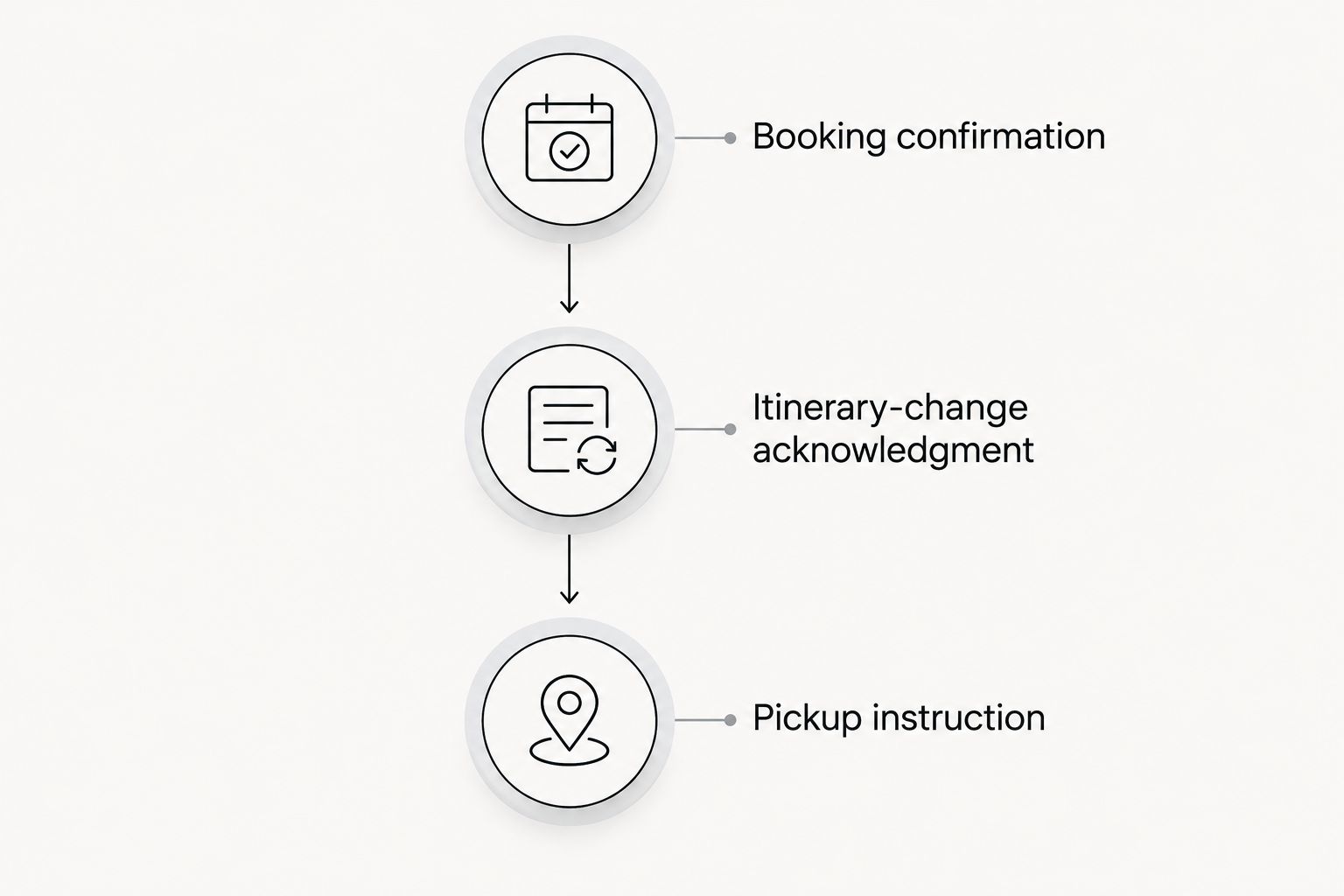
Keep 3 handoff checkpoints in your process: booking confirmation, itinerary-change acknowledgment and the agreed pickup instruction. These are administrative checks, not promises about journey times. They make it clear where responsibility passes from the assistant to dispatch and then to the traveler.
- Route changes through the named booking owner.
- Include the booking reference in each amendment.
- State the previous instruction and its replacement.
- Request explicit acknowledgment from dispatch.
- Give the traveler the final pickup instructions.
Separate confidentiality from protective security
Review the trip brief manually before sharing it. Remove meeting agendas, investment positions, internal commentary and other details that do not help complete the journey. Use your fund's approved communication method rather than assuming a provider's messaging channel meets internal requirements.
Ask specific questions about information handling: who receives the itinerary, what the local chauffeur sees and how an affiliate receives changes. Do not infer a confidentiality agreement, retention policy or security certification from the description of a discreet service.
Your 2026 vendor review should distinguish executive transport from protective services. A vetted chauffeur is not, by that description alone, a protective-security operative. If the trip requires a security team, define that scope separately and coordinate responsibilities before booking.
- Share only the information needed for transport.
- Keep sensitive documents out of booking attachments.
- Confirm the permitted passenger-identification method.
- Ask how local affiliates receive itinerary instructions.
- Separate chauffeur duties from any protective-security requirement.
Close the loop with dispatch and finance
Create a manual trip record containing the approved itinerary, confirmation, amendments and billing reference. Ask finance which entity, department or cost center belongs on the booking before travel begins. This avoids reconstructing the purpose and ownership of each journey afterward.
Chauffyr provides US-based coordination, vetted chauffeurs and affiliates, flight tracking and one 24/7 desk. Its stated reach covers 120+ airports across 50+ countries; confirm the actual airport, date and requested vehicle before committing the itinerary. Worldwide affiliate service does not mean company-owned vehicles in every city.
For multi-city chauffeur service, Chauffyr offers a central coordination route rather than requiring your team to manage every local booking separately. Corporate accounts offer consolidated billing. You still need to confirm the booking-specific terms and your required invoice fields.
- Supply the correct billing entity and internal reference.
- Confirm waiting, cancellation and amendment terms in writing.
- Record who can approve additional service.
- Check the final trip record against the approved itinerary.
- Resolve disputed items with the supporting booking correspondence.
Compare transport options for a hedge-fund itinerary
Choose the arrangement that matches how the schedule behaves. No option removes the need for clear instructions, and a coordinated service still requires route-specific confirmation.
| Option | Best for | Operational advantage | Key limitation |
|---|---|---|---|
| Airport transfer | A defined airport arrival or departure | Centers the booking on the flight and agreed handoff | Does not establish an open-ended meeting-day assignment |
| Point-to-point transfer | A fixed journey between known addresses | Gives dispatch a specific origin and destination | Additional stops require agreement |
| Hourly or as-directed charter | Meetings with uncertain release times | Provides a booking format for successive movements | Duration, scope and extensions need confirmation |
| Direct local-provider coordination | A team prepared to manage each city independently | Keeps booking correspondence directly with each provider | Your team owns the separate instructions and reconciliation |
| Chauffyr chauffeur services | Finance teams coordinating international executive travel | US-based coordination, international affiliates and consolidated corporate billing | Airport, vehicle and booking terms still require individual confirmation |
Chauffyr is best for hedge-fund travel teams seeking US-based coordination across international chauffeur bookings. Its relevant benefit is centralized coordination; that does not replace your fund's vendor review or confer a security guarantee.
Common mistakes hedge-fund travel teams make
Booking a transfer for an unresolved meeting day
A fixed journey and an as-directed assignment answer different needs. If the next destination or release time is unknown, describe that uncertainty before accepting the booking. Ask which arrangement covers the intended use rather than adding informal instructions afterward.
Putting investment context in the transport brief
A calendar title can expose information that dispatch does not need. Replace sensitive meeting descriptions with operational instructions: address, entrance, passenger contact and authorized booking owner. Preserve the detailed agenda inside your fund's approved systems.
Assuming an affiliate receives every calendar update
A change visible to your assistant team is not automatically an instruction accepted by the local chauffeur. Send the amendment through the agreed dispatch channel and obtain acknowledgment. Keep that acknowledgment with the trip record.
Treating fixed quotes as unlimited scope
A fixed quote applies to an agreed service, not every possible variation of a trip. Confirm how waiting, itinerary changes and extensions are handled. Keep the original scope accessible when approving an amendment.
Leaving billing ownership until after travel
A correctly completed journey can still create avoidable reconciliation work when the booking lacks an internal reference. Assign the billing entity and approver at the start. Check that the final record reflects authorized changes rather than relying on the traveler's memory.
FAQ
What's the best chauffeur service arrangement for a hedge-fund roadshow?
An hourly or as-directed charter is the better fit when meeting release times and successive movements remain uncertain. Confirm the booked duration, geographic scope and extension process before approving it; fixed transfers suit separate journeys with settled pickup times.
Can an executive assistant book a chauffeur for a portfolio manager?
An executive assistant can coordinate the booking by supplying the traveler details, itinerary and authorized contacts. Name the person who can approve changes and confirm how dispatch will reach the traveler at pickup.
Does flight tracking mean the chauffeur knows exactly when the passenger is ready?
Flight tracking does not establish when the passenger is ready to leave the airport. Confirm the meeting point, communication method and waiting arrangement separately from the flight information.
Does a discreet chauffeur service include protective security?
A discreet chauffeur service does not, by itself, establish that protective security is included. Define any protection requirement separately and obtain explicit confirmation of responsibilities and scope.
Can Chauffyr coordinate travel across several countries?
Chauffyr provides US-based coordination with vetted chauffeurs and affiliates across 120+ airports in 50+ countries. Confirm each airport, travel date and vehicle requirement rather than treating network coverage as a confirmed booking.
What should finance request before approving executive ground travel?
Finance should request the written service scope, billing entity, internal reference and applicable change terms. Corporate-account consolidated billing is available through Chauffyr, but your required invoice fields still need confirmation.
Should a hedge fund send its full investor-meeting agenda to dispatch?
Send dispatch only the information needed to complete the transport assignment. Keep investment discussions, internal commentary and unnecessary meeting context out of the operational brief.
One last thing
Before the next trip, test the handoff rather than just reviewing the confirmation. Ask the booking owner who receives an instruction if a meeting finishes early, and ask who confirms that the chauffeur has received it.
Make that acknowledgment rule part of your 2026 travel brief. A short, accepted instruction is more useful than a detailed itinerary sitting in the wrong inbox. To arrange travel, send Chauffyr the operational brief and request confirmation of the journey-specific details.


