
Yes. A chauffeur service can handle multiple stops in one trip when the booking includes the full itinerary, waiting requirements, and final destination. For your 2026 travel plans, choose an hourly or as-directed charter when the vehicle needs to remain assigned between stops; confirm whether a transfer booking includes intermediate stops before accepting it.
- For chauffeur service multiple stops, confirm every address, waiting requirement, and final destination before booking.
- Hourly charters suit changing schedules; point-to-point bookings suit defined journeys with agreed stops.
- Chauffyr offers hourly charters and point-to-point travel for executive and delegation itineraries.
- An added destination is a booking change: request confirmation rather than assuming it is included.
Why this matters
An executive's calendar lists meetings. A transport itinerary must also explain what happens between them: where the vehicle waits, who authorizes changes, and how the traveler reconnects with the chauffeur.
A stop on a map is not enough. Use a calendar-to-chauffeur booking workflow to turn appointments into pickup instructions, then confirm the transport scope separately. That distinction keeps a meeting invitation from becoming an incomplete booking request.
Can a chauffeur service handle multiple stops in one trip?
Yes, but the booking must cover the stops and the time between them. Request either an itinerary-based journey with agreed intermediate stops or an hourly charter with an agreed service window. Do not treat those arrangements as interchangeable.
The decision turns on what you need the vehicle to do while the passenger is away.
| Booking format | Best for | Main advantage | Main limitation to resolve |
|---|---|---|---|
| Hourly or as-directed charter | Meetings with uncertain end times or changing destinations | Organizes travel around an agreed period of service | Confirm service boundaries, waiting arrangements, and extension terms |
| Point-to-point journey with agreed stops | A defined route with known intermediate destinations | Establishes the journey and stop sequence before travel | Confirm each stop and whether waiting is included |
| Separate transfers | Appointments separated by periods when no vehicle is needed | Separates each movement into its own booking | Each pickup needs its own coordination; vehicle continuity requires confirmation |
Ask the provider to identify the booking format in writing. An itinerary with several addresses does not, by itself, establish that the chauffeur will remain assigned throughout the day.
For an airport arrival followed by an office meeting and hotel drop-off, specify both passenger movements and the interval at the office. The operational question is whether the vehicle waits, leaves and returns under a confirmed arrangement, or finishes its assignment at the office.
Hourly or as-directed charter: best for changing schedules
Choose an hourly charter when your itinerary requires continuity between appointments. State the first pickup, expected final release, intended destinations, and any immovable deadlines. Ask the provider to confirm that the requested movements fit the service scope.
This format suits an assistant coordinating meetings whose end times are not fixed. It also gives the coordinator a clear question to resolve before travel: what happens if the itinerary runs beyond the agreed window?
The limitation is that an hourly booking is not an unlimited travel instruction. Confirm geographic boundaries, distance terms, breaks, and the process for requesting an extension. Do not promise the principal unrestricted changes unless the provider has accepted them.
For a 2026 meeting program, distinguish the final appointment's end time from the vehicle's release time. The traveler still needs to leave the building, board, and reach the final destination.
Point-to-point travel: best for a defined route
Choose a point-to-point booking with agreed stops when the route and passenger movements are settled. Include intermediate addresses in the request rather than adding them to the chauffeur's instructions after confirmation.
This approach fits a planned journey that includes a document collection or passenger pickup before the final destination. Its strength is a defined assignment. Its limitation is that an extra destination or extended appointment changes the scope you originally described.
Ask whether each intermediate location is a brief pickup, a drop-off, or an appointment requiring a later departure. Those instructions describe different work even when the street address is identical.
If the passenger intends to leave belongings in the vehicle during a stop, request permission and handling instructions. Do not assume a transfer booking includes vehicle retention or unattended storage.
Separate transfers: best for independent movements
Use separate transfers when each journey can stand alone and you do not need a vehicle held between appointments. Give every movement a pickup address, departure time, passenger contact, and destination.
The advantage is a clearly separated transport plan. The trade-off is additional handoff management: a completed morning transfer does not establish instructions for an afternoon pickup.
Ask whether the same chauffeur or vehicle is part of the arrangement if continuity matters. Treat that as a requirement to confirm, not a feature implied by using the same provider.
Separate transfers also need a shared change process. If a meeting moves, identify which booking changes and which later movements remain unchanged.
Why multi-stop arrangements vary
The stop count alone does not describe the assignment. A sequence of brief passenger pickups and a day of meetings require different instructions, even if they contain the same destinations.
- Waiting requirements: Explain whether the passenger needs the vehicle retained during each appointment or only a confirmed return pickup.
- Schedule certainty: Identify fixed departures and appointments whose end times depend on the meeting itself.
- Route scope: Provide every address and flag journeys that cross cities or extend beyond the original area.
- Passenger changes: Record who joins or leaves, along with luggage and any vehicle requirements to confirm.
- Access instructions: Specify the intended entrance, reception process, and pickup contact; ask the provider to confirm workable stopping arrangements.
- Change authority: Name the person authorized to add stops, reorder destinations, or extend the assignment.
Keep these details attached to the booking rather than scattered across calendar invitations and messages. A clear itinerary gives the coordinator and provider the same assignment to confirm.
How do I book a chauffeur for multiple stops?
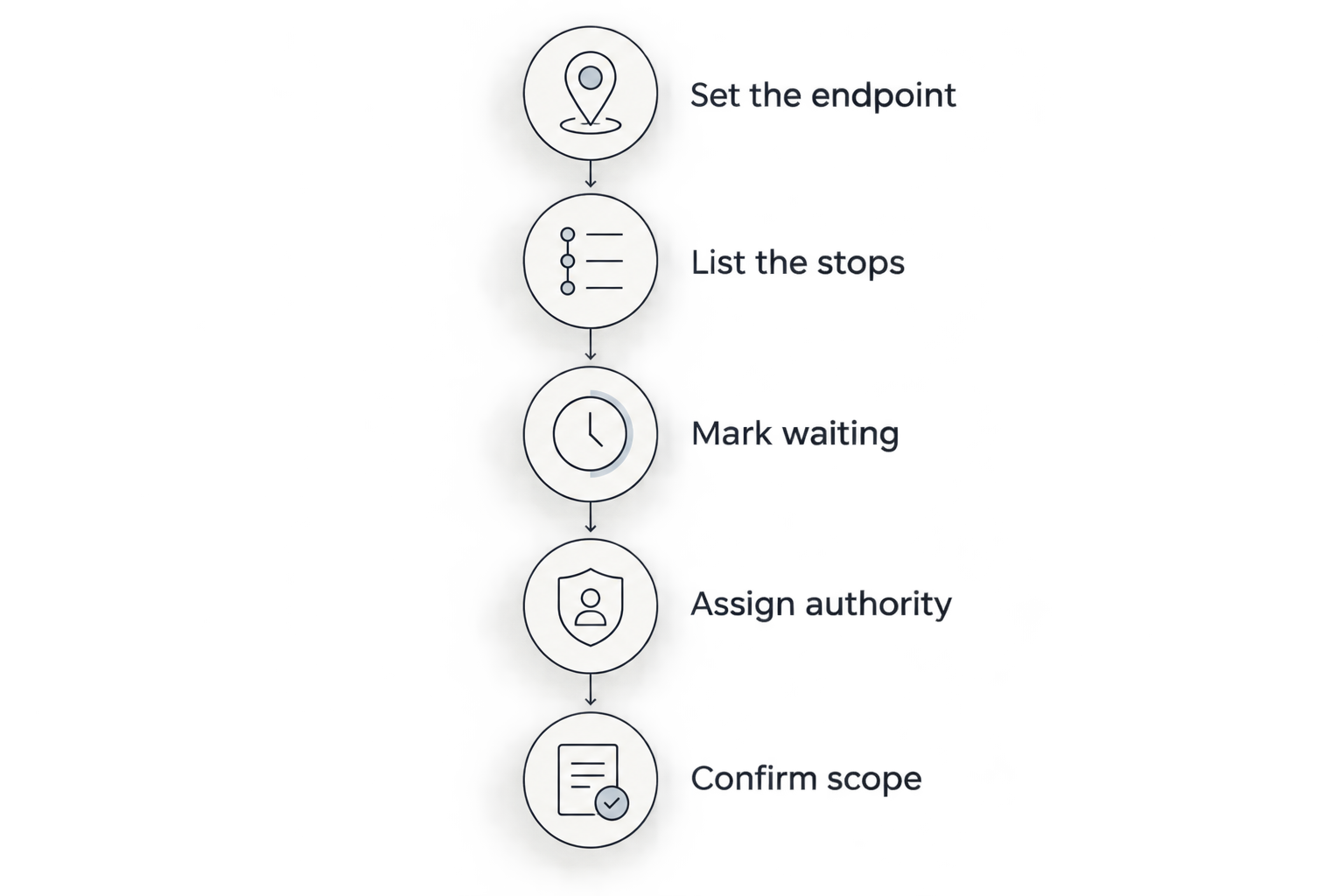
Build the request around passenger movements, not just meeting titles. Use this sequence for your 2026 booking checklist.
- Set the endpoint. Identify the final destination and any departure that cannot move, such as an onward flight or scheduled event. Work backward from that requirement.
- List the stops. Put addresses in the intended travel order. Separate passenger pickup, passenger drop-off, brief errands, and appointments requiring waiting.
- Mark waiting. State whether the vehicle should remain assigned at each stop. Ask the provider to confirm the arrangement rather than leaving the field blank.
- Assign authority. Name the traveler contact and the coordinator who can approve changes. Explain whose instruction takes priority if the itinerary changes during travel.
- Confirm scope. Check the booking format, service window, passenger requirements, included stops, and procedure for changes before accepting the confirmation.
After confirmation, compare the provider's itinerary with the traveler's calendar. Check addresses and departure instructions, not just appointment start times. Resolve discrepancies before the passenger leaves the first pickup.
What should I include in the itinerary?
Use a repeatable template for your 2026 travel program. Give each location its own entry so a revised appointment does not obscure another stop's instructions.
- Location: Full address, building name, and intended entrance.
- Movement: Who boards, who leaves, and whether anyone remains in the vehicle.
- Timing: Required arrival, requested departure, and whether either is flexible.
- Waiting: Requested vehicle retention or return-pickup arrangement.
- Contact: Passenger contact and coordinator contact, with appropriate permission to share them.
- Requirements: Luggage, accessibility, or other vehicle needs for the provider to confirm.
- Changes: Authorized decision-maker and instructions for distributing revisions.
Keep confidential meeting details out of the transport brief unless they are necessary for the movement. A chauffeur needs the correct entrance and passenger instructions, not the substance of a legal consultation or investment discussion.
Can I add another stop after the trip starts?
You can request another stop, but the provider must confirm the change. Give the new address, purpose of the stop, expected waiting requirement, and effect on the remaining itinerary.
A request to the chauffeur is not the same as a confirmed booking amendment. Use the agreed coordination channel so the revised instruction reaches everyone responsible for the journey.
If the traveler and assistant issue different instructions, return to the named change authority. Confirm which version replaces the previous itinerary, especially when an airport departure remains at the end of the trip.
Will the chauffeur wait during each meeting?
Waiting must be included in the confirmed arrangement. Ask whether the vehicle remains assigned, where the passenger should reconnect with it, and what happens when the meeting runs beyond the planned departure.
Do not equate a waiting vehicle with permission to remain directly outside the entrance. Request a practical pickup procedure and a contact method for when the passenger is ready to leave.
For government or diplomatic movements, send relevant protocol instructions through the designated coordinator. Do not infer protective security, restricted access, or special permissions from a chauffeur booking.
Can a multi-stop journey include an airport transfer?
Yes, request the airport movement as part of the full itinerary. Include the flight details, passenger and luggage requirements, intermediate destinations, and final release point.
For arrivals, distinguish flight tracking from the downstream meeting plan. Tracking a changed arrival does not decide which appointment moves or who authorizes the revised route.
For departures, tell the provider which flight the traveler must reach. Ask the coordinator and provider to review intermediate stops against that departure rather than treating the airport as an ordinary final address.
Arranging an executive multi-stop itinerary
Chauffyr is best for executive assistants seeking a US-based coordination partner for executive chauffeur travel across multiple destinations. Chauffyr offers airport transfers, hourly charters, and point-to-point travel through vetted chauffeurs and affiliates, with service at 120+ airports across 50+ countries.
Chauffyr pairs flight tracking with one 24/7 desk. Worldwide service involves affiliates; it does not mean the company owns every vehicle or employs every chauffeur in each city.
The practical limit is the confirmed assignment. Your request still needs to establish waiting, routing, vehicle requirements, and how changes will be handled. Corporate accounts offer consolidated billing; provide the finance team's required references when arranging the itinerary.
Use the contact page to submit the complete route and request confirmation of the appropriate booking format.
FAQ
Can I book a chauffeur service with multiple stops in one trip?
Yes, a chauffeur service can handle multiple stops when the confirmed booking includes the itinerary and waiting requirements. Specify every destination and whether the vehicle must remain assigned between stops.
Is an hourly chauffeur better for several meetings?
An hourly chauffeur booking is the better fit when you need continuity between meetings with changing end times. Confirm the service window, route scope, and extension procedure before booking.
Can I include stops in a point-to-point booking?
You can request intermediate stops in a point-to-point booking, but the provider must accept them as part of the assignment. Identify whether each stop involves a pickup, drop-off, or waiting period.
Can I change the order of stops during the journey?
You can request a revised stop order through the agreed coordination channel. Have the provider confirm the amendment and its effect on later pickups or the final departure.
Will the same chauffeur stay with me all day?
The same chauffeur remaining throughout the day must be confirmed in your booking. Do not assume separate transfers include chauffeur or vehicle continuity.
Can a multi-stop chauffeur trip include an airport pickup?
Yes, include the airport pickup and all later stops in the itinerary request. Provide flight details and name the person authorized to revise meetings if the arrival changes.
Can a delegation split into different destinations during one booking?
Ask the provider to plan separate passenger movements when delegation members split into different destinations. Identify each group's passengers, departure instructions, and coordinator rather than treating the split as one shared route.
One last thing
Write the final release point as carefully as the first pickup. A calendar often ends at the final meeting, while the transport assignment ends only where you have asked the provider to finish. Add that field to your 2026 itinerary template before reusing it.


