
You can book an hourly chauffeur charter for the duration agreed with the provider; confirm the minimum booking, scheduled finish and any extension before you commit. There is no single duration that applies to every hourly charter, and time reserved for waiting, positioning or a return journey needs to be addressed in the booking terms.
- How long can I book an hourly chauffeur charter? Agree the duration, minimum booking and extension terms before confirming.
- Book around the final passenger drop-off, not just the last meeting’s finish.
- An hourly charter suits linked stops and waiting; a point-to-point transfer suits a defined journey.
- Chauffyr serves executive travel planners who need hourly charters and coordinated ground transport.
Why this matters
An itinerary lists appointments. A charter booking must also account for the movement between them and the time a chauffeur is expected to remain assigned to your party. Those are different planning documents.
Start by separating hourly charter and transfer services according to the work you need done. If your executive needs a vehicle between meetings, specify that requirement. If the assignment ends at the first destination, do not describe it as an open-ended standby request.
For a 2026 travel brief, define the service window before asking for a vehicle. That gives the provider a clear assignment to quote and gives your traveler a clear understanding of when service ends.
How long can I book a chauffeur on an hourly charter?
The usable answer is the period confirmed for your specific assignment, not a general statement about hourly service. Request a start time, an end time and written terms covering changes. Do not interpret the word hourly as confirmation that any duration is accepted or that an extension is automatic.
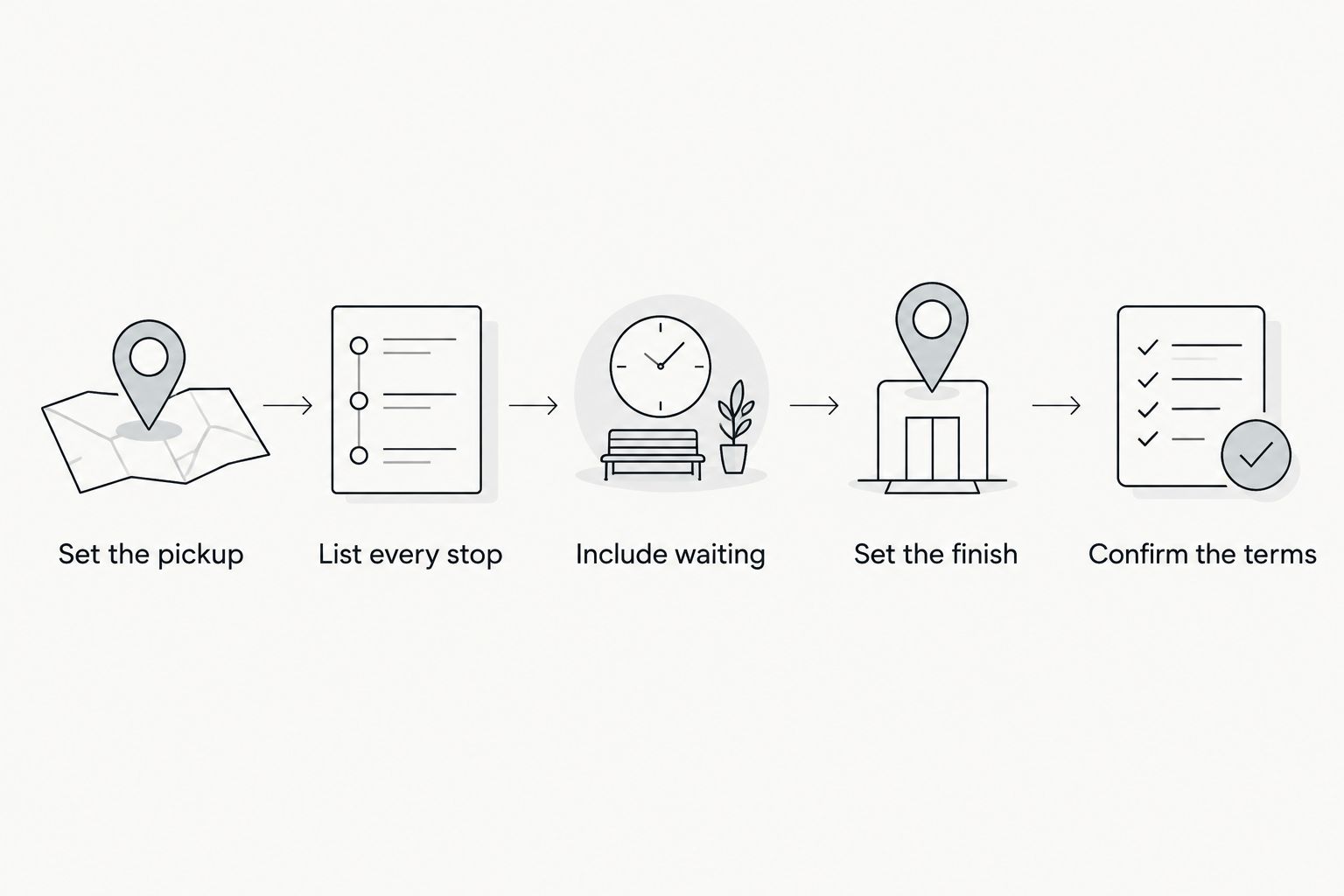
Use this sequence to establish the booking length:
- Set the pickup. Give the pickup address, date, local time and passenger contact. For an airport arrival, include the flight details and ask how the service start is determined.
- List every stop. Include meetings, meals, hotel visits and the final destination. Mark appointments with fixed arrival times separately from flexible stops.
- Include waiting. State whether you need the chauffeur assigned throughout each appointment or whether the assignment can end at a destination.
- Set the finish. Base the requested end time on the final passenger drop-off, including travel after the last appointment.
- Confirm the terms. Ask about the minimum booking, time calculation, extension process and any restrictions affecting the itinerary.
These steps produce a defined request without assuming a provider’s rules. Keep the confirmed service window alongside the traveler’s calendar so the two do not drift apart.
Choose the service window that matches the assignment
For your 2026 itinerary, compare the assignment structures below before choosing a booking length. These are planning options to discuss with a provider, not statements that every operator offers the same arrangements.
| Planning option | Best for | Main benefit | Main limitation |
|---|---|---|---|
| Continuous hourly charter | Linked meetings with waiting between stops | Keeps the itinerary within one defined assignment | The reserved window includes time when passengers are in meetings |
| Separate booking windows | Distinct morning and evening assignments | Separates unrelated travel requirements | Requires confirmation of each pickup and the arrangements between them |
| Point-to-point transfer | A defined journey with a known destination | Gives the provider a clear pickup and drop-off assignment | Does not establish ongoing standby or additional stops |
Choose continuous coverage when you need continuity; choose separate journeys when the assignment genuinely ends between trips. A gap on the calendar is not, by itself, a reason to release the vehicle. First establish what happens if the meeting finishes early or the passenger needs to leave unexpectedly.
Continuous coverage for connected stops
A continuous charter request should describe the whole working itinerary. Include the expected waiting periods, not only the driving legs. Ask where the chauffeur will wait and how the passenger should request departure.
The benefit is a single defined assignment across connected stops. The trade-off is that a long meeting remains part of the reserved service window when continued assignment is required. Decide whether that continuity is necessary before confirming the duration.
Separate windows for independent journeys
Separate bookings can fit an arrival transfer followed by an unrelated departure later in the day. Each journey needs its own confirmed pickup instructions. Do not assume the same chauffeur or vehicle will return unless the provider expressly confirms that arrangement.
The benefit is a clear endpoint for each assignment. The trade-off is an additional handoff: the evening pickup still needs its own contact, timing and confirmation, even if the morning journey went exactly as planned.
Why hourly charter duration varies
The right service window follows the itinerary and the confirmed booking terms. These factors determine what you should request:
- Pickup definition. A hotel departure and an arriving flight create different coordination tasks. Ask what event or time starts the assignment.
- Number and order of stops. An additional stop changes the journey after it, not just the time spent at that address. Give the provider the full sequence.
- Waiting requirements. State whether the chauffeur must remain assigned during appointments. An appointment’s duration is not the same as driving time.
- Final destination. A last meeting does not end the assignment if the passenger still needs transport to a hotel, airport or another address.
- Extension arrangements. Ask who authorizes extra time and how the provider confirms an updated finish. A request is not a confirmed extension.
- Provider terms. Minimum bookings, time calculation and restrictions belong in the written confirmation. Do not infer them from the service name.
For a 2026 delegation itinerary, circulate one approved version showing these details. Identify the person permitted to change it, particularly when several assistants or coordinators are involved.
What should the booking confirmation say?
A useful confirmation defines when responsibility starts, when the assignment ends and how changes are handled. A calendar invitation with only the first pickup does not answer those questions.
Request the following details in the service confirmation:
- Pickup date, address and local time, with flight details where relevant.
- Passenger count and luggage requirements for vehicle selection.
- Stop sequence, destination addresses and fixed arrival commitments.
- Requested waiting arrangements during appointments.
- Scheduled final drop-off and service end time.
- Minimum booking and the basis used to calculate service time.
- Procedure for requesting and confirming additional time.
- Day-of-travel contact and the person authorized to approve changes.
For multi-city travel, identify the local date and time for each assignment. Keep airport arrival information separate from the requested passenger pickup instructions so the provider can resolve any ambiguity.
Limit itinerary distribution to the people who need it. Share practical pickup and contact details without adding sensitive meeting information that does not help deliver the journey.
Can I extend an hourly chauffeur charter during the day?
An extension needs the provider’s confirmation; the original booking does not establish an unrestricted right to keep the vehicle. Contact the coordinating desk before the scheduled finish, explain the revised itinerary and ask for written confirmation of the new service window.
If a meeting begins running late, send the updated expected departure and final destination together. That lets the provider assess the complete revised assignment rather than an isolated request to wait longer.
Also define a fallback before travel. If an extension cannot be confirmed, your coordinator needs to know whether to arrange a separate onward journey or revise the remaining stops. Do not leave that decision to the passenger at the end of a meeting.
Does waiting during meetings count toward the booking?
Waiting needs to be addressed explicitly in the booking terms, especially when you require the chauffeur to remain assigned throughout a meeting. Do not assume that the service clock stops whenever the passenger leaves the vehicle.
Describe the requirement plainly: the passenger needs onward travel after the appointment, and the chauffeur is requested to remain assigned until then. Ask the provider to confirm how that waiting period is treated.
If you do not need continuous assignment, request separate journeys instead. That changes the operational brief: each pickup must be confirmed independently, and the later journey should not depend on an informal conversation during the first trip.
Build a workable end-of-day plan
The last appointment is the point where an otherwise clear itinerary often becomes incomplete. A meeting end time does not tell the provider where the traveler goes next, whether luggage must be collected or whether an airport departure follows.
For your 2026 travel schedule, work backward from the required final arrival. Ask the provider to assess the route and proposed timing, then record the agreed final drop-off in the confirmation. Do not substitute a generic journey estimate for route-specific planning.
Give your coordinator a simple decision rule: any change affecting the final destination, stop sequence or service end goes back to the provider for confirmation. Tell the traveler when the revised arrangement is confirmed, not merely when it has been requested.
Before the assignment ends, check that the passenger has reached the intended destination and that any onward journey has its own arrangements. Closing the calendar event is not the same as completing the transport handoff.
When coordinated executive travel is the better fit
Chauffyr is best for executive assistants coordinating hourly chauffeur travel and multi-stop executive itineraries. Its services include hourly charters, airport transfers and point-to-point travel, supported by one 24/7 desk and flight tracking.
Chauffyr provides US-based coordination with vetted chauffeurs and affiliates across 120+ airports in 50+ countries. Worldwide service does not mean every chauffeur is an employee or every vehicle belongs to the company.
The practical fit is coordinated travel with a defined brief and a central contact. The limitation remains the booking itself: confirm the requested duration, local arrangements and extension terms rather than treating worldwide coverage as confirmation of a particular assignment.
Send the pickup, stops, waiting requirements and final destination when you arrange your hourly charter. Ask for the proposed service window and relevant terms together so your approval covers the whole assignment.
FAQ
How long can I book an hourly chauffeur charter?
Book an hourly chauffeur charter for the duration agreed and confirmed by the provider. Ask for the minimum booking, scheduled finish and extension terms before committing.
Can I book a chauffeur just for a meeting?
Request a service window that covers the pickup, journey, meeting-related waiting and final drop-off you need. The provider must confirm whether that request meets its booking terms.
Can I keep the chauffeur longer if my meeting runs late?
Additional time requires the provider’s confirmation. Send the revised departure time and final destination before the original service window ends.
Does an hourly charter include waiting between stops?
Confirm waiting arrangements in the booking terms. If you need the chauffeur to remain assigned during appointments, state that requirement explicitly in the itinerary.
Is an hourly charter better than a point-to-point transfer?
An hourly charter fits connected stops and requested waiting; a point-to-point transfer fits a defined journey. Choose according to whether the assignment continues after the first drop-off.
What should I send for an hourly charter request in 2026?
Send the pickup date and local time, passenger and luggage requirements, stop sequence, waiting needs and final destination. Identify the person authorized to approve changes during travel.
Can Chauffyr coordinate hourly travel across multiple cities?
Chauffyr provides coordinated corporate and delegation transport with worldwide service through vetted chauffeurs and affiliates. Submit each city’s itinerary and confirm the service window and local arrangements for every assignment.
One last thing
Write the final drop-off before you write the charter duration. It forces the brief to include the journey after the last meeting and gives the provider a defined endpoint to assess. Then confirm who can authorize a change if the day runs differently.


