
Point-to-point suits a fixed transfer; hourly suits an itinerary that needs a chauffeur between stops. The cheaper choice is the booking with the lower total for your complete itinerary—not simply the lower advertised rate. For a 2026 comparison, account for waiting, booking minimums, additional stops and changes before choosing either format.
- Compare hourly vs point-to-point chauffeur cost using the complete itinerary, including waiting and additional stops.
- Point-to-point is best for a defined transfer without a requirement to retain the chauffeur.
- Hourly charters are best for linked appointments when you need the chauffeur between stops.
- Chauffyr suits executive travel coordinators who need one desk for chauffeur arrangements across multiple destinations.
Why this matters
A booking format is also an instruction about how the journey should operate. A transfer gets you between agreed locations; an hourly charter reserves time for the itinerary described in the booking. Confirm the actual scope rather than assuming either label includes every requirement.
Your comparison needs to protect the travel plan as well as the budget. A lower total does not solve the problem if it excludes the waiting or intermediate journeys you need.
For executive travel, Chauffyr offers airport transfers, hourly charters and point-to-point travel. Choose the format after defining the itinerary, not before.
Is it cheaper to book a chauffeur hourly or point-to-point?
Neither format is automatically cheaper. Compare a complete point-to-point itinerary against an hourly booking covering the same movements and waiting requirements. A single transfer and a retained chauffeur are different services unless the scope is made equivalent.
Use this comparison when requesting quotes in 2026:
| Booking format | Best for | What to compare | Main limitation |
|---|---|---|---|
| Point-to-point | A defined journey between agreed locations | Complete transfer scope, included waiting, additional stops and change terms | A completed transfer does not establish arrangements for later travel |
| Hourly charter | Linked appointments requiring a chauffeur between stops | Reserved duration, minimum booking, operating area and extension terms | You are reserving time, including intervals when you are not moving |
Do not compare an hourly rate with a complete transfer quote. Ask for the total covering the expected itinerary under each format, with the same vehicle requirements, passenger details and service dates.
If the itinerary changes between requests, restart the comparison. Adding a return journey to only one proposal makes the apparent saving meaningless.
Point-to-point: best for a defined transfer
Choose point-to-point when you know the pickup, destination and required timing, and do not need to retain the chauffeur afterward. An airport arrival followed by a direct hotel transfer is a clear planning example.
Its advantage is a bounded assignment. You can specify the journey and review the terms attached to that movement without reserving an open-ended itinerary.
Its limitation is equally important: a later departure is a separate operational requirement unless the booking explicitly includes it. Do not assume the arrival chauffeur will remain assigned while you attend a meeting or wait for a return flight.
Before accepting a point-to-point quote, confirm:
- The exact pickup and destination, including the appropriate entrance.
- Whether intermediate stops are part of the agreed journey.
- How waiting is measured and what the booking includes.
- What happens if the flight, meeting or passenger is delayed.
- Whether a return journey requires its own confirmation.
Point-to-point is the right comparison baseline for a fixed transfer, not a substitute for retained service. If the assignment expands, request a revised scope before deciding that the original quote still represents the complete trip.
Hourly charter: best for linked appointments
Choose an hourly charter when the assignment requires the chauffeur between movements. Examples include an office visit followed by another appointment, or an itinerary whose departure times depend on when meetings finish.
The advantage is continuity within the agreed booking. You can describe the sequence as one assignment instead of treating every departure as an unrelated transfer.
The trade-off is reserved time. A lengthy meeting can occupy part of the charter even while the vehicle is stationary, so assess the full booking window rather than counting only driving time.
Before accepting an hourly proposal, confirm the start and end conditions. Ask whether the booking is measured from passenger pickup, another agreed event or a different contractual starting point; do not infer the answer from the word hourly.
Also confirm the permitted geography and extension process. An hourly booking is not permission for unlimited distance, unrestricted routing or an unconfirmed late finish.
Hourly service fits a need to retain the chauffeur; it is not automatically the economical choice for every multi-stop day. Compare it with separately arranged transfers when substantial gaps do not require the chauffeur to remain assigned.
How to compare both formats for your 2026 itinerary
Build one brief and use it for both proposals. Matching inputs make the total meaningful and expose differences in what each booking actually covers.
- Define the itinerary. List each pickup, destination and required arrival. Identify which times are fixed and which depend on the preceding appointment.
- Mark retained time. Identify the intervals when you need the chauffeur to remain assigned. Distinguish that requirement from simply needing another journey later.
- Match the scope. Use the same passenger count, luggage description, vehicle requirement and accessibility requests for both formats.
- Compare complete totals. Request a complete point-to-point proposal and a complete hourly proposal for that scope. Review any conditions that change the total.
- Confirm changes. Establish who can authorize an extension, added stop or revised destination, and how the coordinator receives confirmation.
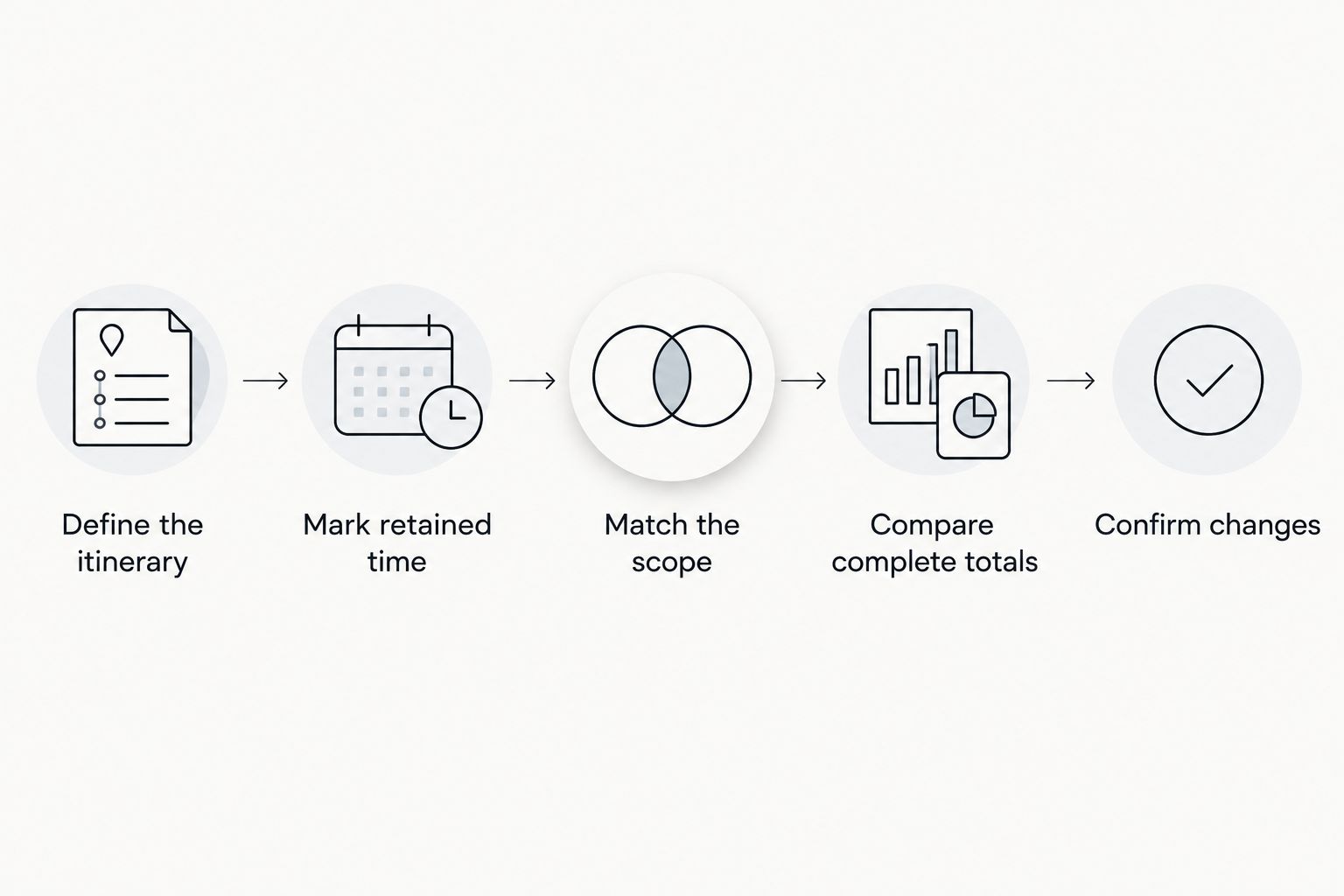
Keep the responses beside the original brief. If one proposal excludes a stop or assumes a different finish time, resolve that difference before comparing the totals.
The decision then becomes straightforward: choose the lower complete total among proposals that meet the actual assignment. If continuity is essential, remove proposals that do not provide it rather than treating that omission as a saving.
Why hourly vs point-to-point chauffeur cost varies
The booking label alone does not describe the assignment. These factors change what you need to include in the comparison:
- Itinerary scope. A direct journey and a sequence of appointments require different instructions. Include every movement before requesting either format.
- Reserved duration. An hourly assignment covers a time window. Confirm its minimum and the treatment of extensions rather than estimating from time spent driving.
- Waiting requirements. Airport processing, meetings and passenger readiness affect the required waiting arrangements. Separate planned waiting from a change to the itinerary.
- Stops and routing. An additional destination changes the assignment. Ask how each proposal handles stops rather than assuming they are included.
- Vehicle requirements. Keep the requested vehicle and luggage requirements consistent. Different specifications prevent a like-for-like comparison.
- Change terms. A revised pickup, delayed departure or longer assignment needs an agreed process. Check the applicable terms before approving the booking.
For 2026 travel approvals, keep these assumptions with the quote. Finance needs to see what was authorized; the travel coordinator needs instructions that remain usable when the schedule changes.
Does an airport transfer need an hourly booking?
A fixed airport transfer does not inherently need an hourly booking. Start with the arrival or departure assignment and identify whether anything beyond the transfer requires retained service.
For an arrival, provide the flight details, destination and passenger contact arrangements. Request flight tracking and clarify the pickup procedure, included waiting and response to a delayed arrival.
Flight tracking and passenger readiness are different issues. Tracking a landing does not establish when the passenger will reach the pickup location, so confirm how the booking handles that interval.
Consider an hourly proposal when the airport journey connects directly to further movements requiring the chauffeur. Keep that requirement explicit rather than asking for an airport transfer and adding an unconfirmed itinerary afterward.
Is hourly service cheaper for multiple meetings?
Multiple meetings do not automatically make hourly service cheaper. The deciding question is whether you need the chauffeur during the gaps and whether the complete hourly total is lower than the complete transfer alternative.
For closely connected appointments, retained service addresses a continuity requirement. For widely separated appointments, separate transfers deserve comparison if you do not need the chauffeur in between.
Write the requirement in operational terms: the passenger must leave when the meeting ends, or the next pickup is at an agreed time. Those are different instructions, even if the addresses are identical.
Should you book the return journey separately?
A separate return transfer fits an agreed return pickup; an uncertain departure needs an explicit waiting or retained-service arrangement. Do not leave the return leg to an assumption.
If the return timing is fixed, include that journey in the point-to-point comparison from the beginning. If it depends on a meeting finishing, explain the uncertainty and request suitable terms under both formats.
The useful comparison is the complete outward-and-return assignment. Comparing an hourly booking against only the outward transfer leaves part of the travel requirement unaccounted for.
What to send before requesting a quote
Give the provider enough information to quote the assignment rather than interpret it. A concise travel brief also keeps the passenger, assistant and approver aligned.
Include:
- Travel date, flight details where relevant, and local pickup times.
- Every pickup and destination, with entrance instructions when known.
- Passenger count, luggage and vehicle requirements.
- Fixed arrival commitments and uncertain departure times.
- The intervals that require the chauffeur to remain assigned.
- The coordinator and passenger contact arrangements.
- Billing instructions and the person authorized to approve changes.
For a 2026 itinerary involving several cities, separate each local assignment within the brief. Do not assume one city's booking terms apply elsewhere simply because the travel is coordinated together.
When coordinated chauffeur service fits
Chauffyr is best for executive travel coordinators who need one desk for chauffeur arrangements across multiple destinations. Its US-based coordination supports worldwide service through vetted chauffeurs and affiliates; it does not imply an owned fleet in every city.
Chauffyr serves 120+ airports across 50+ countries, with flight tracking and one 24/7 desk. Those capabilities address coordination across an itinerary, while the choice between a transfer and an hourly charter still depends on the individual assignment.
The benefit is a single coordination point. The limitation is that network coverage does not establish the terms of a particular booking: confirm the route, vehicle requirement, waiting arrangements and change conditions before approval.
Corporate accounts offer consolidated billing. For finance teams, keep the agreed itinerary and any authorized changes attached to the booking record so the invoice can be checked against the assignment.
Arrange your chauffeur itinerary
Request an airport transfer, hourly charter or coordinated itinerary through one desk.
FAQ
What's the simplest way to compare hourly vs point-to-point chauffeur cost?
Compare complete totals for the same itinerary, vehicle requirements and waiting arrangements. An hourly rate and a complete transfer quote are not equivalent measures.
Is point-to-point better for a direct airport transfer?
Point-to-point fits a direct airport transfer when you do not need to retain the chauffeur afterward. Confirm pickup instructions, flight tracking and waiting terms before booking.
Does an hourly chauffeur booking include unlimited stops?
Do not assume an hourly chauffeur booking includes unlimited stops. Specify the route and destinations, then confirm the operating area and change terms.
Can I book separate transfers instead of keeping a chauffeur all day?
Separate transfers fit an itinerary with agreed pickup times and no requirement to retain the chauffeur between journeys. Include every transfer in the total before comparing it with an hourly charter.
What happens if my meeting runs late?
The applicable booking terms determine how a late meeting is handled. Confirm waiting, extensions and authorization arrangements before travel rather than assuming the chauffeur can remain indefinitely.
Is hourly service automatically better for a delegation?
Hourly service is not automatically better for a delegation. Define each passenger movement, required vehicle continuity and departure dependency before choosing the booking format.
Can Chauffyr coordinate chauffeur travel in different countries?
Chauffyr coordinates executive chauffeur travel across 50+ countries through vetted chauffeurs and affiliates, supported by one 24/7 desk. Confirm each local itinerary and its booking terms before approval.
One last thing
Mark every gap in the itinerary as either retained time or a separate pickup. That small instruction resolves the central ambiguity before anyone quotes the journey.
For your 2026 travel brief, ask the provider to confirm that distinction in writing. You are not just choosing between hourly and point-to-point; you are deciding what must happen while the passenger is away from the vehicle.


