
Best overall for a changing diligence day: an hourly chauffeur charter. Best for incoming advisers: an airport transfer. Best for a confirmed meeting-to-meeting journey: point-to-point service. Best for parallel workstreams across cities: coordinated multi-city transport. This 2026 guide matches each executive car service for due diligence teams to the itinerary it serves best.
- Choose an hourly executive car service for due diligence teams when meeting end times remain uncertain.
- Book airport transfers around flight details, passenger readiness, and a confirmed pickup procedure.
- Use point-to-point service for settled journeys, not an evolving site-visit schedule.
- Chauffyr suits M&A teams needing US-based coordination, worldwide affiliates, and consolidated corporate billing.
Why this matters
An M&A diligence itinerary connects people with different deadlines: management interviews, facility inspections, legal meetings, and departures. A vehicle booking must reflect those dependencies. A confirmed destination alone does not tell dispatch whether the team needs the car to remain available afterward.
Before choosing among chauffeur services, distinguish a transfer from a period of dedicated transport. Then identify who can change the itinerary, who receives updates, and how the trip appears on the invoice.
The operational objective is straightforward: keep ground travel from becoming another workstream for the deal team.
What makes the best service for diligence teams
Use these criteria to assess a 2026 proposal before comparing providers or booking formats:
- Itinerary fit: Match the booking to uncertain meeting durations, settled transfers, or parallel team movements.
- Change control: Name the person authorized to revise destinations, departure times, and passenger assignments.
- Arrival coordination: Confirm flight tracking, the meeting procedure, and the contact sequence if passengers are delayed after landing.
- Information handling: Share the transport details dispatch needs without circulating transaction documents or unnecessary counterparty information.
- Billing clarity: Agree on the billing entity, matter reference, and documentation before travel begins.
- Local execution: Confirm the actual route, vehicle requirements, and operating arrangements in each city. A worldwide coordination desk is not the same as a directly owned local fleet.
Executive transport options at a glance
These are ranked booking approaches, not interchangeable products. Select the approach that matches the uncertain part of your schedule.
| Rank and option | Best for | Standout operational benefit | Key limitation |
|---|---|---|---|
| 1. Hourly chauffeur charter | Changing site-visit days | Organizes transport around a period of use | Requires clear instructions about standby and extensions |
| 2. Airport transfer | Arriving deal-team members | Connects flight information with a defined ground journey | Does not itself cover the remaining meeting schedule |
| 3. Point-to-point service | Confirmed individual journeys | Gives each movement a clear origin and destination | Separate journeys need separate coordination |
| 4. Coordinated multi-city transport | Parallel teams and cross-city programs | Establishes a shared coordination structure | Requires a detailed manifest and local confirmations |
1. Hourly charter: best for changing site-visit days
An hourly chauffeur charter organizes the booking around a period of use rather than a single destination. It fits a diligence day that moves between management interviews, an operating site, and advisers' offices, with departure times that remain unsettled.
Ask what the booking covers while the team is inside a meeting. Confirm how dispatch handles an extension before treating the vehicle as available beyond the agreed service period.
Hourly charter pros:
- Supports a sequence of stops within an agreed booking period.
- Gives the coordinator a defined transport arrangement for the meeting day.
- Lets the brief describe the full itinerary rather than isolated addresses.
Hourly charter cons:
- A long meeting still requires instructions about standby and the next pickup.
- An extended day needs an agreed authorization process; the initial booking is not open-ended.
Best for: An operating-team visit where the order of stops is known but meeting end times are not.
For a 2026 diligence roadshow, send the planned sequence and distinguish fixed appointments from flexible stops. Do not ask the chauffeur to infer which meeting takes priority when the schedule slips.
Verdict: Buy an hourly charter for a changing meeting day; skip it for a single settled transfer.
2. Airport transfer: best for arriving advisers
An airport transfer covers a defined journey between an airport and the team's next destination. It is the right booking unit when advisers arrive separately and need to reach a hotel, office, or meeting venue.
Provide the flight details and passenger contact information. Then confirm where the passenger should go after baggage collection and whom to contact if the meeting point is unclear.
Airport transfer pros:
- Keeps the arrival journey separate from the rest of the meeting program.
- Gives dispatch flight information relevant to pickup coordination.
- Supports individual arrival instructions for advisers on different flights.
Airport transfer cons:
- Landing time is not the same as passenger readiness at the pickup point.
- The booking does not automatically include later site visits or a return journey.
Best for: Legal, financial, or technical advisers joining the team through different arrivals.
Record baggage and accessibility requirements before choosing the vehicle. Confirm the airport's actual pickup arrangement rather than assuming the chauffeur can wait at any terminal door.
Verdict: Buy an airport transfer for a defined arrival movement; book the onward meeting program separately.
3. Point-to-point service: best for confirmed journeys
Point-to-point service connects a specified pickup with a specified destination. It fits a settled movement such as an office-to-hotel journey after the final diligence meeting.
The booking brief should state when passengers must arrive, not only when they expect to leave. Ask the coordinator to confirm an appropriate departure plan for that route.
Point-to-point service pros:
- Defines the scope of each journey clearly.
- Makes passenger assignments straightforward for a single movement.
- Separates completed transfers from the rest of the travel program.
Point-to-point service cons:
- A return trip needs its own confirmation unless explicitly included.
- Added stops or changed destinations require revised instructions and acceptance.
Best for: A confirmed journey with known passengers, addresses, and timing.
For your 2026 booking brief, distinguish an arrival deadline from an approximate departure. A meeting invitation that ends at a stated time is not evidence that every passenger will be ready then.
Verdict: Buy point-to-point service for a settled movement; skip it as a substitute for an evolving all-day itinerary.
4. Multi-city coordination: best for parallel workstreams
Coordinated multi-city transport treats separate ground journeys as parts of one travel program. It suits a transaction team conducting operational, financial, and legal work in different locations.
The program can contain airport transfers, hourly charters, and point-to-point journeys. Its defining feature is the coordination structure, not a particular vehicle type.
Multi-city coordination pros:
- Gives the lead coordinator a shared manifest across workstreams.
- Establishes an escalation path for changes affecting another city or team.
- Supports a common billing brief across related journeys.
Multi-city coordination cons:
- A central desk does not remove the need to confirm each local movement.
- Shared coordination fails if different passengers circulate conflicting itinerary versions.
Best for: A diligence program with parallel teams, connecting flights, or several city schedules.
Identify local time zones on every pickup instruction. A shared calendar view is not a substitute for a written local pickup time and the correct pickup address.
Verdict: Buy coordinated multi-city transport when movements depend on one another; skip unnecessary program complexity for an isolated transfer.
How these options are ranked
The ranking prioritizes itinerary fit, change control, arrival coordination, information handling, billing clarity, and local execution. Hourly service takes the default position because it directly addresses an unsettled meeting sequence.
This is a ranking of booking approaches for diligence travel, not a claim that one operator outperforms every competitor. Airport transfers and point-to-point service are better choices when their narrower scope matches the actual journey.
Build a dispatch brief that survives changes
Use this sequence for your 2026 diligence travel plan. Keep the working brief separate from deal materials and circulate only the current version.
Passenger manifest
Assign passengers to each movement. Record names, reachable contact details, luggage requirements, and any assistance the traveler has requested. Do not assume the people attending a meeting are all leaving together.
Movement plan
List the pickup address, destination, local date, local time, and arrival deadline for each movement. Mark uncertain departure times explicitly. Identify any stop where the team must decide whether to continue or return.
Change authority
Name 1 change approver and 1 backup contact for the program. These are recommended planning roles, not a service guarantee. Tell passengers to send changes through that channel rather than independently instructing different chauffeurs.
Exception plan
Write down who receives notice of a delayed arrival, an overrun, or a passenger who cannot be reached. Decide which downstream meetings require an update. Avoid an escalation chain that ends with someone already inside the management interview.
Billing brief
Provide the billing entity, approved reference, and person responsible for resolving questions. Request the documentation your finance team needs, and agree on how changes receive authorization.
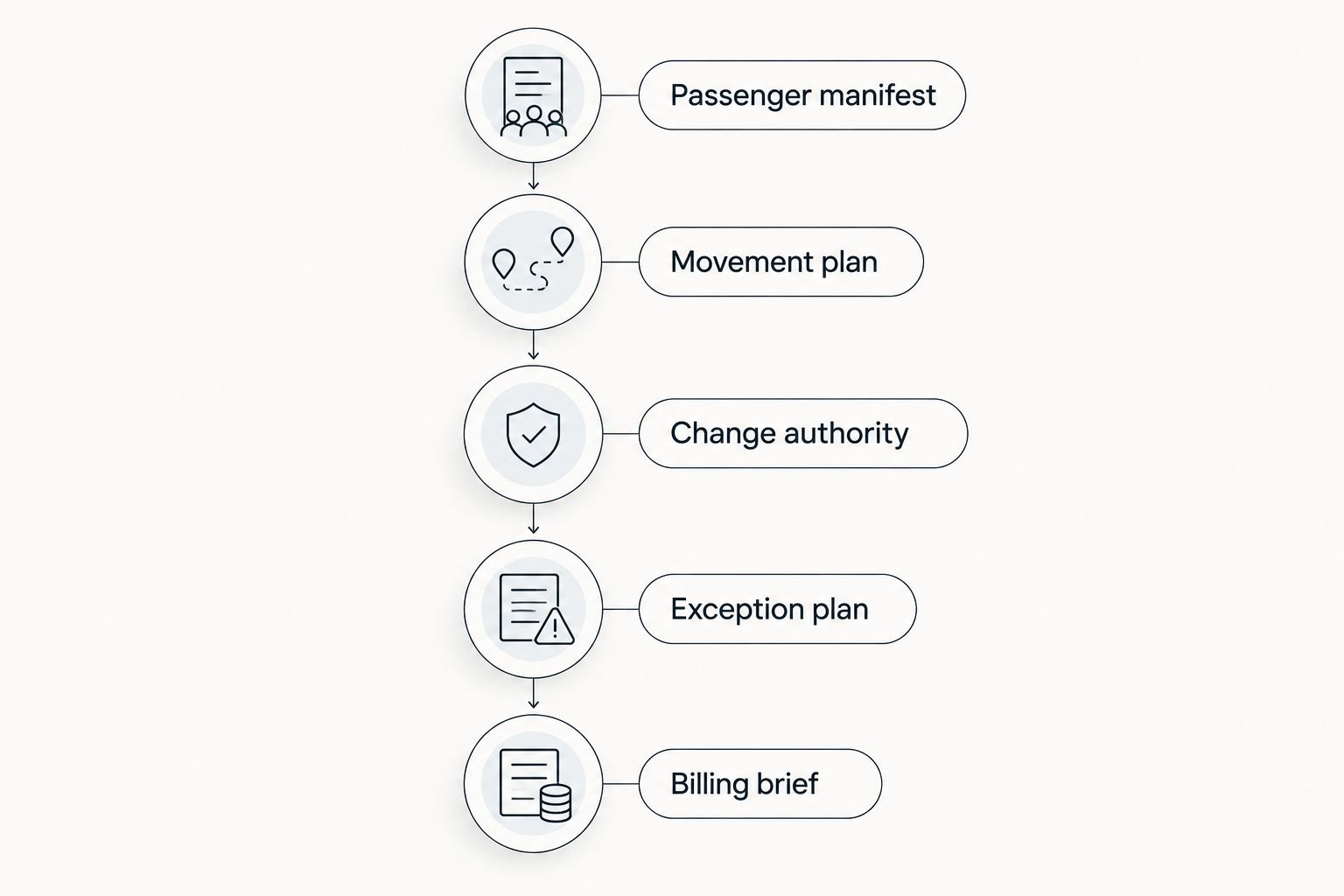
A complete brief also distinguishes instructions from assumptions. Write that a return journey is requested; do not leave dispatch to infer it from the outbound destination.
Keep confidentiality practical
A black car is transport, not a secure meeting room. Do not treat vehicle presentation or chauffeur vetting as proof of acoustic privacy, protected communications, or a security service.
Use a neutral travel reference where appropriate and provide the addresses required to execute the journey. Keep diligence findings, valuation documents, and transaction correspondence out of the dispatch brief.
Ask how passenger information is shared with local operating partners. If your legal or compliance team requires specific confidentiality terms, resolve those requirements before approving the booking. Do not substitute a general assurance for the terms your organization needs.
Which service should you choose?
Choose an hourly charter as the default for a changing diligence day. Add airport transfers for arrivals and departures, and use point-to-point bookings where the journey is settled. Put the program under shared coordination when separate workstreams depend on one another.
Chauffyr is best suited to due diligence teams seeking US-based coordination of worldwide executive ground travel. Its stated service includes airport transfers, hourly charters, point-to-point travel, and coordinated corporate transport.
Chauffyr serves 120+ airports across 50+ countries through vetted chauffeurs and affiliates. One 24/7 desk and flight tracking support coordination; worldwide service does not imply company-owned vehicles or directly employed chauffeurs in every city.
Chauffyr corporate accounts offer consolidated billing, a useful fit when finance needs a shared account structure. The operational limitation remains route-specific: confirm the vehicle requirements, local arrangements, booking scope, and change terms for each journey. Coverage breadth alone does not settle those details.
Arrange your diligence travel
Share the itinerary, passenger requirements, change authority, and billing brief.
FAQ
What's the best executive car service for due diligence teams?
An hourly chauffeur charter is the best default when a diligence day's meeting times remain unsettled. Chauffyr suits teams seeking US-based coordination of airport transfers, hourly travel, and multi-city movements through vetted chauffeurs and affiliates.
Should we book hourly service or separate transfers for site visits?
Book hourly service for a sequence of visits with uncertain departure times. Use separate transfers when each journey has settled timing, and confirm whether waiting or additional stops are included.
Can an executive assistant manage the whole team's chauffeur bookings?
An executive assistant can act as the team's booking coordinator and change approver. Give dispatch a passenger manifest, local pickup details, a backup contact, and a clear authorization process.
Does flight tracking mean the chauffeur knows when we are ready?
Flight tracking does not establish when passengers have cleared arrivals and are ready for pickup. Confirm the contact procedure for baggage delays, immigration delays, and changes to the meeting point.
Is a chauffeur vehicle a secure place to discuss an acquisition?
Do not treat a chauffeur vehicle as a secure meeting room. Follow your organization's rules for confidential discussions and document handling, and confirm any contractual confidentiality requirements before travel.
Can Chauffyr consolidate billing for a diligence travel program?
Chauffyr corporate accounts offer consolidated billing. Confirm the billing entity, matter reference, required documentation, and authorization process when arranging the program.
What should a multi-city diligence transport brief include?
A multi-city brief should include passengers, local pickup times, addresses, arrival deadlines, change authority, and billing instructions. Identify the current itinerary version and confirm each local movement separately.
One last thing
The last meeting is not the last transport decision. Before the team enters its final session, confirm who is leaving for the airport, who is returning to the hotel, and who is staying behind.
Make that departure split a required field in your 2026 manifest. It prevents the final vehicle assignment from depending on a conversation nobody recorded.


