
Private equity firms’ chauffeur service is coordinated ground transportation for investment teams, with the aim of keeping deal meetings, portfolio visits, and airport connections on schedule. This guide explains how to specify each journey, manage itinerary changes, protect sensitive travel details, and reconcile billing without turning the executive assistant into a full-time dispatcher.
- Choose chauffeur service for private equity firms around itinerary control, named contacts, and clear change procedures.
- Use point-to-point transfers for fixed journeys and hourly charters for changing meeting schedules.
- Chauffyr suits private equity coordinators seeking executive chauffeur service with one 24/7 desk.
- Keep sensitive deal information outside the transport brief; share only what the journey requires.
Why chauffeur service matters for private equity firms
A private equity travel brief must connect the investment team’s schedule with the practical requirements of each pickup. A delayed meeting, a different departure address, or an additional passenger changes the transport assignment, not just the calendar entry. Your booking process needs a clear way to communicate those changes.
Start by separating airport transfers, hourly charters, and point-to-point journeys. Review the chauffeur services relevant to the itinerary, then specify the assignment rather than requesting an undefined car for the day.
For your 2026 travel procedure, give each journey an owner, a confirmed scope, and an escalation contact. That structure is more useful than a collection of confirmations that nobody maintains after booking.
The right transport arrangement preserves itinerary control without giving every passenger responsibility for dispatch. Your team should know who changes the booking, who receives chauffeur details, and who approves additional service.
How to arrange chauffeur service for private equity firms
Define the assignment before requesting a vehicle
Build the itinerary manually in a shared document or spreadsheet first. Record the actual travel requirements, not just the flight number and destination. A vehicle request without passenger, baggage, and timing details leaves essential questions unanswered.
Separate a firm appointment from a preferred departure time. A meeting’s scheduled finish does not confirm when the principal will be ready, and an aircraft’s arrival time does not identify when the passenger will reach the pickup point.
Use the same fields for every assignment so another assistant can take over without reconstructing the trip from email. Keep the brief operational and exclude transaction commentary.
- Passengers: List the traveler names needed for coordination and the party size.
- Baggage: Describe luggage and equipment that affect vehicle selection.
- Locations: Provide complete pickup and destination details, including the correct entrance.
- Timing: Distinguish flight arrival, requested pickup, and required arrival at the meeting.
- Ownership: Name the booking owner and the person authorized to approve changes.
Match the booking format to the meeting schedule
Map each leg yourself before requesting a proposal. Mark which journeys have fixed endpoints and which depend on meeting overruns, additional stops, or a principal’s instructions during the day.
Use point-to-point travel for a defined journey; request an hourly charter when you need a vehicle assigned across a changing schedule. Neither format is universally better. The correct choice depends on what must remain under your control.
Ask the provider to confirm the scope in writing. An hourly booking does not answer every question about operating area, extensions, parking, or waiting, and a transfer should not be treated as unlimited access to a vehicle.
- Airport transfer: Specify the flight, arrival airport, destination, and proposed meeting procedure.
- Point-to-point: Confirm the pickup, destination, departure time, and any planned stop.
- Hourly charter: Describe the expected route, assignment window, and changing-stop requirements.
- Separate departures: Request distinct arrangements when executives leave at different times.
- Written scope: Confirm what happens when the itinerary exceeds the original assignment.
Establish a single communication chain
Create a contact sheet before departure. Give the traveler one operational contact and keep the assistant responsible for the master itinerary. Decide whether changes come from the traveler, the assistant, or another authorized coordinator.
Use a 2026 trip brief with a visible revision date so an older attachment cannot silently become the working plan. When an instruction changes, send the replacement details through the agreed channel and request acknowledgment.
A coordinated chauffeur arrangement reduces the number of separate local conversations you manage. It still requires an accurate brief and a named decision-maker; central coordination cannot resolve conflicting instructions that your own team has not settled.
- Booking owner: Maintain the current itinerary and approve the final brief.
- Traveler contact: Confirm a reachable mobile number and any communication restrictions.
- Dispatch contact: Record the provider’s operational contact and escalation method.
- Change authority: Identify who can add stops, extend service, or change destinations.
- Acknowledgment: Obtain confirmation that revised instructions reached the operational team.
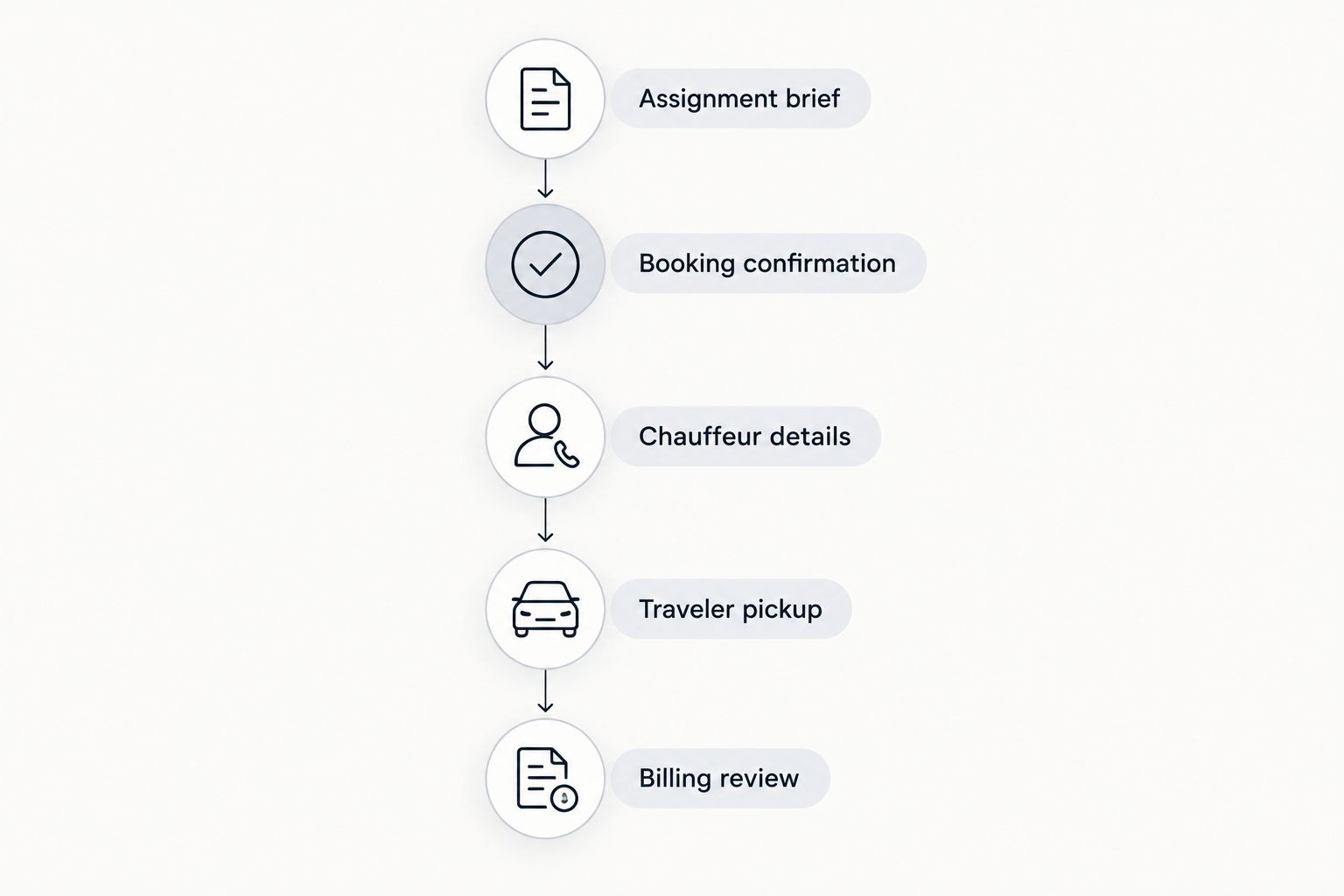
The handoff should follow a clear sequence: assignment brief, booking confirmation, chauffeur details, traveler pickup, and billing review. Each stage needs an owner before the journey begins.
Limit the travel brief to necessary information
Prepare a short operational version of the itinerary rather than forwarding the full deal-team calendar. Include the information needed to identify the passenger, locate the pickup, and complete the journey. Keep investment analysis, negotiation details, and unrelated participant information outside the brief.
Ask how passenger details and itinerary changes are shared with the chauffeur and any local affiliate. Do not treat a black vehicle, a professional appearance, or the word executive as evidence of a particular confidentiality or security standard.
For sensitive assignments, involve your firm’s security or legal team in setting requirements. A transport booking is not a substitute for specialist protective services or an agreed information-handling process.
- Necessary details: Share only passenger and journey information required for the assignment.
- Document access: Restrict the working itinerary to people with an operational role.
- Meeting labels: Use neutral location descriptions where the business purpose is unnecessary.
- Pickup identification: Agree on an appropriate passenger-identification procedure.
- Special requirements: Confirm confidentiality and security requirements explicitly, rather than assuming acceptance.
Plan for delays and split itineraries
Build contingencies in the same document as the main itinerary. Identify what changes if the flight arrives late, the meeting moves, or the team separates after a portfolio visit. A fallback is useful only when someone has authority to activate it.
For airport travel, distinguish flight tracking from passenger readiness. A tracked landing does not confirm baggage collection, immigration completion, or the traveler’s location. Confirm the actual pickup procedure and the contact method for a passenger who cannot find the chauffeur.
Review these contingencies for each 2026 trip rather than copying them unchanged between cities. Airport access, meeting locations, and the composition of the traveling party belong to the specific assignment.
- Flight disruption: Confirm how schedule changes affect dispatch and the booking.
- Meeting overrun: Establish who requests an extension and how acceptance is confirmed.
- Changed address: Send the complete replacement destination, not an informal venue nickname.
- Split party: Identify which passengers remain together and which need separate journeys.
- Missed contact: Agree on the escalation route if the passenger and chauffeur cannot connect.
- Service interruption: Request the provider’s contingency procedure before the travel day.
Set billing instructions before travel
Use your existing expense process to define the billing fields before requesting confirmation. Identify the paying entity, internal matter or deal reference, and the person authorized to approve changes. Do not leave the traveler to reconstruct those details after the journey.
Ask for the written booking terms and the method for documenting additional service. A confirmed assignment and a later change are separate approval events; keeping both records helps finance understand the invoice without chasing the principal.
For your 2026 expense workflow, reconcile the completed service against the accepted itinerary and approved changes. Separate an administrative coding correction from a dispute about the journey itself.
- Billing entity: Provide the correct legal entity and invoice recipient.
- Internal reference: Supply the approved deal, portfolio company, or department code.
- Authorization: Name the person who can approve changes to the assignment.
- Supporting records: Retain the confirmation and acknowledged itinerary revisions.
- Reconciliation: Compare the invoice with the completed service and approved changes.
Compare transport options for private equity travel
Choose the arrangement that fits the journey, not the one that sounds most prestigious. Self-managed bookings preserve direct control over each reservation but leave the coordination work with your team. A central chauffeur arrangement provides a common contact structure, while still requiring local details and explicit service terms.
| Option | Best for | Operational advantage | Key limitation |
|---|---|---|---|
| Separately booked point-to-point transfers | Fixed journeys with known endpoints | Each leg has a defined assignment | Changes across several bookings require separate coordination |
| Airport transfer | Arrival or departure tied to a flight | Connects flight details with a specific ground journey | Does not cover an open-ended meeting schedule unless agreed |
| Hourly chauffeur charter | Several stops or an uncertain meeting finish | Keeps the assignment organized around a service window | Requires clear terms for scope, extensions, and route changes |
| Central coordination across cities | Investment teams traveling through multiple locations | Gives the booking owner a common coordination structure | Local pickup procedures and assignment details still need confirmation |
An hourly charter is the practical choice when meeting uncertainty drives the itinerary; a transfer is the cleaner choice when the journey is fixed. For mixed trips, combine formats rather than forcing every leg into the same booking type.
Common mistakes private equity coordinators make
Treating a meeting end time as a confirmed departure
A calendar entry describes the planned meeting, not the principal’s actual readiness. Tell the provider whether departure is fixed or dependent on the meeting, and confirm how an extension is requested.
Forwarding the full transaction itinerary
A chauffeur needs the journey instructions, not the investment committee agenda or negotiation notes. Prepare a transport-only brief and keep business-sensitive context in the firm’s own systems.
Allowing several people to issue changes
A principal, assistant, and local office can each send a different destination. Name the change authority and require acknowledgment of the final instruction so dispatch does not have to choose between competing requests.
Assuming flight tracking resolves the airport handoff
Flight tracking addresses the flight’s status. It does not replace an agreed meeting point, a reachable passenger contact, or instructions for a traveler delayed after landing. Confirm each element separately.
Leaving allocation until the invoice arrives
A journey can serve several executives without having an obvious internal billing owner. Agree on the paying entity and reference before booking, then record authorized changes alongside the original confirmation.
When Chauffyr fits the assignment
Chauffyr chauffeur service is best for private equity coordinators seeking executive ground travel with one 24/7 desk. Chauffyr is a US-based coordination partner serving more than 120 airports across more than 50 countries through vetted chauffeurs and affiliates.
For a 2026 itinerary combining airport transfers, hourly charters, and point-to-point travel, Chauffyr offers flight tracking and corporate accounts with consolidated billing. Worldwide service through affiliates does not mean every chauffeur is an employee or every vehicle belongs to the company.
The fit depends on the assignment. Confirm the route, vehicle requirements, pickup procedure, change terms, and any confidentiality requirements before booking. Chauffyr chauffeur service provides a central coordination option; your firm still owns the accuracy of the brief and approval of itinerary changes.
Arrange your team's ground travel
Share the itinerary, passenger requirements, and billing instructions for an assignment-specific quote.
FAQ
What's the best chauffeur service arrangement for a private equity deal team?
The best arrangement matches the team's itinerary: point-to-point transfers for fixed journeys and hourly charters for changing meeting schedules. Confirm the communication chain, change authority, and billing instructions before booking.
Is an hourly chauffeur better than booking separate transfers?
An hourly chauffeur is better when several stops or an uncertain departure require an assigned service window. Separate transfers fit defined journeys, but each booking needs its own confirmation and change process.
What should an executive assistant include in a chauffeur booking?
Include passenger details, baggage requirements, complete addresses, timing, a reachable contact, and the authorized booking owner. Distinguish the flight arrival from the requested pickup and the required meeting arrival.
Does flight tracking mean the chauffeur knows when I am ready?
Flight tracking does not establish when a passenger is ready for pickup. Confirm the meeting procedure and communication method for baggage delays, immigration, or difficulty locating the chauffeur.
Can Chauffyr coordinate travel across several cities?
Chauffyr provides multi-city transport coordination through vetted chauffeurs and affiliates, with one 24/7 desk. Confirm each city's route, airport pickup procedure, and assignment requirements before accepting the itinerary.
How should a private equity firm handle confidential travel details?
Give the transport provider only the information needed to complete the journey. Keep transaction material outside the travel brief and confirm any specific confidentiality requirements through your firm's established approval process.
One last thing
Record the actual pickup entrance, not just the building address. A complete itinerary can still leave the traveler and chauffeur at different doors. Add the entrance instructions to the confirmed brief and update them when the meeting location changes.


