
Yes—luggage or extra stops can change a chauffeur booking’s total, depending on the provider’s terms and the trip you approve. Ask whether the quote covers your actual bags, every planned stop, and any time the chauffeur must wait. A fixed quote is useful only when its written scope matches your itinerary.
- Luggage and extra-stop charges depend on the provider’s written terms; do not assume either is included.
- For airport transfers, confirm bag capacity and waiting terms before approving the vehicle.
- For hourly charters, confirm whether your planned stops fit the agreed service scope.
- Request written approval of itinerary changes before the chauffeur carries them out.
Do chauffeur services charge extra for luggage or stops?
There is no universal luggage allowance or extra-stop rule you should apply across chauffeur providers. Treat both as booking details that require written confirmation, rather than assuming that an executive vehicle includes unlimited baggage or additional destinations.
When reviewing pricing, distinguish the agreed journey from changes requested afterward. A quote for an airport-to-office transfer does not, by itself, confirm a hotel luggage drop along the way.
| Booking requirement | Best for | Advantage when confirmed | Limitation to resolve |
|---|---|---|---|
| Direct airport transfer | A defined pickup and destination | Keeps the journey scope clear | Confirm bags, arrival arrangements, and waiting terms |
| Transfer with planned stops | A known sequence of destinations | Lets you request the complete itinerary upfront | Confirm each stop and the time needed there |
| Hourly charter | An itinerary requiring retained chauffeur time | Lets you request service around a working schedule | Confirm the booked period and change conditions |
| Booking with unusual luggage | Travelers carrying bulky or specialist items | Lets the provider assess the load before assignment | Confirm vehicle fit rather than relying on a category name |
These are booking choices, not universal promises about inclusions. Choose the arrangement that describes the work you need, then obtain confirmation of its boundaries.
Why this matters
For an executive assistant, an unexpected charge is also an approval problem. Someone must establish what changed, who authorized it, and how the final invoice should be allocated.
Resolve those questions before travel. Your 2026 booking checklist should connect the traveler’s requirements, the confirmed itinerary, and the person authorized to approve changes.
The operational issue is broader than the invoice. An undisclosed luggage load or an unplanned stop leaves the coordinator resolving a requirement that should have been part of the original booking.
Luggage: confirm fit before asking about a supplement
Start with what must travel, not whether baggage is described as included. A luggage policy cannot establish whether the assigned vehicle fits your particular combination of passengers and bags.
Give the provider a practical inventory:
- Passenger count: Include everyone traveling in the vehicle.
- Bag inventory: Separate suitcases, cabin bags, briefcases, and other items.
- Item dimensions: Supply measurements for bulky or unusually shaped items.
- Handling requirements: Explain any assistance the traveler needs.
- Route changes: Identify where luggage will be collected or unloaded.
Ask the provider to confirm vehicle suitability against that inventory. Do not infer luggage capacity from a vehicle category, a photograph, or the word luxury.
Luggage acceptance and luggage inclusion are different questions. First establish that the load fits; then establish whether the quote covers transporting and handling it as described.
For a delegation, keep the inventory tied to each vehicle rather than listing only the group’s total baggage. Request confirmation that the proposed assignment accounts for both the passengers and the items allocated to it. Do not assume spare capacity elsewhere in the group solves an individual vehicle’s loading requirement.
Planned stops: put every destination in the request
A stop needs more detail than an address. Tell the provider what the traveler will do there, whether anyone will leave the vehicle, and whether the chauffeur should remain with the booking.
For example, a hotel luggage drop and a meeting are different instructions. Describe each activity without deciding on the provider’s behalf how it should be classified or charged.
Include the following in your stop list:
- The destinations in travel order.
- The purpose of each stop.
- The intended arrival or departure time, where relevant.
- Whether passengers or luggage change at that location.
- Whether the vehicle should remain assigned during the stop.
Ask for the complete route to appear in the confirmation. A verbal acknowledgment of an extra address is not the same as written confirmation of how it affects the booking.
If a destination is tentative, mark it as tentative. Ask what approval will be needed if the traveler adds it later, rather than treating an unconfirmed possibility as an included stop.
Unplanned stops: agree on approval before departure
An executive can request a change without knowing the booking’s commercial terms. Give the traveler a simple instruction: route changes should go through the designated coordinator or booking desk.
The objective is not to prevent reasonable changes. It is to establish who can authorize them and obtain confirmation of their effect before they are carried out.
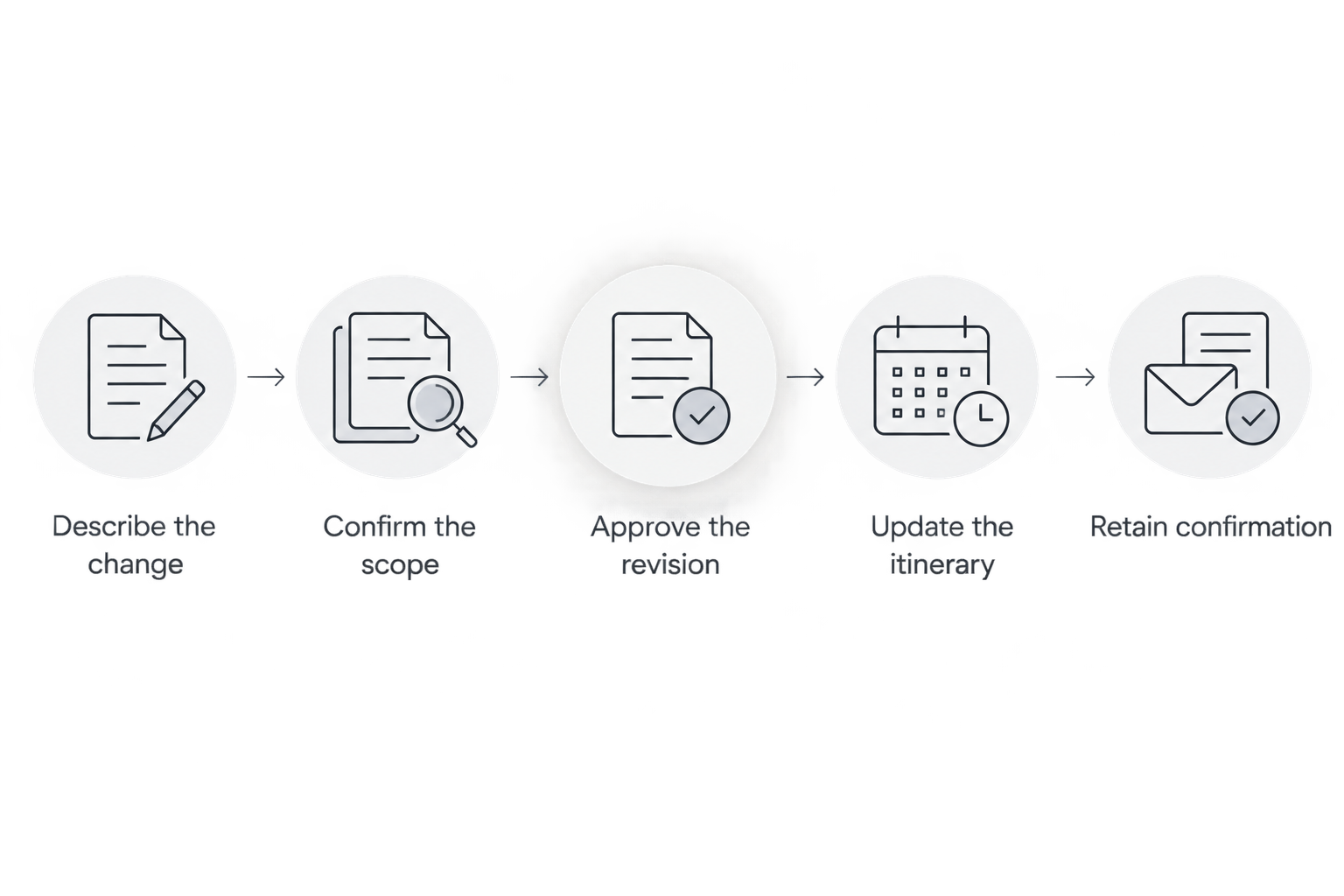
Use this approval sequence for your 2026 travel instructions:
- Describe the change. State the new destination, activity, or luggage requirement.
- Confirm the scope. Ask how the request changes the agreed service.
- Approve the revision. Have the authorized contact accept the revised terms.
- Update the itinerary. Keep the traveler, coordinator, and provider aligned.
- Retain confirmation. Save the approval with the booking record.
This sequence is a recommended coordination process, not a claim about any provider’s mandatory procedure. Confirm the actual communication channel before the trip.
Why luggage and stop charges vary
The useful question is not simply whether a provider charges extra. It is which parts of your request the provider has included in the agreed service.
Use these factors to structure the conversation:
- Vehicle fit: Ask whether the specified passenger and luggage load changes the vehicle requirement.
- Service format: Confirm whether the request is a direct transfer, a multi-stop journey, or an hourly charter.
- Stop activity: Explain whether the chauffeur is dropping off, collecting, waiting, or continuing with the traveler.
- Service time: Identify the requested period and ask how an extension would be handled.
- Booking changes: Distinguish the approved itinerary from additions requested after confirmation.
- Local arrangements: For multi-city travel, request the relevant terms for each booking rather than assuming identical conditions.
These are questions to resolve, not a list of automatic supplements. Do not budget an assumed fee or promise an inclusion until the provider confirms it.
Should you book hourly service for several stops?
Request an hourly charter when your requirement includes retained chauffeur time between destinations. Request a transfer quote when the requirement is a defined journey. If either arrangement could describe the trip, ask the provider to assess the same written itinerary under both.
An hourly booking does not, by its name alone, establish unlimited distance, unrestricted routing, or an open-ended finish. Confirm those boundaries before choosing it for a changing schedule.
A transfer with planned stops also needs explicit confirmation. Do not assume that describing the stops in an email means they have been accepted within the original quote.
For your 2026 travel policy, use a scope-based decision: select the arrangement whose written terms match the required work. The service label is secondary.
Does flight tracking include waiting after landing?
Flight tracking and waiting terms answer different questions. Tracking concerns the flight’s progress; waiting terms define how the booking handles the interval before the passenger is ready.
Ask when any included waiting period begins, how the traveler should communicate after landing, and what happens if baggage collection takes longer than expected. Obtain those answers for the specific booking rather than borrowing a rule from a previous trip.
Also distinguish an airport delay from a requested stop after departure. A hotel visit added after pickup is a route change, not simply part of monitoring the incoming flight.
Does a fixed quote include extra luggage and stops?
A fixed quote should be read against the journey and requirements it describes. It does not establish that an undisclosed bag, a different vehicle requirement, or an added destination is included.
For a 2026 booking, make the quote and itinerary tell the same story. Check passenger details, luggage requirements, destinations, service timing, and the process for authorizing changes.
If the documents disagree, resolve the difference before approval. Do not leave the traveler or chauffeur to interpret conflicting instructions at pickup.
What should you send before requesting a quote?
Send one booking brief that the provider can assess without reconstructing the journey from separate messages. Keep sensitive travel information limited to what is necessary for coordination.
Your brief should contain:
- The service date and pickup location.
- Flight details when the trip involves an airport arrival.
- Passenger count and luggage inventory.
- Every confirmed destination in order.
- Requested timing and waiting requirements.
- Any bulky items or handling needs.
- The traveler’s operational contact and the coordinator’s contact.
- The person authorized to approve itinerary changes.
- Billing references required by your organization.
Then request a written response confirming vehicle suitability, included stops, waiting terms, exclusions, and the change-approval process. Ask the provider to identify anything that requires separate confirmation.
Keep the approved version accessible to the person managing travel on the day. A detailed brief has little value if the coordinator is working from an earlier itinerary.
Where Chauffyr fits
Chauffyr is a fit for executive assistants coordinating airport transfers, hourly charters, and multi-city delegation transport. Its US-based coordination supports service at 120+ airports across 50+ countries through vetted chauffeurs and affiliates; that is not a claim of an owned fleet in every destination.
Chauffyr provides flight tracking, one 24/7 desk, fixed, upfront pricing, and no surge. Those features do not replace booking-specific confirmation of luggage, stops, waiting, and itinerary changes. Review the available chauffeur services against the trip you need arranged.
For Chauffyr bookings, send the full passenger, baggage, and stop requirements when requesting a quote. Corporate accounts offer consolidated billing; keep any approved trip changes attached to the booking record for reconciliation.
FAQ
Do chauffeur services charge for each suitcase?
Do not assume a per-suitcase charge or a universal baggage allowance. Give the provider your passenger count, bag inventory, and unusual-item dimensions, then request written confirmation of fit and inclusion.
Can I add a hotel stop to an airport transfer?
Ask the provider to confirm the hotel stop before adding it to the journey. State whether you need a luggage drop, passenger collection, or waiting time, and obtain approval of any revised terms.
Is an hourly chauffeur better for a trip with several meetings?
An hourly charter is worth requesting when you need retained chauffeur time between meetings. Confirm the booked period, route scope, and extension conditions rather than assuming the service is unrestricted.
Does flight tracking mean airport waiting is included?
Flight tracking does not, by itself, establish the booking’s waiting allowance. Ask when waiting begins, what the quote includes, and how to communicate delays after landing.
Can an executive ask the chauffeur for an extra stop?
Set the authorization process before the trip so an executive’s request reaches the right coordinator or booking desk. Confirm the change’s effect on the agreed service before approving it.
Does no surge mean there are no extra charges?
No surge is not a statement that every added service is included. Check the written scope for luggage, destinations, waiting, and later changes.
What should I confirm before booking Chauffyr in 2026?
Confirm the passenger and luggage requirements, planned stops, service timing, and change-approval process for the specific journey. Submit the complete itinerary when requesting the fixed, upfront quote.
One last thing
A luggage drop is still a stop. Describe the hotel visit even if nobody plans to check in or leave the vehicle for long.
Before approving the booking, read the itinerary as an instruction to someone who has never seen the earlier messages. Every required destination and luggage movement should be understandable from that document alone.


