
Pharma executives’ chauffeur service is prearranged ground transportation with the aim of keeping business travel aligned with meetings, site access and flight schedules. This guide explains how to brief the chauffeur, control itinerary changes and separate essential transport instructions from confidential business information.
- Choose chauffeur service for pharma executives by itinerary: airport transfers for arrivals, hourly charters for changing meeting schedules.
- Keep confidential meeting content out of chauffeur instructions; share access details and operational contacts instead.
- Chauffyr fits travel teams seeking US-based coordination, worldwide affiliate service and one 24/7 desk.
- Confirm pickup arrangements, change approval and billing references before the executive travels.
Why chauffeur service matters for pharma executives
A pharma itinerary can combine an airport arrival, a controlled-access facility, a business meeting and an onward departure. Each handoff needs its own instructions. Booking a vehicle does not resolve a visitor entrance, an unavailable host or a changed meeting finish.
For your 2026 travel plan, organize ground transportation around commitments, not just addresses. Record when the executive must be inside the meeting location, then build the transport plan around that requirement. Keep travel estimates separate from confirmed appointment times.
Start with a shared itinerary and a named owner. The calendar-to-chauffeur booking workflow provides a useful structure for turning appointments into transport instructions without treating every calendar edit as an approved dispatch change.
The distinction matters when an executive assistant, local host and traveler all receive updates. Your plan must state who can authorize a new destination, who receives the revised pickup details and who checks the next commitment.
Build the ground transport plan
Use these steps as your 2026 booking checklist. You can manage the process with a spreadsheet, calendar and written confirmations; a coordinated chauffeur service becomes useful when the handoffs exceed what your team wants to manage directly.
Capture the executive’s operational requirements
Create a reusable traveler brief before requesting individual journeys. Include what affects the vehicle, pickup and communication, but exclude meeting agendas, research details and other material the transport provider does not need.
Keep 2 itinerary views: a complete internal schedule and a transport-only version. The internal version holds business context. The transport version gives the chauffeur enough information to complete the movement without exposing unnecessary details.
Confirm preferences with the traveler rather than copying an old booking indefinitely. A different party size or luggage requirement changes the brief.
- Record passenger names and the booking owner’s contact details.
- State passenger count and luggage requirements.
- Identify accessibility or assistance requirements for confirmation.
- Specify the preferred method for operational messages.
- Remove confidential meeting titles from chauffeur-facing instructions.
Match the booking format to the itinerary
Choose an airport transfer for a defined arrival or departure movement. Use point-to-point travel when the origin, destination and pickup time are settled. Consider an hourly or as-directed charter when the executive needs a vehicle across a sequence of meetings.
An hourly charter gives the itinerary room to change; it does not make every change feasible. Ask the provider to confirm the operating area, planned stops and extension process. Do not assume a late finish automatically extends the booking.
You can compare formats manually by mapping each leg and identifying the gaps. Request a written service scope before approving the arrangement.
- Separate airport movements from meeting-day transport.
- List all known stops in their expected order.
- Identify uncertain meeting finishes.
- Confirm how additional stops receive approval.
- Ask how the provider handles an overrun.
Confirm airport and facility handoffs
Treat landing, passenger readiness and vehicle departure as separate events. Flight tracking helps the provider follow the aircraft; it does not tell the chauffeur when the traveler has cleared immigration or collected luggage.
For a pharma site visit, obtain the transport entrance from the host. A published street address does not establish the correct visitor gate, drop-off point or waiting location. Ask whether the chauffeur needs advance instructions, and keep the local host reachable.
Build the arrival plan from confirmed access details, not assumptions about terminal access or facility procedures.
- Supply the flight number and arrival date.
- Confirm the meeting point and passenger contact method.
- Ask whether meet-and-greet arrangements apply to the booking.
- Obtain the correct facility entrance from the host.
- Confirm where the vehicle can wait or return.
- Identify a contact for failed passenger-chauffeur contact.
Control changes through one booking owner
Assign 1 named approver for itinerary changes and identify a backup. The executive can still request a change, but the coordinator needs a clear record of what changed and whether the remaining schedule still works.
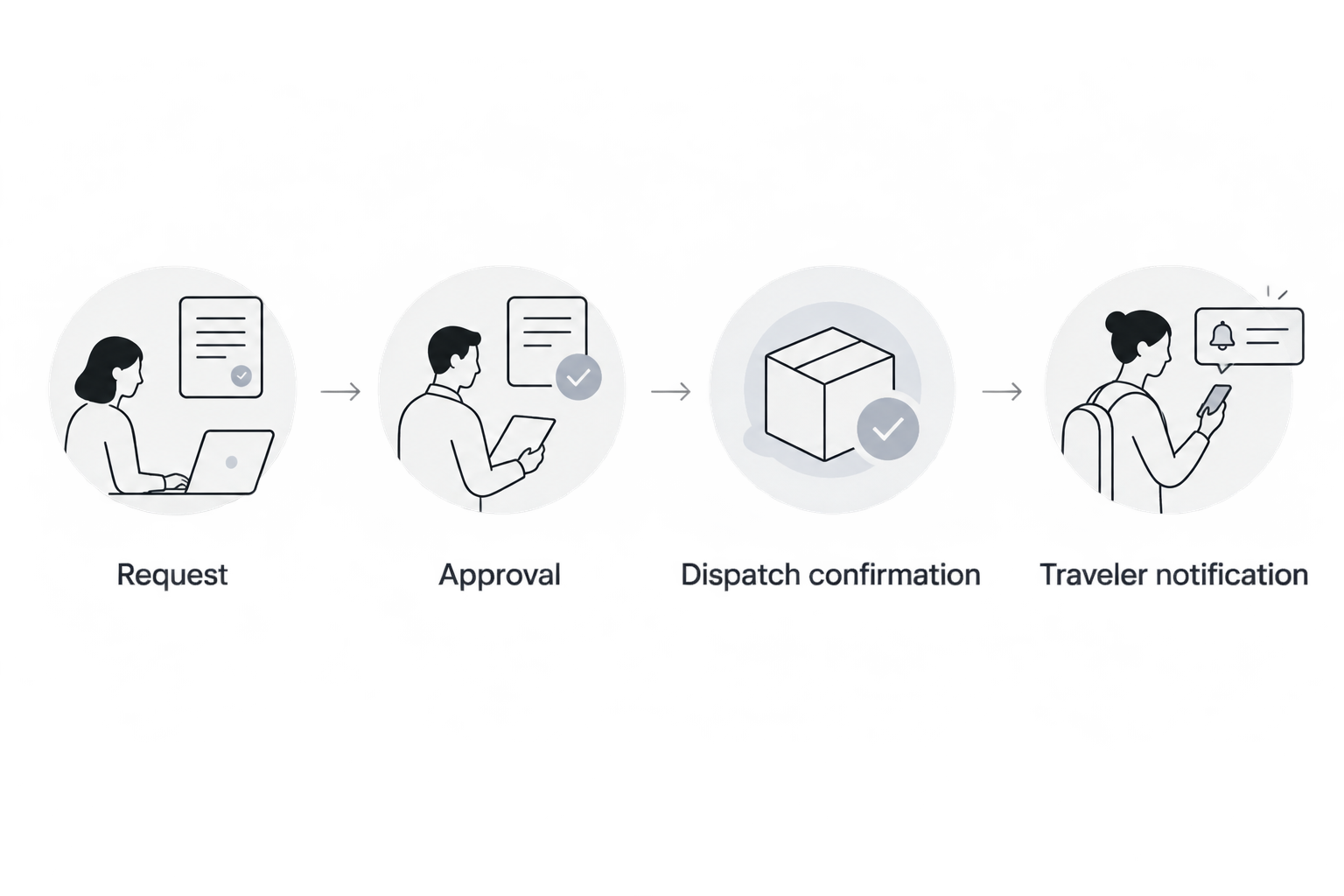
Use a simple change sequence: request, approval, dispatch confirmation and traveler notification. A calendar edit alone is not confirmation that a chauffeur has received new instructions. Ask for an explicit acknowledgment of the revised pickup time or destination.
Keep the latest approved transport itinerary in a single shared location. Archive superseded versions so an older attachment does not become the working plan.
- Name the primary approver and backup.
- Record the revised time, destination and passenger count.
- Check the effect on the next commitment.
- Obtain dispatch acknowledgment.
- Send the traveler the approved update.
The booking owner connects the traveler, local host and dispatch contact. Keep that responsibility visible even when several people can request changes.
Limit information shared with transport contacts
Give transport contacts the information required to identify the passenger, reach the pickup point and complete the journey. Avoid placing clinical details, patient identifiers, deal descriptions or unpublished business plans into booking notes.
A discreet chauffeur arrangement is not a substitute for your company’s information-security controls. Use company-approved communication channels and ask the provider how passenger information reaches local affiliates. Confirm any confidentiality requirements through your procurement or legal process.
Do not treat a vehicle as a private meeting room by default. The executive should apply the same judgment to a sensitive call as in any other shared space.
- Use neutral meeting labels in transport notes.
- Share access instructions without attaching full agendas.
- Keep passenger lists limited to operational recipients.
- Confirm the approved channel for sensitive coordination.
- Separate confidentiality requirements from personal preferences.
Prepare a workable disruption plan
Write the fallback before departure. Cover a delayed inbound flight, an extended meeting, an unreachable passenger and a destination change. Assign each scenario to someone who can make a decision rather than simply receive an alert.
For connected journeys, check the effect on the whole itinerary. Moving an airport pickup does not automatically move a facility appointment or preserve an onward departure. The booking owner must confirm the business schedule separately from the transport schedule.
A 2026 contingency plan should identify the decision point, responsible contact and next action. Avoid promises about replacement vehicles or response times unless the provider has expressly confirmed them.
- Name the contact for flight-related changes.
- Set the escalation path for failed contact.
- Identify which meeting can move or be shortened.
- Confirm the process for requesting replacement transport.
- Record who approves changes affecting onward travel.
Reconcile the booking with finance requirements
Ask finance what the completed journey record must contain before travel begins. A clear booking reference is easier to maintain from the start than to reconstruct after several airport and meeting transfers.
For your 2026 expense process, distinguish the passenger, person requesting transport and internal approver. They are not necessarily the same person. If a trip involves guests or healthcare professionals, have the appropriate internal team determine the required classification and documentation.
Transport coordination does not determine compliance treatment. Keep that decision with your company’s finance, legal or compliance team.
- Add the cost center or project reference.
- Identify the entity responsible for the booking.
- Record approved itinerary changes.
- Request the journey documentation finance needs.
- Match completed movements against the approved itinerary.
Compare transport options for a pharma itinerary
Choose by the work the journey must support. A defined airport transfer and an open-ended meeting day solve different problems; neither format is automatically the right answer for every executive movement.
| Option | Best for | Practical advantage | Key limitation |
|---|---|---|---|
| Prearranged airport transfer | A defined arrival or departure | Establishes a pickup plan before travel | Does not replace a separate plan for later meetings |
| Point-to-point chauffeur booking | A fixed journey between known locations | Gives each leg a clear scope | Changed stops or timing need confirmation |
| Hourly or as-directed charter | A meeting sequence with uncertain finishes | Keeps transport organized around a working itinerary | Operating scope and extensions need agreement |
| Separately coordinated local bookings | A travel team managing each city directly | Allows individual arrangements for each location | Leaves the team responsible for cross-city handoffs |
| One coordinating chauffeur partner | An itinerary spanning airports or cities | Provides a central coordination contact | Local access and operating details still require confirmation |
Start with the simplest format that covers the itinerary. Do not request an open-ended charter merely because the traveler is senior, and do not divide a changing meeting day into fixed transfers without considering who will manage the changes.
Common mistakes pharma travel coordinators make
Sending the complete meeting pack to dispatch
A full agenda can contain information unrelated to transportation. Send a transport-only brief with locations, timing, contacts and access instructions. Keep scientific, commercial and personal details in your approved internal systems.
Treating the facility address as the pickup instruction
A campus address does not identify the correct gate or visitor reception. Ask the host to confirm the entrance and explain where the executive should meet the chauffeur after the visit. Include a contact who can resolve access confusion.
Allowing parallel itinerary changes
An executive, assistant and local host can each hold a different version of the day. Require the booking owner to approve and circulate the operational version. Confirm dispatch receipt before treating the change as settled.
Confusing executive transport with specialist handling
A passenger booking does not establish arrangements for biological samples, temperature-sensitive materials or regulated goods. Keep those requirements separate and obtain the relevant specialist approvals. Do not add them casually to luggage instructions.
Assuming discretion means protective security
Vetted chauffeurs and professional presentation do not establish an executive-protection service. If the trip requires protective measures, involve your security team and confirm the scope with the relevant provider. Keep transport duties and security responsibilities explicit.
Where Chauffyr fits the plan
Chauffyr is best for pharma travel teams seeking US-based coordination through one 24/7 desk. Its services include airport transfers, hourly charters, point-to-point travel and coordinated corporate transport, with worldwide service delivered through vetted chauffeurs and affiliates.
Chauffyr’s stated coverage includes 120+ airports across 50+ countries. That breadth supports a central coordination approach, but it does not establish the details of a particular airport pickup, vehicle request or facility visit. Confirm those details for each itinerary.
For a 2026 travel program, compare the Chauffyr service options against your operational brief. Flight tracking, fixed, upfront pricing and no surge address defined coordination and budget-control needs; corporate accounts offer consolidated billing. None of those features replaces your own access, confidentiality or compliance instructions.
The limitation is specific: the supplied service description does not establish pharma-specific handling, protective security or specialist compliance services. Request confirmation of any requirement beyond executive passenger transport before approving the booking.
Arrange executive ground travel
Share the itinerary, passenger requirements and coordination contacts for a booking-specific quote.
FAQ
What is the best chauffeur service format for pharma executives?
The best format follows the itinerary: an airport transfer for a defined arrival, point-to-point travel for a fixed journey, or an hourly charter for a changing meeting sequence. Confirm the scope and change process before booking.
Should I book hourly transport for a pharma site visit?
Book hourly transport when the executive needs a vehicle across several stops or an uncertain meeting finish. A single visit with a settled return time can instead suit separately confirmed transfers.
Can an executive assistant manage the chauffeur booking?
Yes, an executive assistant can serve as the booking owner and change approver. Give dispatch the assistant’s contact details and identify a backup for periods when the assistant cannot respond.
Does flight tracking confirm when the executive is ready for pickup?
No, flight tracking follows the flight rather than the passenger’s progress through the airport. Confirm how the traveler contacts the chauffeur after arrival formalities and luggage collection.
What confidential information should I include in chauffeur instructions?
Include only information needed to identify the passenger and complete the journey. Keep patient identifiers, scientific material and confidential meeting content out of transport notes.
Can a chauffeur booking include laboratory samples?
Do not assume an executive passenger booking includes laboratory sample transport. Arrange any specialist handling separately through your company’s approved process.
Does Chauffyr coordinate international executive travel?
Chauffyr provides US-based coordination for worldwide executive transport through vetted chauffeurs and affiliates. Its stated coverage includes 120+ airports across 50+ countries; confirm the requirements of each itinerary before booking.
One last thing
Confirm the return pickup before the executive enters the building. An arrival plan can be complete while the departure remains unresolved. Record the exit, passenger contact method and person authorized to change the next movement; that is a useful final check for every 2026 site visit.


