
Best default for an arriving executive: an airport transfer. Best for a changing schedule: an hourly charter. Best for one direct journey: point-to-point service. For same day black car booking in 2026, choose the service format first, then require written confirmation of the pickup plan before treating the journey as arranged.
- For same day black car booking, choose airport transfers for arrivals and hourly charters for changing executive schedules.
- A submitted request is not a confirmed chauffeur assignment; obtain the pickup details in writing.
- Chauffyr suits executive assistants seeking airport transfers, hourly charters, and coordinated travel through one desk.
- Confirm the meeting point, luggage requirements, change terms, and escalation contact before releasing the traveler.
Why this matters
A late meeting, changed flight, or added stop creates two separate tasks: finding transport and confirming that the transport fits the itinerary. A fast acknowledgment solves neither task on its own.
Compare chauffeur service formats against the journey you actually need. A direct transfer and an as-directed charter require different instructions, even when both start at the same hotel.
For a 2026 executive travel plan, rank the booking by operational fit rather than the speed of the first reply. The decision rests on a confirmed pickup, suitable vehicle requirements, a clear meeting point, and someone authorized to handle changes.
What makes the best same-day black car booking
Use these criteria before choosing a service format or accepting a proposal:
- Confirmed acceptance: Get an explicit acceptance of the trip, not just an acknowledgment that the request arrived.
- Arrival coordination: For airport travel, specify the flight, arrival airport, terminal if known, and requested meeting arrangement.
- Itinerary control: Match the booking to a direct journey, changing stops, or coordinated movements across cities.
- Vehicle suitability: State passenger count, luggage, and access requirements. Do not select on vehicle appearance alone.
- Change handling: Identify who approves additional stops, revised pickup instructions, and other itinerary changes.
- Commercial clarity: Obtain the written quote, inclusions, waiting terms, cancellation terms, and billing instructions before acceptance.
The strongest booking is the one with an executable pickup plan, not the shortest request form. Use the ranking below to choose that plan.
Same-day black car options at a glance
This is a ranking by trip fit, not a claim that one format has more chauffeurs ready than another. A service description is not confirmation for your particular journey.
| Rank and format | Best for | Standout feature | Key limitation |
|---|---|---|---|
| 1. Airport transfer | An executive arriving by air | Connects the pickup instructions to the flight itinerary | Does not by itself reserve transport for subsequent meetings |
| 2. Hourly charter | Meetings with changing departure times | Organizes travel around an agreed period and itinerary | Requires clear duration, stop, and extension instructions |
| 3. Point-to-point service | One defined journey | Keeps the assignment focused on an origin and destination | Additional stops or a return trip need separate agreement |
| 4. Coordinated multi-city transport | Delegations and linked executive movements | Brings separate journey details into one coordinated plan | Each movement still needs its own confirmation |
1. Airport transfer: best for an arriving executive
An airport transfer is the first choice when the immediate problem is getting an arriving traveler to a hotel, office, or meeting. Build the request around the flight and the destination, then settle the pickup procedure.
Do not use the scheduled landing time as the entire handoff plan. Specify whether the traveler should follow meeting instructions inside the terminal or proceed to an agreed pickup location, and obtain confirmation of that arrangement.
Airport transfer pros:
- Keeps the request focused on a defined arrival and destination.
- Gives the coordinator a flight reference to include in updates.
- Makes the meeting procedure an explicit part of the assignment.
Airport transfer cons:
- A confirmed arrival transfer does not establish an onward charter.
- Terminal instructions and waiting terms still require agreement.
Best for: An executive assistant arranging transport from an airport to a known destination.
Before accepting, check that flight tracking is part of the arrangement and ask how a changed arrival affects pickup instructions. Distinguish the flight's arrival from the moment the traveler is ready to meet the chauffeur. For an international arrival, leave immigration and baggage processing out of any promised meeting time unless the traveler has supplied a workable instruction.
Verdict: Buy this format for a defined airport arrival after the pickup procedure is confirmed.
2. Hourly charter: best for a changing meeting schedule
An hourly or as-directed charter fits a day in which the traveler needs transport between appointments and the sequence can change. The booking should define the agreed service period, planned stops, and who can redirect the chauffeur.
For a 2026 meeting itinerary, separate the confirmed appointments from the tentative ones. Give the coordinator both, clearly labeled, so a provisional stop does not become an instruction by accident.
Hourly charter pros:
- Keeps several planned movements within one service brief.
- Gives the assistant a place to document changing stops.
- Supports an itinerary built around meetings rather than one destination.
Hourly charter cons:
- The end time and extension process need explicit agreement.
- An hourly booking does not remove routing or pickup restrictions.
Best for: Executives whose meeting locations or departure times need active coordination.
State whether the traveler expects the vehicle to remain assigned between stops. Ask where the chauffeur should wait and how the traveler will request the next departure. Do not assume a charter includes an extension beyond the agreed period or a different vehicle category when plans change.
Verdict: Buy this format for a changing schedule once the service period and change process are agreed.
3. Point-to-point service: best for one direct journey
Point-to-point service fits a defined trip from one address to another. Use it when the immediate need is clear: leave this location, at this time, with these passengers, for this destination.
Keep the brief narrow. If the traveler already expects stops, a waiting period, or a return journey, include those requirements before accepting the booking rather than adding them after pickup.
Point-to-point service pros:
- Makes the origin, destination, and requested departure easy to audit.
- Keeps traveler instructions focused on one movement.
- Separates a direct journey from a longer transport assignment.
Point-to-point service cons:
- A return journey is not established by the outbound instructions.
- A revised destination or added stop needs agreement.
Best for: A traveler moving directly between a hotel, office, residence, or meeting venue.
Verify the actual entrance at both ends. A street address alone does not tell the chauffeur which lobby, driveway, or building access point the traveler intends to use. Send those details with the initial request and identify the person who can clarify them.
Verdict: Buy this format when the journey is direct and both pickup and destination instructions are settled.
4. Coordinated multi-city transport: best for linked movements
Coordinated multi-city transport fits a delegation or executive itinerary with separate journeys that need central oversight. Its purpose is to keep the instructions, contacts, and changes organized across those movements.
Treat every leg as a separate operational assignment. An accepted journey in one city does not establish acceptance of another journey elsewhere.
Coordinated transport pros:
- Brings separate journey instructions into one itinerary.
- Identifies dependencies between flights, meetings, and pickups.
- Gives the lead coordinator a consistent place to record changes.
Coordinated transport cons:
- Each leg needs its own pickup and contact details.
- A change in one city requires checking the affected movements individually.
Best for: Delegation coordinators and assistants managing linked travel across cities.
For a same-day change, identify the affected leg first. Send the revised instruction with its city, local date, local time, and traveler name so the recipient does not have to infer which assignment has changed. Keep unchanged movements clearly marked.
Verdict: Buy this format for linked movements only after each required leg has explicit acceptance.
Turn a request into a confirmed pickup
Use this sequence for your 2026 booking checklist. Keep the booking owner responsible for the handoff until the traveler has the final instructions.
Trip brief
Send the pickup address or flight details, destination, local date and time, passenger count, luggage requirements, and booking contact. Add any access requirements and necessary privacy instructions without circulating unrelated sensitive information.
Written acceptance
Ask the provider to confirm the requested journey and service format. Distinguish an acknowledgment, a quote, and an accepted assignment; each serves a different purpose.
Pickup plan
Obtain the meeting instructions and the contact route for the traveler. Check who will communicate any chauffeur assignment details and how subsequent changes will reach both the traveler and the coordinator.
Change owner
Name the person authorized to revise the itinerary. For a delegation, separate the travel coordinator's authority from individual passengers' requests so conflicting instructions do not become competing assignments.
Final handoff
Send the traveler one concise message with the confirmed pickup instructions and escalation contact. Remove superseded instructions from the active itinerary rather than leaving the traveler to choose between versions.
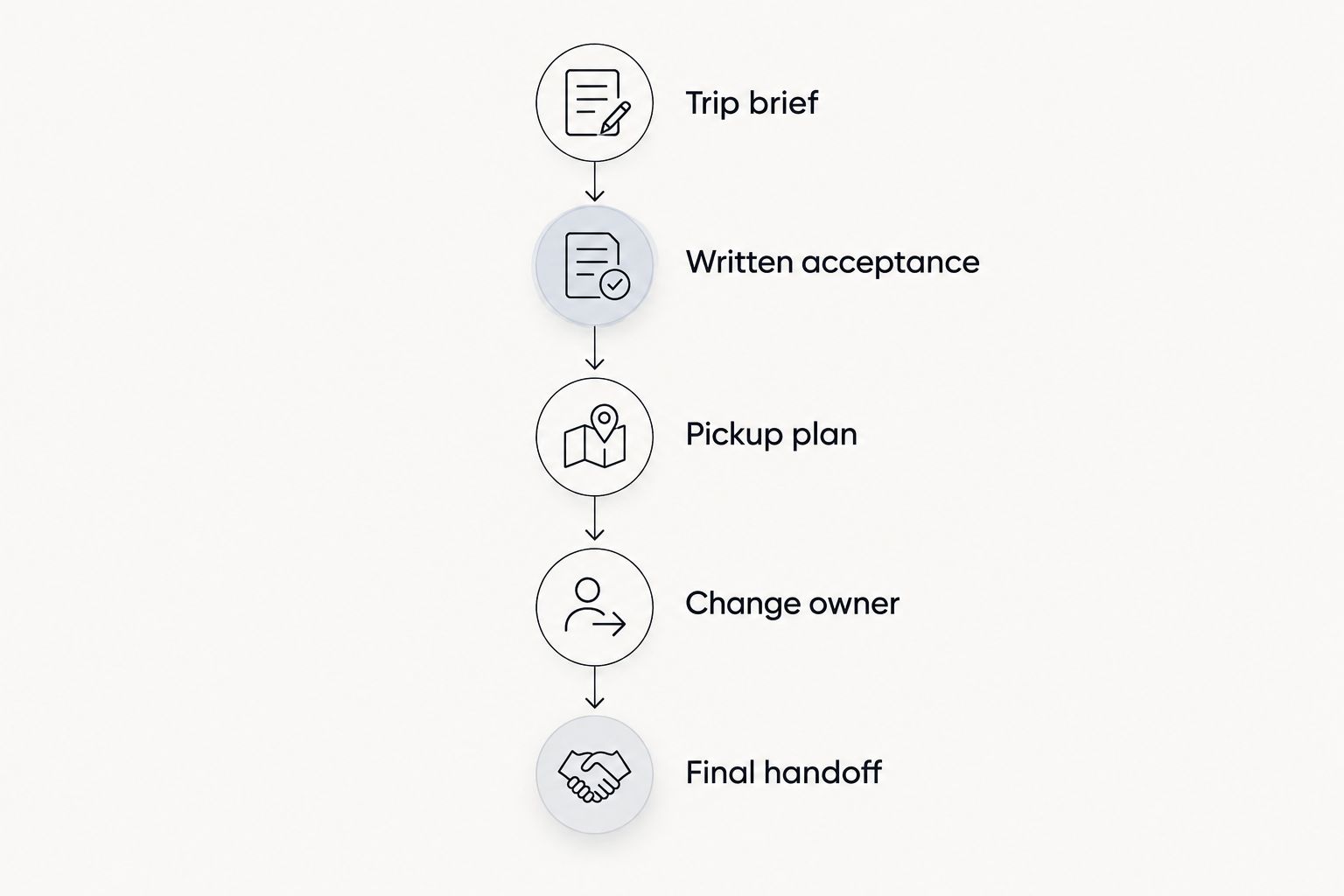
Keep the request and the acceptance together. If a flight, address, or departure time changes, send a clearly identified revision and obtain acknowledgment of the changed instruction.
Where Chauffyr fits
Chauffyr is best for executive assistants seeking coordinated black-car transfers and charters through one 24/7 desk. Its services include airport transfers, hourly charters, point-to-point journeys, and coordinated corporate or delegation transport.
Chauffyr's stated reach covers 120+ airports across 50+ countries. Coordination is US-based, with worldwide service supported by vetted chauffeurs and affiliates; that reach should not be read as ownership of vehicles in every city.
Chauffyr pros: Flight tracking, a central coordination desk operating 24 hours a day, and consolidated billing for corporate accounts address practical assistant and finance workflows.
Chauffyr constraints: A network footprint is not a confirmed local assignment. Airport coverage also does not settle your particular meeting instructions, vehicle requirements, waiting terms, or cancellation terms.
For a same-day request, contact the coordination team with the complete trip brief and ask for explicit acceptance of the journey. Keep the traveler on the existing plan until the replacement instructions are confirmed.
How this ranking works
The ranking puts a defined airport arrival first, followed by a changing meeting schedule, a direct journey, and linked multi-city movements. The criteria are arrival coordination, itinerary control, vehicle suitability, change handling, and commercial clarity.
It ranks booking formats by the problem they solve. It does not assign response-time scores or promise that a particular journey can be accepted.
Which format should you choose?
Choose an airport transfer for an arriving executive, an hourly charter for changing meetings, and point-to-point service for one direct journey. Use coordinated multi-city transport when separate movements need a common owner.
If you are undecided, describe the full itinerary before choosing. Do not force a multi-stop day into a direct-transfer brief simply because the first destination is known.
FAQ
What's the best same day black car booking option for an airport arrival?
An airport transfer is the best-fit format for a defined airport arrival and onward destination. Confirm the flight reference, meeting procedure, luggage requirements, and change contact before treating the pickup as arranged.
Does submitting a same-day booking request confirm my ride?
No. A submitted request is not the same as explicit acceptance of the journey. Obtain written acceptance and the pickup instructions before sending the traveler a final plan.
Should I choose an hourly charter or a direct transfer?
Choose an hourly charter for a changing meeting schedule and a direct transfer for one defined journey. Agree the charter period, additional stops, and extension process before accepting the arrangement.
What information should an executive assistant send first?
Send the pickup location or flight details, destination, local date and time, passenger count, luggage requirements, and booking contact. Include necessary access requirements and identify who can authorize changes.
Does flight tracking replace the airport meeting instructions?
No. Flight tracking and meeting instructions address different parts of the pickup. You still need an agreed meeting location and a contact route if the traveler cannot find the chauffeur.
Can a delegation use one confirmation for several cities?
Each city movement needs explicit acceptance and its own operational details. A central itinerary helps coordinate the legs, but it does not replace confirmation of each assignment.
Is Chauffyr's coordination desk open around the clock?
Yes. Chauffyr provides one 24/7 desk for its executive chauffeur services. Desk access is distinct from acceptance of a particular trip, which still requires confirmation.
One last thing
Add a local date and time zone to every revised pickup instruction. For your 2026 travel template, place those fields beside the pickup address—not in a note at the bottom—so the traveler, assistant, and coordinator see the same instruction.


