
Yes—a chauffeur service can handle same-day executive bookings when it confirms a suitable vehicle, chauffeur and pickup plan for the requested itinerary. Treat the trip as unconfirmed until those details are accepted; a submitted request or an open dispatch desk does not establish that the journey can be covered.
- Same day chauffeur booking for executives requires confirmed transport, not just an acknowledged request.
- Send the pickup deadline, itinerary, passenger count, luggage requirements and coordinator contact together.
- Choose an airport transfer, point-to-point trip or hourly charter to match the actual itinerary.
- Chauffyr is best suited to executive coordinators seeking airport transfers and multi-city ground travel through one desk.
Can a chauffeur service handle same-day bookings for executives?
Yes, provided the operator accepts the specific journey and confirms the arrangements. Same-day booking describes the timing of the request, not a separate service standard or a guarantee that every route can be covered.
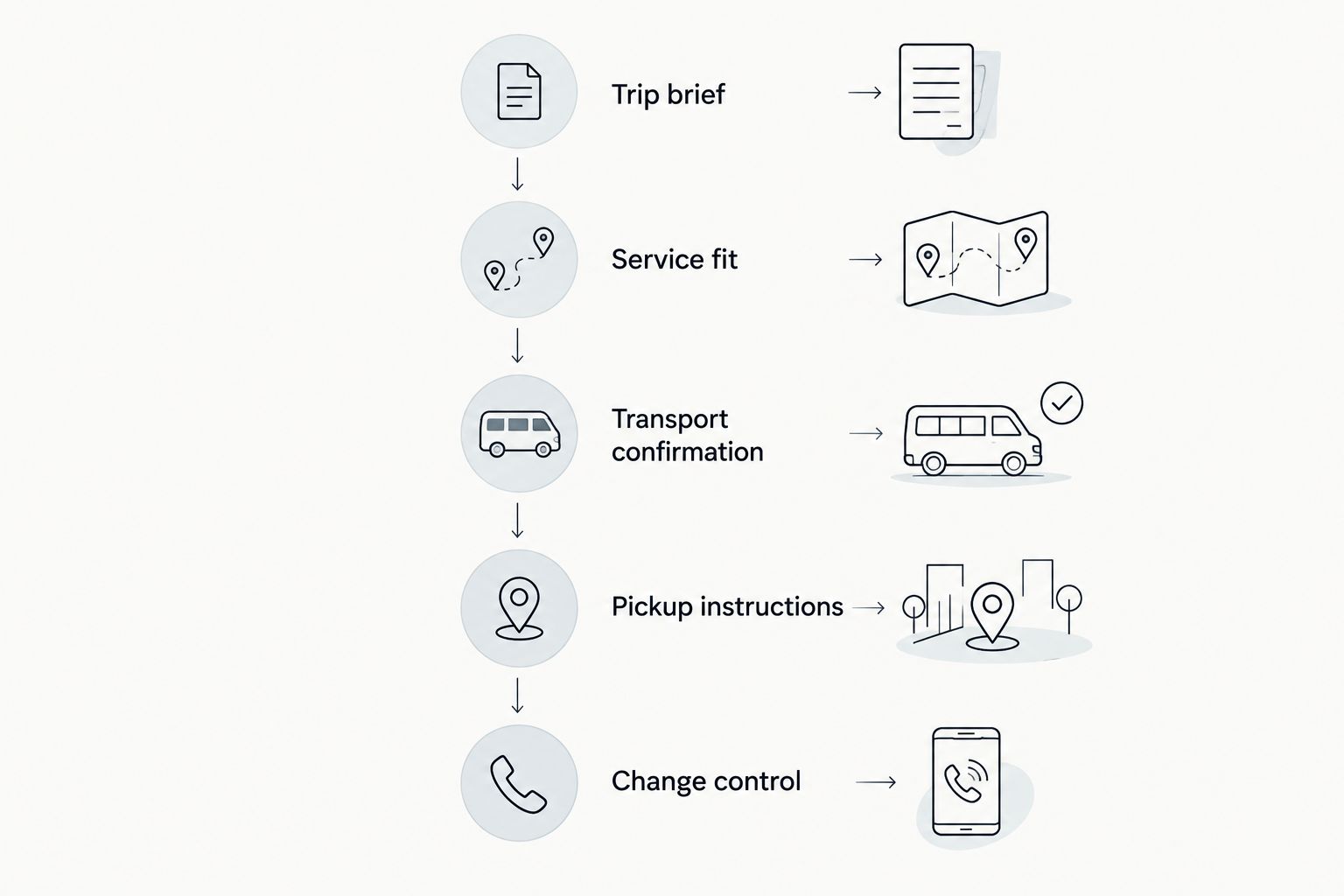
For a 2026 executive itinerary, use this confirmation sequence rather than treating a booking form submission as the final step:
- Trip brief. Send the pickup location, destination, required arrival time, passenger count and luggage details together. Include every known stop.
- Service fit. Identify whether the trip is an airport transfer, a defined point-to-point journey or an hourly assignment with changing stops.
- Transport confirmation. Obtain acceptance of the requested itinerary and vehicle requirements. Ask when chauffeur and meeting instructions will be supplied.
- Pickup instructions. Confirm where the traveler should go, whom the traveler should contact and how the coordinator will receive updates.
- Change control. Name the person authorized to amend the itinerary. Establish the contact route for a delayed flight, moved meeting or changed destination.
These steps separate a promising response from an actionable travel plan. A coordinator needs to know what has been accepted, what remains unresolved and who owns the next action.
Why this matters for an executive itinerary
A same-day request often combines transport planning with a decision deadline. Your task is to turn an incomplete itinerary into instructions the traveler and chauffeur can both follow, without passing uncertainty to the executive.
For 2026 travel, keep a reusable booking brief rather than rebuilding each request from scattered messages. Chauffyr serves executive assistants, embassies, finance teams and law firms; those coordinators need a clear distinction between a requested journey and an accepted assignment.
Do not send the executive a final pickup message while the transport arrangement remains unresolved. Send an internal status update instead, identifying the outstanding confirmation and the person responsible for obtaining it.
Airport transfers: best for a flight-linked journey
An airport transfer fits a defined arrival or departure movement. Its advantage is a clear flight-related purpose; its limitation is that an onward meeting schedule requires separate agreement rather than an assumption that the chauffeur remains assigned.
For an arrival, provide the flight number, arrival airport and onward destination. Ask for flight tracking, then confirm how the pickup will work after landing. A flight's arrival time does not tell the traveler where to meet the chauffeur.
For a departure, start with the required airport arrival time and work backward with the provider. Do not impose a generic driving estimate on a route that has not been assessed.
Confirm these operational details:
- The flight and travel date being monitored.
- The meeting location and method of contact.
- The procedure if the traveler cannot locate the chauffeur.
- Whether an additional stop forms part of the accepted itinerary.
Choose an airport transfer when the journey has a defined airport endpoint. If the traveler needs the vehicle through subsequent appointments, discuss an hourly assignment instead.
Point-to-point travel: best for a fixed destination
Point-to-point travel fits a clear pickup and drop-off, such as an office-to-meeting journey. Its strength is a defined scope; its limitation is that it does not establish an ongoing vehicle assignment after arrival.
Give the provider the actual entrance or pickup instructions, not only a building name. Include the destination contact when that person is authorized to help with access or arrival coordination.
A return journey needs its own confirmation. Do not assume that accepting the outbound trip also reserves transport after an uncertain meeting finish.
Choose point-to-point travel when the endpoint is known and the traveler does not need continuing transport. Confirm any intermediate stop before presenting it to the executive as part of the plan.
Hourly charters: best for an itinerary that changes
An hourly charter fits an assignment with several stops or an uncertain departure from a meeting. It establishes a service format for continuing travel, but it does not remove the need to agree the operating scope.
Provide the known stops, expected sequence and intended end point. Explain which parts remain undecided. Ask how the provider handles itinerary changes, extensions and chauffeur instructions before relying on that flexibility.
The trade-off is a more detailed brief. A coordinator must define what the assignment covers rather than treating an hourly booking as permission for unrestricted changes.
Choose an hourly charter when continuing access to transport is part of the requirement. Confirm the assignment boundaries and amendment procedure in writing.
Which service format fits the same-day request?
Select the service format before requesting confirmation. A precise request gives the provider a defined assignment to accept, clarify or decline.
| Service format | Best for | Main advantage | Limitation to resolve |
|---|---|---|---|
| Airport transfer | A flight-linked arrival or departure | Keeps the brief focused on the airport movement | Meeting instructions and onward stops need confirmation |
| Point-to-point travel | A fixed pickup and destination | Establishes a clear journey scope | A return or continuing assignment is not implied |
| Hourly charter | Several stops or an uncertain meeting finish | Provides a format for continuing travel | Boundaries and changes still require agreement |
None of these formats proves that a specific vehicle can be assigned today. Service fit and trip acceptance are separate decisions. Resolve both before issuing final travel instructions.
Why same-day booking arrangements vary
The relevant question is not simply whether a provider takes same-day requests. Ask whether the provider can accept this itinerary, with these requirements, at the required time.
- Pickup timing. State the required pickup and destination arrival times. Identify which deadline is fixed and which remains negotiable.
- Route scope. List the origin, destination and intermediate stops. Distinguish a local movement from a multi-city coordination request.
- Vehicle requirements. Provide passenger and luggage details, plus any specific requirement. Let the provider confirm the appropriate vehicle rather than assuming a category will fit.
- Flight changes. Supply the flight reference and ask how a schedule change affects the pickup plan. Request updated instructions when the arrangement changes.
- Coordination requirements. Identify the traveler contact, booking coordinator, billing contact and person authorized to approve amendments. State privacy and protocol requirements explicitly.
These factors belong in the initial request, not in separate messages after acceptance. For a 2026 booking template, make each one a required field or a deliberate confirmation that it does not apply.
What should you send in the first message?
Send a complete trip brief in a format the coordinator can read without opening several attachments. Keep operational instructions separate from background information about the traveler.
Use the following checklist:
- Traveler: name, passenger count and authorized contact number.
- Timing: travel date, pickup time and required destination arrival time.
- Locations: exact pickup and destination addresses, with entrance instructions where relevant.
- Flight: flight number and airport for an airport movement.
- Transport: luggage details, requested service format and any specific vehicle requirement.
- Coordination: booking owner, amendment authority and billing instructions.
- Special instructions: privacy requirements, protocol considerations and known itinerary uncertainty.
Write out the travel date and local time zone for a multi-city request. Avoid relying on the word today when the traveler, assistant and coordinating desk are not working in the same location.
Do not describe preferences as requirements unless they are essential. Separate the non-negotiable arrival deadline from a preferred vehicle so the provider can respond to the actual decision.
How do you know the booking is confirmed?
A confirmed booking should identify the accepted journey, its scope and the instructions needed to proceed. An automated acknowledgement establishes receipt of a request; it does not by itself resolve transport assignment.
Check the itinerary against your original brief. Look for the correct date, local pickup time, locations, service format and passenger requirements. Ask when the chauffeur contact and meeting details will be communicated if they are not included.
Then send the traveler a short operational message. Include the pickup time, meeting point, relevant contact and any action the traveler must take. Keep billing discussion and unresolved internal questions out of that message.
Confirmation is a usable plan, not merely a reference number. If the traveler cannot tell where to go or whom to contact, obtain the missing instructions before treating the handoff as complete.
What happens if the executive's schedule changes?
Report the revised requirement through the agreed coordination channel and request acceptance of the change. A message sent is not the same as an amendment accepted.
State what changed: pickup time, destination, stop sequence, passenger count or assignment duration. Ask whether the existing arrangement still covers the revised itinerary and request an updated confirmation where necessary.
Keep the previous instruction clearly superseded. For 2026 travel records, maintain a single current itinerary rather than asking the executive to reconcile several contradictory messages.
When does Chauffyr fit the request?
Chauffyr is best suited to executive coordinators who need airport transfers and multi-city ground travel through one desk. Its US-based coordination supports worldwide service through vetted chauffeurs and affiliates, rather than an assumption that the company owns vehicles or employs every chauffeur in each destination.
Chauffyr's stated coverage includes 120+ airports across 50+ countries. One 24/7 desk and flight tracking are relevant to time-sensitive coordination, but that coverage does not establish acceptance of a particular same-day journey.
The service also states fixed, upfront pricing with no surge and consolidated billing for corporate accounts. Request the written scope for the actual itinerary; those arrangements do not replace route-specific transport confirmation.
For a same-day request, send the complete brief and ask for explicit acceptance before instructing the traveler to proceed. Worldwide coverage is a service footprint, not a same-day booking guarantee.
Arrange executive travel
Send the itinerary, pickup deadline and passenger requirements for a route-specific request.
FAQ
Can I book a chauffeur on the same day as my executive's trip?
Yes, when the provider accepts the specific itinerary and confirms suitable transport. Treat a submitted request as pending until the journey and pickup arrangements are confirmed.
Does a 24/7 desk mean a chauffeur is confirmed?
No. A 24/7 desk provides a coordination channel; it does not establish that transport has been assigned to your itinerary. Request explicit trip acceptance.
What's the best service format for several executive meetings?
An hourly charter is the best fit when continuing transport is part of the requirement. Confirm the stops, assignment boundaries and procedure for changes rather than assuming unrestricted use.
Can an airport transfer include another stop?
An additional stop needs the provider's acceptance as part of the itinerary. Include it in the initial request and check that it appears in the confirmed scope.
What should I send for a last-minute airport pickup?
Send the flight number, airport, travel date, onward destination, passenger count, luggage details and authorized contact. Request flight tracking and explicit meeting instructions.
Can Chauffyr coordinate international executive travel?
Chauffyr provides US-based coordination for worldwide chauffeur service through vetted chauffeurs and affiliates, with stated coverage at 120+ airports across 50+ countries. Confirm the specific route and itinerary before treating the journey as accepted.
What should I do if the pickup time changes after confirmation?
Send the revised pickup requirement through the agreed contact channel and request acceptance. Replace the traveler's previous instructions only after the revised arrangement is confirmed.
One last thing
Put the destination arrival deadline near the top of the request, not only the preferred pickup time. The provider needs to understand the outcome you are arranging, especially when a meeting or departure cannot move.
Before releasing a 2026 itinerary, read the traveler message without the booking email beside it. If it does not explain when to be ready, where to meet and whom to contact, the handoff is not finished.


