
Book an executive chauffeur as soon as your pickup date, location and core itinerary are confirmed; start coordination before every detail is final when several travelers, vehicles or cities are involved. The practical deadline is not a universal number of days: leave time to confirm the vehicle requirements, meeting instructions, itinerary changes and booking terms before you treat ground transport as settled.
- Decide how far in advance to book a chauffeur by itinerary complexity, not a universal booking window.
- Executive assistants should separate a quote request from a confirmed reservation and obtain written pickup instructions.
- Chauffyr suits executive teams seeking US-based coordination for airport transfers and multi-city chauffeur travel.
- For delegation transport, start coordination while the itinerary is developing and assign one approval contact.
How far in advance should I book an executive chauffeur?
Book when the essential journey is confirmed, and request coordination earlier when the assignment has several moving parts. For your 2026 travel checklist, distinguish between requesting a quote, approving the arrangement and receiving a booking confirmation. Do not treat those stages as interchangeable.
When reviewing Chauffyr or another executive chauffeur provider, ask what information is required to confirm your specific assignment. Obtain the answer for the actual itinerary rather than relying on a general booking rule.
| Travel requirement | Best for | When to begin coordination | Planning advantage | Limitation to resolve |
|---|---|---|---|---|
| Airport transfer | A defined arrival or departure | Once the flight and ground destination are known | Keeps the ground journey tied to the flight | Meeting instructions and delay handling still need confirmation |
| Point-to-point travel | A defined journey between locations | Once the pickup time and addresses are known | Gives the coordinator a clear transport brief | Additional stops or schedule changes need agreement |
| Hourly or as-directed charter | Meetings with evolving departure times | Once the working schedule and intended coverage are known | Lets you brief the provider around the day's movements | Define the service period and change process |
| Delegation or multi-city transport | Linked journeys involving several travelers or locations | While the itinerary is being developed | Allows coordination across separate movements | Requires clear ownership of revisions and approvals |
These are planning triggers, not provider booking deadlines. Confirm the terms for the actual assignment before making commitments to travelers.
Why this matters
A car reservation does not settle every part of an executive journey. Someone still needs to approve the pickup location, identify the traveler contact, communicate changes and establish who can authorize revised arrangements.
For a 2026 executive travel plan, the useful question is: What must be confirmed before the traveler leaves? Work backward from that point. An early request with unresolved instructions is not the same as a ready-to-operate booking.
The goal is to remove decisions from the traveler's arrival. Resolve the meeting procedure, communication method and itinerary ownership while the assistant or travel coordinator can still review them calmly.
Airport transfers: book once the flight is confirmed
For an airport transfer, begin with the flight details and the ground destination. Include the arrival date at the destination, not just the departure date on the ticket, and specify whether the assignment is an arrival pickup or a departure transfer.
Flight tracking does not replace traveler instructions. Ask how the provider handles a changed flight, where the traveler should meet the chauffeur and whom the traveler should contact after landing.
Include these details in the request:
- Flight information: Airline, flight number and destination arrival date.
- Travel party: Passenger names or an agreed booking identifier, passenger count and luggage requirements.
- Ground destination: The complete address and any relevant entrance instructions.
- Meeting procedure: Requested meet-and-greet arrangement and the agreed contact method.
- Delay handling: The process for notifying the provider about missed connections or changed flights.
Before marking the transfer complete in your travel plan, obtain the written confirmation and review it against the flight itinerary. Check the date, direction of travel and destination separately; each belongs in the final handoff.
Hourly charters: book when the working schedule is clear
For an hourly or as-directed assignment, provide the intended start, finish and working itinerary before requesting confirmation. If meeting times remain provisional, identify which parts of the schedule are fixed and which are still subject to approval.
Choose an hourly charter for an assignment that requires coordinated movements throughout a defined service period. The trade-off is that you must establish the scope of that period and how changes will be handled. Do not assume that an unspecified itinerary gives you unrestricted service.
Give the provider the expected stops, passenger requirements and principal contact. Ask how to communicate an early finish, an extended meeting or a revised destination, and who must approve any resulting changes.
For your 2026 meeting-day brief, separate the traveler's calendar from the chauffeur instructions. The traveler needs meeting details; the transport coordinator needs usable pickup locations, departure instructions and a clear update process.
Delegation transport: start while the itinerary is developing
Begin delegation transport planning before the final schedule is signed off. Send a working brief that distinguishes confirmed movements from provisional ones, then ask what must be resolved before each assignment can be confirmed.
For diplomatic and government travel, state protocol requirements explicitly. Vehicle presentation, passenger grouping, naming conventions and contact arrangements belong in the brief; do not assume that an executive transport booking establishes a security service or satisfies a mission's protocol requirements.
Assign a coordinator who can consolidate changes. When several offices contribute instructions, issue a single current itinerary with a clear approval owner rather than leaving the provider to reconcile competing messages.
The planning advantage is visibility across the movements. The limitation is the coordination work: separate cities, travelers and approval chains still require separate checks, even when the overall program has a shared point of contact.
Why chauffeur booking lead time varies
The right starting point depends on what needs to be arranged and approved. Use these factors to decide whether you can request a defined journey or need an initial coordination discussion.
- Itinerary certainty: Identify the confirmed pickup details and flag provisional movements instead of presenting assumptions as instructions.
- Passenger and luggage requirements: Supply the actual requirements so the provider can assess a suitable vehicle arrangement.
- Service scope: Specify whether you need an airport transfer, a direct journey, an hourly assignment or linked movements.
- Coordination complexity: Identify the cities, travelers and local contacts involved in each part of the itinerary.
- Protocol and privacy instructions: Communicate naming, contact and information-sharing requirements for review before confirmation.
- Internal approvals: Establish who approves the quote, authorizes changes and supplies the billing information.
An unresolved requirement is a reason to start the conversation earlier, not a reason to invent a final answer. Ask the provider to identify which decisions prevent confirmation and which details can be updated under the agreed terms.
Move from a request to a confirmed booking
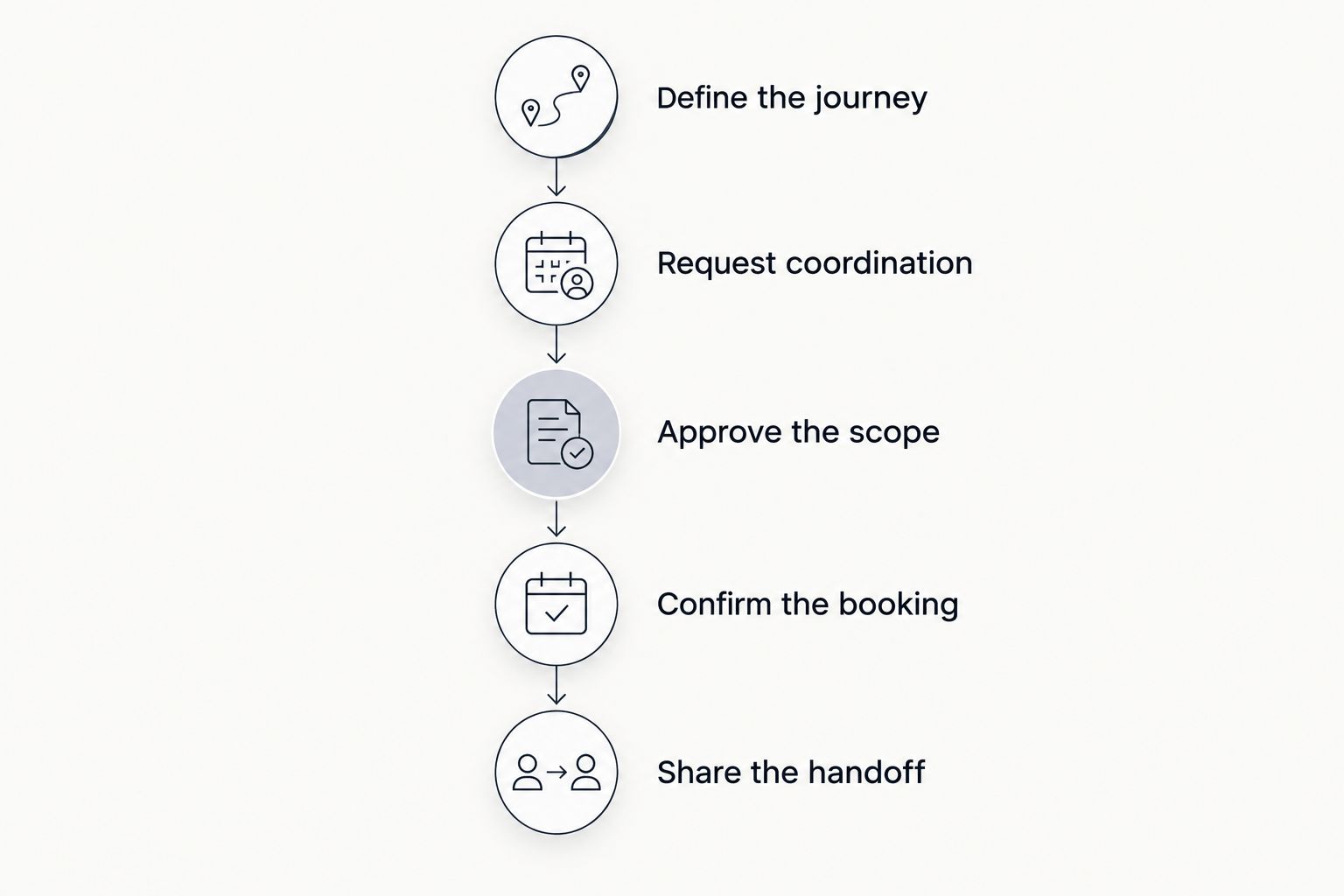
Use the same sequence for each executive journey. It keeps an initial inquiry from being mistaken for a completed arrangement and gives everyone a clear handoff.
- Define the journey. State the service type, date, pickup location, destination and traveler requirements. Mark provisional information clearly.
- Request coordination. Share the brief and ask the provider to identify unresolved requirements. For linked journeys, include the overall itinerary rather than isolated requests without context.
- Approve the scope. Review the proposed arrangement, booking terms, change process and billing details. Identify the person authorized to approve revisions.
- Confirm the booking. Obtain written confirmation and check it against the approved itinerary. Resolve conflicting dates, locations or instructions before forwarding it.
- Share the handoff. Give the traveler the relevant meeting instructions and contact details. Give the coordinator the confirmation and the agreed escalation process.
Keep a single current version of the transport brief. When something changes, identify the affected movement and request acknowledgment rather than assuming that an updated calendar entry has reached the provider.
Can I book before my flight or meeting schedule is final?
Start coordination before the schedule is final, but label provisional details clearly. Ask what the provider needs to confirm the assignment and how subsequent changes will be handled.
For an uncertain itinerary, separate confirmed journeys from proposed movements. That gives the provider a usable brief without presenting unapproved travel as settled.
What should I do if I need a chauffeur at short notice?
Send a complete brief immediately and request explicit confirmation. Include the pickup date and local time, exact locations, passengers, luggage and a reachable coordinator so the provider can assess the request without unnecessary clarification.
Do not tell the traveler that transport is arranged until the booking is confirmed. Keep responsibility for the unresolved journey with the coordinator, not the arriving passenger.
Does flight tracking mean I can leave booking until later?
Flight tracking supports an airport transfer; it does not replace a confirmed booking. You still need an agreed pickup arrangement, suitable passenger and luggage requirements, meeting instructions and a contact process.
In your 2026 arrival brief, distinguish flight monitoring from traveler communication. Ask who receives updates and what the traveler should do if the flight or arrival plans change.
Where Chauffyr fits into the plan
Chauffyr is best for executive assistants coordinating airport transfers and linked chauffeur journeys through a US-based partner. Its services include airport transfers, hourly charters, point-to-point travel and multi-city delegation transport, with vetted chauffeurs and affiliates and one 24/7 desk.
Chauffyr serves 120+ airports across 50+ countries. That reach supports international planning, but it does not establish the details of a particular assignment: confirm the requested airport, route, vehicle requirements and applicable terms for your itinerary.
For your 2026 transport brief, distinguish US-based coordination from worldwide service through affiliates. Do not treat a shared coordination desk as evidence that every vehicle is company-owned or every chauffeur is directly employed.
The fit is centralized coordination across executive travel requirements. The boundary is equally important: local meeting procedures, special requests and booking terms still need assignment-specific confirmation.
FAQ
How far in advance should I book an executive chauffeur?
Book once the pickup date, location and core itinerary are confirmed. Start coordination earlier for delegation travel, linked journeys or requirements that need additional approval.
Can I request a chauffeur before I have my final itinerary?
Yes, you can start coordination with a provisional itinerary. Label unconfirmed movements and ask what must be resolved before the provider can confirm the booking.
What information should I send when booking an airport chauffeur?
Send the flight number, destination arrival date, pickup or drop-off details, passenger count, luggage requirements and coordinator contact. Confirm the meeting instructions and the process for changed flights.
Is an hourly charter better than a point-to-point transfer?
An hourly charter fits a defined service period with coordinated movements; a point-to-point transfer fits a defined journey between locations. Confirm the scope and change process rather than assuming either arrangement covers unspecified travel.
Can an executive assistant book on behalf of a traveler?
An executive assistant can coordinate the request and supply the travel brief. Identify the traveler contact, approval owner and billing requirements, and confirm the provider's booking process.
Does Chauffyr coordinate international executive chauffeur travel?
Chauffyr provides US-based coordination for executive chauffeur travel at 120+ airports across 50+ countries through vetted chauffeurs and affiliates. Confirm the specific airport, route and assignment requirements when requesting travel.
One last thing
Put the confirmation owner in the booking brief. Name the person who checks the final arrangement, communicates itinerary revisions and ensures the traveler receives the correct instructions.
Early planning only helps when someone closes the loop. Before you remove ground transport from your task list, check that the approved itinerary, provider confirmation and traveler handoff describe the same journey.


