
Best overall: a coordinated chauffeur program. Best for changing schedules: an hourly charter. Best for fixed journeys: point-to-point travel. The right executive car service for board meetings in 2026 matches vehicle assignments, arrival times and dispatch responsibility to the board’s itinerary—not just its destination.
- Choose an executive car service for board meetings around itinerary control, airport transfers and clear dispatch responsibility.
- Hourly charters suit changing departure times; point-to-point service suits confirmed journeys.
- Chauffyr suits board coordinators who need executive ground travel managed through one 24/7 desk.
- Confirm waiting, changes, passenger contacts and billing arrangements before approving the booking.
Why this matters
A board meeting creates several transport decisions: who arrives together, who needs a separate vehicle, which flights connect to the meeting and who authorizes changes. Booking each journey independently leaves those decisions with the executive assistant unless another party explicitly accepts them.
Start with the movement plan, then select the chauffeur service format that fits it. A director traveling directly from a hotel needs a different arrangement from a chair moving between an airport, office, dinner and hotel.
The best booking is the one with a named owner for every movement and every change. A vehicle confirmation alone does not establish that responsibility.
What makes the best executive car service for board meetings
Use these criteria to assess a proposal before comparing vehicle descriptions:
- Itinerary ownership: Identify who reconciles flight arrivals, meeting times, passenger changes and final departure instructions.
- Arrival coordination: Request flight tracking for airport transfers and written instructions for the passenger’s meeting point.
- Schedule control: Match the booking format to the uncertainty of the meeting’s end time.
- Discreet communication: Specify approved contacts and share only the passenger information needed to complete each journey.
- Commercial clarity: Confirm the service scope, waiting terms, change procedures and billing recipient in writing.
- Contingency ownership: Establish who handles flight diversions, missed passenger contact and changes affecting subsequent journeys.
For a 2026 board-travel brief, keep these requirements separate from vehicle preferences. A preferred vehicle category does not answer who will manage a late-running committee session.
Board-meeting car services at a glance
These rankings compare booking formats, not competing operators. Choose the format first, then assess a provider against the same written brief.
| Rank and service format | Best for | Standout feature | Key limitation |
|---|---|---|---|
| 1. Coordinated chauffeur program | Directors arriving through different cities or airports | A shared movement plan and coordination contact | Requires accurate passenger information and clear approval authority |
| 2. Hourly charter | Meetings with uncertain departure times | An as-directed booking structure | Booking duration and extension terms need explicit agreement |
| 3. Airport transfer | Directors traveling between an airport and a defined destination | Flight-linked arrival coordination | Does not establish coverage for the rest of the day |
| 4. Point-to-point travel | Confirmed hotel, office and dinner journeys | A defined origin and destination | Additional stops and revised departures need separate agreement |
1. Coordinated chauffeur program: best for complex board travel
A coordinated chauffeur program brings individual transfers and charters into a shared movement plan. It is the strongest default when directors arrive separately, use different airports or continue to different destinations after the meeting.
The practical distinction is coordination responsibility. Instead of treating every reservation as an isolated journey, the coordinator keeps passenger assignments, contact instructions and itinerary revisions connected.
Coordinated chauffeur program pros
- Gives the executive assistant a central place to communicate itinerary changes.
- Keeps arrival transfers and meeting departures in the same planning document.
- Supports different service formats within the same board itinerary.
- Provides a clear structure for assigning approval and billing responsibility.
Coordinated chauffeur program cons
- Requires more preparation than booking an isolated journey.
- Depends on accurate passenger details and timely updates from the organizer.
- Needs explicit boundaries between transport coordination, venue access and security responsibilities.
Best for: Executive assistants, corporate travel managers and delegation coordinators managing several connected journeys.
Before booking, ask who maintains the current itinerary and who can authorize changes. Specify whether individual directors can revise their own bookings or whether every request must pass through the organizing office.
Verdict: Buy this format when the board itinerary needs central coordination, not merely separate vehicle reservations.
2. Hourly charter: best for changing meeting schedules
An hourly charter is an as-directed service arrangement for travel within an agreed booking period. It fits a director whose day includes a board meeting, an additional office visit and a departure time that remains unsettled.
The booking still needs boundaries. Confirm the service area, planned stops, chauffeur waiting arrangements and the process for extending the assignment.
Hourly charter pros
- Suits an itinerary with several stops and changing departure instructions.
- Reduces the need to define every movement as a separate booking.
- Gives the organizer a clear period during which to plan travel requests.
Hourly charter cons
- The agreed booking period still limits the assignment.
- Extensions and substantial route changes require confirmation.
- A long gap without travel can make a simpler transfer arrangement more appropriate.
Best for: Chairs, committee members and visiting directors with a changing sequence of meetings.
For a 2026 board day, distinguish the scheduled meeting close from the time the passenger is actually ready to leave. Use the latter when discussing departure instructions, and identify who sends the release message.
Do not assume an hourly booking means the vehicle can wait immediately outside the building. Confirm the pickup procedure with the provider and the venue.
Verdict: Buy an hourly charter when departure uncertainty is central to the itinerary; skip it for a clearly defined isolated journey.
3. Airport transfer: best for flight-linked arrivals
An airport transfer connects an arriving or departing flight with a defined destination. For board travel, its main planning value is linking the ground movement to the flight rather than treating the pickup as an unrelated appointment.
Request flight tracking and confirm how the passenger will find the chauffeur. Establish the procedure for baggage delays, terminal changes and failed phone contact before the travel day.
Airport transfer pros
- Creates a clear airport-to-destination assignment.
- Allows flight details to inform arrival coordination when tracking is included.
- Keeps airport instructions separate from the meeting’s departure arrangements.
Airport transfer cons
- Does not cover later journeys unless they are separately included.
- Requires clear waiting and passenger-contact terms.
- Flight arrival alone does not establish when the passenger reaches the pickup point.
Best for: Directors traveling directly between an airport and a hotel, office or meeting venue.
Keep flight numbers attached to the correct passenger, not simply to a group arrival entry. Directors on the same flight can have different baggage, destination or contact requirements.
For departures, supply the flight details and ask the provider to confirm the proposed collection time. Keep the board organizer informed when that collection time constrains participation in the meeting.
Verdict: Buy an airport transfer for a defined flight-linked journey; add another format for an open-ended meeting day.
4. Point-to-point travel: best for confirmed local journeys
Point-to-point travel covers a defined journey between agreed locations. It fits a director traveling from a hotel to the boardroom or from the office to a confirmed dinner venue.
Keep the booking instructions specific. Include the correct building entrance, passenger contact and departure time rather than relying on an address alone.
Point-to-point travel pros
- Defines the required movement without an open-ended itinerary.
- Works well for journeys with confirmed departure instructions.
- Makes it straightforward to allocate a journey to its passenger or billing reference.
Point-to-point travel cons
- Does not create an ongoing chauffeur assignment between journeys.
- Additional stops need explicit agreement.
- A revised meeting finish can require a change to the original booking.
Best for: Directors with fixed hotel, office and dinner movements.
Book the return journey deliberately. An outbound confirmation does not establish a return assignment, and a dinner reservation does not establish when the passenger will leave.
If the meeting close remains uncertain, compare an hourly arrangement against separately scheduled transfers before approving the plan. Make that choice around itinerary needs, not an assumption that either format is always better.
Verdict: Buy point-to-point travel for confirmed movements; skip it when continuous itinerary flexibility is the main requirement.
Build the movement plan before requesting vehicles
For your 2026 board itinerary, establish the passenger requirements before requesting a vehicle category. Use the following sequence to turn a collection of travel requests into instructions a coordinator can act on.
Passenger brief
Record each traveler’s name, approved contact, luggage requirements and any stated accessibility needs. Ask how the traveler wants to receive pickup instructions rather than assuming every director uses the same communication channel.
Journey map
List each origin, destination, flight reference and required arrival time. Mark departures that remain unsettled so they are not mistaken for confirmed instructions.
Dispatch owner
Name the organizing contact and the person responsible for communicating transport changes. State whether the traveler can amend the itinerary directly.
Change approval
Set the approval route for additional stops, revised departures and replacement passenger details. Keep meeting content out of transport messages unless it is necessary to execute the journey.
Billing record
Attach the correct entity, reference and invoice recipient. Confirm whether the account arrangement supports consolidated billing before relying on it for the board visit.
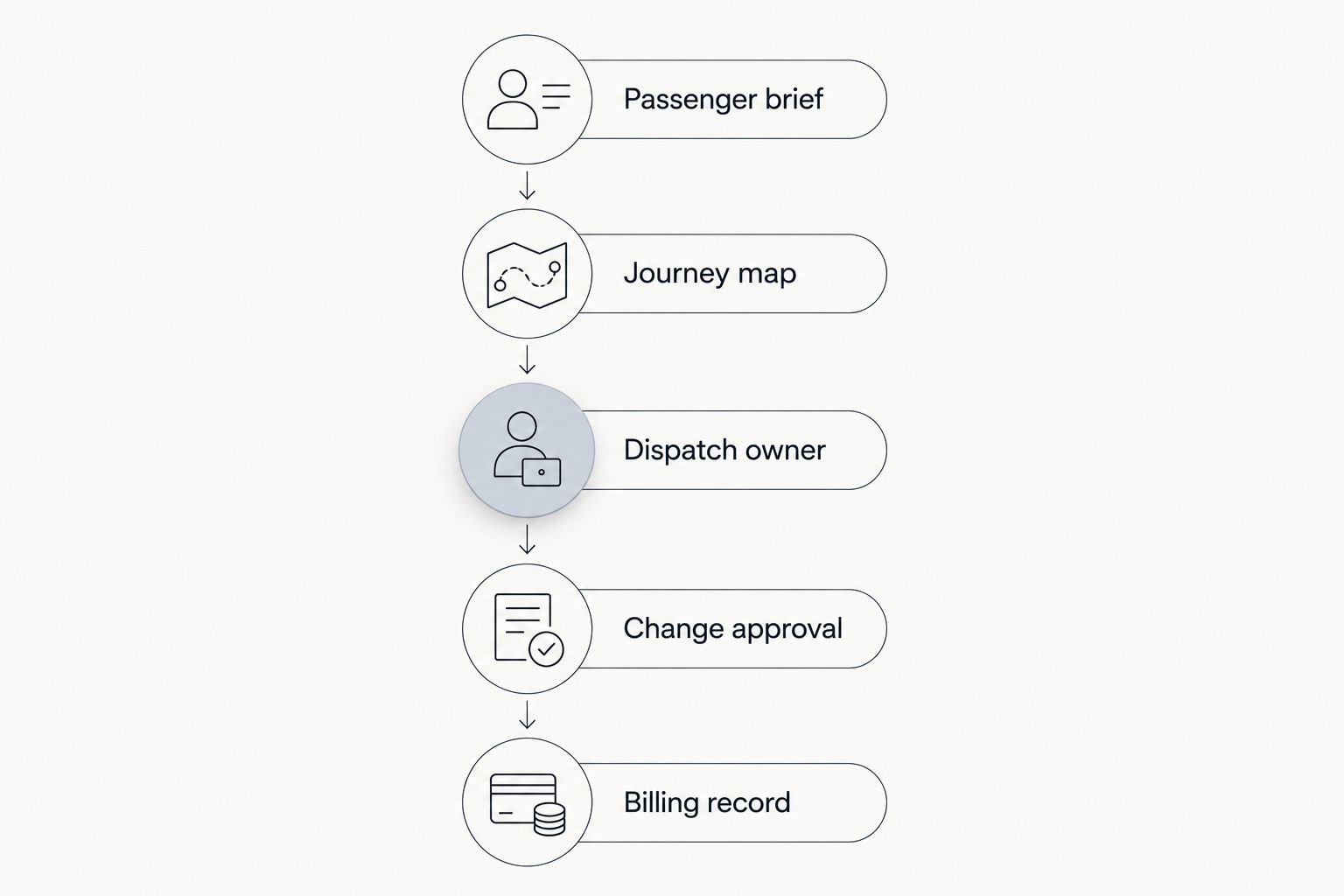
Keep the latest approved movement plan in a single controlled version. When an instruction changes, identify the affected journey and confirm that the coordinator has received it; forwarding a revised meeting agenda is not a substitute for a transport instruction.
How the service formats were ranked
The ranking prioritizes itinerary ownership, arrival coordination, schedule control, discreet communication, commercial clarity and contingency responsibility. It assesses operational fit rather than vehicle prestige.
A coordinated program ranks first because it addresses connected journeys. Hourly charters, airport transfers and point-to-point bookings each rank highest for a narrower requirement; none replaces a written movement plan.
Which service should you choose?
Choose a coordinated program for the board visit, then assign hourly charters or individual transfers to each traveler’s actual itinerary. Do not force every director into the same format.
Chauffyr is best for board coordinators who need executive car service across airports and cities through one 24/7 desk. Chauffyr provides airport transfers, hourly charters and point-to-point travel, with US-based coordination and worldwide service through vetted chauffeurs and affiliates.
Chauffyr’s stated coverage includes 120+ airports across 50+ countries. Flight tracking, fixed, upfront pricing, no surge and corporate accounts with consolidated billing address core coordination requirements; confirm the scope and terms for the specific itinerary.
For a 2026 board visit, send Chauffyr the movement plan and request a quote. Include unsettled departure times and approval contacts, not just destinations.
FAQ
What is the best executive car service for board meetings?
A coordinated chauffeur program is the best fit when a board visit includes connected journeys, separate arrivals or several destinations. Use hourly charters for changing schedules and individual transfers for confirmed movements.
Should I book an hourly charter for a board meeting?
Book an hourly charter when the director’s departure time or sequence of stops remains unsettled. Confirm the booking period, waiting arrangements and extension process before approval.
Is an airport transfer enough for a director’s entire visit?
An airport transfer covers the agreed airport journey, not the entire visit. Arrange meeting departures, dinners and return airport travel explicitly rather than assuming they are included.
What information should an executive assistant provide?
Provide passenger contacts, flight details, pickup and destination instructions, luggage requirements and required arrival times. Identify the person authorized to approve changes and the correct billing recipient.
Does a chauffeur booking include security services?
Do not treat a chauffeur booking as a security-services agreement. Confirm transport responsibilities separately from protective security, venue access and diplomatic protocol requirements.
Can Chauffyr coordinate international board travel?
Chauffyr provides US-based coordination for executive travel at 120+ airports across 50+ countries through vetted chauffeurs and affiliates. Confirm the specific route, service requirements and booking terms for each journey.
What should a board transport brief include in 2026?
A 2026 board transport brief should include the movement plan, passenger contacts, approval authority, pickup instructions and billing references. Mark uncertain departures clearly and establish who communicates the final release instruction.
One last thing
Separate the meeting’s scheduled finish from the passenger’s departure instruction. Write down who tells the chauffeur the director is ready, where the passenger should wait and who receives the message if that plan changes.
That small distinction turns an ambiguous calendar entry into an actionable pickup instruction.


