
A chauffeur service is worth it for a single-day business trip when several appointments, a fixed return flight or changing plans make ground transport a coordination problem rather than a simple ride. For a straightforward airport-to-office journey, a prearranged transfer can be enough; before reserving an hourly charter, confirm how waiting, itinerary changes and the final airport journey are handled.
- Is a chauffeur worth it for a single day business trip? Yes, when your schedule needs coordinated transport.
- Airport transfers suit a defined arrival or departure; hourly charters suit journeys with changing stops.
- Confirm waiting terms, luggage handling and the return-airport plan before choosing a service.
- Chauffyr serves executive travel coordinators who need airport transfers, hourly charters and one 24/7 desk.
Is a chauffeur service worth it for single-day business trips?
A chauffeur is worth considering when you need control between appointments, not just transport to them. Start with the itinerary. A day with a clear destination and a predictable finish calls for a different booking from a day of meetings that can move or overrun.
For your 2026 travel planning, distinguish the service types before comparing proposals. The booking label alone does not establish whether a chauffeur stays available between journeys.
| Service option | Best for | Main advantage | Main limitation |
|---|---|---|---|
| Airport transfer | A defined airport arrival or departure | Keeps the airport journey separate from the rest of the day | Do not assume it includes later appointments or waiting |
| Point-to-point travel | Known journeys between specific addresses | Gives each journey a clear origin and destination | Changes between booked journeys require coordination |
| Hourly/as-directed charter | Several stops or a changing meeting schedule | Lets you request a service organized around the itinerary | Confirm the reserved period, permitted changes and waiting terms |
These options can also be combined. An airport transfer followed by separately arranged journeys can suit a predictable day, while an hourly charter deserves consideration when the schedule remains fluid. Reserve the service that matches the uncertainty in your day, not the most elaborate option.
Why this matters
A single-day business trip ties arrival, meetings and departure together. A change to the first appointment can alter the next pickup and the return-airport plan, even when the flight itself stays on schedule.
The coordinator needs a transport plan that explains who receives changes and who confirms them. Without that distinction, sending an updated calendar invitation can be mistaken for updating the chauffeur booking.
Treat ground travel as part of the working itinerary. Record meeting locations, pickup instructions and the final departure requirement together, then decide which parts need an available vehicle and which need only a booked journey.
When an hourly charter earns its place
Best for: a multi-stop day with uncertain meeting finishes. An hourly/as-directed charter is the option to assess when you need transport organized around changing instructions rather than a fixed list of separate journeys.
Its value depends on the booking terms. Ask whether the arrangement covers the full intended itinerary, how instructions reach the chauffeur and what happens if the last meeting extends beyond the reserved period.
Do not assume an hourly booking means the vehicle waits immediately outside every entrance. Confirm the pickup process at each location, especially where building access or stopping restrictions affect the handoff.
The drawback is commitment. If the traveler spends most of the day in a single building, retaining a vehicle throughout that period needs a clear operational reason. Compare that arrangement with a confirmed return pickup rather than treating hourly service as the default executive choice.
When separate transfers are enough
Best for: a stable itinerary with clearly defined journeys. Separate transfers suit a traveler who knows the destination, expects to remain there and can specify the onward pickup.
Keep each journey explicit. An arrival booking does not, by itself, establish a return reservation, an intermediate stop or permission to change the destination. Request those elements in the itinerary rather than leaving them to an informal conversation on arrival.
The limitation is the handoff between journeys. If the meeting finishes early or late, someone must update the next pickup and receive confirmation. Assign that task before travel begins.
For a simple day, this can be an appropriate arrangement. You do not need continuous vehicle availability merely because the passenger is an executive; you need it when the itinerary requires it.
Why the value of a chauffeur varies
The same service can be useful on one trip and unnecessary on another. Review these factors when approving a 2026 itinerary:
- Arrival timing: Decide how the ground plan will respond to an earlier or later flight arrival. Ask for flight tracking where relevant, and separately confirm the passenger meeting instructions.
- Itinerary control: List the stops that are confirmed and identify those still subject to change. Ask how destination changes are accepted and acknowledged.
- Waiting requirements: Distinguish a booked pickup from a request for continued availability. Put meeting overruns and extended stops into the discussion before booking.
- Privacy requirements: Give the coordinator only the passenger and itinerary information needed to arrange travel. Specify communication preferences without assuming that a premium vehicle establishes a security standard.
- Contingencies: Identify the person authorized to change the booking and the contact responsible for handling disruption. Make the return-airport journey part of that plan.
- Billing: Decide whether the booking belongs to an individual traveler or a corporate account. Confirm how the itinerary and subsequent changes will appear in the billing record.
These are decision factors, not a scoring system. A single immovable commitment can justify closer coordination, while several flexible stops do not automatically require an all-day charter.
How do you plan the day before requesting a quote?
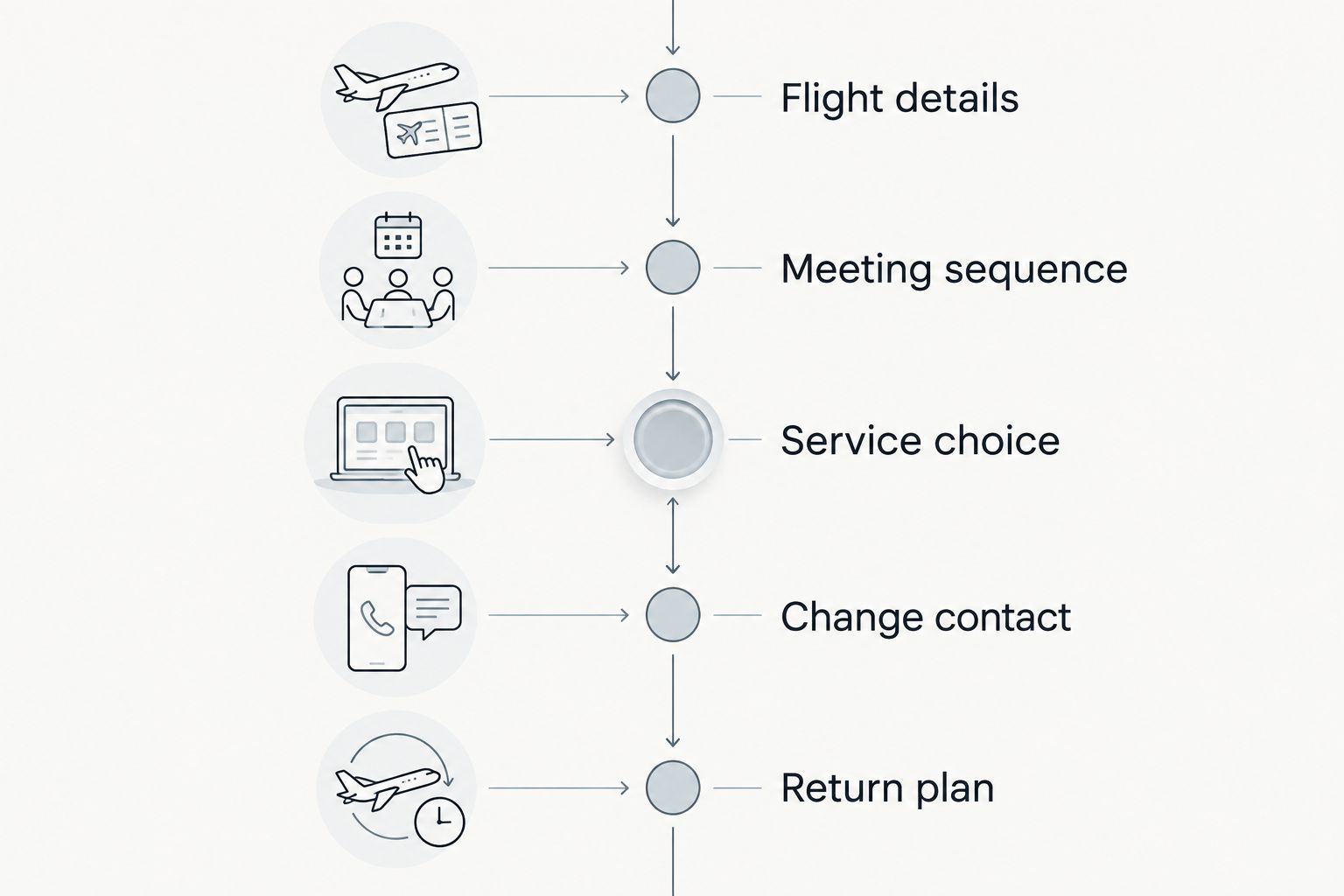
Build a short operational brief before comparing services. Use this sequence for your 2026 booking request so each proposal addresses the same travel requirement.
- Flight details. Supply the arrival and departure information, the travel date and a reachable traveler contact. Ask how flight tracking connects to pickup coordination; do not treat the scheduled landing time as the passenger's meeting time.
- Meeting sequence. List complete destination addresses in travel order. Separate fixed appointments from tentative stops, and identify the latest point at which the traveler must leave the final meeting.
- Service choice. Request an airport transfer, point-to-point travel or an hourly/as-directed charter based on that sequence. If you are comparing arrangements, ask each provider to address the same stops and assumptions.
- Change contact. Name the person authorized to revise the itinerary. Specify whether updates should go through the assistant, travel manager or traveler, and request confirmation of accepted changes.
- Return plan. Confirm the final pickup location and the departure-airport journey. Include a clear instruction for escalating a meeting overrun rather than leaving the traveler to resolve it at the end of the day.
The brief should be usable without access to the traveler's full calendar. Keep essential transport instructions together and exclude unrelated meeting material.
What should the written booking confirm?
A useful confirmation describes the service, not just the vehicle. Read it against the actual day: arrival, each requested journey, any waiting arrangement and the final airport pickup.
For a 2026 single-day trip, check these points before sharing the plan with the traveler:
- Passenger name and the appropriate day-of-travel contact.
- Correct airports, destination addresses and travel date.
- Requested vehicle arrangement and passenger and luggage requirements.
- Airport meeting instructions and the process for locating the chauffeur.
- Whether the booking covers separate journeys or an hourly/as-directed period.
- How waiting, additional stops and itinerary changes are handled.
- The contact route for disruption and the person authorized to approve changes.
- Billing instructions and the record needed by the company or travel team.
Ask for clarification when wording is ambiguous. A phrase such as executive transport does not answer whether the chauffeur remains available between meetings. Neither does a vehicle description establish what happens when the itinerary changes.
Keep the confirmed version accessible to the traveler and the coordinating team. When the plan changes, identify the revised instruction explicitly rather than forwarding a long message thread without context.
Does flight tracking cover the whole arrival?
Flight tracking supports arrival coordination, but it does not replace passenger meeting instructions. The traveler still needs to know where to go, whom to contact and how to report a delay after landing.
Separate flight changes from passenger changes. A flight arriving late is different from a traveler remaining inside the terminal longer than expected; ask how each situation is communicated and handled under the booking.
For your 2026 arrival brief, request the meeting procedure rather than assuming a particular airport pickup format. Do not promise a terminal location, meet-and-greet arrangement or waiting allowance unless it has been confirmed for that service.
Can you work privately during the journey?
Treat the vehicle as transport, not as a guaranteed confidential workspace. A chauffeur booking alone does not establish sound isolation, connectivity or permission to discuss sensitive material.
If the traveler needs to work, distinguish practical preferences from security requirements. Ask about the relevant vehicle arrangement, limit unnecessary itinerary sharing and follow the organization's rules for calls and documents.
For government, diplomatic and legal travel, specify the approved communication process. Do not replace a formal security or protocol requirement with an assumption about the service category.
When Chauffyr fits the itinerary
Chauffyr is best for executive travel coordinators who need chauffeur services across airport transfers, hourly charters and point-to-point journeys. Its US-based coordination serves worldwide travel through vetted chauffeurs and affiliates; that does not mean it owns a fleet or employs every chauffeur in every destination.
Chauffyr's stated coverage includes 120+ airports across 50+ countries, supported by one 24/7 desk and flight tracking. Corporate accounts offer consolidated billing. Those features are relevant when an assistant or travel manager needs a central coordination contact, but destination-specific arrangements still need confirmation.
The limitation is fit: a straightforward airport-to-office trip does not automatically call for an hourly charter. Review the Chauffyr service options and request an arrangement based on the actual itinerary, including waiting requirements and the return journey.
Arrange your business-day travel
Share your flights, meeting sequence and return-airport requirements.
FAQ
Is a chauffeur worth it for a single day business trip?
A chauffeur is worth it when several stops, changing appointments or a fixed return flight require coordinated ground travel. A straightforward airport-to-office itinerary can be served by a prearranged transfer instead of an hourly charter.
Should I book an hourly chauffeur or separate airport transfers?
Choose an hourly/as-directed charter for an itinerary that needs continued availability, and separate transfers for clearly defined journeys. Confirm waiting terms and change procedures before deciding.
Do I need to keep the chauffeur for the whole day?
You do not need an all-day booking simply because the trip is for business. Assess whether the traveler needs transport between meetings or only a confirmed arrival and return journey.
Does flight tracking mean the chauffeur knows when I am ready?
Flight tracking does not replace communication about when you are ready to meet the chauffeur. Confirm the airport meeting instructions and the contact process for delays after landing.
What should an executive assistant send before booking?
An executive assistant should send flight details, destination addresses, the meeting sequence, passenger and luggage requirements, and the return-airport plan. Identify the person authorized to approve itinerary changes.
Can I treat a chauffeur vehicle as a confidential workspace?
A chauffeur booking does not establish a guaranteed confidential workspace. Follow your organization's rules for sensitive calls and documents, and confirm any specific requirements separately.
Does Chauffyr coordinate travel outside the United States?
Chauffyr provides US-based coordination for worldwide chauffeur travel through vetted chauffeurs and affiliates. Its stated coverage includes 120+ airports across 50+ countries; confirm the requested destination and itinerary before booking.
One last thing
Plan the return journey before approving the arrival booking. The outbound pickup is easy to describe because the flight anchors it; the return depends on how the working day actually unfolds.
Write down who can end the final meeting, who can change the pickup and who receives confirmation. That small piece of operational clarity is more useful than reserving a more elaborate vehicle arrangement without a clear departure plan.


