
A chauffeur is worth it for finance executives when airport arrivals, tightly sequenced meetings, or changing itineraries require more coordination than the traveler should manage personally. The value is itinerary control and a clear operational contact—not a guaranteed productivity gain or a substitute for information-security precautions.
- Is a chauffeur worth it for finance executives? Yes, when arrival coordination and itinerary control justify arranged ground transport.
- Choose an airport transfer for a defined arrival; consider hourly service when meetings require ongoing vehicle coordination.
- Chauffyr serves finance teams needing executive chauffeur travel with US-based coordination and worldwide service through vetted chauffeurs and affiliates.
- Compare the confirmed service scope, cancellation terms, waiting arrangements, and billing requirements before approving travel.
Why this matters
For a finance executive, the ground journey connects commitments: an airport arrival, an investor meeting, a client visit, or a departure. Your booking should explain who manages that connection when the flight or meeting schedule changes.
For your 2026 travel policy, start with the journey rather than the vehicle. Review the available chauffeur services against the actual itinerary, then decide whether you need an airport transfer, point-to-point travel, or an hourly charter.
Approve the coordination you need, not an undefined promise of luxury. A named operating contact and a documented pickup plan are more useful approval criteria than vehicle presentation alone.
Is a chauffeur service worth it for finance executives?
Yes, when the service removes a defined coordination task from the executive or travel arranger. It is less compelling when the journey is straightforward, the timing is flexible, and the traveler does not need continued itinerary support.
The decision is not whether arranged transport sounds more comfortable. It is whether the booking addresses an operational requirement that another arrangement leaves with your team.
| Ground transport option | Best for | Practical advantage | Limitation to assess |
|---|---|---|---|
| Chauffeur airport transfer | A defined flight arrival or departure | Lets you agree on flight details, pickup instructions, and the operating contact before travel | A transfer booking does not establish ongoing transport between later meetings |
| Hourly chauffeur charter | A meeting schedule requiring continued coordination | Gives you a service format to discuss vehicle retention and itinerary changes | Included time, operating area, and change terms need confirmation |
| Point-to-point chauffeur travel | A defined journey between known addresses | Keeps the booking focused on a specific movement | Additional stops and later journeys require an agreed scope |
| On-demand ride | A simple journey without a broader coordination brief | Avoids arranging an ongoing itinerary when none is needed | Confirm whether the available booking supports your arrival and billing requirements |
| Self-driving | A traveler who wants to manage the journey directly | Leaves routing and departure decisions with the traveler | The traveler also manages driving, parking, and vehicle return where applicable |
Do not treat this as a ranking for every trip. Match the transport arrangement to the work you need someone else to own. An airport pickup and a changing investor-meeting schedule are different assignments.
Define the approval test before requesting transport
Write a short operational brief before comparing providers. State the arrival requirement, itinerary flexibility, communication route, and billing needs. This prevents an attractive vehicle description from becoming the deciding factor.
For a 2026 booking review, ask the arranger to identify the problem the service solves. If the answer is only preference, record it as preference rather than presenting it as measurable business savings.
Airport transfers: best for a defined arrival
An airport transfer fits an executive arriving for a meeting or leaving after a completed schedule. The booking should connect the flight, traveler, pickup instructions, destination, and contact responsible for changes.
Flight tracking is useful, but it does not answer every arrival question. You still need to establish how the traveler finds the chauffeur, who receives updates, and what happens if baggage collection or border processing changes the pickup timing.
What to confirm
- Flight details and the correct arrival date.
- Traveler and assistant contact details.
- The agreed meeting instructions.
- Waiting arrangements and the process for reporting delays.
- Destination details, including the correct entrance where relevant.
Choose an airport transfer when the requirement ends at the destination. If the executive needs continued transport afterward, request that separately rather than assuming the arrival booking includes it.
Hourly charters: best for a changing meeting schedule
An hourly charter is the format to discuss when an executive needs transport across a sequence of appointments. Examples include meetings at different offices or a schedule whose departure times depend on conversations finishing.
The benefit is an agreed operating arrangement for the itinerary. The limitation is that an hourly booking still needs boundaries: what period is covered, where the vehicle operates, and how extensions or additional movements are approved.
What to confirm
- The scheduled start and end of service.
- Known stops and the final destination.
- How the assistant communicates meeting changes.
- Where the chauffeur waits between movements.
- Who can authorize an extension or revised itinerary.
Choose hourly service when retaining transport is part of the plan. Do not request it solely because the day contains several meetings; first establish whether travel between those meetings is actually required.
Point-to-point travel: best for a fixed movement
Point-to-point travel fits a defined journey between known locations. It suits a booking brief that identifies the pickup, destination, traveler, and departure requirement without asking the provider to manage an open-ended schedule.
Its strength is a clear assignment. Its limitation is equally clear: an extra stop, a later return, or a changed destination should be communicated and confirmed rather than treated as automatically included.
For a finance team's 2026 travel procedure, distinguish a fixed movement from an as-directed itinerary. That distinction helps the assistant request the appropriate scope and gives the approver a clearer record of what was authorized.
Why the value of a chauffeur varies
The value changes with the coordination required, not simply the executive's job title. Use these factors to explain the decision:
- Arrival timing: A flight-linked journey needs a plan for communicating changes between the traveler, assistant, and operating contact.
- Itinerary control: A fixed destination is a different requirement from a schedule with multiple appointments and changing departures.
- Communication ownership: Define whether the executive, assistant, or travel manager handles operational messages.
- Privacy requirements: Give the provider appropriate handling instructions without assuming a private vehicle is a secure communications environment.
- Billing requirements: Establish the information finance needs to reconcile the journey and allocate the expense.
- Contingencies: Decide who receives changes and who can approve a revised transport arrangement.
These factors support an operational decision. They do not establish a financial return by themselves. Do not assign a monetary value to supposed time savings without evidence from your own travel records.
How should an assistant arrange the journey?
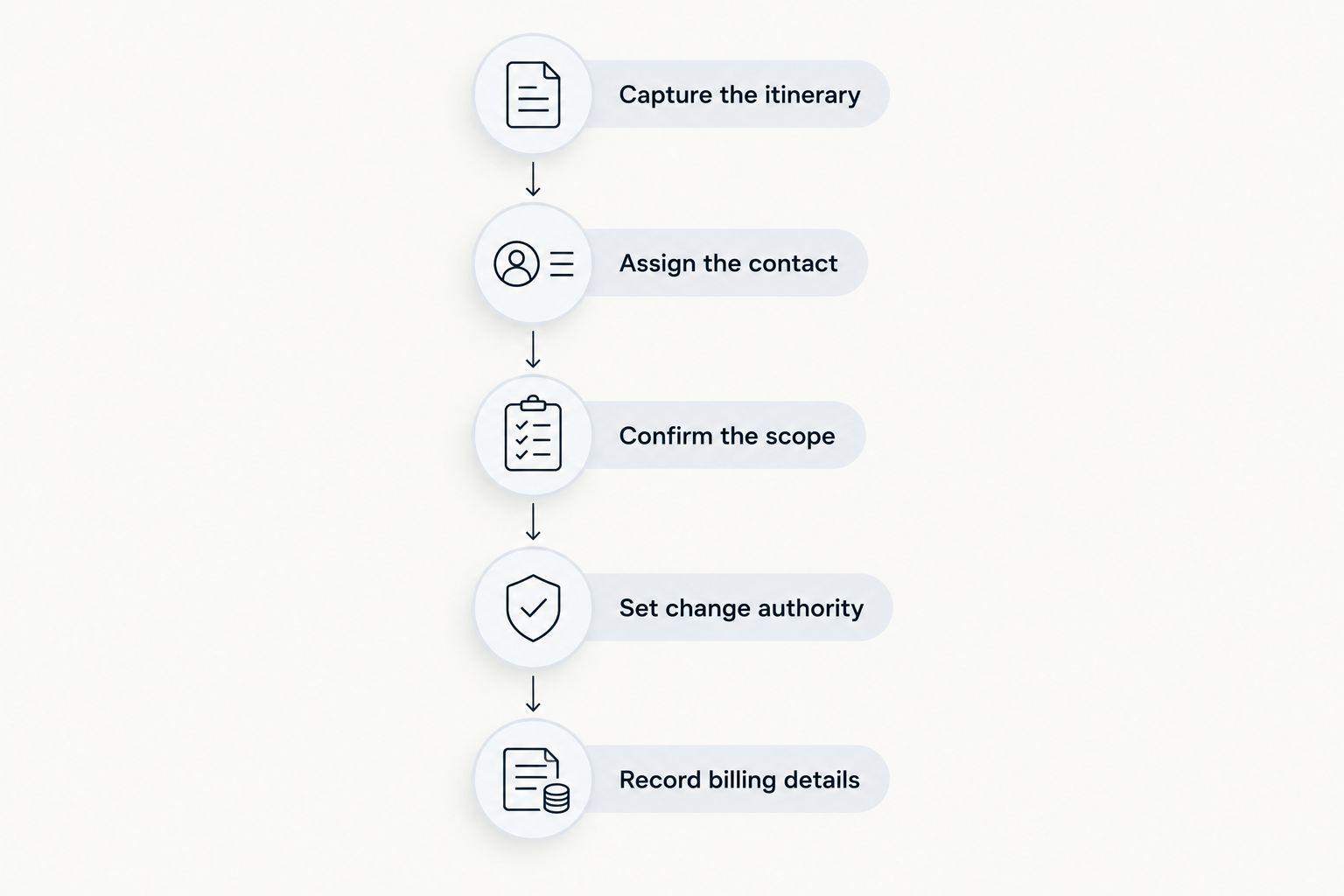
Build a booking brief that another coordinator can use without reconstructing the itinerary. Keep the operational details together, and separate necessary traveler information from sensitive meeting material.
- Capture the itinerary. Record flight details, pickup and destination addresses, meeting movements, and the required end of service. Distinguish confirmed appointments from provisional ones.
- Assign the contact. Name the person who receives chauffeur details and operational updates. Specify whether the traveler should receive routine messages directly.
- Confirm the scope. Ask for the service format, waiting arrangements, change process, and applicable booking terms in writing. Resolve unclear inclusions before approval.
- Set change authority. Identify who can approve additional movements or an extension. Give that person the current itinerary and operating contact.
- Record billing details. Supply the correct billing entity, expense reference, and any required journey information. Retain the confirmation for reconciliation.
The handoff is complete when the traveler and assistant know how the pickup works and whom to contact if it does not proceed as planned. A confirmation without clear instructions still leaves coordination work unfinished.
Does a chauffeur make confidential work safe in transit?
A chauffeur booking does not establish that a vehicle is suitable for confidential calls or sensitive document review. Treat transport arrangements and information-security requirements as separate decisions.
For finance executives, ask your firm's security or compliance team what work is permitted in transit. Do not infer confidentiality protections, recording restrictions, or secure communications from the vehicle category or the provider's presentation.
Share only the journey information needed to deliver the service. A chauffeur needs a destination and pickup instructions; detailed transaction documents or the substance of a client discussion do not belong in the transport brief.
Is hourly service better than separate transfers?
Hourly service is the better fit when your itinerary requires retained transport and coordinated departures between meetings. Separate transfers fit movements that can each be defined and confirmed independently.
The trade-off is scope. Retained service needs clear instructions for waiting and changes, while separate bookings need a reliable handoff for each journey. Choose the arrangement your assistant can specify accurately, not the one that merely sounds more flexible.
Can finance teams standardize chauffeur approvals?
Finance teams can standardize approvals by defining eligible journey requirements, booking authority, and billing documentation. Keep exceptions visible rather than asking assistants to interpret an unwritten executive preference.
A 2026 policy can distinguish flight-linked arrivals, changing meeting itineraries, and fixed point-to-point travel. Require the booking request to state which requirement applies and what coordination is included.
Review the resulting records against actual needs. Repeated changes to the same type of booking are a reason to revise the booking brief, not evidence that every executive journey needs the same service format.
Where Chauffyr fits
Chauffyr is best for finance teams that need executive chauffeur services with US-based coordination and worldwide delivery through vetted chauffeurs and affiliates. Its stated coverage spans 120+ airports across 50+ countries, with flight tracking and one 24/7 desk.
Chauffyr offers airport transfers, hourly charters, and point-to-point travel. Corporate accounts offer consolidated billing. Those capabilities address arrival coordination, itinerary management, and expense administration without requiring the executive to manage every operational message.
The service still needs a specific brief. Worldwide coverage does not establish the arrangements for an individual airport, route, vehicle, or booking; request confirmation for the actual journey. A straightforward trip without these coordination needs does not require a more involved service merely because the traveler is a finance executive.
For your 2026 itinerary, request a quote against the confirmed movements and ask for the relevant service terms. Keep the operational confirmation with the travel record.
FAQ
Is a chauffeur worth it for finance executives who travel occasionally?
A chauffeur is worth considering for occasional travel when a specific journey requires coordinated arrival handling or itinerary support. Travel frequency alone does not establish the need; assess the actual pickup, schedule, and communication requirements.
What's the best chauffeur service format for an airport arrival?
An airport transfer is the appropriate format for a defined airport pickup and destination. Confirm flight details, meeting instructions, waiting arrangements, and the operating contact before travel.
Should I book an hourly chauffeur for investor meetings?
Book hourly service when the investor-meeting itinerary requires retained transport and coordinated departures. Confirm the service period, known stops, and process for authorizing changes.
Can an executive assistant manage transport without involving the traveler?
An executive assistant can act as the operational contact when that arrangement is agreed with the provider. The traveler still needs clear pickup instructions and a way to report an immediate problem.
Can finance executives discuss confidential matters in a chauffeur vehicle?
A chauffeur vehicle is not, by itself, a verified secure communications environment. Follow your firm's rules for confidential calls and sensitive documents rather than assuming privacy protections from the booking.
Does Chauffyr support corporate travel billing?
Chauffyr corporate accounts offer consolidated billing. Confirm account arrangements and the journey information your finance team needs before booking.
What should I check before approving a chauffeur booking?
Check the itinerary, service scope, waiting arrangements, change authority, and billing requirements. Approve the service against a defined travel need rather than an assumed productivity benefit.
One last thing
Flight arrival time is not the same as traveler readiness for pickup. Your booking brief should explain how the traveler or assistant communicates readiness after arrival, not just supply the flight number.
Before approving the journey, read the confirmation as if you were the traveler. If it does not tell you where to go, whom to contact, and how a change is handled, resolve those questions before departure.


