
Group chauffeur transport for a corporate roadshow requires an itinerary-specific quote; a per-person estimate does not capture the vehicles, chauffeur time and movements you need. Build your 2026 budget around the complete operating schedule, then confirm how waiting, schedule changes, parking, tolls and other exclusions affect the total. Compare written quotes against the same itinerary—not headline rates with different assumptions.
- Group chauffeur transportation cost corporate roadshow comparisons need matching itineraries, vehicle requirements and waiting terms.
- Compare airport transfers, hourly charters and point-to-point travel against the actual meeting schedule.
- Confirm exclusions, overtime rules and cancellation terms before approving a roadshow quote.
- Chauffyr serves executive roadshows with US-based coordination, worldwide affiliates and one 24/7 desk.
Why the full itinerary matters
A roadshow is a sequence of commitments, not simply a trip between addresses. Your transport brief needs to connect airport arrivals, hotels, meeting entrances and departures while accounting for passengers who split off or finish at different times.
Budget for the operating plan, not just the passenger count. A group traveling together presents a different requirement from the same travelers attending separate meetings. Likewise, a vehicle released after a drop-off is not the same service as a vehicle held for the next departure.
Keep those distinctions visible in every quote request. Otherwise, you risk comparing a transfer-only proposal with a proposal that includes continued vehicle access and coordination.
How much does group chauffeur transport cost for a roadshow?
The total depends on the agreed itinerary, service structure and written booking terms. Request a complete quote that separates the core transport scope from charges triggered by changes or additional use.
Use this breakdown to make each proposal comparable. These are items to confirm, not assumptions that every provider bills separately.
| Quote component | What your request should specify | What to check before approval |
|---|---|---|
| Vehicle allocation | Passenger groups, luggage and simultaneous movements | Whether the proposed allocation covers every movement |
| Service time | First pickup, final release and periods of vehicle retention | When chargeable time starts and ends |
| Route | Airports, hotels, meeting addresses and city changes | Whether all requested stops appear in the quote |
| Waiting | Arrival uncertainty and gaps between meetings | Included waiting and the terms for additional waiting |
| Operating expenses | Parking, tolls and requested access arrangements | Which expenses are included or passed through |
| Changes and cancellation | Approval process for revised movements | Applicable deadlines, charges and authorization requirements |
| Billing | Paying entity, references and reporting needs | Invoice structure and supporting trip detail |
Ask for the total for the submitted itinerary alongside the assumptions that support it. A rate without its service scope is not an approved roadshow budget.
Keep the accepted itinerary attached to the quote. When a meeting moves or a passenger group changes, you can identify the affected service rather than renegotiate an undefined plan.
Airport transfers: best for defined arrival and departure movements
An airport transfer fits a movement with a known airport, destination and passenger group. Its advantage is a clearly bounded assignment. Its limitation is that the airport journey does not, by itself, define transport for the rest of the day.
For a roadshow, specify the flight, arrival date, passenger contact and destination. Ask how flight tracking affects dispatch, how the traveler finds the chauffeur and what happens if passengers take longer than expected to reach the pickup point.
Do not assume flight tracking and waiting terms mean the same thing. Tracking provides arrival information; the booking terms determine the treatment of waiting and changes.
Choose airport transfers for discrete airport movements. Request separate confirmation for meetings, hotel departures or other journeys outside that scope.
Hourly charters: best for retaining a vehicle between meetings
An hourly charter fits a schedule where you need a vehicle retained across several movements. The benefit is continuity between appointments. The trade-off is that retaining a vehicle also commits service time during gaps in the itinerary.
Write down when the vehicle must first be ready and when you expect to release it. Include the meeting sequence, expected pauses and the person authorized to extend service.
Confirm the applicable booking minimum, time-counting rules and treatment of extensions. Also ask whether a route change or a movement outside the original operating area changes the quote.
Choose an hourly charter when continued vehicle access is part of the requirement. Do not request it solely because a day contains several meetings; first establish whether you actually need the vehicle held between them.
Point-to-point travel: best for separate, scheduled journeys
Point-to-point travel fits journeys with defined pickup and destination details, without an assumed requirement to retain the vehicle afterward. It makes individual movements easy to specify. Its limitation is that each subsequent departure needs its own confirmed arrangement.
This structure deserves consideration when travelers remain at a venue and do not require a vehicle during the intervening period. It requires more care when meeting end times are unsettled or passengers expect to leave on demand.
Confirm what happens when a meeting runs late. Ask whether the next journey remains a separate assignment and how changes affect its terms.
Choose point-to-point travel when each journey can stand on its own. Do not treat separate bookings as continuous vehicle access unless the provider confirms that arrangement.
Compare the service structures
| Service structure | Best for | Main advantage | Main limitation |
|---|---|---|---|
| Airport transfer | Defined airport arrivals and departures | Clear airport-to-destination scope | Does not establish all-day transport |
| Hourly charter | Keeping a vehicle across meeting movements | Continued access within the agreed booking | Service time includes retained periods |
| Point-to-point travel | Separate journeys with defined details | Individual movements have distinct scopes | Later departures need confirmed arrangements |
A roadshow can combine these structures. Ask for each movement to be labeled so you can see where the vehicle is retained, released or assigned to a separate journey.
Why roadshow transport costs vary
The main cost drivers come from what you ask the transport provider to deliver. Make these requirements explicit before asking providers to revise their proposals.
- Concurrent movements: Travelers attending different meetings need an allocation that supports those movements at the same time.
- Vehicle requirements: Passenger count, luggage and any accessibility requirements shape the vehicle request. Confirm suitability rather than relying on a category name.
- Retained time: Holding a vehicle between appointments differs from releasing it after a journey.
- Route scope: Airport movements, additional stops and city changes alter the assignment you are asking the provider to quote.
- Schedule changes: Late finishes, revised pickups and added journeys need agreed handling and authorization terms.
- Coordination requirements: Separate passenger groups, named contacts and billing instructions need to appear in the service brief.
These factors explain why a per-person figure is a weak starting point. First define the movement plan; then use the total to allocate costs internally if your finance process requires it.
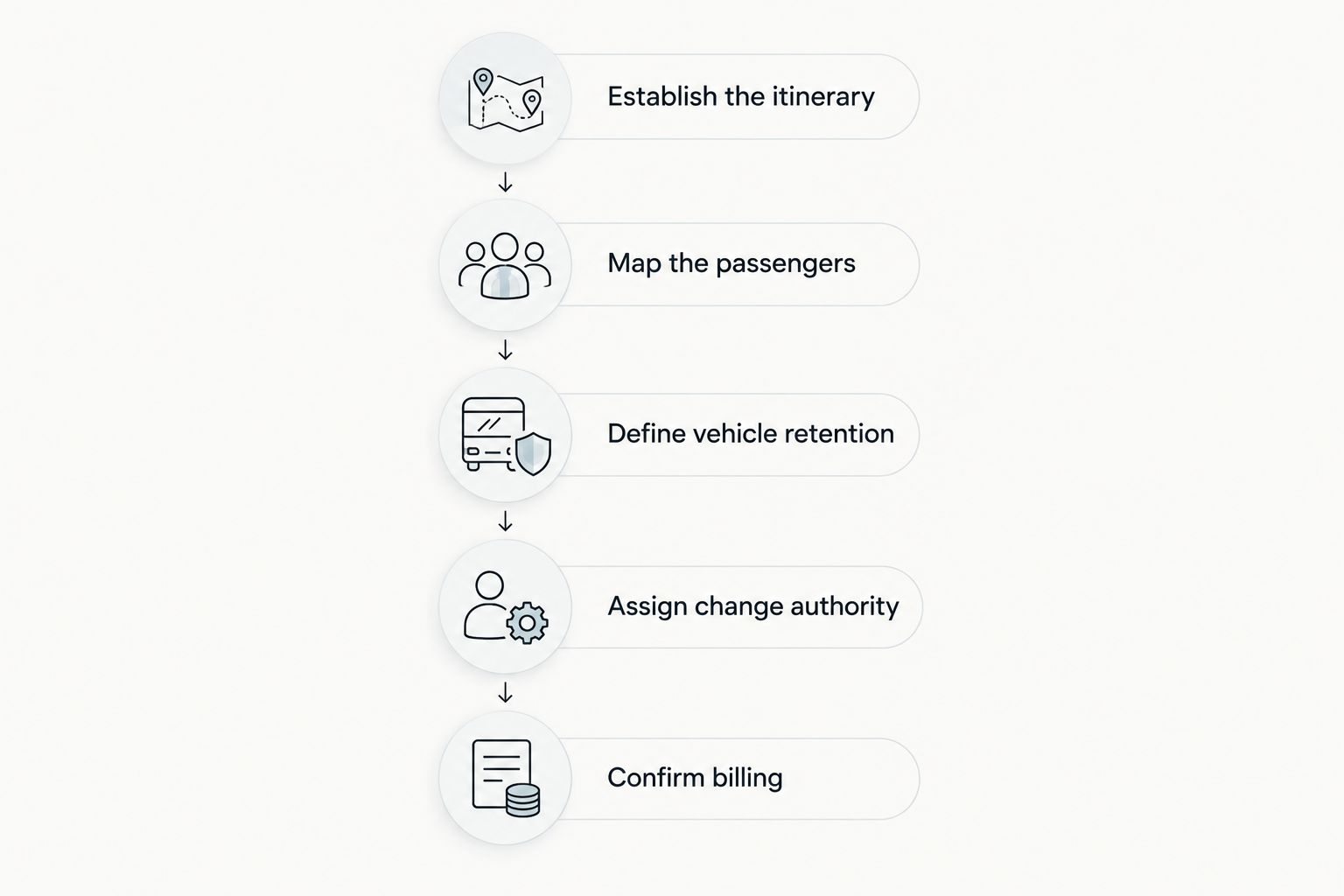
Build a quote request that a coordinator can execute
A useful quote request doubles as the first operating brief. It should let a coordinator understand who moves, where they go, when the vehicle is needed and who can approve a change.
Establish the itinerary
List every pickup and destination in order. Use full addresses and distinguish the building address from the requested passenger entrance where necessary.
Record appointment times separately from requested pickup times. A meeting start is a destination constraint, not an instruction about when to collect the passenger. Ask the provider to review the proposed routing and timing before confirming the schedule.
Map the passengers
Assign travelers to each movement rather than attaching a single attendee list to the entire roadshow. Record who arrives separately, who leaves early and which groups need to move simultaneously.
Include luggage and relevant accessibility requirements. Keep sensitive personal information limited to what the operating team needs, and confirm how it should be shared.
Define vehicle retention
Mark each gap as either retained service or released service. This is a purchasing decision, not a detail to leave implicit.
Where a meeting finish is uncertain, describe that uncertainty directly. Ask the provider to explain the operational arrangement and applicable terms rather than requesting an undefined flexible pickup.
Assign change authority
Name the person who can approve an extension, an added stop or a replacement movement. Give the coordinator a working contact during the travel period.
Separate passenger requests from spending authority when your organization requires it. A traveler asking for an extra stop should not leave the chauffeur or dispatch team guessing whether the change is authorized.
Confirm billing
State the paying entity, purchase order requirements and internal references before booking. Ask how the invoice will distinguish travelers, movements or cost centers if you need that detail.
Resolve expense treatment at the quote stage. Finance should be able to reconcile the final invoice against the accepted service scope and documented changes.
Check the terms before approving the budget
A clear itinerary does not replace clear booking terms. Read the proposal for the boundaries of the service as carefully as you read the total.
Before approval, confirm:
- Included scope: Every airport movement, meeting transfer and retained period appears in writing.
- Time rules: The proposal explains service start, release, waiting and extensions.
- Excluded expenses: Parking, tolls and other potential additions have an explicit treatment.
- Change handling: You know whom to contact and who must approve a revised assignment.
- Cancellation terms: The applicable deadlines and consequences are documented.
- Invoice detail: The provider can supply the references your organization needs.
Ask for a revised quote whenever the operating scope changes. An added journey is not merely an itinerary annotation if it changes the service being purchased.
Keep the latest accepted version with the travel coordinator. Distributing several versions without a clear current copy creates avoidable ambiguity about pickup instructions and authorized work.
Is an hourly charter cheaper than separate transfers?
An hourly charter is not automatically cheaper than separate transfers. It purchases retained service, while separate transfers cover defined movements under their own terms.
Compare both against the same meeting schedule. Choose based on the access your travelers require, then assess the complete quoted scope rather than an isolated rate.
Can you budget per traveler?
A per-traveler allocation works after the transport plan is quoted. It does not establish how many vehicles or separate assignments the roadshow requires.
For internal reporting, retain the underlying movement costs. Otherwise, a simple average hides which groups, routes or schedule changes account for the expenditure.
Does fixed pricing cover itinerary changes?
Fixed pricing applies to the scope agreed in the quote; confirm how the provider treats changes outside that scope. Do not interpret a fixed quote as permission to add time, stops or vehicles without approval.
Request written confirmation when the itinerary changes. That gives the coordinator and finance team the same record of the revised assignment.
When Chauffyr fits the roadshow brief
Chauffyr is best for executive teams that need coordinated chauffeur travel across a roadshow itinerary. Chauffyr provides airport transfers, hourly charters and point-to-point travel, with US-based coordination and worldwide service through vetted chauffeurs and affiliates.
Chauffyr serves 120+ airports across 50+ countries, with flight tracking and one 24/7 desk. Its fixed, upfront pricing and no surge approach support budget control; corporate accounts offer consolidated billing.
The practical limit remains the agreed scope. Confirm the specific route, vehicle requirements, waiting terms and change conditions before booking rather than treating worldwide coverage as confirmation of every local arrangement.
Arrange your roadshow travel
Request a quote against your itinerary, passenger groups and vehicle-retention requirements.
FAQ
How much does group chauffeur transport cost for a corporate roadshow?
Group chauffeur transport requires an itinerary-specific quote covering vehicle allocation, service time, routing and booking terms. Compare the total for the same operating scope, including the treatment of waiting and additional expenses.
What should I include when requesting a roadshow transport quote?
Include every movement, passenger group, luggage requirement, pickup time, destination and period of vehicle retention. Add a working contact, change-approval authority and billing instructions.
Should I book hourly service or separate transfers for meetings?
Book hourly service when retaining a vehicle between meetings is part of the requirement; consider separate transfers when journeys can operate independently. Compare written proposals against the same itinerary before deciding.
Does flight tracking mean airport waiting is included?
Flight tracking does not establish the booking's waiting allowance. Confirm the arrival pickup process, included waiting and treatment of additional waiting in the written terms.
Can a corporate roadshow use different service types?
A corporate roadshow can combine airport transfers, hourly charters and point-to-point journeys. Label each movement so the coordinator knows when a vehicle is retained or released.
Does a fixed quote include extra stops and late finishes?
A fixed quote covers the agreed scope, so confirm how additional stops and late finishes are handled. Obtain approval and written confirmation for changes that affect the assignment.
Can Chauffyr coordinate a multi-city executive roadshow?
Chauffyr provides coordinated corporate and delegation transport through US-based coordination and worldwide vetted chauffeurs and affiliates. Confirm the requested cities, routes, vehicle requirements and booking terms for your itinerary.
One last thing
Put a vehicle-release decision beside every meeting. State whether the vehicle stays assigned, is released or requires a new confirmed pickup afterward.
That instruction connects the budget to the actual service. It also gives your coordinator a precise question to resolve when an appointment changes: do you still need the vehicle, or has the operating requirement changed?


