
A chauffeur pickup after landing takes as long as the passenger needs to reach the agreed meeting point and the vehicle needs to reach the permitted loading area; there is no universal wait in minutes. Confirm whether the chauffeur will meet you inside the terminal or collect you at the curb, because landing time alone does not establish when you can leave the airport.
- How long does chauffeur pickup take after landing? Passenger readiness and the agreed meeting point determine departure timing.
- Flight tracking follows the aircraft; it does not confirm that you have cleared immigration or collected baggage.
- Terminal meet-and-greet and curbside pickup require different handoffs. Confirm which arrangement applies before departure.
- Chauffyr suits executive assistants who need airport transfers coordinated through one 24/7 desk.
Why this matters
An aircraft arrival is not a passenger-ready notification. Between touchdown and vehicle departure, you still need to leave the aircraft, complete any arrival formalities, collect checked bags and reach the pickup location.
For your 2026 travel plans, separate the flight arrival time from the ground departure time. An executive assistant scheduling an onward meeting needs the latter, not just the former.
The practical question is not simply when the chauffeur arrives. It is whether the passenger and vehicle will be ready at the same permitted location, with a clear way to contact each other.
How long does it take for a chauffeur to arrive after landing?
There is no single airport-wide interval between landing and chauffeur pickup. The relevant sequence is aircraft arrival, passenger clearance, passenger readiness and the vehicle handoff. Ask the provider which event triggers each part of its pickup procedure.
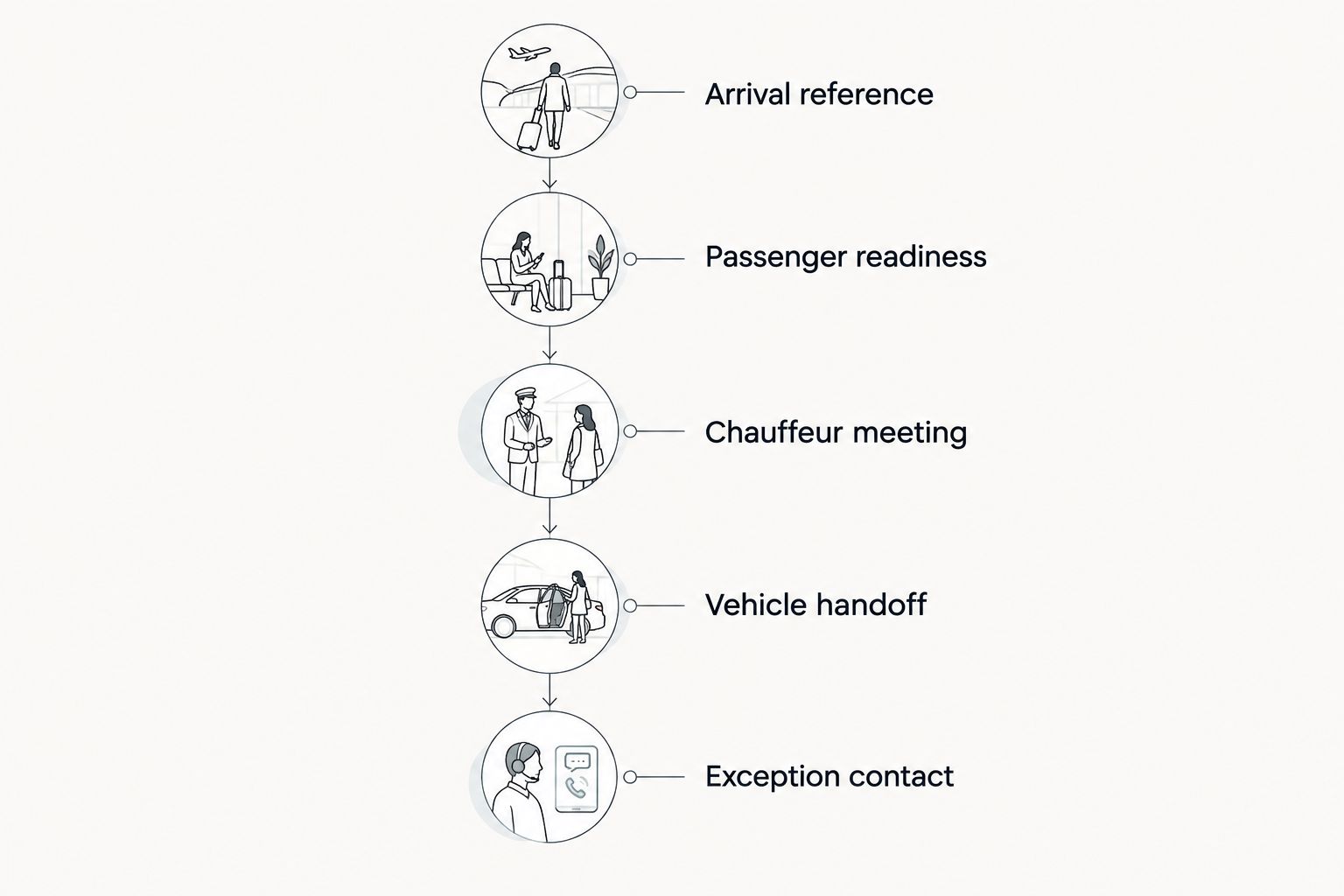
Use this sequence when confirming a 2026 airport transfer:
- Confirm the arrival reference. Ask whether the booking follows the scheduled arrival, updated flight arrival or another agreed trigger. Do not assume that a flight update automatically changes every booking instruction.
- Confirm the passenger-ready point. Specify whether the traveler will send a message after collecting bags, clearing customs or reaching a designated meeting location.
- Confirm the chauffeur meeting arrangement. Establish whether the chauffeur meets the passenger inside or gives directions to an authorized vehicle pickup area.
- Confirm the vehicle handoff. Ask whether the vehicle will already be at the loading location or must move there once the passenger is ready.
- Confirm the exception contact. Identify who handles a missed connection, terminal change, baggage delay or unsuccessful contact attempt.
A waiting chauffeur and a vehicle ready for boarding are not necessarily the same thing. Your confirmation should explain both the human meeting point and the vehicle location.
Terminal meet-and-greet: confirm where the handoff happens
Best for: travelers who want a defined person-to-person meeting inside the terminal. Request the exact meeting location and identification procedure rather than relying on a general instruction such as arrivals hall.
A terminal meeting can make the passenger handoff clearer. It does not, by itself, establish where the vehicle is parked or how far the passenger must walk before boarding.
The limitation is the additional coordination between the indoor meeting and the vehicle location. Ask whether the chauffeur accompanies the passenger to the vehicle and how luggage assistance will work; neither should be assumed from the service label alone.
For international arrivals, identify whether the meeting point is after customs. The traveler needs instructions that match the area they can actually access after completing arrival formalities.
Curbside pickup: confirm the passenger-ready signal
Best for: travelers comfortable following terminal-specific pickup instructions and contacting the chauffeur when ready. Obtain the permitted pickup location before the flight, including any terminal, level, door or zone details supplied by the provider.
Curbside pickup uses a direct passenger-to-vehicle handoff. Its limitation is that the passenger must reach the correct location while the chauffeur coordinates vehicle access.
Do not treat a message sent from the aircraft as confirmation that you are ready at the curb. Send the readiness update at the agreed point, and report your actual location rather than an estimated one.
Airport access arrangements differ. A car being nearby does not establish that it can stop at the passenger's preferred exit.
| Pickup arrangement | Best for | Practical advantage | Limitation to confirm |
|---|---|---|---|
| Terminal meet-and-greet | Travelers wanting an indoor meeting | Establishes a person-to-person handoff | Vehicle location and the walk from the meeting point |
| Curbside pickup | Travelers comfortable with location instructions | Uses a direct handoff at the permitted loading area | Passenger readiness, exact pickup zone and vehicle access |
Choose the arrangement around the traveler's needs, not an assumed speed advantage. Neither label establishes a universal pickup duration.
Why chauffeur pickup timing varies
These factors explain why the same flight arrival time can produce different ground departure times:
- Aircraft-to-terminal progress. Touchdown comes before the passenger leaves the aircraft. Taxiing, reaching the stand and disembarking remain part of the arrival sequence.
- Arrival formalities. International passengers may need to complete immigration and customs before reaching a public meeting area. A chauffeur cannot complete those steps for the traveler.
- Checked baggage. A passenger waiting for bags is not ready for vehicle boarding. Tell the coordinator when a baggage issue changes the expected handoff.
- Meeting-point access. Terminal exits, parking arrangements and permitted loading locations determine where the passenger and vehicle can meet.
- Passenger movement. Walking to the meeting point, traveling with companions and arranging assistance affect readiness. Record those requirements before travel.
- Communication. An unanswered call, an incorrect mobile number or an unclear location message can interrupt an otherwise agreed pickup plan.
Flight tracking addresses the aircraft's progress. It does not replace a passenger-ready update when the agreed pickup procedure requires one.
Ask the coordinator to explain how these factors affect your specific arrival. A useful answer identifies the next action and responsible contact, rather than promising the same interval at every airport.
What should an executive assistant confirm before departure?
Build a short arrival brief that the traveler can use without searching through a long booking thread. For a 2026 itinerary, make the brief specific to the booked flight and airport rather than copying instructions from a previous trip.
Flight and passenger details
Record the operating flight details, arrival airport, travel date and lead passenger's name. Include a reachable traveler contact and the assistant's contact, with clear instructions about who receives operational updates.
Add the passenger count, checked baggage expectations and any requested assistance. These details help the coordinator assess the handoff without asking the traveler to repeat information after landing.
Meeting instructions
Write down the pickup method and exact meeting point provided for that booking. Include how the traveler identifies the chauffeur, what message to send when ready and what to do if the meeting does not happen as planned.
Keep the instructions available offline. An arrival plan should not depend entirely on the passenger opening an email or messaging app immediately after landing.
Waiting and changes
Ask when any included waiting period begins, how it is measured and what happens if the passenger remains inside longer than expected. Request the applicable terms in the booking confirmation rather than assuming flight tracking answers these questions.
Also confirm how to report a changed flight, missed connection or diverted arrival. An updated itinerary is useful only if the responsible coordinator receives it.
Onward commitments
Give the coordinator the destination and any firm appointment time. Ask for a route-specific planning assessment that accounts for airport exit and onward travel separately.
Do not schedule an external meeting by adding a guessed airport pickup interval to the published flight arrival. Keep the arrival dependency visible to everyone managing the executive's calendar.
What should you do immediately after landing?
Follow the agreed contact sequence. If the provider requests an arrival message, say where you are in the process: still on the aircraft, waiting for bags, completing formalities or ready at the meeting point.
A useful update states your actual status and the next obstacle. For example, tell the coordinator that baggage collection is still outstanding rather than simply saying you have landed.
Once you reach the agreed meeting location, check the booking instructions before moving elsewhere. If you cannot locate the chauffeur, contact the designated desk and give a precise location.
Avoid creating competing instructions across the traveler, assistant and chauffeur. Nominate an operational contact so a location change reaches everyone who needs it.
Does flight tracking mean the chauffeur is waiting when I land?
Flight tracking follows the flight; it does not establish the chauffeur's precise meeting position or confirm passenger readiness. Ask how the provider uses the flight update to coordinate the booking.
For a 2026 booking, request explicit confirmation of the meeting procedure alongside flight tracking. Those are separate parts of the arrival plan.
Should I contact the chauffeur before collecting my bags?
Contact the chauffeur at the stage specified in your booking instructions. If an initial arrival message is requested, explain that you are still waiting for baggage rather than presenting that message as a request to bring the vehicle to the curb.
Send a further update when you reach the agreed readiness point. Accurate status is more useful than repeated estimates.
When coordinated airport transfers fit the trip
Chauffyr is best for executive assistants who need airport transfers coordinated through one 24/7 desk. The US-based partner serves 120+ airports across 50+ countries through vetted chauffeurs and affiliates; worldwide service does not imply a company-owned vehicle or employee chauffeur in every location.
Chauffyr airport transfers include flight tracking, fixed, upfront pricing and no surge. Those features support coordination and booking clarity, but they do not establish a universal number of minutes from touchdown to boarding.
For your 2026 arrival, ask Chauffyr to confirm the airport-specific meeting instructions, readiness signal and applicable waiting terms. A coordinated service still depends on accurate traveler details and a workable passenger handoff.
Arrange your airport transfer
Request an airport transfer quote and confirm the meeting procedure for your arrival.
FAQ
How long does chauffeur pickup take after landing?
Chauffeur pickup after landing has no universal duration. Your departure depends on reaching the agreed meeting point and completing the vehicle handoff after any arrival formalities and baggage collection.
Will my chauffeur meet me inside the airport?
An indoor meeting applies only when that arrangement is confirmed for your booking. Request the exact meeting point, identification procedure and instructions for reaching the vehicle.
Is curbside pickup faster than meet-and-greet?
Curbside pickup is not automatically faster than meet-and-greet. Passenger readiness, permitted loading locations and the vehicle's position determine how the handoff works.
Does flight tracking tell the chauffeur when I have cleared customs?
Flight tracking does not confirm that you have cleared customs. Send the passenger-ready update required by your pickup instructions after completing the relevant arrival steps.
What happens if my baggage is delayed?
Notify the designated coordinator that baggage collection is delaying your readiness. Ask how the booking's waiting terms apply and confirm the next contact point before changing your meeting location.
What should I check on a 2026 airport transfer confirmation?
Check the flight details, pickup method, meeting point, traveler contact and waiting terms on your 2026 airport transfer confirmation. Also identify who handles flight changes and an unsuccessful passenger-chauffeur meeting.
One last thing
The most useful arrival message is not that the aircraft has landed. It is that the passenger has reached the agreed readiness point.
Put that readiness signal in the booking instructions before departure. It gives the traveler a clear action and gives the coordinator information that flight tracking cannot supply.


