
Instead of manually chasing landing updates, build an FBO chauffeur pickup workflow that sends each verified arrival change to the transport coordinator and ends with an explicit release to the pickup point. Connect flight information, FBO instructions and chauffeur acknowledgment in one trip record; a landing alert alone is not permission to approach the aircraft.
- FBO chauffeur pickup needs a verified arrival update, confirmed access instructions and an explicit chauffeur acknowledgment.
- Chauffyr is best for executive assistants coordinating chauffeur services through one desk.
- Keep flight tracking separate from passenger readiness; landing does not confirm that travelers are ready to leave.
- Use one trip record for aircraft changes, FBO instructions, chauffeur status and passenger handoff.
Why this matters
A fixed-base operator, or FBO, serves private aviation at an airport. For ground transport, the airport name alone is not a complete pickup instruction: you need the receiving facility, its ground-access instructions and the person authorized to confirm the handoff.
Your 2026 arrival workflow should distinguish aircraft movement from passenger readiness. A touchdown notification gives the coordinator information; the receiving FBO and your designated trip contact establish where and when the chauffeur should collect the passengers.
Match the booking to the actual movement before building notifications. Review the available chauffeur services, then confirm the specific airport, FBO and requested transport arrangement directly.
The operating rule is simple: an alert starts verification, not vehicle movement.
Before you start
- Secure the right access. Obtain authorized flight updates from the flight department, aircraft operator or agreed tracking source. Have the receiving FBO's operational contact and your transport coordinator's confirmed contact details.
- Prepare a shared trip record. Use an approved worksheet or coordination system that the responsible team can update. Record the aircraft identifier, arrival date, local time zone, destination airport, receiving FBO, passenger contact and chauffeur contact.
- Confirm the access constraint first. Do not assume a chauffeur can drive airside or meet beside the aircraft. Obtain the receiving FBO's pickup location, vehicle-access requirements and release instructions before arranging the arrival handoff.
Keep traveler details limited to what each participant needs. An arrival-status message does not need the principal's full itinerary, meeting agenda or sensitive personal information.
Arrival record configuration
The field names below are suggested labels for your own coordination record, not buttons or settings in a particular application. Use them consistently across your 2026 arrival template so a substitute coordinator can understand the trip without reading an entire message thread.
- Create a trip reference. Give the movement a unique reference and put it in every operational message. Use the same reference for the flight update, chauffeur assignment and pickup confirmation.
- Add the flight identity. Enter Aircraft identifier, Arrival date, Destination airport and Receiving FBO. Confirm these details with the authorized flight contact rather than copying an old itinerary.
- Separate planned and current timing. Add Scheduled arrival, Latest arrival estimate, Time zone and Update received. Preserve the scheduled time; put subsequent changes in the current estimate field.
- Assign responsibility. Enter Trip owner, Backup contact, FBO contact and Chauffeur contact. Identify who can authorize a location change and who confirms that passengers are ready.
- Record the ground arrangement. Add Pickup point, Access instructions, Passenger contact and Next destination. Keep unconfirmed instructions visibly marked as pending.
Expected result: a coordinator can identify the correct aircraft movement, receiving facility, responsible contacts and unresolved instructions from the trip record alone.
Do not use the passenger's name as the only reference. A principal can have several movements on the same itinerary, and a changed aircraft must remain connected to the correct ground booking.
Arrival alert routing
Build a message handoff before adding automation. If your approved systems support notifications, use their documented configuration; otherwise, the same process works through a monitored operational channel and a named coordinator.
- Select the arrival source. Record Flight update source and confirm which contact resolves conflicting information. Ask the aircraft operator which source should govern operational changes.
- Define the update events. Include a revised arrival estimate, a reported landing, a destination change and a receiving-FBO change. Treat passenger readiness as a separate confirmation, not a flight-tracking event.
- Choose the recipient. Send updates to the Trip owner or monitored transport desk. Do not make the chauffeur interpret unrelated flight messages or reconcile conflicting versions while driving.
- Standardize the message. Include the trip reference, event, event time, time zone, source and requested action. State whether the update changes staging, requires verification or needs no movement.
- Test the handoff. Send a clearly labeled test message through the chosen channel. Confirm that the responsible person receives it and can associate it with the correct trip.
Expected result: every arrival update reaches a named decision-maker with enough context to act, without being mistaken for a pickup release.
A practical message structure is: trip reference; verified event; current arrival estimate; receiving FBO; required action; acknowledgment requested. This is a template, not a substitute for the FBO's instructions.
Chauffeur release and pickup confirmation
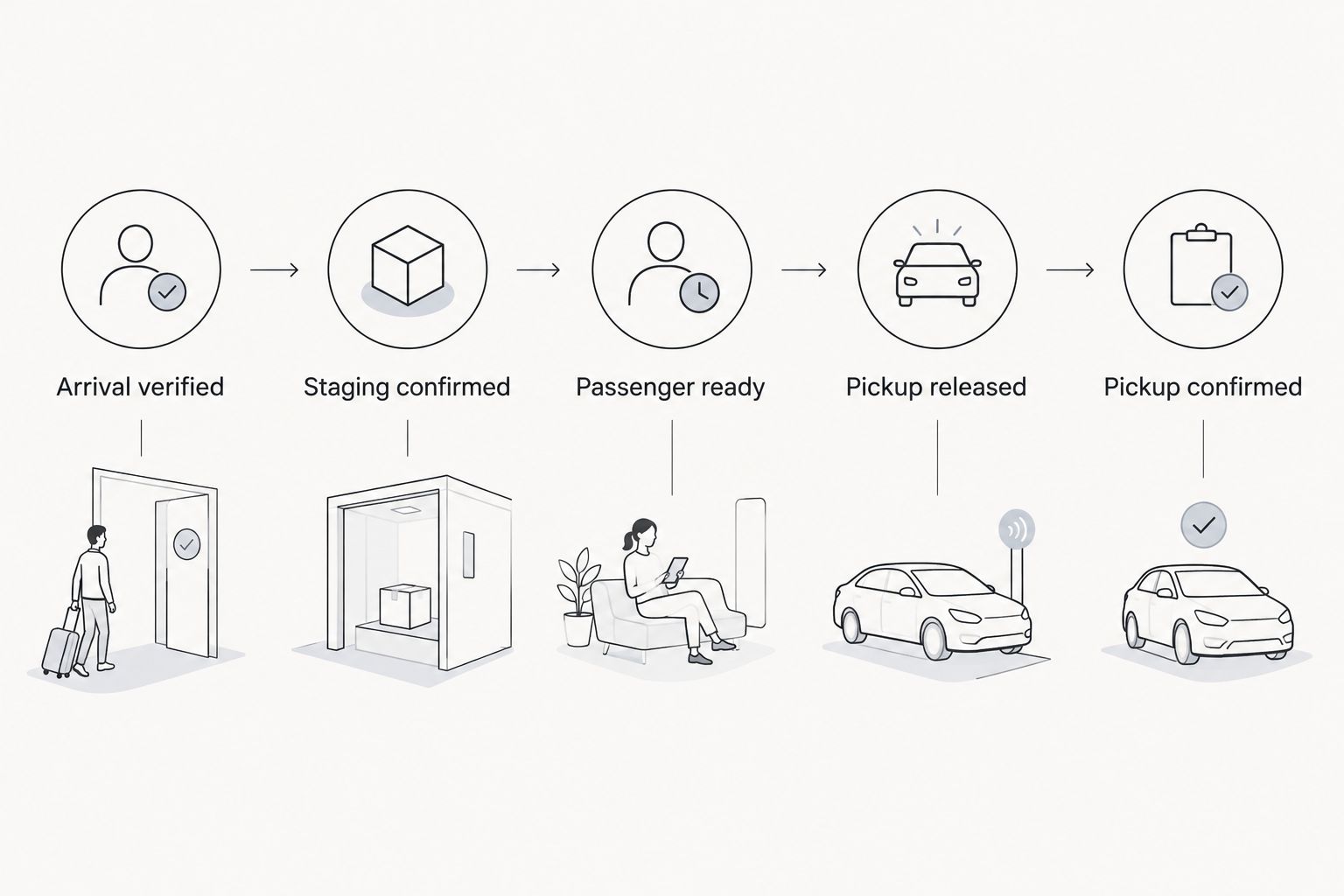
Use distinct statuses to prevent an aircraft event from becoming an unverified chauffeur instruction. The sequence below belongs in the trip record and the coordinator's checklist.
- Arrival verified. Check the incoming update against the correct aircraft, date and airport. Resolve conflicting information with the authorized flight contact before changing the ground arrangement.
- Staging confirmed. Confirm the receiving FBO and approved waiting location. Send the chauffeur the current location instructions without implying permission for restricted access.
- Passenger ready. Obtain readiness confirmation from the designated FBO or trip contact. Confirm any revised handoff location before releasing the chauffeur from staging.
- Pickup released. Send a clear instruction identifying the trip and collection point. Require the chauffeur or transport desk to acknowledge the instruction through the agreed channel.
- Pickup confirmed. Record that the correct party has connected with the chauffeur. Note the departure status and send the agreed operational confirmation to the trip owner.
Expected result: the record distinguishes a landed aircraft, a staged chauffeur, a ready passenger and a completed pickup. None of those statuses stands in for another.
For your 2026 operating checklist, specify what counts as acknowledgment: a direct response through the approved channel, not merely a sent message. If acknowledgment is missing, contact the backup rather than assuming the instruction was received.
Change control configuration
Arrival workflows fail when a changed instruction remains buried in a conversation. Make amendments visible in the same record that controls the pickup.
- Record the changed field. Update the arrival estimate, aircraft identifier, receiving FBO or destination as appropriate. Retain the source and time of the change.
- Check the downstream effect. Ask whether the amendment changes staging, access, passenger contact or the ground booking itself. An airport change requires a fresh operational confirmation, not just an edited address.
- Withdraw the old instruction. Mark the superseded pickup instruction clearly. Send the replacement to the same operational recipients and request acknowledgment.
- Confirm acceptance. Record who accepted the revised arrangement. If the transport provider has not confirmed it, leave the change pending rather than presenting it as settled.
Expected result: everyone acts on the latest accepted instruction, and the record shows which earlier instruction no longer applies.
Keep the change history concise. The useful information is what changed, who authorized it, who received it and whether the revised movement is confirmed.
Variant: update staging when the arrival estimate changes
A revised arrival estimate can trigger a staging review before the aircraft lands. This adjacent workflow uses the same trip reference and contacts, but it must not release the chauffeur for passenger collection.
| Workflow | Best for | Advantage | Limitation |
|---|---|---|---|
| Arrival-estimate update | Coordinators managing changes before arrival | Gives the desk a prompt to reassess staging | An estimate does not establish passenger readiness |
| Landing-to-pickup handoff | Coordinators managing the final passenger connection | Separates arrival, readiness and collection | Requires direct confirmation beyond the flight alert |
For the estimate-update variant, compare the new timing with the accepted ground arrangement. Ask the transport coordinator to confirm any adjustment, then send the accepted staging instruction to the chauffeur.
Use arrival-estimate updates for planning and the pickup-release sequence for collection. Both workflows belong in your 2026 procedure, but they serve different decisions.
Do not introduce an automatic departure rule based on a fixed interval after touchdown. Agree on passenger readiness and local access instructions instead; a timer cannot verify either.
Troubleshooting
The alert names the airport but not the receiving FBO
Keep the pickup location unconfirmed. Contact the authorized flight representative or receiving facility, then obtain the actual ground-access instructions before directing the chauffeur to a collection point.
The arrival time appears inconsistent
Check the arrival date, time zone and whether the message reports an estimate or an actual event. Preserve the source timestamp and ask the authorized flight contact to resolve the discrepancy before issuing revised instructions.
The aircraft has landed, but passengers are not ready
Leave the chauffeur in the approved staging arrangement. Ask the designated contact for a readiness update; do not turn the landing notification into an instruction to approach the aircraft.
The chauffeur has not acknowledged the change
Use the agreed backup contact or transport desk. Confirm that the message reached the assigned chauffeur and that the revised instruction is understood before marking the change accepted.
The aircraft or receiving facility changes
Verify the replacement aircraft identifier, airport and FBO against the same trip reference. Reconfirm the ground booking, access and pickup point; matching the passenger name alone does not validate the revised movement.
Customize your workflow
Extend the record to the next destination, the return movement or a delegation's separate arrival groups. Give each movement its own operational status while keeping a clear itinerary owner across the wider assignment.
For finance handoff, attach the trip reference and approved amendments to the booking record. Keep sensitive passenger information out of billing notes unless it is required by your organization's process.
Chauffyr's chauffeur services cover executive airport transfers, hourly charters and point-to-point travel at 120+ airports across 50+ countries. US-based coordination works with vetted chauffeurs and affiliates worldwide; it does not mean every vehicle or chauffeur belongs to one owned fleet.
Chauffyr is best for executive assistants coordinating chauffeur services through one desk. Flight tracking and one 24/7 desk support the coordination model, but you still need explicit confirmation of the particular FBO, access instructions and requested handoff.
The advantage is a central coordination contact. The constraint is local execution: receiving-facility instructions and the specific booking still require confirmation. Send your trip requirements through the contact page, including the authorized flight contact and any unresolved access questions.
FAQ
How do I arrange an FBO chauffeur pickup?
Confirm the aircraft movement, receiving FBO, authorized pickup point and passenger-readiness contact before issuing chauffeur instructions. Keep those details in one trip record and require acknowledgment of the final pickup release.
Does a landing alert mean the chauffeur should approach the aircraft?
No. A landing alert confirms an aircraft event, not passenger readiness or vehicle-access permission. Follow the receiving FBO's instructions and obtain the agreed release confirmation.
Can the chauffeur meet passengers beside the aircraft?
Confirm the permitted meeting point directly with the receiving FBO and transport coordinator. Do not assume airside access or an aircraft-side handoff from the airport name or booking request alone.
What should I do if the private flight changes FBOs?
Reconfirm the receiving facility, ground booking, access instructions and pickup point. Replace the old instruction in the trip record and obtain acknowledgment from the responsible transport contact.
Can I automate an FBO landing alert to chauffeur pickup?
You can automate notification routing when your approved systems support it, but keep passenger readiness and pickup release as explicit confirmations. Test recipient delivery and trip matching before using the process for a live arrival.
What information does Chauffyr need for an FBO transfer request?
Provide the aircraft identifier, arrival date and time zone, airport, receiving FBO, passenger count, luggage requirements and destination. Include the authorized flight contact and ask Chauffyr to confirm the specific pickup arrangement before treating it as settled.
How should I handle a delayed arrival in a 2026 travel workflow?
Update the current arrival estimate, verify the source and ask the transport coordinator to confirm any staging adjustment. Keep the delay update separate from passenger readiness and final pickup release.
One last thing
Add Next action owner to your 2026 trip record. A correct status without an assigned next action leaves the handoff unfinished; every unresolved item should name the person responsible for obtaining the next confirmation.


