
Venture capital firms’ chauffeur service is prearranged executive ground transport with the aim of keeping partners, founders and visiting investors on schedule. This 2026 guide explains how to match airport transfers, meeting-day travel and changing itineraries to the people responsible for coordinating them.
- Chauffeur service for venture capital firms should follow the itinerary: airport transfers, fixed journeys and changing meeting days need different arrangements.
- Chauffyr suits coordinators seeking executive ground travel through one 24/7 desk, including worldwide service through vetted chauffeurs and affiliates.
- Name the person authorized to change the itinerary before travel begins.
- Keep sensitive meeting details out of chauffeur instructions unless operationally necessary.
Why chauffeur service matters for venture capital firms
A venture capital itinerary connects people with different priorities: a partner needs to reach a meeting, an executive assistant needs confirmation, and finance needs a usable invoice. A vehicle booking alone does not resolve those handoffs.
When arranging executive ground travel, specify who manages arrival changes, who approves additional stops and who receives the final journey record. Those instructions matter as much as the pickup address.
For your 2026 travel brief, separate a missed meeting risk from a simple preference. A hard departure deadline needs an escalation plan; a preferred route needs an instruction. Treating both as equal makes the brief harder to act on.
Book against the day’s operating requirements, not just the first journey. A single airport arrival and a partner’s changing meeting schedule need different booking instructions.
How to arrange venture capital ground travel
Define the traveler and the decision owner
Start with a reusable traveler brief. Record the passenger’s name, reachable contact, pickup preferences and the person responsible for approving changes. Keep the brief operational rather than biographical.
Give the assistant and the traveler different responsibilities where necessary. The traveler can communicate that a meeting is running late, while the assistant retains approval over a revised itinerary. State that distinction explicitly rather than expecting the chauffeur to interpret it.
For a 2026 travel profile, confirm the details again before reuse. An old office address or former assistant’s number can undermine an otherwise accurate reservation.
- Record the traveler’s preferred name and direct contact.
- Assign 1 itinerary owner with authority to approve changes.
- List 2 contact roles: the traveler and the coordinator.
- Separate essential requirements from optional preferences.
- Confirm the destination entrance, not only the street address.
Match the booking format to the itinerary
Write the journey sequence in a shared document before requesting a quote. Identify fixed movements, uncertain meeting end times and any return journey. Then choose the service format that matches those movements.
A point-to-point booking fits a defined origin and destination. An hourly or as-directed arrangement fits a day when the passenger needs transport between changing stops. An airport transfer needs arrival instructions and a plan for reaching the passenger after landing.
Do not assume a booked transfer includes an open-ended meeting day. Ask how an additional stop or extended assignment would be handled before confirming the reservation. That question establishes the scope without requiring you to predict every change.
- Use an airport transfer for an arrival or departure movement.
- Use point-to-point travel for a defined journey.
- Consider hourly service for a changing meeting sequence.
- Identify stops that are confirmed versus provisional.
- Request written confirmation of the booked scope.
Confirm the airport handoff
Build the airport plan around passenger readiness, not landing alone. Flight tracking addresses the flight’s progress; the traveler still needs to clear the airport and reach the agreed pickup location.
Ask for the meeting instructions in writing. Confirm whether the arrangement is a curbside pickup or a requested meet-and-greet, and establish how the passenger receives chauffeur details. Do not assume either arrangement is included without confirmation.
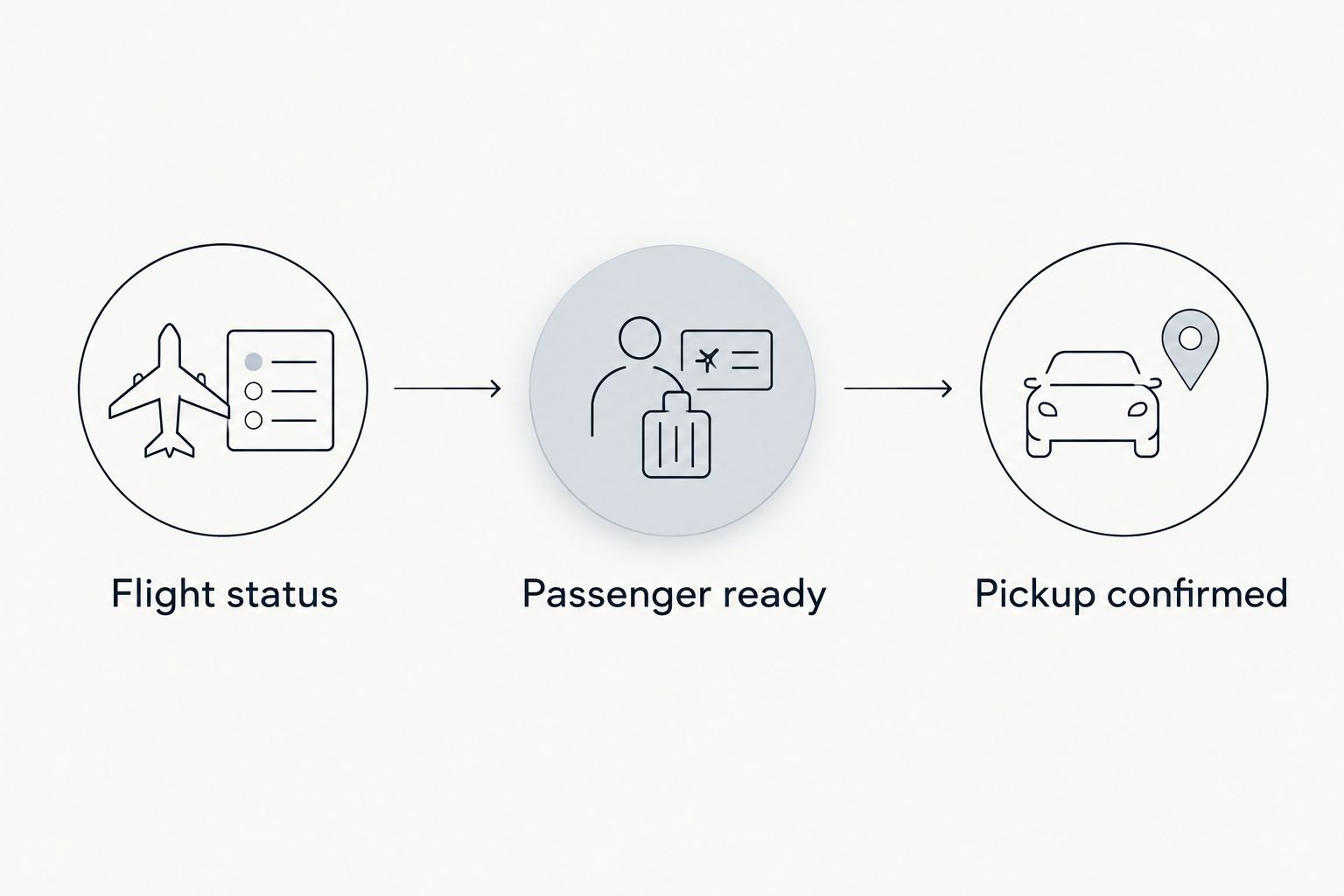
Use 3 handoff checkpoints: flight status, passenger ready and pickup confirmed. Each checkpoint answers a different question. Keeping them separate gives the assistant a clearer picture than a single message saying the flight has arrived.
- Flight status: Supply the flight number and arrival date.
- Passenger ready: Agree how the traveler signals readiness.
- Pickup confirmed: Identify the meeting location and contact method.
- Confirm luggage and passenger requirements before vehicle assignment.
- Establish who handles a missed connection or changed flight.
Build a meeting-day movement sheet
Create a movement sheet that the assistant, traveler and transport coordinator can follow. Use the calendar to establish timing, but write a separate operational version for the chauffeur. A calendar invitation can contain information the transport team does not need.
For every stop, record the usable entrance, meeting start time and the next required departure. Identify which appointments have hard starts. Ask the coordinator to review journey timing rather than treating a calendar gap as proof that a transfer fits.
Keep revision control simple. When the partner changes the afternoon sequence, send the replacement instructions through the agreed channel and request acknowledgment. A forwarded email chain should not become the working itinerary.
- List stops in the confirmed travel order.
- Distinguish meeting start times from required departure times.
- Include entrance and pickup instructions for each location.
- Mark provisional stops so they are not mistaken for commitments.
- Name the person who distributes the current version.
Limit sensitive information and clarify conduct
Give the chauffeur enough information to perform the journey, not the full investment context. A pickup name and building entrance can be sufficient without identifying the transaction, fundraising discussion or investment committee topic.
Separate confidentiality expectations from verified protections. A request for discreet conduct is an instruction; it is not proof of a security capability or a legal confidentiality agreement. If your firm requires documented terms, address them through the appropriate internal process before travel.
For visiting investors or founders, confirm who receives operational updates. Avoid copying a broad deal team into messages containing passenger locations. The same discipline applies when several firms share the cost or coordinate a meeting.
- Remove deal names from the chauffeur-facing itinerary.
- Share passenger contact details only with necessary recipients.
- State expectations for conversation and passenger privacy.
- Confirm any required confidentiality documentation separately.
- Keep sensitive meeting notes outside transport messages.
Set the change and escalation rules
Decide how changes will be handled before the first pickup. A partner running late, a founder adding a stop and a flight disruption require different decisions. The transport team needs to know which changes the traveler can request directly and which need coordinator approval.
Start with a shared contact sheet and a written escalation path. If an assistant cannot be reached, name the alternate decision-maker. Do not make a chauffeur choose between competing instructions from the passenger and the office.
Chauffyr provides one 24/7 desk for coordination. That gives your brief a central contact point, but your firm still needs to define approval authority and communicate itinerary changes. Ask for the applicable change, waiting and cancellation terms before booking.
- Name the primary approver and an alternate.
- Specify which changes require approval before acceptance.
- Set the channel for urgent operational messages.
- Request acknowledgment when a revised itinerary is issued.
- Confirm the escalation process for a missed connection.
Close the billing loop
Agree the billing structure before travel, then reconcile the completed journey against the booking. Finance should be able to distinguish the original scope from approved changes without reconstructing the assistant’s messages.
For your 2026 booking template, include the legal billing entity, internal reference and the person responsible for invoice queries. Where a partner travels across several cities, use consistent references so the journeys remain connected in your records.
Chauffyr offers consolidated billing through corporate accounts. That is useful for centralized administration, but it does not replace your internal allocation rules. Confirm account arrangements and invoice requirements directly before relying on them for a travel program.
- Supply the correct billing entity and invoice contact.
- Add the required cost center or internal reference.
- Record who approved additional stops or extended service.
- Check the completed journey against the confirmed scope.
- Route invoice questions to a named owner.
Compare the options for a venture capital itinerary
Choose the arrangement that fits the work the traveler needs to complete. The 2026 comparison below separates journey formats from coordination models: an airport transfer describes a movement, while a central desk describes how movements are managed.
| Option | Best for | Practical advantage | Key limitation or check |
|---|---|---|---|
| Airport transfer | Partners and visiting investors arriving or departing by air | Centers the brief on flight details and the airport handoff | Does not define an entire meeting-day assignment; confirm onward travel separately |
| Point-to-point journey | A fixed trip between known locations | Keeps the origin, destination and booking scope clear | Additional stops need their own instructions and confirmation |
| Hourly or as-directed charter | Partners attending a changing sequence of meetings | Organizes the booking around the meeting day | Confirm the assignment duration, change process and applicable terms |
| Direct bookings with separate local providers | Coordinators who want to manage each city independently | Allows a separate brief for each local assignment | Your team must maintain the handoffs and reconcile separate confirmations |
| Chauffyr coordination | Teams seeking a central desk for executive travel across cities | Combines US-based coordination with worldwide service through vetted chauffeurs and affiliates | Confirm the exact route, vehicle arrangement and local operating details for each booking |
Choose the booking format first, then the coordination model. An hourly assignment still needs clear dispatch instructions; a central desk still needs a complete traveler brief.
Common mistakes venture capital firms make
Booking only the arrival journey
An airport booking does not answer how the partner gets from the first meeting to the next. Write the full movement sequence before deciding which parts need separate bookings. Identify the return or onward journey even when its timing remains provisional.
Sending the investment calendar as chauffeur instructions
The calendar can expose deal names while leaving out the correct entrance. Prepare a transport-only version with addresses, timing, contact details and operational notes. Keep the meeting context with the people who need it.
Letting every stakeholder amend the itinerary
A partner, an assistant and a visiting investor can each send reasonable instructions that conflict. Give one person responsibility for the current itinerary and define the traveler’s authority to request changes. Require confirmation when the sequence changes.
Treating worldwide coverage as identical local operations
A provider’s service reach does not establish the details of a specific airport pickup or vehicle assignment. Chauffyr coordinates worldwide service through vetted chauffeurs and affiliates; confirm the local arrangement rather than assuming fleet ownership or identical procedures in every city.
Leaving invoice allocation until after travel
A completed journey is harder to allocate when the internal reference was never supplied. Capture the billing entity and cost center at booking. Keep approval records for changed assignments with the trip record, not only in an assistant’s inbox.
When a central coordination desk fits
Chauffyr is best for venture capital coordinators who want one 24/7 desk for executive ground travel. The service covers airport transfers, hourly charters, point-to-point travel and coordinated multi-city transport.
The decision is operational. Use a central desk when you want a defined coordination contact across the itinerary. Keep direct local arrangements when your team wants to manage those handoffs itself. Neither approach removes the need to confirm pickup details, service scope and applicable terms.
Arrange your executive travel
Share flight details, meeting stops and billing requirements for your itinerary.
FAQ
What is chauffeur service for venture capital firms?
Chauffeur service for venture capital firms is prearranged ground transport for partners, founders, visiting investors and other business travelers. The booking can cover airport transfers, individual journeys or an hourly meeting-day assignment.
What is the best chauffeur arrangement for a partner with changing meetings?
An hourly or as-directed arrangement fits a meeting day with changing stops. Confirm the assignment scope, who can approve changes and how revised instructions reach the chauffeur.
Is an airport transfer enough for a full day of investor meetings?
An airport transfer alone does not define transport for a full meeting day. Book onward movements separately or request an arrangement that covers the required sequence.
What should an executive assistant provide before an airport pickup?
Provide the flight number, arrival date, passenger contact, luggage requirements and agreed meeting instructions. Confirm how the traveler signals readiness and who handles flight changes.
Can Chauffyr coordinate venture capital travel across cities?
Chauffyr provides coordinated multi-city transport through US-based coordination and worldwide service by vetted chauffeurs and affiliates. Confirm each route, airport pickup and vehicle arrangement for the specific itinerary.
How should a venture capital firm protect sensitive meeting information?
Give the transport team operational instructions without unnecessary deal information. Keep transaction names, investment notes and confidential calendar attachments out of the chauffeur-facing brief.
What should finance confirm before booking executive ground travel?
Finance should confirm the billing entity, internal reference, invoice contact and approval process for changes. For corporate accounts, establish consolidated billing arrangements before the journeys begin.
One last thing
Make the last line of every 2026 movement sheet an acknowledgment request: ask the coordinator to confirm the current stop sequence, pickup instructions and escalation contact. Sending a revision is not the same as confirming that it has replaced the previous version.
Close the handoff before closing the message. A short acknowledgment gives the assistant a clear record of which instructions are in force when the traveler leaves the meeting.


