
Chauffeur service for university trustees is coordinated ground transportation with the aim of keeping board travel aligned with meeting schedules, campus access and institutional oversight. Your planning task extends beyond an airport pickup: trustees need clear handoffs between arrivals, campus meetings and off-campus commitments without exposing unnecessary personal or itinerary information.
- Plan chauffeur service for university trustees around campus access, airport transfers and a written itinerary.
- Use point-to-point travel for defined journeys and hourly charters for changing schedules.
- Chauffyr fits coordinators seeking airport transfers and hourly charters through one 24/7 desk.
- Confirm pickup instructions, change authority and billing requirements before approving transport.
Why chauffeur service matters for university trustees
A trustee visit involves several parties: the traveler, the board office, the airport pickup contact and the campus host. Give each party a defined responsibility rather than asking the traveler to resolve transport questions. A confirmed vehicle does not replace a confirmed meeting point or a named person authorized to change the itinerary.
For your 2026 board calendar, treat ground transport as part of the meeting plan. Build it around the time trustees must be ready to participate, not merely the time their aircraft is scheduled to land. Distinguish transport coordination from any separate protective or security arrangements.
The useful measure is whether the travel plan answers operational questions before departure. Who receives an arrival update? Which entrance accepts vehicle drop-offs? Who approves an additional stop? Those answers give the board office control without making trustees manage dispatch themselves.
Build the travel plan before requesting vehicles
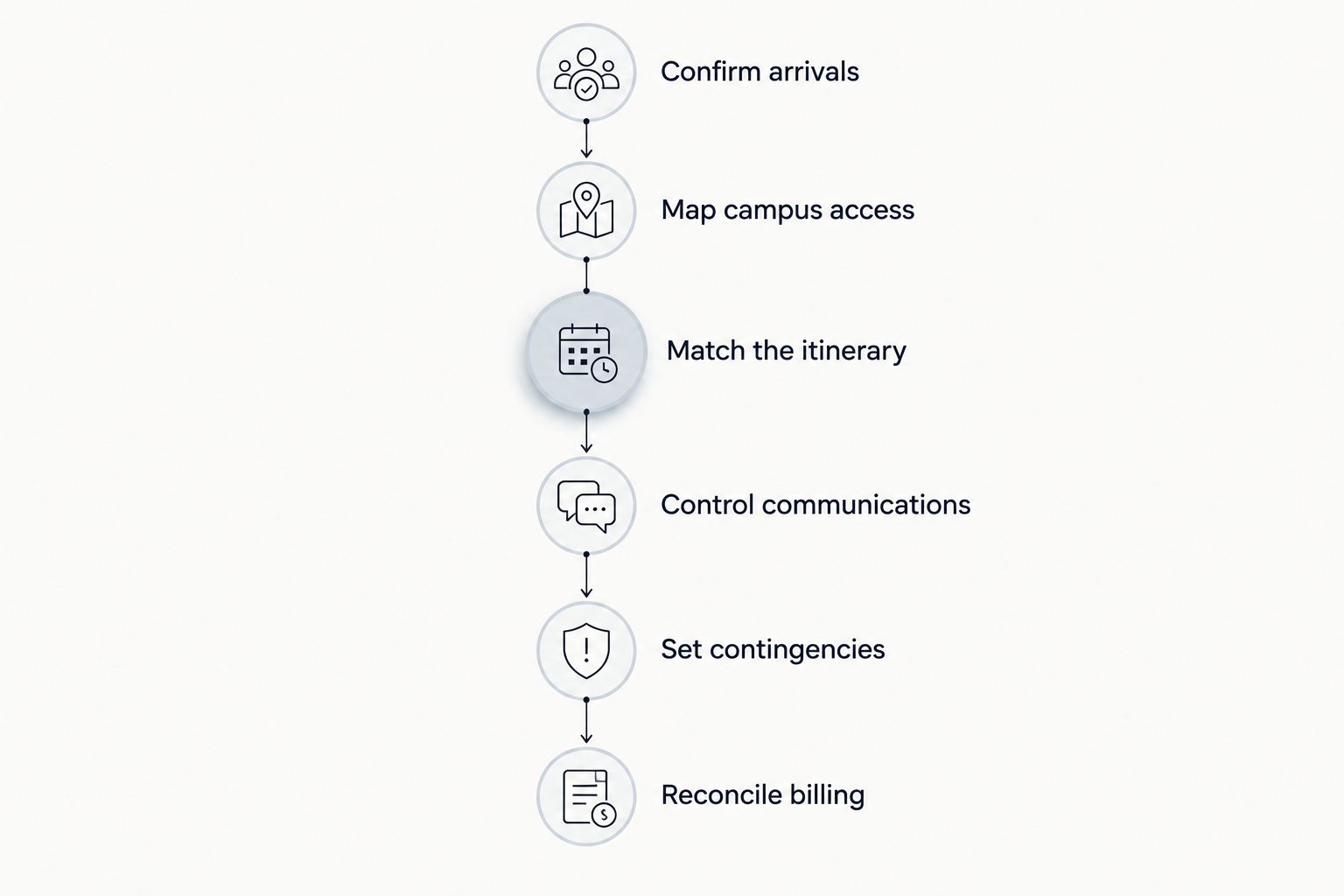
Confirm arrivals
Start with a shared worksheet and the airline information supplied by each traveler or authorized assistant. Separate flight arrival from the requested campus arrival: immigration, baggage collection and the onward journey are different parts of the schedule. Do not assign an assumed transfer duration without checking the actual route and conditions.
Request flight tracking from the transport provider, then confirm how an aircraft delay affects the pickup. Tracking a flight does not, by itself, establish where a traveler meets the chauffeur or how dispatch learns that the traveler is ready.
- Record the arrival airport, flight identifier and local arrival date.
- Capture the passenger count and luggage requirements without assuming vehicle capacity.
- Confirm the pickup method and traveler contact channel.
- Identify who receives delay updates and revised pickup instructions.
- Record the required campus arrival time separately from the flight time.
Map campus access
Build a campus access note manually with the university host or facilities contact. A street address is not enough when the meeting room, vehicle entrance and passenger drop-off are in different places. Have the host confirm the current arrangement rather than relying on a previous visit.
For a 2026 trustee meeting, keep vehicle instructions separate from the full board agenda. The chauffeur needs the approved access point and an operational contact, not confidential meeting materials. Check permission to wait as well as permission to enter.
- Specify the building entrance and approved vehicle approach.
- Confirm gate access, loading restrictions and any required authorization.
- Identify a permitted waiting location for the vehicle.
- Ask the traveler privately about mobility or assistance requirements.
- Name a campus contact who can resolve access problems on arrival.
Match the itinerary
List every required journey before selecting the service type. A spreadsheet can show whether the visit consists of isolated transfers or a sequence of stops with uncertain departure times. Choose the transport arrangement from the itinerary, not from the label attached to the event.
Point-to-point travel suits a defined origin and destination. An hourly charter suits a schedule requiring a vehicle across several stops, subject to the provider's confirmed terms. For trustees arriving separately, check whether shared travel fits their actual timing before combining passengers.
- Separate airport journeys from campus and off-campus movements.
- Mark each departure as fixed or dependent on the meeting schedule.
- Identify stops involving luggage or a change of passengers.
- Confirm whether the vehicle remains assigned between journeys.
- Request written handling instructions for added stops or extended use.
Control communications
Create a concise movement brief and designate an owner. Email and a shared document are enough to establish the process; the essential requirement is an authoritative version that dispatch, the board office and the traveler can distinguish from earlier drafts.
Your 2026 transport brief should identify who can authorize changes. A trustee can request a different destination, but the institution still needs a clear process for recording that request and managing the resulting journey. Keep personal details limited to what each recipient needs.
- Name the board-office lead and a backup contact.
- Specify who can approve route, passenger and schedule changes.
- Send travelers a concise pickup summary rather than the entire movement sheet.
- Give dispatch only the operational information required for the journey.
- Record revisions with a clear version label and local time zone.
Set contingencies
Write down the response to a delayed flight, an inaccessible entrance and an overrun meeting. Begin with a simple exception log: the event, the person responsible for deciding and the approved communication route. Do not leave these decisions to competing message threads during the visit.
Ask the provider how dispatch handles each exception and what requires fresh approval. Do not assume that a flight change automatically changes a booking, or that a charter automatically includes any extension. Obtain the applicable terms before travel.
- Confirm who reports a missed connection or changed arrival airport.
- Identify an approved alternative campus meeting point.
- Establish who decides whether separate arrivals should still travel together.
- Record the process for requesting a replacement vehicle or revised journey.
- Clarify how the traveler contacts dispatch if the pickup contact is unreachable.
Reconcile billing
Set up a basic trip register before requesting transport. Give each movement a reference that connects the itinerary, authorization and invoice. The university's own procurement and expense rules determine what documentation is required; do not substitute the provider's standard booking fields for institutional requirements.
For the 2026 board travel file, separate planned journeys from approved changes. That distinction helps finance understand why the final movement record differs from the original itinerary. Ask whether consolidated billing is available when several travelers or journeys belong to the same visit.
- Supply the correct billing entity and institutional reference.
- Record the person authorized to approve additional travel.
- Request the provider's written cancellation, waiting and amendment terms.
- Agree how completed journeys and changes appear on the invoice.
- Reconcile the invoice against the final movement record, not an outdated draft.
The planning sequence is straightforward: confirm travelers, resolve access, choose the service arrangement, assign communications, document exceptions and close the billing record. Keep these decisions connected in the same operating brief.
Compare transport arrangements for trustee visits
No transport arrangement is best for every movement. Select each option against the visit's timing, access and change requirements. The table compares service arrangements, not guarantees about any particular operator.
| Option | Best for | Operational advantage | Key limitation |
|---|---|---|---|
| Prearranged airport transfer | A defined airport-to-campus or hotel journey | Establishes the pickup and destination before travel | Later stops or changed destinations require confirmation |
| Point-to-point chauffeur service | A scheduled journey between known addresses | Gives the board office a defined movement to coordinate | Does not establish continued vehicle assignment afterward |
| Hourly chauffeur charter | Several stops or departure times tied to meetings | Supports planning around a sequence of movements | Duration, extensions and vehicle assignment need written agreement |
| Institution-coordinated shared transport | Trustees whose arrivals and destinations align | Combines compatible journeys within a shared plan | Different arrival times or meeting obligations can make sharing unsuitable |
A combined plan can be more appropriate than a uniform booking. For example, assign a defined airport transfer on arrival and assess the campus meeting sequence separately. Do not place every trustee on an hourly arrangement simply because some participants need multiple stops.
For your 2026 comparison, ask every prospective provider to respond to the same brief. Compare pickup handling, dispatch responsibility, change procedures, vehicle suitability and billing documentation. Vehicle presentation alone does not answer those questions.
Common mistakes university travel coordinators make
Treating the campus address as a complete destination
A correct address can still leave the traveler at the wrong entrance. Verify the passenger drop-off with the meeting host, and pass the approved instructions to dispatch. Keep building access questions with the campus contact rather than expecting the chauffeur to resolve institutional permissions.
Combining trustees because they attend the same meeting
A shared destination does not establish compatible arrival times, luggage needs or departure obligations. Group travelers only after checking those details. Preserve separate movements when sharing would conflict with the required schedule.
Distributing the board agenda as the transport brief
A full agenda contains information dispatch does not need. Create a separate movement sheet with destinations, timing, relevant access instructions and authorized contacts. Handle personal information according to university requirements and ask the provider how it manages booking data.
Assuming vehicle assignment includes protective services
A chauffeur booking and a protective transport plan are different arrangements. If a trustee's visit requires security coordination, have the university's designated lead define those requirements separately. Do not infer protective capabilities from vehicle appearance or executive-service language.
Checking the invoice against the original itinerary
The first itinerary stops being the correct reference when authorized journeys change. Maintain a final movement record and retain the approvals. This gives finance a direct explanation for amendments without reconstructing the visit from personal messages.
Where Chauffyr fits in the trustee travel plan
Chauffyr is best for university travel coordinators seeking airport transfers and hourly charters through one 24/7 desk. The service also includes point-to-point travel and coordinated multi-city transport. Use the completed operating brief to establish whether the proposed arrangement fits the trustee visit.
Chauffyr provides US-based coordination with worldwide service through vetted chauffeurs and affiliates. Its stated coverage includes 120+ airports across 50+ countries, with flight tracking and corporate accounts offering consolidated billing. Confirm the requested airport, route, vehicle suitability and applicable booking terms for the specific journey.
The operational advantage of Chauffyr chauffeur service is a central coordination contact across the stated service types. The limitation is that general coverage information does not confirm a particular campus access arrangement, vehicle configuration or institutional requirement. Those details belong in the booking confirmation.
Arrange trustee travel
Share the itinerary, campus access instructions and billing requirements for the proposed journeys.
FAQ
What's the best chauffeur service arrangement for university trustees?
The best arrangement matches each trustee's actual itinerary. Use defined transfers for fixed journeys and assess an hourly charter when several stops or meeting-dependent departures require continued vehicle assignment.
Should university trustees share an airport transfer?
Trustees should share an airport transfer only when their arrival times, destinations and passenger requirements align. Check luggage, required campus arrival times and the response to a delayed flight before combining bookings.
What should a university board office send to the chauffeur provider?
Send a transport brief with traveler details, flight information, destinations, approved campus access instructions and authorized contacts. Keep confidential board materials out of the dispatch brief unless a specific operational requirement justifies sharing them.
Does flight tracking mean the chauffeur will meet a trustee inside the terminal?
Flight tracking does not establish the pickup meeting point. Confirm whether the arrangement uses an inside meeting point or another approved pickup location, and give the traveler the corresponding instructions.
Is an hourly charter better than point-to-point travel for a board meeting?
An hourly charter fits a sequence of stops or meeting-dependent departures; point-to-point travel fits a defined journey. Confirm vehicle assignment, duration and amendment terms before choosing either arrangement.
Can Chauffyr coordinate trustee journeys in different cities?
Chauffyr offers coordinated multi-city transport through US-based coordination and vetted chauffeurs and affiliates. Confirm the specific airports, routes and booking requirements rather than treating general worldwide coverage as a confirmed itinerary.
How should a university manage billing for trustee transport?
Connect each journey to an institutional reference and reconcile the invoice against the final approved movement record. Establish the billing entity, approval authority and required documentation before travel.
One last thing
Put the required campus arrival time beside the flight details, not in a separate email. That single planning choice makes the actual objective visible to everyone coordinating the journey. In your 2026 trustee travel brief, also name the person authorized to act when those timings no longer fit.


