
Trade show delegates’ chauffeur service is prearranged ground transport connecting airports, hotels, exhibition venues and meetings so your delegation can follow one controlled itinerary. This guide explains how to plan a chauffeur service for trade show delegates in 2026, including separate arrivals, venue pickups, schedule changes and billing.
- Choose airport transfers for defined arrivals, hourly charters for changing schedules, and point-to-point travel for confirmed journeys.
- A chauffeur service for trade show delegates needs one movement manifest, clear pickup instructions and an authorized coordinator.
- Chauffyr suits coordinators seeking airport transfers and hourly charters through one 24/7 desk.
- Confirm venue access, luggage requirements and change terms before approving delegate transport.
Why chauffeur service matters for trade show delegates
Trade show transport has to connect several schedules: flight arrivals, hotel check-in, exhibition access, private meetings and departures. A vehicle booking covers only one part of that chain. Your plan also needs to explain who travels together, where each pickup happens and who can approve changes.
For your 2026 event plan, distinguish a fixed appointment from a preferred departure time. An exhibitor briefing requires a different transport decision from an optional networking reception. Record that distinction before choosing the booking format.
Book around the delegate’s required arrival, not just the requested pickup. That gives the coordinator a clear basis for reviewing the route, venue entrance and contingency with the transport provider.
How to arrange delegate transport
1. Build one movement manifest
Start with a shared spreadsheet or document. Give each journey its own row, and nominate one person to maintain the current version. Separate the person requesting transport from the person authorized to approve it; they are not always the same.
Record arrival flights and departure flights as distinct movements. Add the event’s local time zone wherever people are coordinating across countries. For a 2026 trade show, use the event’s current access instructions rather than reusing last year’s entrance details.
Keep personal information limited to what the journey requires. A chauffeur needs an actionable brief, not the delegate’s full meeting agenda or confidential business context.
- Record the traveler’s name, mobile number and coordinator contact.
- Enter the flight, hotel, destination and required arrival time.
- Identify shared journeys and separate departures.
- Assign an approver for itinerary changes.
- Mark the document version and remove superseded copies from circulation.
2. Match each movement to its booking format
Map the itinerary manually before asking for a quote. Use an airport transfer for a defined airport journey, point-to-point travel for a confirmed origin and destination, and an hourly charter when you need a vehicle assigned across a sequence of stops.
Choose the format per movement, not per delegation. Your arriving guests can need airport transfers while the lead executive needs an hourly charter for meetings. Putting everyone on the same booking format sacrifices useful flexibility or adds a scope you do not need.
An hourly booking still needs instructions. Confirm the planned stops, standby expectations and process for extending or changing the assignment; do not treat hourly service as an unrestricted arrangement.
- Separate airport arrivals from exhibition-day movements.
- Mark journeys with confirmed destinations and departure times.
- Identify meeting sequences that need an hourly charter.
- Request the scope and change terms for each booking format.
- Keep unconfirmed social plans separate from essential transport.
3. Validate vehicle requirements and venue access
Collect passenger and luggage requirements yourself, then ask the provider to confirm a suitable vehicle arrangement. Describe the actual load: delegates, suitcases, presentation materials and any mobility requirements. A vehicle category alone does not establish that everything will fit.
Venue access needs a separate check. Ask the organizer which entrance accepts passenger vehicles, whether credentials are required, and where drivers should wait when they cannot remain at the door. Do not substitute an exhibitor loading entrance for an approved passenger pickup.
Resolve these details before issuing the final itinerary. Discovering an access restriction at the venue leaves the delegate and chauffeur trying to repair the plan separately.
- Confirm passenger numbers and luggage for every shared movement.
- Declare presentation materials and unusual items in advance.
- Request confirmation of accessibility requirements.
- Obtain the approved passenger entrance and pickup location.
- Ask who handles venue credentials and access permissions.
4. Write an airport-to-venue handoff plan
Build the handoff in plain text before distributing it. Name the arrival airport, flight, meeting procedure, first destination and receiving contact. Request flight tracking, then confirm how an updated arrival affects the pickup arrangement.
Flight tracking does not replace instructions for baggage delays, changed flights or a traveler who cannot find the meeting point. Each situation needs a contact route. Your delegate should know whom to call without searching through a long booking thread.
For your 2026 arrival brief, give the traveler a concise instruction sheet and keep the operational detail with the coordinator. Use the same destination names in both documents so the hotel, venue and chauffeur receive a consistent brief.
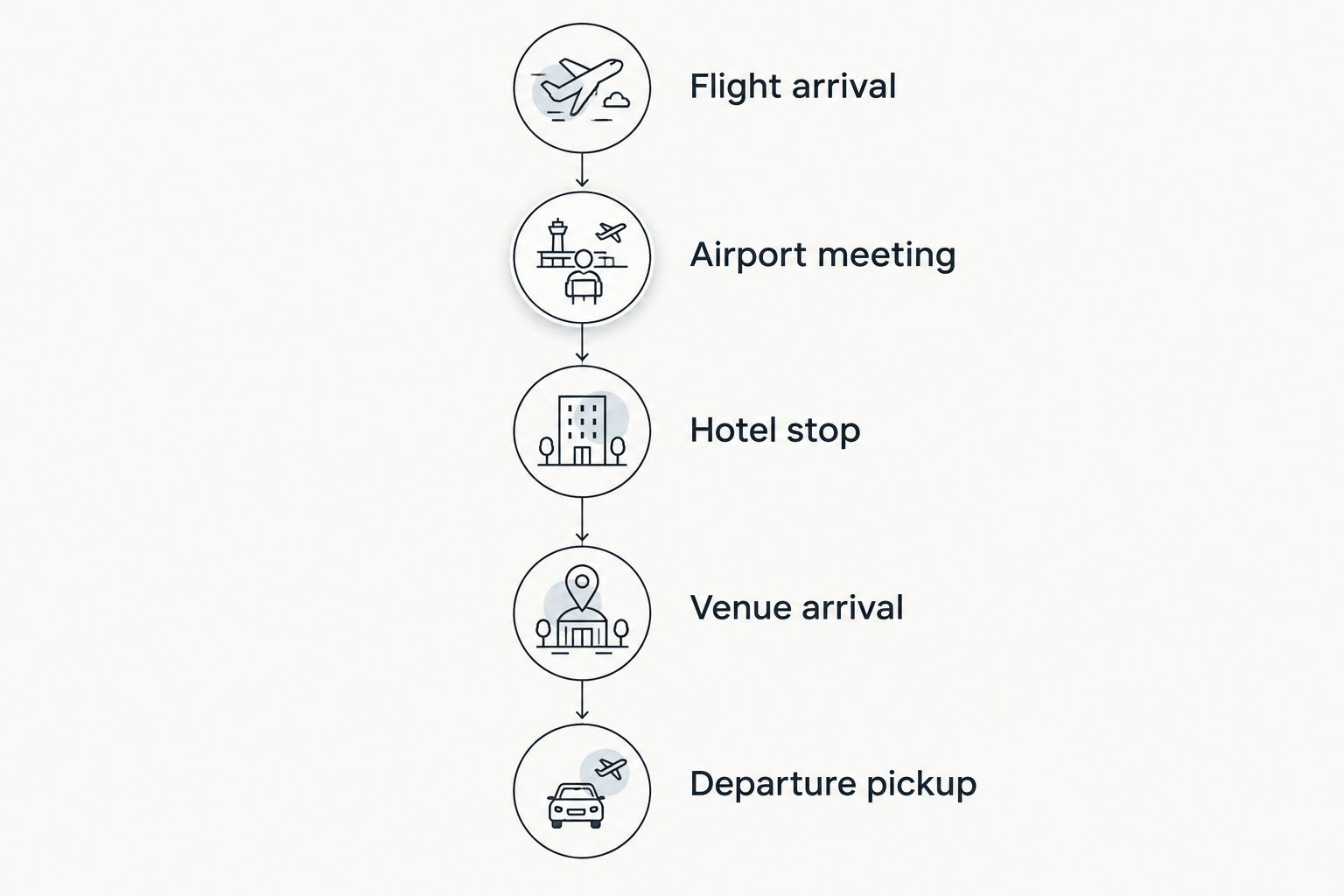
- Flight arrival: record the flight and confirm tracking arrangements.
- Airport meeting: specify the meeting procedure and contact route.
- Hotel stop: state whether check-in or a luggage drop is required.
- Venue arrival: identify the approved entrance and receiving contact.
- Departure pickup: issue return instructions as a separate movement.
5. Establish a change and privacy protocol
Use a shared change log or a clearly named message thread. Identify the current instruction, the requested change and the person approving it. A revised pickup is not confirmed merely because someone sent a message; require acknowledgment from the responsible transport contact.
Keep the delegate-facing message brief. The coordinator can manage route, timing and booking implications without forwarding every operational exchange to the traveler. Share sensitive itinerary details only with people who need them to deliver the movement.
Do not describe a standard chauffeur booking as protective security. If the delegation has security or diplomatic protocol requirements, route those requirements through the responsible security or protocol lead and confirm responsibilities separately.
- Name the authorized coordinator and a backup contact.
- Require acknowledgment of revised pickup instructions.
- Record the latest approved destination and departure time.
- Define who receives traveler information and itinerary updates.
- Keep security responsibilities distinct from transport coordination.
6. Reconcile confirmations and billing before travel
Create a booking checklist that mirrors the movement manifest. Check each confirmation against the approved journey rather than reviewing confirmations in isolation. An accurate booking can still be wrong for the itinerary if the venue, hotel or date has changed elsewhere.
For the 2026 event file, agree how invoices should identify journeys, travelers or cost centers. Ask how changes, waiting and additional stops are recorded under the applicable booking terms. An upfront quote does not remove the need to understand the agreed scope.
Close each movement after travel. Record a cancellation, changed destination or completed journey while the details are clear, then reconcile the invoice against that record.
- Match every confirmation to an approved manifest entry.
- Verify local dates, times, addresses and passenger requirements.
- Confirm the change, cancellation and waiting terms.
- Supply the billing entity and required cost-center references.
- Retain journey changes alongside the final invoice record.
Compare transport options for your delegation
Use airport transfers for defined arrivals and hourly charters for changing meeting schedules. Point-to-point bookings work when the journey itself is settled. Neither format fixes an unclear pickup instruction or an unapproved venue entrance.
The table compares operating formats, not interchangeable service promises. Confirm the actual scope with the provider before assigning an option to a delegate.
| Option | Best for | Operational advantage | Key limitation |
|---|---|---|---|
| Prearranged airport transfer | Delegates arriving on known flights | Connects a specified arrival with an agreed destination and meeting procedure | Later meetings and additional stops need separate confirmation |
| Hourly charter | Executives attending a sequence of meetings | Keeps the planned stops within one assigned service period | Service scope, standby instructions and changes still require agreement |
| Point-to-point booking | A confirmed hotel-to-venue or meeting journey | Defines the origin and destination clearly | An uncertain return or extended meeting needs its own arrangement |
| Organizer shuttle, when offered | Delegates whose plans match the published service | Gives travelers an event-defined transport option | Suitability depends on the published route, stops and timetable |
| Independently arranged journeys | Delegates managing separate itineraries | Leaves each traveler in control of individual bookings | The coordinator must collect confirmations to maintain a complete movement record |
A mixed plan is often the clearest operational choice: assign the format that matches each journey. Keep all movements in the same manifest, including those booked independently, so a missing confirmation does not look like a missing traveler.
Common mistakes trade show coordinators make
Using the exhibition address as the pickup instruction
A street address does not identify a passenger entrance or a workable meeting point. Confirm the entrance with the organizer, then give the traveler and transport contact the same location description. Include a fallback meeting instruction agreed with the provider.
Booking the group around the principal’s schedule
The lead executive’s meetings do not define every delegate’s travel needs. Build separate movements for exhibition staff, visiting executives and guests with different departures. Combine journeys only after checking the shared timing and destination.
Treating flight tracking as the complete arrival plan
Flight tracking addresses flight status, not every part of the airport handoff. Confirm the meeting procedure, baggage-delay contact and instructions for a changed flight. The delegate should have a usable contact route before departure.
Leaving the return journey undecided
A confirmed arrival does not establish a return pickup. Decide whether the return is a separate point-to-point booking or part of an agreed hourly assignment. Give the coordinator a clear instruction for extending a meeting or leaving an evening event early.
Approving a quote without checking its scope
Compare the quoted movement with the actual itinerary, including intermediate stops and standby expectations. Ask for applicable terms rather than assuming every change is included. Keep the approved scope with the booking confirmation so finance can reconcile the final record.
When Chauffyr fits the delegate travel plan
Chauffyr provides executive chauffeur services covering airport transfers, hourly charters and point-to-point travel. Its US-based coordination supports worldwide service through vetted chauffeurs and affiliates, with coverage at 120+ airports across 50+ countries. That distinction matters: worldwide coordination does not mean an owned fleet in every destination.
Chauffyr is best for trade show coordinators who need airport transfers and hourly charters through one 24/7 desk. Flight tracking and corporate-account consolidated billing support a plan managed across several movements. The service also uses fixed, upfront pricing and no surge; confirm the requested itinerary and applicable terms when arranging travel.
Chauffyr chauffeur service still requires a complete brief. Airport coverage does not establish access to a particular exhibition entrance, confirm vehicle suitability for an unusual load, or replace a separate security arrangement. Submit those requirements for confirmation rather than treating them as included.
For a 2026 event, send the approved movement manifest to Chauffyr and request confirmation of the airport journeys, charter periods, venue instructions and billing requirements together. This gives the coordinator one scope to review before travelers receive their final instructions.
Arrange delegate travel
Share arrival flights, venue movements and billing requirements for a coordinated travel quote.
FAQ
What is a chauffeur service for trade show delegates?
A chauffeur service for trade show delegates is prearranged ground transport for airport arrivals, hotels, exhibition venues and related meetings. A workable plan identifies the traveler, pickup instructions, destination and person authorized to approve changes.
Is an hourly charter better than a point-to-point booking for a trade show?
An hourly charter fits a sequence of meetings or an itinerary that needs an assigned service period. A point-to-point booking fits a confirmed origin and destination; agree the scope and change terms before choosing either format.
What information should I send when arranging delegate transport?
Send passenger numbers, flight details, luggage requirements, destinations, required arrival times and coordinator contacts. Add approved venue entrances, accessibility requirements and billing references where relevant.
Does flight tracking cover every airport pickup change?
Flight tracking covers flight status, not the entire airport handoff. Confirm how revised arrivals, baggage delays, changed flights and difficulties finding the meeting point should be handled.
Can one vehicle arrangement cover the airport, hotel and exhibition venue?
An airport journey with a hotel stop and onward venue travel needs an explicitly agreed itinerary. Ask the provider to confirm the stops and suitable booking format rather than assuming a direct airport transfer includes them.
Does chauffeur service include security for diplomatic delegates?
A chauffeur booking does not establish a protective-security arrangement. Have the responsible security or protocol lead define those requirements and confirm responsibilities separately from transport coordination.
What should finance check before approving delegate transport?
Finance should check the billing entity, cost-center references, approved journey scope and applicable change terms. Reconcile completed movements and recorded changes against the invoice after travel.
One last thing
Give every traveler a short instruction that still works when the group chat is unavailable: the confirmed pickup location, the transport contact and the coordinator’s backup contact. Keep it separate from the full itinerary.
The best final check is to read the pickup instruction without the rest of the booking thread. If you cannot tell where to stand and whom to contact, revise it before sending it to the delegate.


