
Sports team chauffeur service is prearranged ground transport with the aim of getting players, coaches and support staff to the right place on schedule. A chauffeur service for sports teams must account for equipment, separate passenger groups and changing fixture times—not just the distance between an airport and a hotel.
- Choose chauffeur service for sports teams by passenger group, equipment requirements and itinerary—not vehicle appearance.
- Chauffyr is best suited to executive travel alongside a team, rather than an unverified whole-squad transport requirement.
- Use point-to-point transfers for fixed journeys and hourly arrangements when the same party needs several stops.
- Confirm vehicle suitability, airport meeting instructions and change procedures before approving the movement plan.
Why chauffeur service matters for sports teams
A team itinerary contains several different transport jobs. Players arriving together, a coach arriving separately and a club director attending a sponsor meeting do not necessarily need the same arrangement. Treating those movements as one booking obscures who needs which vehicle and when.
For your 2026 travel plan, separate the main team movement from executive, medical and support-staff journeys. A chauffeur arrangement can cover a defined passenger group, but the service label alone does not establish capacity for a full squad or its equipment.
Choose the transport format around the movement, not the other way around. Confirm passenger and luggage requirements before approving any vehicle category. Keep specialist equipment and accessibility requirements explicit rather than assuming they fit within a standard booking.
Build your sports team ground transport plan
Define each passenger group
Start with a shared document or spreadsheet. List each traveling party, its arrival details, its destination and the person authorized to change the booking. You do not need a booking platform to establish clear ownership.
Separate the passenger manifest from the version shared with every supplier. Your transport provider needs operational details, but not unrestricted access to the team's full itinerary or private information. Designate who can see each version.
For a 2026 tournament or away fixture, distinguish confirmed passengers from provisional travelers. A late roster change should trigger a capacity review, not just an amended name on the same booking.
Close this step with a usable passenger brief:
- Identify players, coaches, support staff and executive parties separately.
- Record passenger counts for each journey.
- Name a lead contact for each traveling party.
- Record accessibility and assistance requirements.
- Mark provisional travelers clearly.
Match vehicles to passengers and equipment
Prepare an equipment inventory before requesting a vehicle. Record bags and cases separately from passenger numbers, including any unusually shaped or bulky items. Send dimensions when fit is uncertain rather than describing everything as team luggage.
A black-car booking does not establish that the vehicle can carry a squad's equipment. Equally, a larger passenger vehicle does not automatically solve every loading requirement. Ask the provider to confirm the proposed vehicle against the actual inventory.
Do not approve a vehicle on passenger capacity alone. If equipment travels separately, assign responsibility for loading, delivery and receipt. Keep essential personal items with the appropriate travelers rather than relying on an unspecified handoff.
Use this vehicle-fit checklist:
- List passengers and their accompanying bags.
- Identify oversized equipment cases.
- Provide relevant equipment dimensions.
- Request written confirmation of the proposed vehicle's suitability.
- Assign an equipment handoff contact.
Build journeys around required arrival times
Work backward from the time the party must be ready, not merely present at the destination. An arena arrival, hotel check-in and sponsor appearance each have different handoff requirements. Include those requirements in the brief.
Your 2026 itinerary should distinguish flight arrival, passenger meeting, vehicle departure and destination arrival. They are separate events. Flight tracking helps coordinate an airport pickup, but it does not replace instructions for baggage collection, passenger contact or the meeting location.
Ask the provider to review the proposed departure time against the route and operating conditions. Do not copy the same allowance across different airports, venues or cities. Obtain local confirmation of access arrangements without assuming a chauffeur booking includes special entry privileges.
Make the timing brief actionable:
- Record the required destination arrival time.
- Separate flight arrival from vehicle departure.
- Confirm the airport meeting procedure.
- Verify the permitted venue drop-off location.
- Identify the person who approves departure changes.
Assign ownership of every handoff
Draw a simple movement chain in your shared document. For each handoff, name the person responsible and the person receiving the update. This makes coordination possible without asking every traveler to manage the supplier directly.
Use these handoff labels consistently: Passenger brief, Provider confirmation, Arrival contact, Venue handoff and Journey close. Each label represents a specific exchange of information, not a general instruction to keep everyone informed.
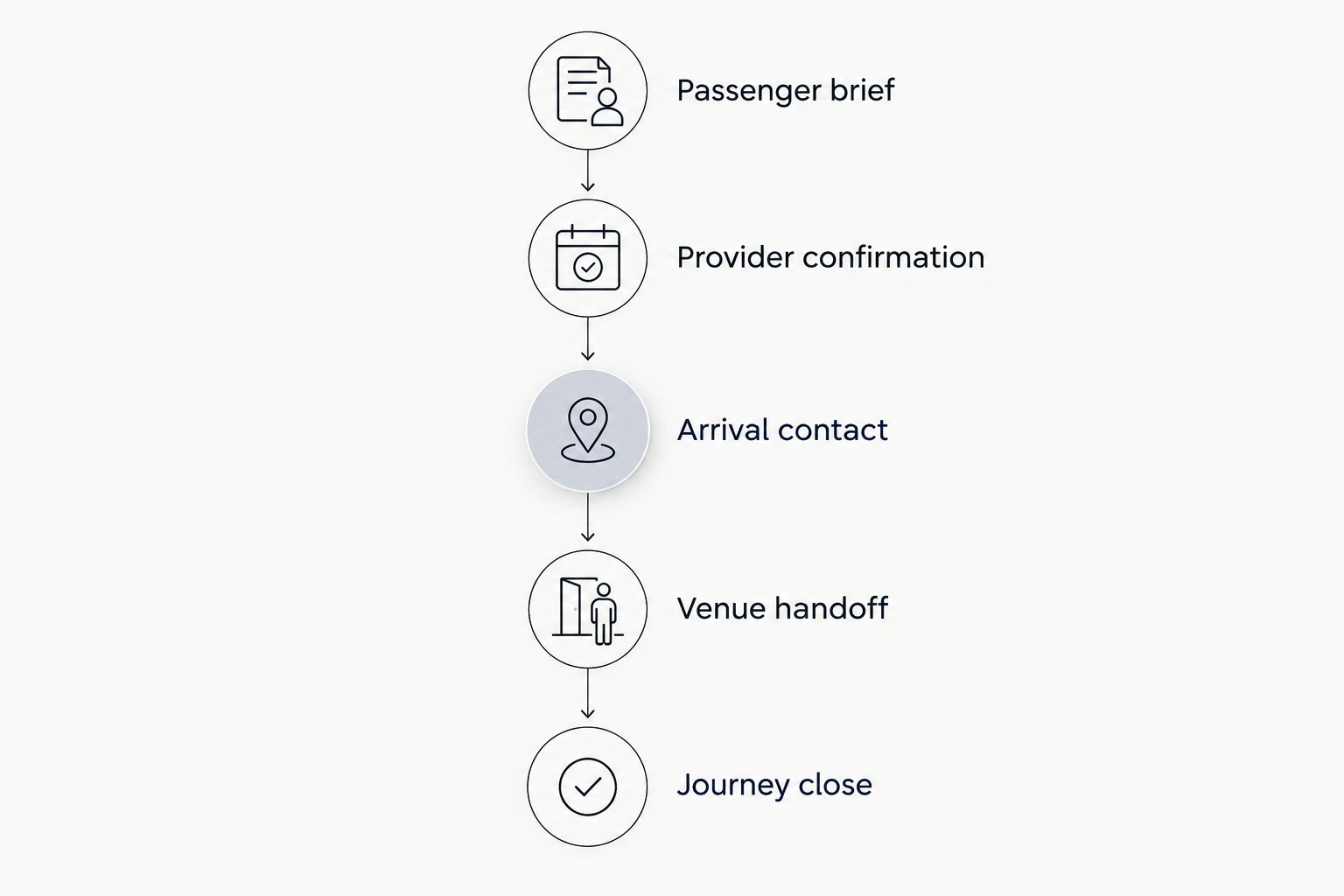
Keep the coordinator as the decision-maker for itinerary changes. Travelers should still receive clear pickup instructions and a usable contact method, but conflicting instructions should not reach the chauffeur from several people at once.
Document the handoff rules:
- Passenger brief: send the approved movement requirements.
- Provider confirmation: check the agreed transport arrangement.
- Arrival contact: establish who reports that the party is ready.
- Venue handoff: name the receiving contact where needed.
- Journey close: record completion and unresolved issues.
Set change and contingency procedures
Write the change procedure before travel begins. A shared contact sheet is enough to record the booking reference, the coordinator and the provider's operating contact. Keep it accessible to the people who actually manage the journey.
For your 2026 movement plan, distinguish a flight delay from an itinerary change. A delayed arrival affects pickup coordination; an additional hotel stop changes the requested journey. Ask how each situation is handled rather than assuming both fall within the original arrangement.
Confirm procedures for missed contact, changed venues and unavailable vehicles. A contingency plan is useful only when someone owns the next action. Do not describe a replacement arrangement as guaranteed unless the provider has explicitly confirmed it.
Set these procedures in writing:
- Name the person authorized to approve changes.
- Record how to report a delayed or canceled flight.
- Agree what happens when passengers cannot find the chauffeur.
- Confirm how additional stops are requested.
- Establish who communicates a replacement arrangement.
Reconcile bookings and billing
Build a simple journey ledger before requesting supplier documentation. Give every movement a reference that connects the approved request, confirmation and billing record. This lets your finance contact distinguish the team transfer from a separate executive journey.
Use your 2026 booking brief to establish billing ownership. A club, sponsor and individual traveler should not each receive an assumption about who pays. Identify the account or approving party before the journey is confirmed.
Ask for written commercial terms covering the requested itinerary and changes. Keep the operational brief separate from sensitive payment information. Where a provider offers consolidated billing, confirm which journeys and account entities it covers rather than assuming every movement belongs on the same statement.
Close the booking loop:
- Assign a reference to every journey.
- Record the approving organization or contact.
- Match confirmations to the approved itinerary.
- Document approved changes.
- Route billing questions to one finance owner.
Compare transport options for your team
Use different transport formats when the passenger groups have different jobs. A whole-squad airport movement and an executive's changing meeting schedule are separate requirements. Combining them for administrative simplicity can leave one party with an unsuitable arrangement.
The table below compares service formats, not verified fleet offerings. Confirm vehicle suitability and operating terms with the selected provider for every booking.
| Option | Best for | Operational advantage | Key limitation |
|---|---|---|---|
| Point-to-point chauffeur transfer | A defined passenger party making a fixed journey | Gives the booking a clear origin and destination | Additional stops or changed destinations require agreement |
| Hourly or as-directed chauffeur arrangement | Coaches or executives making several planned stops | Keeps multiple movements within one agreed service period | Hours, route scope and vehicle suitability need confirmation |
| Group coach or minibus arrangement | A squad traveling together | Keeps the main passenger group on one movement plan | Vehicle access, luggage fit and supplier terms still require verification |
| Separate equipment transport | Bulky kit traveling independently | Separates equipment handling from passenger seating needs | Adds a collection and delivery handoff |
| Mixed transport plan | Teams with different arrival times and duties | Matches each group to its actual itinerary | Requires a coordinator to maintain the full movement record |
Start with the simplest arrangement that meets the requirement. Add separate transport only when passenger numbers, equipment or schedules justify it. More bookings mean more handoffs to manage.
Common mistakes sports team coordinators make
Treating the team as one passenger group
A roster is not a movement plan. Staff arriving from another city or executives attending a separate meeting need their own journey records. Keep those records connected to the master itinerary without forcing everyone into the same departure.
Describing all baggage as standard luggage
Equipment cases and personal bags create different loading questions. Provide an inventory and obtain confirmation against the proposed vehicle. Do not leave the chauffeur to discover a fit problem at the airport.
Using landing time as pickup time
An aircraft's arrival does not mean the passengers are ready to leave. Separate the flight event from the passenger meeting procedure. Confirm how the party reports readiness and how the provider communicates meeting instructions.
Assuming vehicle service includes venue access
A booking does not establish permission to enter a restricted loading area, stadium approach or team entrance. Verify the permitted access point with the venue and share the approved instructions with the provider.
Letting everyone change the itinerary
Conflicting requests undermine a confirmed movement plan. Give travelers a way to report problems, but assign approval authority to a named coordinator. Record the revised itinerary and distribute the same version to everyone affected.
Where Chauffyr fits in a sports team travel plan
Chauffyr is best suited to executive travel alongside a team, rather than an unverified whole-squad transport requirement. Chauffyr provides executive black-car airport transfers, hourly charters and point-to-point travel. Its stated worldwide coverage includes 120+ airports across 50+ countries, with US-based coordination and service delivered through vetted chauffeurs and affiliates.
For a sports organization, assess Chauffyr chauffeur service against a defined executive or support-party brief. Flight tracking and one 24/7 desk address airport coordination and a central operating contact. Corporate accounts offer consolidated billing.
Those capabilities do not establish whole-team vehicle capacity, equipment fit, specialist medical transport or venue access. Confirm the specific journey and requirements before approval. Use Chauffyr to request a quote with the passenger brief, equipment inventory and itinerary attached.
FAQ
What's the best chauffeur service for sports teams?
The best chauffeur service for sports teams is the provider that confirms suitability for your passenger group, equipment and itinerary. Compare the proposed arrangement and change procedures rather than choosing by vehicle appearance alone.
Can a chauffeur service transport an entire sports squad?
A chauffeur service can transport an entire squad only when the provider confirms suitable vehicles and capacity for that booking. The service name alone does not establish passenger capacity or equipment space.
Is an hourly chauffeur better than a point-to-point transfer?
An hourly arrangement fits a party making several stops within an agreed service period; point-to-point transport fits a defined journey. Confirm how itinerary changes and additional stops are handled before choosing.
What details should I send for a sports team airport pickup?
Send the flight details, passenger count, equipment inventory, destination and lead contact. Request clear meeting instructions and confirm how the party reports that everyone is ready to depart.
Does flight tracking cover every airport delay?
Flight tracking follows the flight, not the team's progress through the airport. Confirm separate procedures for passenger readiness, baggage issues, missed contact and changes to the onward journey.
Does Chauffyr provide sports team buses?
The supplied service description does not establish a sports team bus offering. Chauffyr describes executive black-car transfers and charters; request confirmation of vehicle suitability for the specific passenger and equipment brief.
What should a 2026 sports team transport brief include?
A 2026 sports team transport brief should include passenger groups, equipment, flight details, destinations, required arrival times and approval contacts. Add venue access instructions, change procedures and billing ownership before confirming the booking.
One last thing
Give the return journey its own approval. The passenger list, equipment load and departure location after a fixture can differ from the arrival plan. Before travel begins, assign someone to reconfirm the return brief rather than treating it as the outbound journey in reverse.


