
Real estate developers’ chauffeur service is planned ground transport with the aim of keeping site visits, investor meetings, and airport arrivals on schedule. This 2026 guide explains how to brief a transport partner, choose the right booking format, and retain control when a property visit runs long.
- Chauffeur service for real estate developers should follow site access, meeting order, and change authority—not just pickup addresses.
- Choose hourly charters for changing site tours and point-to-point travel for clearly defined journeys.
- Chauffyr suits teams seeking airport transfers and hourly charters coordinated through one 24/7 desk.
- Confirm waiting arrangements, vehicle access, itinerary changes, and billing references before approving the booking.
Why chauffeur service matters for real estate developers
A development itinerary connects places with different access rules: an airport, an occupied building, a construction entrance, a sales office, and a meeting venue. A street address alone does not tell a chauffeur which gate to use or where passengers can safely step out.
The operational problem is continuity. When an inspection overruns, someone must decide which appointment moves, tell the transport coordinator, and keep the next host informed. Without that decision chain, a well-planned route becomes a series of conflicting instructions.
For your 2026 travel plan, define success through completed movements and clear handoffs rather than vehicle appearance alone. The right booking format supports the itinerary; it does not replace site permissions, realistic scheduling, or an accountable trip lead.
Your transport brief should answer three questions before anyone books:
- Who controls changes when the developer, investor, and site host have different priorities?
- Which stops require confirmed access, protective equipment, or a separate site escort?
- Which passenger, project, or entity should receive each journey’s billing allocation?
Book around the work taking place at each stop, not simply the distance between properties. A short drive still needs a workable arrival point, an available host, and a clear departure instruction.
How to plan developer ground travel
Define the purpose of each movement
Start with a shared itinerary document. List what each journey supports: an acquisition inspection, a lender meeting, a construction review, an investor tour, or an airport connection. Those purposes determine which appointments are fixed and which can move.
Separate passenger transport from site logistics. A chauffeur booking does not establish permission to enter a construction area, provide a site induction, or authorize a vehicle to use a restricted entrance. Assign those responsibilities to the relevant property or project contact.
For a 2026 trip involving several organizations, identify the person authorized to approve the transport brief. An investor’s assistant, development manager, and site superintendent can all contribute information without all issuing instructions during the journey.
Keep the brief readable on a phone. Put decision-critical details first, and store background documents separately so the coordinator does not have to search an investment presentation for the pickup location.
- Record the trip purpose beside each movement.
- Identify fixed appointments and flexible visits.
- Name the trip lead and a backup contact.
- Separate transport instructions from site-entry requirements.
- Mark passenger groups that must travel together.
Match the booking format to the itinerary
Sketch the day manually before requesting transport. A sequence of confirmed meetings with known departure times differs from a property tour whose order depends on access or discussion length.
Use point-to-point travel for defined journeys and consider an hourly charter for an evolving sequence of stops. Confirm the actual booking terms before treating either format as suitable for waiting, extra stops, or changes. A label alone does not explain what the booking includes.
Airport transfers deserve a separate movement in the plan. Record the flight, arrival airport, onward destination, and passenger contact rather than burying the arrival inside a general site-tour request. Ask how flight tracking connects to pickup coordination.
For split groups, define the reunion point. A principal leaving early for a legal meeting should not unintentionally remove transport needed by the remaining site visitors.
- Use airport transfers for arrival and departure movements.
- Use point-to-point travel for a clearly defined origin and destination.
- Assess hourly charters for tours with changing departure times.
- Confirm how waiting and itinerary amendments are handled.
- Give independently traveling groups separate movement instructions.
Confirm access before choosing the route
Check access directly with each property host. A mapping application can help order stops, but it does not confirm that a loading entrance is open, that visitors can enter a courtyard, or that a construction gate accepts passenger vehicles.
Ask the host to distinguish the postal address from the passenger arrival point. For an occupied development, confirm whether visitors should use reception, a leasing office, or another approved entrance. For a construction visit, agree on the safe public-side handoff unless site management explicitly approves another arrangement.
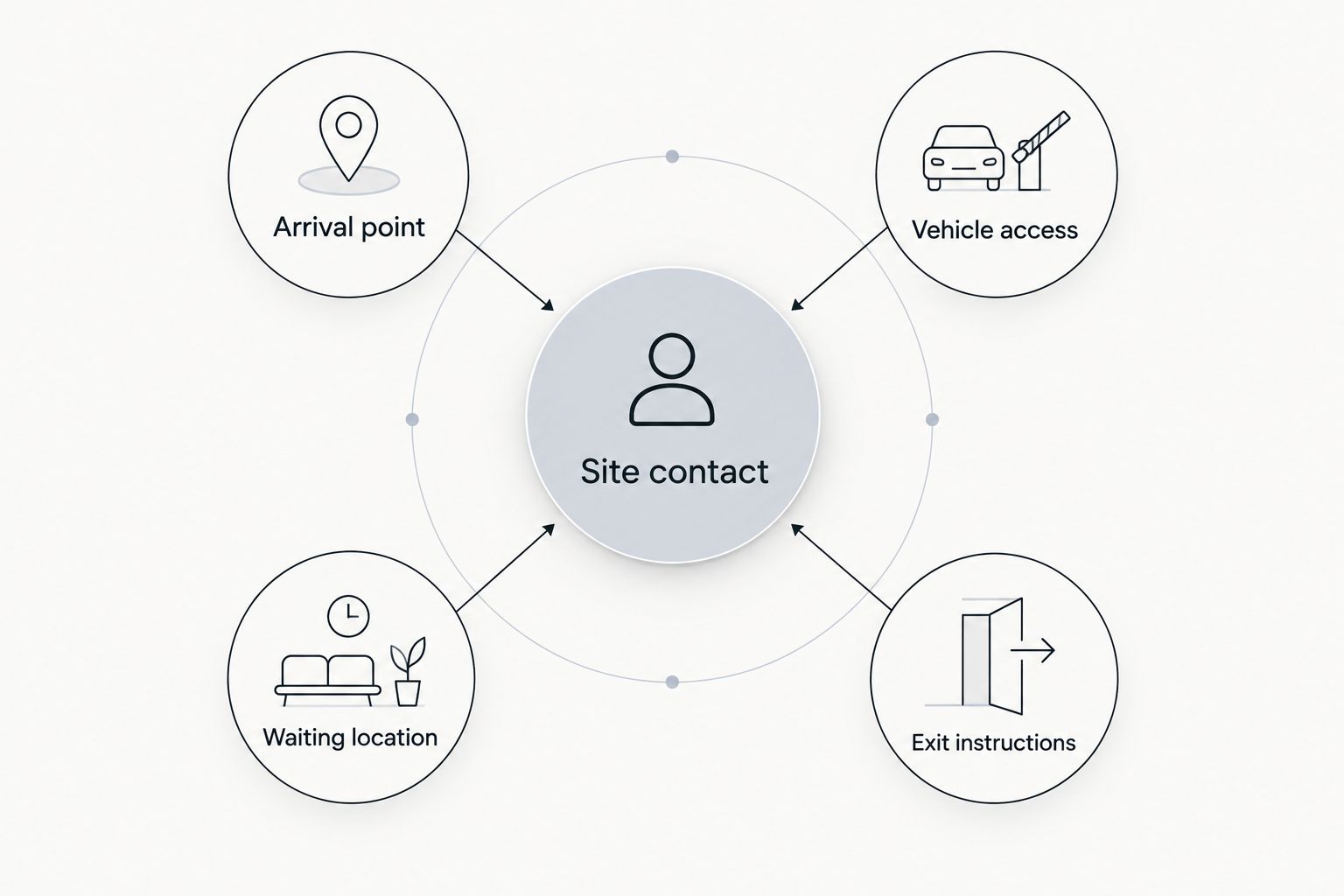
Use the following access fields consistently. They make a free-form itinerary easier to scan and give the coordinator something precise to clarify when instructions conflict.
- Arrival point: Name the approved passenger entrance.
- Site contact: Provide the person receiving the group.
- Vehicle access: Record restrictions confirmed by the host.
- Waiting location: Identify an approved place to wait or regroup.
- Exit instructions: Explain where passengers will return for departure.
Do not ask a chauffeur to resolve an access dispute at the gate. Keep the property host responsible for entry permission, and have the trip lead approve any substitute meeting point.
Build a schedule with explicit release decisions
Create the route in a calendar or spreadsheet, then check it with the people hosting each visit. Work backward from immovable commitments, especially flights, formal meetings, and access windows confirmed by a site representative.
Distinguish meeting end time from passenger-ready time. Visitors still need to leave the building, collect belongings, complete any site exit procedure, and reach the agreed pickup point. Treating these as the same event creates avoidable ambiguity.
For each stop, identify a release decision: who tells the chauffeur that the group is ready, and who decides to shorten or abandon the next visit? That instruction matters more than adding an unexplained cushion to every calendar entry.
Before circulating the final 2026 itinerary, check that every recipient sees the same version and local time references. Clearly mark a superseded version rather than leaving multiple documents in active use.
- Anchor the schedule around commitments that cannot move.
- Separate appointment finish from departure readiness.
- Assign authority to shorten, reorder, or cancel stops.
- Record the next destination beside each departure instruction.
- Distribute one current itinerary with a clear revision label.
Set communication and privacy boundaries
Use a short contact sheet rather than a long group message as the source of operational instructions. Identify the passenger contact, the booking coordinator, the site host, and the person who approves changes. Give each person only the information needed for their role.
A development visit can involve acquisition discussions, tenant information, financing documents, or an unannounced property interest. Do not place those details in transport notes when a neutral destination reference will do. Define what the provider needs to arrange the journey and keep transaction materials elsewhere.
Ask the transport provider how passenger details and itinerary changes are communicated. Treat confidentiality requirements as questions to resolve, not protections automatically created by booking a black car.
For a group containing external investors, agree whether the coordinator or the principal receives operational messages. Otherwise, a routine pickup clarification can interrupt the person hosting the visit.
- Name one authorized instruction channel.
- Provide a backup contact for an unreachable trip lead.
- Use neutral project references where practical.
- Keep transaction documents outside transport instructions.
- Confirm who receives chauffeur and pickup details.
- State how a passenger reports a changed destination.
Approve the brief and reconcile the journey
Send the completed itinerary to your coordinator and request a written confirmation that addresses the actual movements. Check dates, local times, passenger groups, luggage needs, stop sequence, access instructions, and the process for amendments. Resolve discrepancies before the trip begins.
An approval is not complete just because the vehicle category looks right. The booking must also match the itinerary’s structure: separate arrivals, waiting between visits, or a departure after the last meeting. Ask which requested elements have been accepted.
After travel, compare the final movements with the approved brief. Record authorized changes and allocate charges to the correct entity or project using your organization’s accounting rules. Keep the operational record separate from commercially sensitive meeting notes.
Use the completed trip to improve your next brief. Reusable access instructions are useful only after the property host confirms they remain current.
- Confirm every movement in writing.
- Record accepted access and waiting instructions.
- Assign a project or entity reference to each booking.
- Keep a record of authorized itinerary changes.
- Reconcile the final journey against the approved brief.
- Recheck saved property instructions before reuse.
Compare transport options for developer travel
Choose an option by the movement it must support. No single booking format covers every development itinerary equally well. The table separates operational strengths from limitations; confirm provider-specific terms before approving travel.
| Option | Best for | Operational advantage | Key limitation |
|---|---|---|---|
| Airport transfer | A defined airport arrival or departure | Keeps flight and pickup information attached to a specific movement | Does not establish arrangements for a later property tour |
| Point-to-point chauffeur booking | A confirmed journey between known locations | Gives the coordinator a clear origin and destination to approve | Additional stops and waiting need explicit confirmation |
| Hourly/as-directed charter | A connected tour with changing departure times | Lets you brief a sequence of visits within the agreed arrangement | Requires clear instructions about scope, timing, and amendments |
| Separately coordinated local providers | Teams managing their own arrangements in each destination | Allows direct discussion with each local operator | Your team must reconcile different contacts and booking processes |
| Chauffyr coordination | Teams seeking airport transfers and hourly charters through one desk | Combines US-based coordination with worldwide service through vetted chauffeurs and affiliates | Individual routes, access requirements, and booking terms still need confirmation |
Do not confuse a dedicated coordination contact with authority over a property. Your host still controls site entry, and your trip lead still controls the business agenda. A transport partner connects those instructions; it does not replace either role.
For repeat travel, compare the administrative process as closely as the journey itself. Ask how a changed passenger list, revised destination, or billing reference reaches the people responsible for delivery.
Common mistakes real estate developers make
Treating a site address as a pickup instruction
A property address can identify the parcel without identifying a usable passenger entrance. Get the arrival and departure points from the host, then include both in the transport brief. Do not leave the group searching for the vehicle after a tour.
Booking separate journeys without a group plan
Individual transfers can be appropriate, but they need a shared passenger plan when investors or project teams split up. Record who travels on each leg and what happens to the remaining group when a principal leaves early.
Letting every passenger redirect the itinerary
A useful suggestion becomes an operational problem when several people issue different destinations. Name the person who approves changes, and route requests through that person. The chauffeur should receive a resolved instruction, not an internal debate.
Assuming discretion equals a security arrangement
Professional presentation and privacy expectations do not establish protective transport, secure communications, or a security clearance. State any special requirement explicitly and obtain confirmation of the relevant capability. Keep security responsibilities with the people authorized to manage them.
Reusing an old brief without checking access
A saved itinerary is a starting point, not a current access authorization. Before reusing a 2026 brief, reconfirm the host, entrance, waiting instructions, and passenger list. Construction conditions and property arrangements require current instructions.
When Chauffyr fits the brief
Chauffyr is best for teams seeking airport transfers and hourly charters coordinated through one 24/7 desk. Its stated services also include point-to-point travel and coordinated corporate or delegation transport.
Chauffyr’s chauffeur service combines US-based coordination with vetted chauffeurs and affiliates worldwide. Its stated coverage includes 120+ airports across 50+ countries, with flight tracking and consolidated billing for corporate accounts. That coverage does not confirm a particular route or site-access requirement; request confirmation for your itinerary.
For a developer planning travel in 2026, the practical next step is to send the passenger movements, access notes, and change authority together. Use Chauffyr to request a quote against that brief rather than asking a coordinator to reconstruct the day from scattered messages.
FAQ
What's the best chauffeur service arrangement for a real estate site tour?
An hourly/as-directed charter fits a connected site tour with changing departure times, subject to the agreed booking terms. Confirm the stop sequence, waiting arrangements, access points, and who can authorize changes.
Is a point-to-point booking better than an hourly charter?
A point-to-point booking is better for a defined journey between known locations; an hourly charter suits a changing sequence of visits. Confirm extra-stop and waiting arrangements rather than assuming either format includes them.
Can a chauffeur enter a construction site?
Construction-site entry requires permission from the people controlling the site. Confirm vehicle access, passenger handoff, and any induction requirements with the site host before giving arrival instructions.
What should I send when requesting developer transport?
Send the passenger movements, dates, local times, arrival points, site contacts, and change authority. Include luggage needs, billing references, and any privacy requirements relevant to arranging the journey.
How should I arrange transport for investors arriving on different flights?
Create a separate arrival movement for each passenger group that travels independently. Identify the onward destination, receiving contact, and how each group joins the property-tour itinerary.
Does Chauffyr provide worldwide chauffeur coordination?
Chauffyr provides US-based coordination for worldwide service through vetted chauffeurs and affiliates. Its stated coverage includes 120+ airports across 50+ countries; confirm the specific destinations required for your trip.
How do I keep acquisition details out of transport instructions?
Use neutral project references and share only the information needed to arrange each movement. Keep transaction documents separate and confirm how the provider communicates passenger details and itinerary changes.
One last thing
Confirm the exit as carefully as the arrival. The entrance used for a hosted property tour is not automatically the place where visitors finish, regroup, or find their transport.
Before the group enters each property, have the trip lead confirm the departure point and the person who will send the ready-to-leave instruction. Add that detail to your 2026 itinerary template. It gives the next movement a clear starting point without requiring passengers to manage transport while hosting a conversation.


