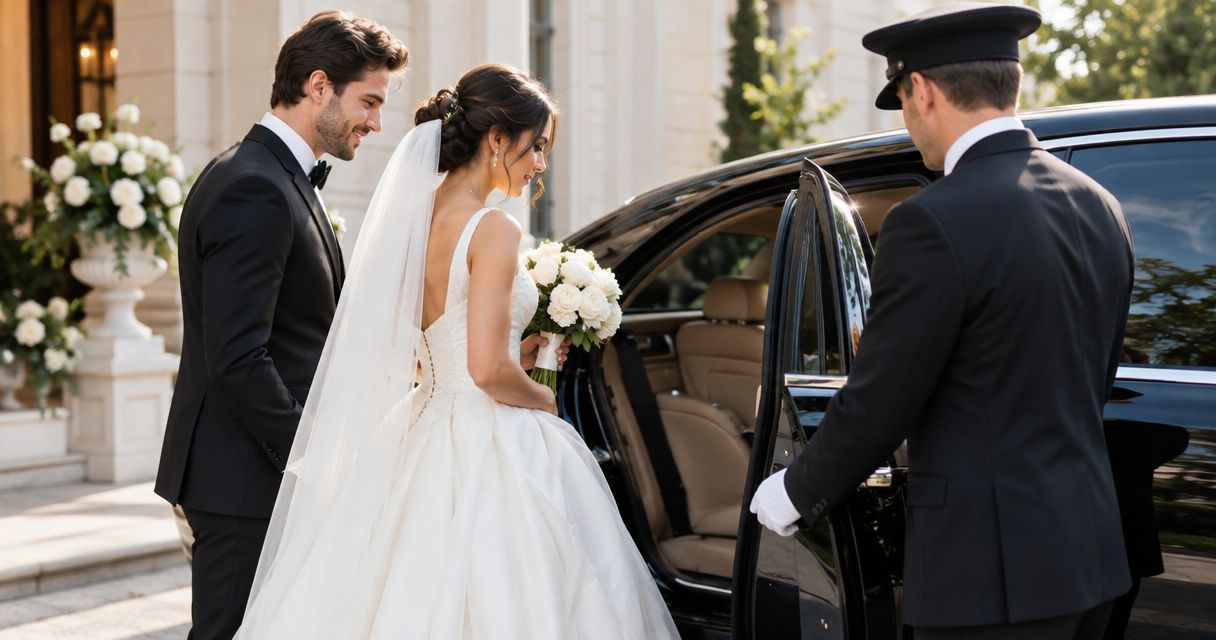
Luxury wedding party chauffeur service is prearranged ground transport that coordinates the couple, attendants, and guests with the aim of keeping wedding arrivals and departures on schedule. This guide explains how to plan a chauffeur service for luxury wedding parties in 2026, including vehicle assignments, venue access, privacy, and late-night changes.
- Book chauffeur service for luxury wedding parties around arrival deadlines, passenger assignments, and venue access—not vehicle appearance alone.
- Separate airport transfers, point-to-point travel, and hourly charters when building the wedding transport plan.
- Chauffyr offers executive transport; confirm wedding-specific requirements before booking.
- Give one coordinator authority over itinerary changes, chauffeur communication, and passenger updates.
Why chauffeur service matters for luxury wedding parties
Wedding transport connects events that cannot move independently: preparation, photographs, the ceremony, the reception, and departures. A vehicle booked for the right time but the wrong entrance still leaves the coordinator solving a problem at the curb.
Plan around the passenger handoff, not just the drive. Decide who confirms boarding, who receives arriving guests, and who authorizes a departure when someone is missing. Those responsibilities belong in the itinerary alongside addresses.
For executive-style transport, Chauffyr provides airport transfers, hourly charters, and point-to-point travel. Assess those services against the wedding itinerary; confirm event-specific requests separately rather than treating them as included.
The central planning constraint is dependency. If the couple's vehicle also carries attendants, a delayed preparation schedule affects everyone aboard. If overseas relatives arrive separately, one shared collection time does not solve their airport transfers. Your 2026 plan should make those dependencies visible before you assign vehicles.
How to plan wedding party chauffeur service
1. Build the itinerary backward from required arrivals
Start with the ceremony's required arrival time, then work backward through venue entry, unloading, travel, photographs, and boarding. Ask the venue and photographer which deadlines are fixed. A ceremony start and a wedding party arrival are different instructions.
Record the exact entrance for each stop. A property's postal address does not tell a chauffeur which gate permits passenger access or where vehicles can wait. Have the venue coordinator confirm those details directly.
Keep a master itinerary with 3 sections: movements, contacts, and exceptions. This is a planning format, not a service standard. It makes the operational instructions easier to find than a long narrative email.
For a 2026 wedding, verify access arrangements against the current event plan rather than copying instructions from an earlier visit. Include the final reception departure, not only the ceremony arrival.
- Record the required arrival for each passenger group.
- Confirm the permitted entrance and unloading location.
- Separate preparation, photography, ceremony, and reception movements.
- Ask the provider to assess route timing and waiting arrangements.
- Mark which deadlines require approval before they change.
2. Assign passengers before selecting vehicles
Create a passenger manifest before choosing vehicle types. List who travels together, who needs a separate departure, and who brings luggage, mobility equipment, or bulky clothing. Confirm capacity against the actual booking rather than relying on a vehicle category name.
The couple's journey also needs a practical boarding check. Formal clothing, garment bags, and photography equipment affect how people enter and use the vehicle. Ask the provider what can be accommodated; do not infer space from exterior photographs.
Build assignments manually in a shared document first. Separate essential wedding party movements from optional guest travel so that an added airport collection does not quietly displace the ceremony vehicle.
Accessibility deserves its own confirmation. State the assistance required and ask the provider to confirm the proposed arrangement. An executive vehicle description does not establish wheelchair access or specialist assistance.
- Assign named passengers to each movement.
- Record luggage and equipment alongside passengers.
- Confirm seating and storage for the assigned vehicle.
- Describe accessibility and boarding needs explicitly.
- Keep the couple's time-critical movements separate where necessary.
3. Match the booking format to each movement
Choose the service structure after mapping the day. Use point-to-point travel for a defined journey; evaluate an hourly charter when the itinerary requires continued vehicle access. Airport transfers need their own arrival instructions and passenger contacts.
The manual approach is a movement-by-movement booking sheet. Label every journey with its origin, destination, passenger group, and whether the vehicle must remain afterward. Send the same brief to each provider you evaluate so that proposals address the same scope.
A single coordinating provider is an alternative to managing separate bookings yourself. Its benefit is a central communication path; its limitation is that you still need explicit confirmation of every movement and service condition. Coordination does not replace a written itinerary.
For your 2026 booking, ask how changes to stops or duration affect the agreed service. An assigned vehicle for one transfer does not establish continued access throughout the reception.
- Use airport transfers for individual flight-linked arrivals.
- Use point-to-point bookings for defined departures and destinations.
- Evaluate hourly charters for linked stops and waiting requirements.
- Confirm when each vehicle's assignment begins and ends.
- Record which itinerary changes require a revised confirmation.
4. Establish one communication chain
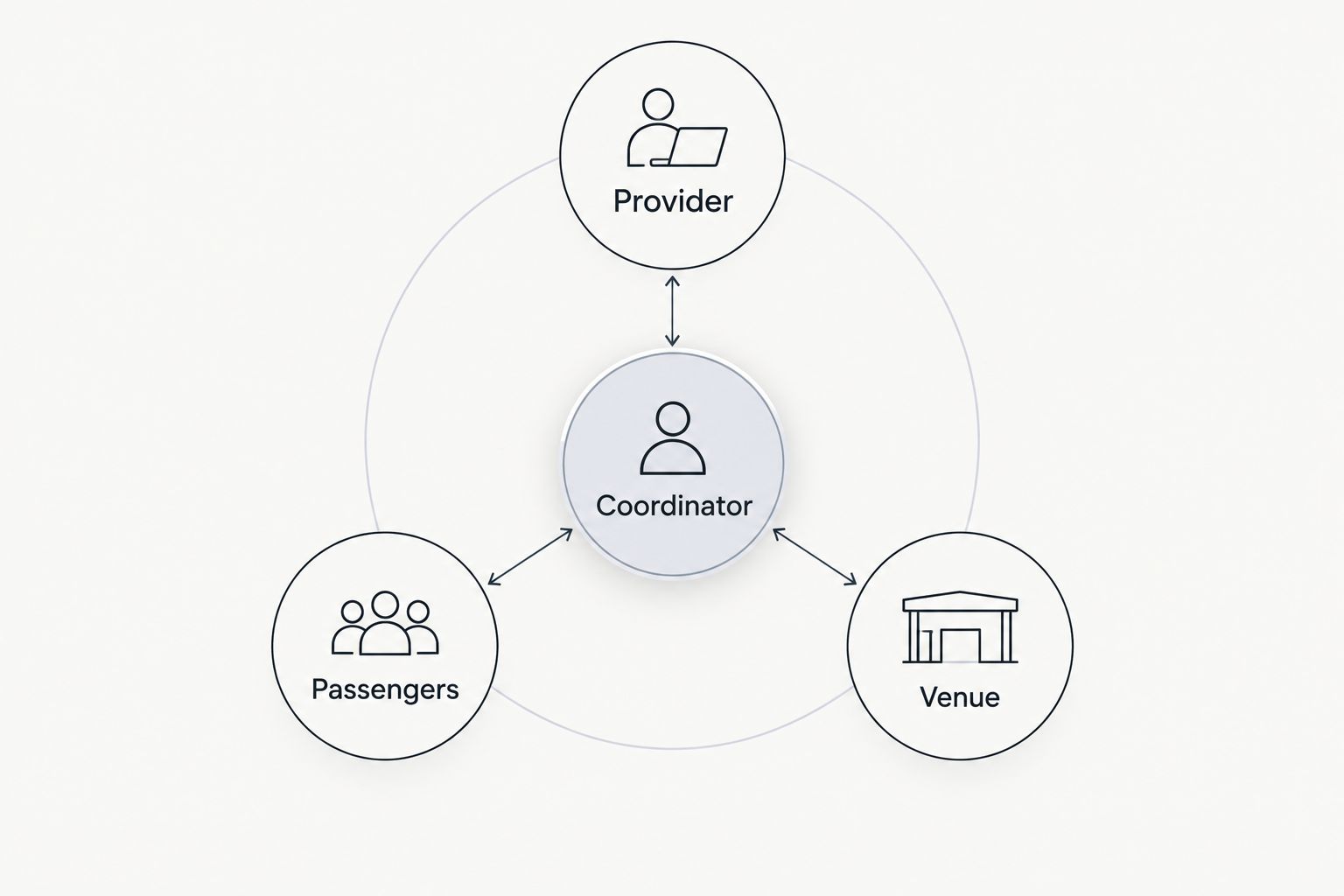
Make the wedding coordinator the operational contact rather than routing routine questions through the couple. Assign a backup who has the current itinerary and authority to act if the primary coordinator is occupied.
Use 2 coordinator contacts in the transport brief: primary and backup. Keep passenger contact details separate so chauffeurs know whom to call for a missing traveler and whom to call for a schedule change.
Use the same communication sequence for every movement: the coordinator issues the instruction, the provider confirms it, and the affected passengers receive the update. Avoid parallel instructions from relatives, attendants, and venue staff.
A provider's central desk offers a direct channel for cross-booking questions. The limitation is practical: the desk cannot resolve an unreported change. Give the coordinator responsibility for communicating decisions rather than assuming every participant sees the same messages.
- Name the primary coordinator and backup.
- Define who can approve a changed destination or departure.
- Record the provider's operational contact details.
- Share passenger updates through one agreed channel.
- Identify who confirms that each group has boarded.
5. Confirm access, discretion, and contingency instructions
A discreet arrival starts with specific instructions. Tell the provider which entrance to use, what passenger name to display if identification is needed, and who can receive journey updates. Do not send the entire wedding guest list when a movement needs only its assigned passengers.
Treat privacy as an operational request, not a security guarantee. Ask how passenger information and itinerary changes are handled. If the wedding includes diplomatic or government guests, have the responsible protocol or security team approve its own requirements separately.
Build exceptions into the plan before the day. State who decides what happens if preparation runs late, an entrance closes, a flight changes, or a passenger cannot be reached. Request the provider's actual procedures rather than assuming a replacement vehicle or extended assignment is automatic.
Review these instructions with the venue coordinator for the 2026 event. The chauffeur and venue team need compatible directions about access and waiting.
- Confirm passenger identification and signboard preferences.
- Limit itinerary distribution to people who need it.
- Record an alternate meeting point approved by the venue.
- Assign authority for delays and changed departures.
- Confirm how to request help during each booked movement.
6. Reconcile the final brief and billing instructions
Before confirming arrangements, compare the provider's written booking with your passenger manifest and venue instructions. Read every movement as an independent assignment. A correct ceremony transfer does not establish that the reception departure is also booked.
Create 3 documents for the final handoff: the movement schedule, passenger manifest, and contact sheet. Keep a revision date on each, and identify the version that supersedes earlier instructions. Send passengers only the details they need.
Clarify who receives billing documents and who can authorize added services. This matters when a planner, family office, employer, or individual guest is arranging different parts of the trip. Keep operational approval distinct from payment responsibility.
For a multi-day wedding, repeat the reconciliation for airport arrivals and departures. The event is not operationally complete when the reception ends; the final assigned guest journey still needs a responsible contact.
- Match each booking to a named passenger group.
- Check dates, local times, entrances, and destinations.
- Confirm the receiving contact for every arrival.
- Name the person authorized to approve added services.
- Retire superseded documents and distribute the final version.
Compare transport options by the job they perform
These options describe booking structures, not interchangeable wedding packages. Choose according to the movement you need and confirm the provider's terms in writing. No format removes the need for passenger assignments and venue access instructions.
| Option | Best for | Main advantage | Key limitation |
|---|---|---|---|
| Airport transfer | Guests arriving by air | Connects a specific flight arrival with an onward journey | Does not establish transport for later wedding events |
| Point-to-point travel | A defined hotel, ceremony, or reception journey | Gives one movement a clear origin and destination | Continued waiting or additional stops require confirmation |
| Hourly charter | Linked stops with a vehicle assigned for an agreed period | Supports an itinerary with ongoing vehicle access | Assignment duration and changes still need clear terms |
| Separately managed bookings | A planner coordinating independent movements | Lets you assign each journey individually | Leaves communication and reconciliation with your team |
| Centrally coordinated itinerary | Multiple passenger groups or connected journeys | Provides one communication path for the transport plan | Requires explicit confirmation of coverage and responsibilities |
Use a combination when the itinerary requires it. Airport arrivals and wedding-day movements solve different problems. Forcing every journey into the same booking format obscures where waiting, coordination, or separate passenger handling is required.
Common mistakes wedding party coordinators make
Choosing vehicles before confirming the manifest
A preferred appearance does not establish passenger or luggage fit. Confirm assignments first, then ask the provider to match the requirements. Keep decorative preferences separate from essential boarding and access needs.
Using the ceremony start as the drop-off deadline
Passengers still need to unload, gather belongings, and reach the preparation or ceremony area. Ask the venue for the required arrival instruction and give that instruction to the provider. Do not substitute a general invitation time.
Letting the couple become the dispatch contact
The couple cannot reliably handle routine chauffeur questions during preparation, photographs, and the ceremony. Give the coordinator authority to resolve those questions. Escalate only decisions that genuinely require the couple's approval.
Treating discretion as a protection service
Private transport arrangements and security operations are different scopes. State confidentiality requests plainly, and refer protective requirements to the responsible specialists. A black vehicle or chauffeur assignment does not establish protective capability.
Leaving the final departure undefined
An open-ended reception does not create an open-ended transport assignment. Record the planned departure, decision-maker, and process for requesting a change. Confirm the arrangement before passengers assume a vehicle remains assigned.
Where Chauffyr fits into the plan
Chauffyr is best considered for executive-style wedding guest transfers, with wedding-specific requirements confirmed before booking. Its stated services include airport transfers, hourly charters, and point-to-point travel, supported by flight tracking and one 24/7 desk.
Chauffyr uses US-based coordination with vetted chauffeurs and affiliates for worldwide service. That supports evaluating connected travel arrangements without assuming the company owns vehicles or employs chauffeurs in every destination.
The limitation is scope: executive transport services do not, by themselves, confirm wedding decoration permissions, particular vehicle assignments, accessibility arrangements, or venue-specific procedures. Submit the movement plan and request confirmation of those requirements for your 2026 itinerary.
Arrange your wedding travel
Share passenger assignments, airport arrivals, venue access, and the movements that need confirmation.
FAQ
What's the best chauffeur service for luxury wedding parties?
The best chauffeur service for luxury wedding parties is one that confirms your passenger assignments, arrival deadlines, venue access, and change procedures. Evaluate the written itinerary rather than vehicle photographs alone.
Is an hourly charter better than point-to-point wedding transport?
An hourly charter fits linked movements that require continued vehicle access; point-to-point travel fits a defined journey. Confirm the assignment period, stops, and waiting arrangements before choosing.
Can wedding guests use airport transfers separately from the wedding party?
Yes, plan guest airport transfers as separate movements from the wedding party's ceremony transport. Record each flight, passenger contact, destination, and receiving contact so airport changes do not alter the ceremony plan without approval.
How many vehicles should I book for a wedding party?
Determine vehicle requirements from the passenger manifest, luggage, accessibility needs, and simultaneous movements. Ask the provider to confirm the assigned vehicles' capacity rather than estimating from a category name.
Who should communicate with chauffeurs on the wedding day?
A designated coordinator should handle operational communication, supported by a named backup. Give that person authority to approve the changes specified in the transport brief.
What happens if the wedding schedule runs late?
Follow the delay and change procedure confirmed with your provider. The coordinator should report the revised departure, obtain confirmation, and update affected passengers rather than assuming the vehicle's assignment automatically extends.
Does Chauffyr provide a dedicated wedding package?
The supplied service information describes executive airport transfers, hourly charters, and point-to-point travel, not a dedicated wedding package. Ask Chauffyr to confirm the proposed wedding itinerary and any event-specific requests before booking.
One last thing
Confirm who receives passengers, not only who drives them. A chauffeur can reach the agreed entrance while the wedding party still lacks instructions for where to go next. Put a receiving contact beside every important arrival, and give that person the same current itinerary as the transport coordinator.


