
Family office chauffeur service is coordinated ground transport for principals, relatives and staff with the aim of keeping private and business travel under clear operational control. This 2026 guide explains how to manage arrivals, changing itineraries, information sharing and billing without making the principal the point of contact.
- Chauffeur service for family offices starts with an approved travel brief, a decision-maker and clear change instructions.
- Use airport transfers for defined arrivals and hourly charters for itineraries that need a vehicle retained.
- Chauffyr suits family offices seeking US-based coordination for international chauffeur travel.
- Confirm local fulfillment, passenger requirements and billing instructions before approving executive ground transport.
Why chauffeur service matters for family offices
A family office coordinates people whose travel requirements do not fit neatly into a standard corporate booking. A principal's meeting, a relative's arrival and an employee's onward journey can share an itinerary while requiring different contacts, information access and expense treatment.
The operational problem is not simply finding a vehicle. It is deciding who receives the chauffeur's details, who approves changes and what happens when the traveler cannot respond. The coordinator should own the instructions; the principal should not have to relay them.
For your 2026 travel procedures, separate three responsibilities: booking approval, day-of-travel decisions and expense allocation. One person can hold several responsibilities, but each responsibility needs an explicit owner. Otherwise, a chauffeur can receive conflicting instructions from the passenger, an assistant and a destination host.
A useful service arrangement also distinguishes coordination from local fulfillment. Ask who manages the itinerary and who supplies the chauffeur in each city. A central contact does not, by itself, establish identical vehicles, procedures or permissions across destinations.
Build your family office ground travel process
Define the travel brief
Start with a shared document or controlled spreadsheet. Record what the transport provider needs to complete the journey, not the principal's entire schedule or personal history. Keep a reusable traveler profile separate from the instructions for a specific trip.
Your 2026 travel brief should distinguish preferences from requirements. A preferred cabin arrangement is different from a necessary accessibility provision; both deserve clear wording. Record the person authorized to resolve any conflict between the request and the proposed vehicle.
Use functional labels such as traveler profile, journey details and approval contact. These make the document easier to update without copying sensitive material into every booking message. Give each trip a reference that the office and provider can use consistently.
- Record passenger names and the approved booking contact.
- State passenger count and describe luggage, including unusual items.
- Identify accessibility or child-restraint requirements where relevant.
- Separate essential vehicle requirements from preferences.
- Name the person authorized to approve itinerary changes.
Match the booking format to the itinerary
Map the stops manually before choosing a service. A defined airport arrival needs a different instruction set from a day of meetings with uncertain departure times. Do not assume that adding another stop preserves the original booking terms.
An airport transfer addresses a specific arrival or departure. Point-to-point travel connects defined locations. An hourly or as-directed charter suits a schedule in which you need the vehicle retained between movements. The right choice depends on what the vehicle must do while the traveler is elsewhere.
Compare the full assignment rather than the journey labels alone. Ask what happens during waiting periods, whether intermediate stops form part of the agreed scope and how changes are authorized. Put the answer into the booking record instead of leaving it in a separate conversation.
- Mark each pickup, destination and intermediate stop.
- Identify intervals when the vehicle must remain assigned.
- Confirm whether the return journey is separately arranged.
- Specify who can add a stop or change the destination.
- Request written confirmation of the agreed service scope.
Assign one coordination channel
Create a contact sheet before adding more people to a message thread. The traveler needs a usable contact, the chauffeur needs clear instructions and the office needs visibility. Those needs do not require everyone to receive every update.
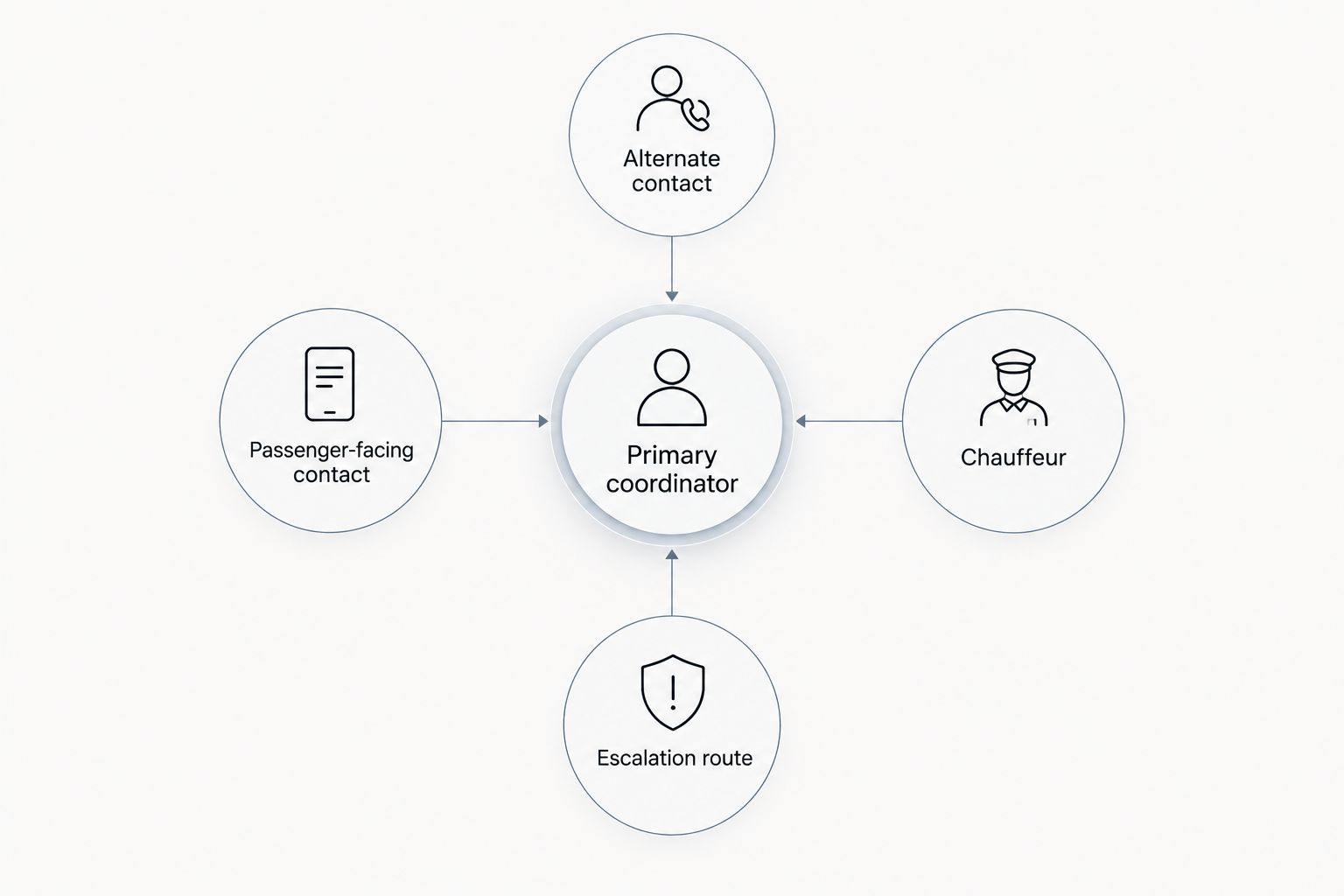
Choose one primary coordinator and an alternate. Define what each person can approve, particularly outside the office's working hours. If a destination host can direct a pickup adjustment, state whether that authority extends to changing the destination or adding passengers.
A provider with a central coordination desk offers a way to route changes without asking the assistant to contact each local supplier separately. That arrangement still needs boundaries: confirm who receives a request, who approves it and how the revised instruction reaches the chauffeur.
- Name the primary coordinator and alternate contact.
- Identify the passenger-facing contact method.
- Record who can approve changes during travel.
- Specify which updates the office must receive.
- Confirm the escalation route when a contact does not respond.
Confirm the airport handoff
Build the arrival instructions around the handoff, not just the scheduled landing time. Flight arrival, passenger readiness and vehicle pickup are distinct events. Immigration, baggage collection and the passenger's own plans affect when the traveler reaches the agreed meeting point.
Request flight tracking, but do not treat tracking as a substitute for meeting instructions. Confirm how the passenger identifies the chauffeur, what contact method works on arrival and where the traveler should wait if contact fails. Airport access arrangements require location-specific confirmation.
For private aviation, provide the relevant arrival facility and ground contact rather than assuming a commercial terminal procedure applies. Verify the handoff directly with the provider and the appropriate arrival contact. Do not promise airside access or a particular meeting location without confirmation.
- Supply the flight details and arrival date in local time.
- Confirm the terminal or arrival facility when known.
- Agree on the meeting method and identification approach.
- Request instructions for delays, diversions and missed contact.
- Confirm how changed arrival details reach the assigned chauffeur.
Limit information and document contingencies
Write a short information-sharing instruction for each assignment. The chauffeur needs enough detail to serve the traveler, but a full investment itinerary or guest list is not automatically necessary. Ask the office's privacy or legal lead to define any additional requirements.
Treat discretion as a set of instructions, not a reassuring adjective. Specify whether a name board is appropriate, which contact details can be shared and who receives journey updates. Do not equate a black vehicle or a vetted chauffeur with a protective security service.
Prepare a contingency record alongside the itinerary. It should identify the response to a changed flight, an unavailable contact or a vehicle issue without assuming the same remedy exists everywhere. Confirm replacement arrangements with the provider for the actual location and assignment.
- Share only the traveler information needed for the booking.
- State any restrictions on visible passenger identification.
- Identify the recipient of arrival and completion updates.
- Record instructions for flight changes and missed contact.
- Confirm the escalation process for a vehicle or chauffeur issue.
Reconcile the journey and refresh the brief
Start with a simple trip register and compare the completed journey against its approval record. Separate the person who traveled from the entity or account responsible for the expense. Ask your finance lead to determine the accounting treatment rather than asking the transport provider to infer it.
A consolidated invoice reduces the number of documents to review, but it does not replace clear references. Require enough trip detail to connect each charge to the approved assignment. Record authorized changes while they are fresh instead of reconstructing them at month-end.
Use your 2026 supplier review to inspect operational exceptions as well as invoices. A smooth journey can still reveal an outdated phone number or an unclear approval rule. Update the reusable profile only when the change belongs to future trips.
- Attach the office's trip reference to each booking.
- Specify the responsible account or billing entity.
- Keep a record of approved itinerary changes.
- Match completed journeys to the invoice detail.
- Update recurring instructions after reviewing exceptions.
Compare coordination options
Choose the arrangement that matches your office's coordination capacity. A familiar chauffeur can suit a recurring local journey, while a traveling principal creates additional handoffs. The table compares operating models, not verified offerings from individual suppliers.
| Option | Best for | Main advantage | Key limitation |
|---|---|---|---|
| Office-managed local chauffeurs | Recurring travel in a familiar city | Direct working relationship with local providers | Your office handles separate contacts and cross-city handoffs |
| Hotel-arranged transport | A journey centered on a hotel stay | Coordination through the property's existing contact | Confirm responsibility for journeys beyond the hotel assignment |
| App-based ride booking | Individual trips with straightforward instructions | Passenger-directed booking | Confirm support for advance coordination and office approval requirements |
| Centrally coordinated chauffeur partner | Multi-city itineraries with shared office oversight | A central route for instructions and changes | Local fulfillment and assignment details still need confirmation |
Do not choose a central partner solely because the itinerary crosses borders. If your office already manages reliable local relationships, retain the parts that work. Compare where each model places the administrative burden and who resolves a failed handoff.
Ask every prospective provider the same operational questions. Who owns the booking? Who fulfills it locally? Who answers during travel? Which instructions appear in the final confirmation? Consistent questions make differences visible without relying on general claims about service quality.
Common mistakes family offices make
Treating the principal as the dispatcher
Sending every question to the traveler defeats the purpose of coordinated transport. Give the provider an authorized office contact and identify the circumstances that require direct passenger confirmation. Keep routine routing and billing questions away from the principal where your instructions permit it.
Booking a vehicle before defining the assignment
A vehicle description does not establish luggage suitability, retention between stops or the agreed meeting process. Describe the journey first, then confirm the proposed vehicle against it. Do not let a familiar category name substitute for an assignment-specific check.
Confusing discretion with security provision
Privacy instructions and protective security requirements are different scopes of work. If a journey has security requirements, have the responsible security lead define them and coordinate the relevant providers. Do not assume chauffeur vetting establishes protective capability or special access permissions.
Reusing an outdated traveler profile
A saved profile is useful only when its contacts and permissions remain current. In 2026, review the instructions attached to the actual journey rather than relying on the date of the original template. Remove obsolete contacts and reconfirm requirements that affect vehicle selection.
Consolidating billing without trip references
A single invoice can still create reconciliation work when the office cannot identify the underlying journeys. Include the trip reference and responsible account at booking. Keep the approval trail with the trip record, particularly when business and personal travel share an itinerary.
Where Chauffyr fits
Chauffyr is best for family offices seeking US-based coordination for international chauffeur travel. The service covers airport transfers, hourly charters, point-to-point journeys and coordinated corporate or delegation transport, with vetted chauffeurs and affiliates and one 24/7 desk.
Chauffyr's stated reach includes 120+ airports across 50+ countries. That coverage supports a multi-destination planning conversation; it does not replace confirmation of the specific airport, route, vehicle requirements or local arrangements. Worldwide service through affiliates should not be read as company-owned vehicles in every destination.
For family office chauffeur service, Chauffyr offers flight tracking and consolidated billing through corporate accounts. The fit depends on your assignment: confirm passenger requirements, information-sharing instructions and invoice references before approval. The coordination model does not remove the need for a clear office brief.
Use Chauffyr to request a quote against a defined itinerary. Include the operational requirements, not just the pickup and destination, so the proposed arrangement answers the actual travel problem.
Arrange family office travel
Share your itinerary, passenger requirements and coordination instructions.
FAQ
What is a chauffeur service for family offices?
A chauffeur service for family offices coordinates ground travel for principals, relatives and staff under the office's instructions. The arrangement should identify booking authority, passenger requirements, change procedures and billing references.
Should I book an airport transfer or an hourly chauffeur?
Book an airport transfer for a defined airport journey and consider an hourly charter when you need the vehicle retained between movements. Confirm stops, waiting arrangements and the scope of the assignment before approval.
Can one provider coordinate chauffeur travel across several countries?
A centrally coordinated chauffeur partner can manage a multi-country itinerary through local fulfillment arrangements. Confirm who supplies each journey and how instructions and changes reach the local chauffeur.
Does flight tracking replace arrival instructions?
Flight tracking does not replace arrival instructions. Confirm the meeting method, passenger contact procedure and response to a delay or missed connection with the chauffeur.
What information should a family office share with a chauffeur provider?
Share the information needed to complete the assignment, including passenger details, itinerary, requirements and authorized contacts. Keep unrelated personal or business information outside the booking unless it is necessary for the journey.
Is a chauffeur service the same as protective transport?
A chauffeur service is not automatically a protective transport service. Have the responsible security lead define any security requirements and confirm the separate scope and qualifications required.
How should a family office organize chauffeur billing?
Assign a trip reference and responsible billing account before travel. Reconcile the completed journey and approved changes against the invoice, even when a corporate account provides consolidated billing.
One last thing
Add a decision field to your 2026 travel brief: Who can authorize a change when the primary coordinator is unreachable? A contact list tells the chauffeur whom to call. An authority instruction tells everyone whose answer governs the journey.


