
Consulting firms’ chauffeur service is coordinated ground transportation with the aim of keeping client work, airport arrivals, and changing itineraries on schedule. This guide explains how to brief a provider, choose the right booking format, protect sensitive trip details, and keep travel expenses tied to the correct engagement in 2026.
- Chauffeur service for consulting firms should prioritize itinerary control, airport transfers, and engagement-level billing over vehicle presentation alone.
- Choose point-to-point travel for defined journeys and hourly charters for changing meeting schedules.
- Chauffyr offers US-based coordination and worldwide service through vetted chauffeurs and affiliates, with one 24/7 desk.
- Confirm pickup instructions, change authorization, and expense allocation before approving each booking.
Why chauffeur service matters for consulting firms
A consulting itinerary can connect an airport arrival, a client office, a hotel, and an onward departure. Those movements need one workable plan, especially when different team members arrive separately or a client meeting changes the departure time.
Book against the engagement itinerary, not just the flight. Compare chauffeur services by the journeys you need covered, the instructions the coordinator receives, and the process for handling changes. A confirmed car does not resolve an unclear pickup location or an unauthorized schedule revision.
For your 2026 travel policy, separate transport requirements from preferences. A named trip coordinator is an operating requirement; a particular vehicle preference needs its own confirmation. Neither should remain buried in an email thread.
The planning objective is straightforward: give travelers clear instructions while preserving the firm’s control over changes and spending. Ground transportation supports that objective when the booking record, dispatch instructions, and expense references agree.
Build a ground transport plan for each engagement
Define the journey before choosing the vehicle
Start with a shared document or spreadsheet. Record every movement separately, including the traveler, flight or meeting reference, pickup location, destination, and person authorized to change the booking. Keep the document accessible to the coordinator without distributing unnecessary client information.
Distinguish a confirmed destination from a tentative stop. A transfer to the client office is not the same assignment as remaining with a team through an afternoon of meetings. Vehicle selection follows the journey requirements, including passenger count and luggage; appearance alone is not a sufficient brief.
Use 1 working brief per engagement as your planning rule. This is a document-control choice, not a service standard: it gives coordinators a single place to check the latest approved instructions.
- List each journey and its business purpose.
- Record passenger and luggage requirements.
- Mark destinations as confirmed or tentative.
- Identify the person authorized to approve changes.
- Assign an engagement or expense reference.
Match the booking format to schedule certainty
Use a calendar and route list to separate fixed journeys from time that requires continued chauffeur access. Point-to-point travel suits a defined origin and destination. An hourly or as-directed charter suits a working period with changing stops, provided the provider confirms the scope.
Choose the format around schedule certainty, not the number of meetings. Several fixed trips can still be separate transfers. One meeting with an uncertain end time can require a different arrangement if the traveler needs the chauffeur to remain assigned.
Ask what a requested extension or additional stop changes before approving the booking. Do not treat a transfer confirmation as permission to retain the vehicle throughout the day.
- Use airport transfers for clearly defined airport journeys.
- Use point-to-point travel for confirmed origins and destinations.
- Consider hourly charters when continued access matters.
- Separate confirmed movements from optional extensions.
- Confirm how additional stops and itinerary changes are handled.
Establish arrival and pickup instructions
Begin with the airline itinerary and the traveler’s contact details. Confirm the flight number, arrival date, airport, destination address, and pickup instructions. Flight tracking helps coordinate an arrival, but it does not replace a plan for the traveler’s movement after landing.
Ask how the provider communicates the meeting location and what the traveler should do if contact fails. Request meet-and-greet details when needed, then confirm the actual arrangement rather than assuming it applies to every airport booking.
For your 2026 arrival checklist, name 2 operational contacts: the traveler and a backup coordinator. Add others only when their role requires it. This keeps a delayed arrival from becoming a group-message dispute over who is handling the change.
- Supply the complete flight reference and arrival date.
- Confirm pickup instructions before departure.
- Request flight tracking for airport arrivals.
- Ask how terminal or meeting-point changes are communicated.
- Name the traveler and backup coordinator.
- Verify the escalation route if contact fails.
Control itinerary changes through one coordinator
A shared calendar is a useful starting point, but it is not a dispatch system. Name a coordinator who can send the approved revision and receive confirmation. Tell travelers whether they can request changes directly or must obtain approval first.
A revised itinerary is actionable only after the receiving party confirms it. Sending a calendar update does not establish that the chauffeur has received a new pickup location. Ask for acknowledgment of material changes and keep that confirmation with the trip record.
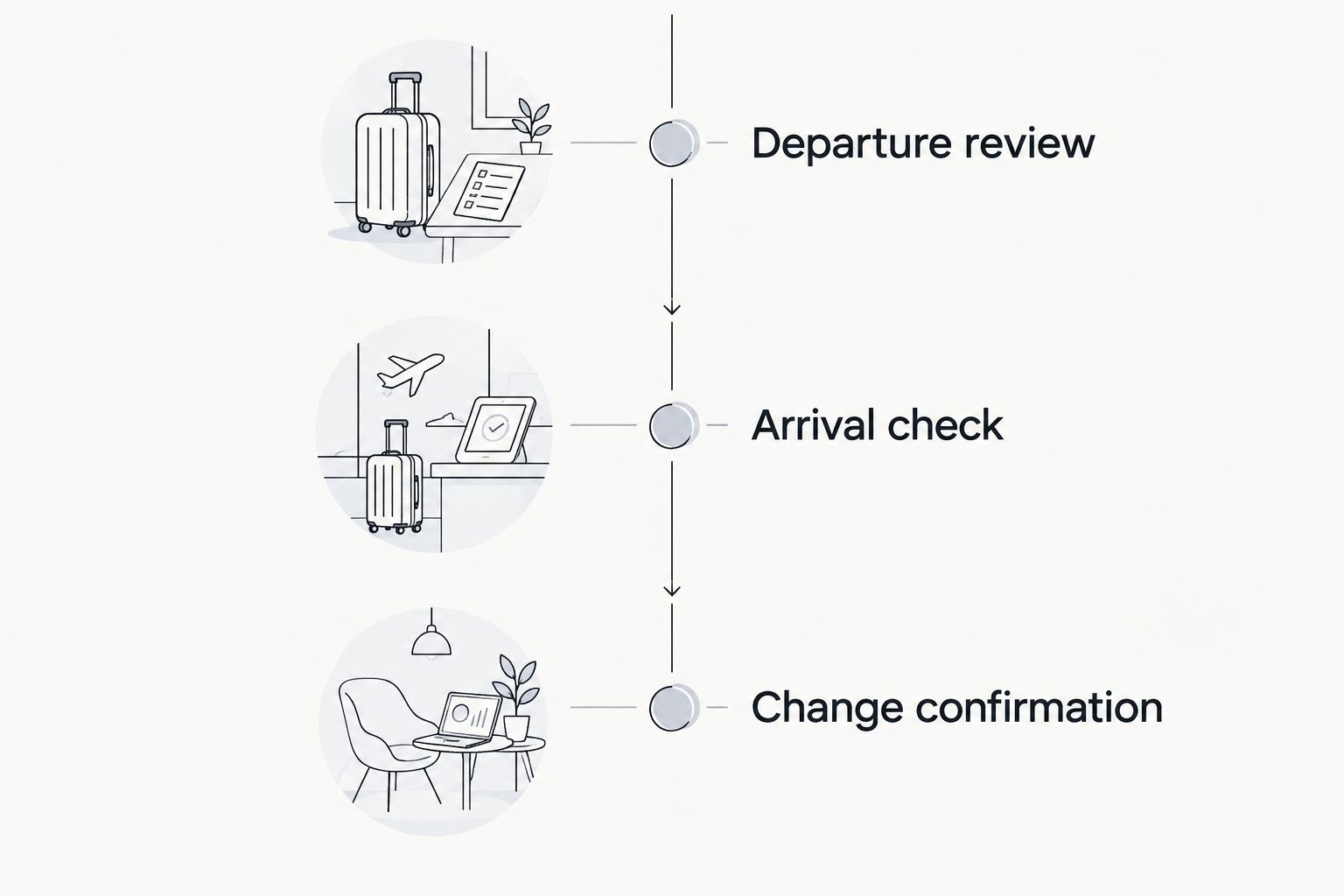
Build the handoff around three checkpoints: Departure review, Arrival check, and Change confirmation. Each checkpoint answers a different question: are the instructions correct, has the arrival plan held, and has a revision reached the people acting on it?
- Departure review: check the approved trip instructions.
- Arrival check: confirm the traveler’s pickup plan.
- Change confirmation: obtain acknowledgment of revisions.
- Identify who can authorize extra stops or extended service.
- Keep the current itinerary separate from superseded versions.
Limit sensitive details and clarify working conditions
Start by removing information the transport team does not need. A chauffeur needs the pickup location and traveler identification; a full engagement description or client document is a separate matter. Use an approved reference rather than distributing commercially sensitive project details.
Treat the vehicle as transportation, not an assumed confidential meeting room. A private booking does not establish sound isolation, a confidentiality agreement, secure connectivity, or permission to discuss restricted material. Your firm’s information-handling rules still apply while traveling.
For your 2026 booking template, separate ordinary travel preferences from contractual requirements. If confidentiality terms are necessary, have the appropriate team confirm them before the journey rather than relying on a general description of discreet service.
- Share only the trip details needed for execution.
- Use approved engagement references in booking records.
- Confirm any required confidentiality terms separately.
- Keep restricted conversations subject to firm policy.
- Avoid assuming connectivity or workspace features.
Close the billing and contingency loop
Use a spreadsheet to map each journey to the engagement reference and approving manager. Ask how the provider records changes and presents charges before the trip takes place. A finance team should not have to reconstruct the journey from a traveler’s calendar after the invoice arrives.
Set a contingency process alongside the billing instructions. Identify who contacts the provider after a flight change, who approves an alternative arrangement, and how the revised itinerary reaches the traveler. Do not substitute an unconfirmed backup promise for a clear escalation route.
Once the manual brief is complete, assess whether a coordinated provider removes repeated handoffs. Chauffyr is best for consulting-firm coordinators seeking one 24/7 desk for executive airport transfers, hourly charters, and point-to-point travel. Its US-based coordination supports worldwide service through vetted chauffeurs and affiliates; route-specific arrangements still require confirmation.
- Attach the engagement reference to every booking.
- Name the billing contact and approving manager.
- Confirm how itinerary changes appear in records.
- Define the escalation route for disrupted travel.
- Reconcile the completed itinerary against the invoice.
Compare transport options for consulting teams
Choose the service format first, then assess the provider. These options solve different scheduling problems; none replaces a complete itinerary brief. Use the table as a selection framework, not as confirmation of any provider’s booking terms.
| Option | Best for | Main advantage | Key limitation |
|---|---|---|---|
| Airport transfer | A defined airport arrival or departure | Focuses coordination on the flight and pickup | Does not establish continued chauffeur access after the transfer |
| Point-to-point travel | A confirmed office, hotel, or meeting journey | Gives a clear origin and destination | Additional stops require scope confirmation |
| Hourly or as-directed charter | A working period with changing destinations | Accommodates a brief built around continued service | The booking period and extension process need confirmation |
| Separate local bookings | Journeys managed independently by local coordinators | Lets each coordinator arrange a specific movement | Requires separate handoffs and records unless consolidated elsewhere |
| Chauffyr coordination | Executive travel managed through one desk across locations | Offers flight tracking and corporate consolidated billing | Local execution involves vetted chauffeurs and affiliates; confirm each route’s requirements |
Chauffyr offers fixed, upfront pricing with no surge. That does not remove the need to define the itinerary: ask what the quote covers and how a changed journey is confirmed. Corporate accounts offer consolidated billing, while your team remains responsible for supplying accurate engagement references.
For a 2026 provider review, request confirmation against a representative itinerary rather than asking only whether executive transport is offered. A useful response addresses the actual movements, contact chain, and billing requirements you intend to use.
Common mistakes consulting firms make
Booking only the partner’s arrival
The lead traveler’s transfer does not resolve separate arrivals, team departures, or the onward journey after a client meeting. Build the movement list around everyone included in the assignment. Then distinguish shared journeys from individual bookings.
Treating a meeting finish time as a confirmed departure
A calendar end time is a planning input, not an instruction to keep a chauffeur waiting indefinitely. Decide whether the journey needs a fixed pickup or continued service. Confirm the process if the meeting runs beyond the approved plan.
Passing client details through booking notes
A convenient booking field is not a reason to include confidential engagement information. Give the transport team the details needed to identify the traveler and execute the journey. Keep internal project context in the firm’s approved systems.
Approving transport without expense references
A confirmed journey can still create reconciliation work when its billing reference is missing. Attach the engagement reference before approval and name the person responsible for reviewing changes. Do not leave allocation to the traveler’s memory.
Assuming one desk means identical local arrangements
Central coordination does not make every airport’s pickup process or every city’s service arrangement identical. Confirm the instructions for each location. For Chauffyr, distinguish the US-based coordination desk from worldwide delivery through vetted chauffeurs and affiliates.
Arrange travel with a complete brief
Send the approved journey list, passenger and luggage requirements, contact chain, and billing references together. Use the contact page to request confirmation against that brief. Keep tentative destinations clearly marked so they are not mistaken for approved movements.
Arrange your consulting team’s travel
Share the itinerary, pickup requirements, and billing references for your engagement.
FAQ
What is chauffeur service for consulting firms?
Chauffeur service for consulting firms is coordinated ground transportation for engagement-related journeys, including airport transfers, client meetings, and onward travel. The booking brief should connect each movement to its traveler, coordinator, and billing reference.
Is an hourly charter better than separate transfers?
An hourly charter fits a period when the team needs continued chauffeur access; separate transfers fit defined journeys. Confirm the booking scope and change process rather than choosing only by the number of stops.
What should an executive assistant send before booking?
Send the itinerary, flight references, passenger and luggage requirements, pickup and destination details, operational contacts, and engagement reference. Identify who can approve changes and mark tentative movements clearly.
Does flight tracking replace pickup instructions?
Flight tracking does not replace pickup instructions. Confirm the meeting location, communication method, and escalation route so the traveler knows what to do after landing.
Can consulting teams discuss confidential work in the car?
Consulting teams should follow their firm’s information-handling rules in the car. A private vehicle booking does not establish sound isolation, contractual confidentiality terms, or secure connectivity.
Can Chauffyr coordinate travel across different cities?
Chauffyr provides US-based coordination for worldwide executive transport through vetted chauffeurs and affiliates. Confirm each city’s journeys, pickup arrangements, and itinerary requirements before approving the plan.
How should a consulting firm organize chauffeur billing?
Attach an approved engagement reference and billing contact to each booking. Confirm how journey changes are documented and reconcile the completed itinerary against the invoice.
One last thing
Make the change owner visible in the traveler’s instructions. A carefully prepared itinerary still needs someone authorized to revise it. For every 2026 engagement, put that person’s name beside the provider’s contact details so the traveler knows who handles the next decision.


