
Yes, you can arrange an airport chauffeur service in South America; confirm the specific airport, route and service requirements before treating the booking as complete. A reservation should include written pickup instructions, a vehicle suited to your passengers and luggage, and a contact who can manage arrival changes. Do not assume that a provider’s worldwide network confirms coverage for your particular journey.
- Book an airport chauffeur service in South America only after confirming the exact airport, route and pickup arrangements.
- South America airport transfers need separate plans for flight arrival, passenger readiness and the chauffeur meeting point.
- Choose a direct transfer for a defined journey; request hourly service when your itinerary includes stops or waiting.
- Keep one approved itinerary and a named contact responsible for changes.
Can I book an airport chauffeur service in South America?
Yes. The practical question is whether the provider has confirmed your particular journey, not whether it advertises international service. For a 2026 booking, request written confirmation against your actual flight and destination rather than relying on a general coverage statement.
Start with the chauffeur services you need, then submit the trip details for confirmation. An airport arrival, an afternoon of meetings and a delegation movement require different instructions.
Use this sequence before authorizing travel:
- Identify the airport. Give the airport name, airport code, flight number and local arrival date.
- Define the journey. Provide the destination address, passenger count, luggage and any intermediate stops.
- Confirm the handoff. Request the meeting location, passenger contact procedure and instructions if contact fails.
- Approve the terms. Review the quoted scope, waiting arrangements, changes and cancellation conditions.
- Distribute the confirmation. Send the approved instructions to the traveler and the person coordinating the trip.
A booking is operationally complete when the traveler knows where to meet and the coordinator knows whom to contact. A reservation reference alone does not answer either question.
Why this matters
A flight landing is not the same event as a passenger reaching the pickup point. Immigration, baggage collection and the walk to the meeting location sit between those events. Your transport instructions need to account for that handoff without promising an exact exit time.
For executive assistants and diplomatic coordinators, the task also extends beyond the arrival. The traveler needs a usable contact, the receiving office needs an agreed destination, and the billing team needs a clear record of the authorized service.
Keep your 2026 arrival brief focused on decisions someone must make. A long itinerary is less useful than a concise confirmation that names the airport, meeting procedure, destination and escalation contact.
Which service should you request?
Choose the service around the itinerary, not the vehicle description. A direct airport journey and an open-ended schedule need different booking scopes, even when the passenger requests the same vehicle category.
| Service option | Best for | Planning advantage | Limitation to resolve |
|---|---|---|---|
| Airport transfer | A defined airport-to-address journey | Keeps the arrival assignment specific | Additional stops and waiting need agreement |
| Point-to-point travel | A separate journey between confirmed addresses | Gives each movement a clear origin and destination | Does not establish ongoing chauffeur access |
| Hourly/as-directed charter | Meetings, stops and an evolving schedule | Lets you brief the provider on a wider itinerary | Requires an agreed service window and instructions |
| Coordinated delegation transport | Related movements involving several travelers | Lets the coordinator manage the itinerary as a connected plan | Requires explicit passenger and vehicle assignments |
Airport transfer: best for a defined arrival
Request an airport transfer when the traveler needs to move from the airport to a confirmed hotel, office or other address. State whether the journey ends there. Do not leave the chauffeur to infer that a later meeting is part of the same assignment.
The advantage is a narrow, clear brief. The limitation is that a direct transfer does not, by itself, establish arrangements for a return journey or an extended stop.
Hourly service: best for an itinerary with stops
Request hourly or as-directed service when the traveler needs transport across a scheduled period rather than a single defined journey. Share the expected stops and the person authorized to change them.
The advantage is a booking scope built around the wider schedule. The limitation is that the service window, operating area and treatment of itinerary changes still need written agreement.
Delegation coordination: best for connected movements
For a delegation, assign passengers to movements before assigning vehicles. Separate an advance party, the principal’s arrival and support staff when their schedules differ.
Coordinated transport gives you a common operating brief. It also requires more preparation: each movement needs its own passenger list, contact and destination, even when all journeys belong to the same visit.
What should the arrival brief include?
Give the provider enough information to confirm the work without circulating unnecessary personal details. Keep travel instructions separate from sensitive meeting material.
Flight details
Include the operating flight number, airport, local arrival date and onward destination. Flag a connection that affects the arrival being monitored. If the itinerary changes, identify which flight replaces the original instruction.
Request flight tracking, but also identify who will communicate a missed connection or a passenger decision to take a different flight. Tracking an aircraft does not explain every change to a traveler’s plans.
Passenger and luggage details
State the passenger count and describe the luggage, including bulky items or equipment. Ask the provider to confirm suitability for both people and bags. A vehicle category name is not a substitute for checking the actual requirement.
Raise accessibility needs and any required child restraints before approval. Request explicit confirmation rather than placing an unresolved request in a general notes field.
Destination and contact details
Provide the full destination address and any entrance instructions supplied by the receiving location. A hotel or office name alone leaves room for confusion when a property has multiple entrances or similarly named locations.
Name the traveler’s reachable contact and the booking coordinator. State which person can approve a destination change, extra stop or revised departure.
How should the airport handoff work?
Agree on a sequence that remains usable if the traveler is delayed or cannot immediately find the chauffeur. Your 2026 confirmation should distinguish the planned meeting procedure from the backup contact procedure.
- Flight tracking: Confirm which flight the provider will monitor.
- Passenger readiness: Explain how the traveler reports being ready to leave.
- Meeting instructions: Obtain the exact agreed meeting location and identification procedure.
- Contact fallback: Record what the traveler should do if the initial connection fails.
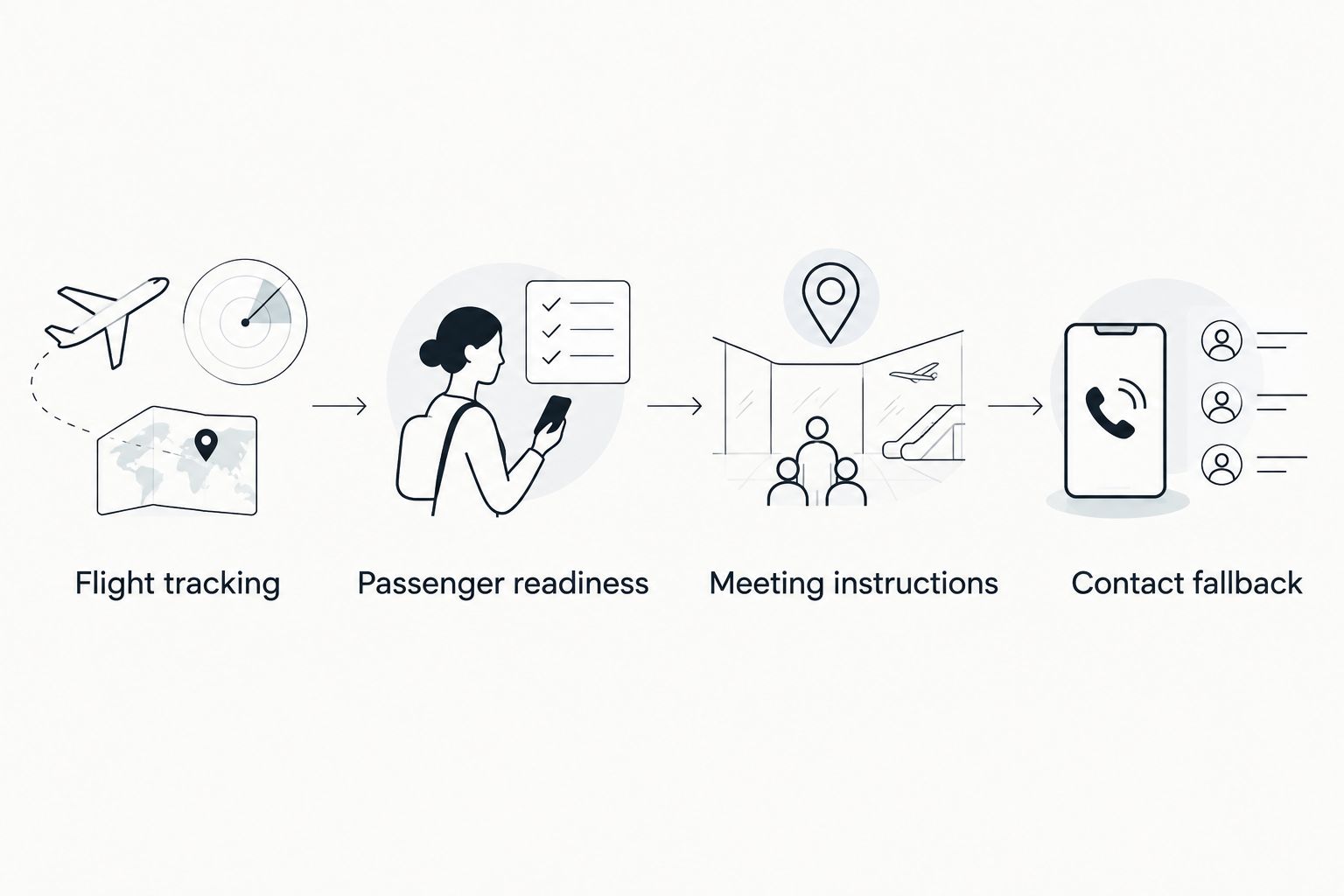
Ask whether the proposed meeting arrangement applies to your terminal and arrival. Do not assume that a meet-and-greet request establishes permission for a particular meeting location.
Save the instructions somewhere the traveler can access without searching a long email chain. If another person receives operational updates, make that responsibility explicit in the brief.
Why do booking requirements vary?
South America is not a single airport operation. Confirm the details of each movement rather than copying an arrival procedure from a different city.
The requirements depend on the trip you submit:
- Airport and terminal: The meeting instructions must identify the actual arrival location.
- Flight schedule: An overnight journey needs an unambiguous local arrival date.
- Passengers and luggage: Vehicle suitability depends on both, not just the number of travelers.
- Service scope: A direct transfer, multiple stops and an extended schedule require different instructions.
- Communication needs: The coordinator must know how the traveler and local chauffeur will connect.
- Itinerary authority: The provider needs to know who can approve operational changes.
For multi-city travel in 2026, confirm these points separately for every arrival. A shared account or booking contact does not replace the local instructions for each airport.
What should you confirm about privacy and protocol?
Describe the requirement instead of using a broad request for discreet service. Specify how the passenger should be identified, who receives the itinerary and which contacts can authorize changes.
For diplomatic or government travel, give the transport coordinator the instructions approved by your own protocol or security team. Ask the provider to confirm what it can perform. A chauffeur reservation does not establish a security service or a protective arrangement.
For law firms and finance teams, keep unrelated client and transaction information out of the transport brief. Include what the chauffeur needs to execute the journey, not the substance of the meeting.
If a language requirement affects the handoff, request confirmation before final approval. Do not assume the local chauffeur and the coordinating desk offer identical language support.
Can I book transport for several South American cities?
Yes. Submit each city as a separate movement within one master itinerary, then ask for explicit confirmation of each airport, route and service window. Keep the overall schedule together without merging the local pickup instructions.
Use a movement record with these fields:
- Local date and scheduled arrival.
- Airport, flight and destination.
- Passenger assignment and luggage.
- Meeting procedure and traveler contact.
- Approving coordinator and change instructions.
Use the same field names throughout your 2026 itinerary. When a flight changes, update the affected movement and identify the revised version so the traveler, coordinator and provider work from the same instructions.
What happens if the flight or itinerary changes?
Request the provider’s change, waiting and cancellation terms before authorizing the booking. Ask how to report a missed connection, changed airport or revised destination. Do not assume that flight tracking automatically resolves those events.
If the traveler changes flights, communicate the replacement flight and local arrival date directly. Ask for acknowledgment and a revised confirmation when the original instructions no longer apply.
Keep an escalation contact outside the traveler’s own phone. An executive assistant or travel manager should be able to resolve the booking even when the traveler is in transit or unreachable.
Where Chauffyr fits
Chauffyr is best for executive assistants and travel coordinators seeking a US-based partner for executive ground travel. Its services include airport transfers, hourly charters, point-to-point travel and coordinated delegation transport.
Chauffyr describes a network covering 120+ airports across 50+ countries, with vetted chauffeurs and affiliates, flight tracking and one 24/7 desk. That worldwide scope does not establish confirmation for every South American airport or route. Request confirmation for the actual movement before adding it to the final itinerary.
Chauffyr offers fixed, upfront pricing, no surge and consolidated billing for corporate accounts. The operational benefit is a defined booking scope and a central coordination contact; the requirement on your side is a complete brief and approval of the applicable terms.
To arrange travel, provide the airport, flight, local arrival date, destination, passengers, luggage and requested service. Ask for written coverage confirmation and arrival instructions before circulating the booking as final.
FAQ
Can I book an airport chauffeur service in South America before I travel?
Yes, you can arrange an airport chauffeur service in South America before departure. Confirm the specific airport, route, meeting procedure and applicable terms in writing before treating the reservation as complete.
Will my airport chauffeur track my flight?
Request flight tracking and confirm which flight the provider will monitor. You should still communicate a changed flight, missed connection or different arrival airport directly.
Can I request a chauffeur for meetings after my airport arrival?
Yes, request hourly or as-directed service when the itinerary includes meetings, stops or waiting. Confirm the service window and change instructions rather than assuming a direct airport transfer includes them.
How do I choose a vehicle for passengers and luggage?
Give the provider the passenger count and a description of all luggage, then request confirmation of vehicle suitability. Include bulky equipment and accessibility requirements before approving the booking.
Does worldwide coverage mean my South American airport is covered?
No, a worldwide coverage statement does not confirm your particular airport or route. Ask for written confirmation against the exact journey and date you intend to book.
Can Chauffyr coordinate executive airport travel?
Chauffyr provides executive airport transfers and coordinated ground travel through a worldwide network of vetted chauffeurs and affiliates. Confirm the specific South American movement before finalizing your itinerary.
What should I do if I cannot find my chauffeur?
Use the fallback contact procedure in your booking confirmation. Obtain that procedure before travel, along with the meeting location and the contact responsible for resolving the handoff.
One last thing
Check the local arrival date before approving the pickup. For an overnight itinerary, the departure date printed prominently in an email is not necessarily the date the chauffeur needs. Write the arrival airport, local date and flight together in the final confirmation.


