
Yes. Government delegations can request armored chauffeur vehicles, but the booking must remain conditional until a provider confirms the vehicle, documented protection specifications, chauffeur arrangements and local operating requirements for the actual itinerary. A request for executive black-car transport does not, by itself, establish that an armored vehicle is included.
- An armored vehicle chauffeur service for government delegations requires explicit vehicle confirmation, not a standard black-car reservation.
- Request protection documentation, chauffeur details and contingency arrangements before approving the movement.
- Chauffyr coordinates delegation transport; armored vehicle capability is not established by its stated executive chauffeur services.
- Keep the security decision with the delegation’s designated authority and share sensitive details through an agreed channel.
Can government delegations request armored chauffeur vehicles?
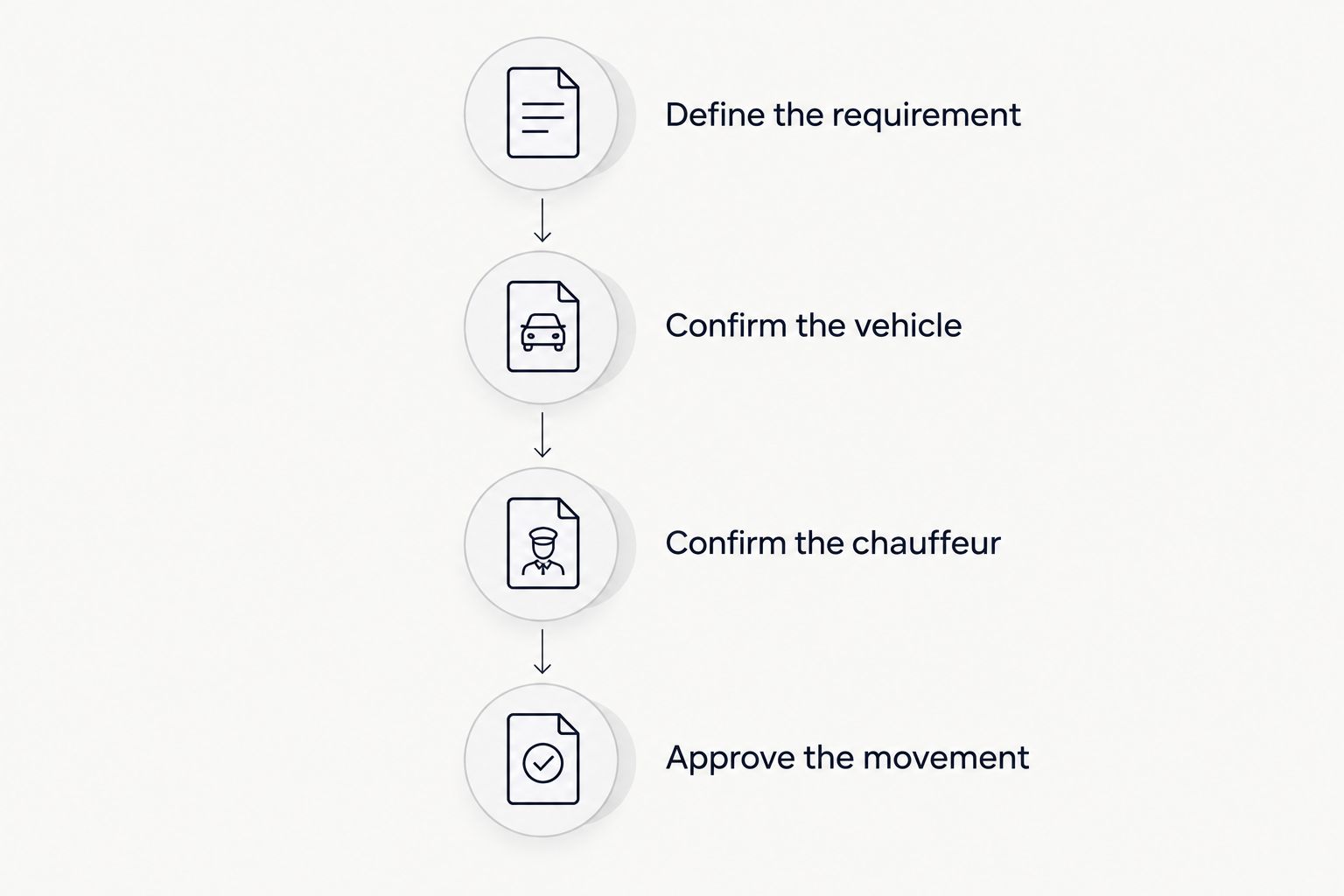
Yes, but treat the request as a separate transport specification. For a 2026 delegation movement, use this approval sequence:
- Define the requirement. Have the delegation’s designated security authority specify what the vehicle must satisfy.
- Confirm the vehicle. Obtain written confirmation that the proposed vehicle meets that requirement for the requested movement.
- Confirm the chauffeur. Establish who supplies the chauffeur and who controls operational instructions.
- Approve the movement. Resolve airport access, passenger handling, itinerary changes and replacement arrangements before release.
Chauffyr provides executive chauffeur and delegation transport. That service description does not establish armored capability; request a separate, explicit response before treating an armored movement as confirmed.
Why this matters
An executive transport booking and an armored transport specification are not interchangeable. Vehicle presentation, passenger comfort and coordinated dispatch do not answer the delegation’s protection question.
Separate the decisions in your travel brief. The travel coordinator manages the itinerary and booking; the designated security authority defines and accepts the protection requirement. Name both decision-makers so a vehicle substitution or schedule change reaches the right person.
Do not let an unresolved protection requirement disappear inside a general reservation. Keep it visible as an approval condition until the responsible authority accepts the proposed arrangement in writing.
Armored vehicle request: best for a defined protection requirement
An armored vehicle request is the appropriate booking route when the delegation’s designated authority has specified vehicle protection. Its advantage is clarity: the provider receives a requirement that can be checked rather than an ambiguous request for a secure or premium car.
The constraint is confirmation. Do not assume that a provider’s normal executive vehicles, airport coverage or dispatch arrangements extend to armored transport.
| Transport request | Best for | What it establishes | What remains unresolved |
|---|---|---|---|
| Executive black-car booking | Delegation travel without a specified armored-vehicle requirement | A request for executive passenger transport | Any protection specification not explicitly included |
| Armored chauffeur vehicle request | Movements with a defined protection requirement | A request for a vehicle meeting that requirement | Vehicle documentation, chauffeur arrangements and local execution until confirmed |
For your 2026 itinerary, keep these requests distinct even when the passenger, destination and arrival time are identical. If armor is required, do not accept a standard vehicle description as an answer to the armored request.
Executive black-car booking: best for coordinated executive travel
An executive black-car booking addresses transport coordination, not an unstated protection specification. It is the relevant option when the delegation needs airport transfers, point-to-point travel or an hourly charter and its designated authority has not required an armored vehicle.
Its strength is a clear passenger-transport brief. Its limitation is equally clear: black-car service is not evidence of armor, protective equipment or a security-trained chauffeur. Confirm each additional requirement separately rather than inferring it from the category name.
If the requirement changes after booking, reopen the vehicle approval. A new protection instruction is a change to the transport specification, not simply another passenger preference.
Build a request the provider can answer
Send a controlled brief that separates operational facts from sensitive material. Give the provider enough information to assess the movement, then agree how to exchange details that should not circulate in ordinary reservation correspondence.
Define the requirement
Record the protection requirement exactly as approved by the delegation’s designated authority. Do not ask a travel coordinator to translate a general concern into a technical specification.
Identify who can answer clarification questions and who has final acceptance authority. A provider’s proposal should return to that person before the booking is released.
Confirm the vehicle
Ask for the proposed vehicle description and documentation relevant to the specified protection requirement. Require the provider to explain which documents apply to the vehicle proposed for your movement.
Do not substitute a brochure, generic vehicle photograph or broad service description for that confirmation. If the vehicle changes, require a fresh approval against the same requirement.
Confirm the chauffeur
Ask who supplies the chauffeur, who dispatches the movement and who communicates changes. Distinguish ordinary chauffeur vetting from any additional qualifications your authority requires.
Set a clear instruction chain. The principal’s office, travel coordinator and security lead should not issue conflicting directions through separate conversations.
Approve the movement
Resolve the arrival procedure, pickup instructions, passenger contact method and itinerary-change process. For airport movements, ask how flight tracking connects to the actual pickup arrangement.
Record the person authorized to release the booking. Keep unresolved items marked as unresolved rather than describing the overall movement as confirmed.
Why armored chauffeur arrangements vary
A delegation’s request must be answered against its actual itinerary. Use these factors to structure the provider’s response rather than assuming one confirmation covers every movement:
- Destination and route. Name the airports, cities and journey endpoints that need confirmation. Do not extend an approval to another location without checking it.
- Arrival timing. Supply flight details and the planned movement schedule. Ask who handles a changed arrival or a revised departure.
- Service format. State whether you need an airport transfer, point-to-point journey or hourly, as-directed transport. Specify which movements carry the armored requirement.
- Local delivery. Establish whether the coordinating company or a local affiliate supplies the vehicle and chauffeur. Ask who remains accountable for updates.
- Privacy requirements. Identify the permitted recipients of passenger and itinerary information. Keep distribution rules explicit.
- Contingencies. Ask how vehicle changes and itinerary amendments are submitted for approval. Do not authorize a replacement by implication.
These are questions for the movement brief, not evidence that a particular provider can fulfill the request. Require a direct answer to each applicable item.
What should the written confirmation contain?
For a 2026 booking, use a confirmation record that lets the approving authority distinguish accepted arrangements from open questions. A general reservation acknowledgment is not enough when the vehicle specification remains unresolved.
Include the following:
- Movement scope: the approved journey, service format and applicable itinerary version.
- Vehicle confirmation: the proposed vehicle and the documentation accepted against the requirement.
- Chauffeur responsibility: the supplying party, dispatch contact and instruction chain.
- Passenger handling: the agreed contact method and pickup procedure.
- Change control: who must approve a vehicle replacement, route amendment or revised movement.
- Release status: the approving person and any conditions still outstanding.
Keep the record usable. Put operational instructions where the people executing the movement can find them, while restricting sensitive supporting material to its agreed recipients.
Avoid vague acceptance language. Replace a statement such as vehicle arranged with a precise status: proposed for review, accepted subject to listed conditions, or approved by the designated authority. The point is to prevent a reservation status from being mistaken for security approval.
Can the same approval cover a multi-city delegation itinerary?
A multi-city itinerary needs explicit confirmation for each relevant movement. Do not assume that acceptance of a vehicle in the arrival city establishes the arrangement in another city or country.
Use a movement register with a separate status for each leg. Record the local supplying party, the approved requirement, the decision-maker and any outstanding condition. A central coordinator can manage the register without erasing differences between local arrangements.
For a 2026 delegation schedule, version the itinerary before circulating a change. Ask recipients to acknowledge the revised movement rather than relying on an updated attachment to explain itself.
What happens if the proposed vehicle changes?
A vehicle change reopens the vehicle-specific approval. Ask the provider to identify the replacement and submit the relevant documentation against the original requirement before the delegation accepts it.
Define this process before travel. State who receives the notice, who assesses the replacement and who communicates the final instruction to dispatch.
Do not allow a transport coordinator to waive a protection requirement simply to preserve the schedule. Escalate the decision to the person authorized to accept that change, and record the resulting instruction.
Does flight tracking confirm the airport pickup procedure?
Flight tracking does not confirm the entire pickup procedure. It addresses the flight’s status; the provider must separately confirm the meeting arrangement and the instructions the traveler will receive.
Ask where the passenger should go, how the chauffeur or coordinator will make contact, and what happens if the passenger cannot find the agreed meeting point. Keep those instructions consistent with the delegation’s approved handling requirements.
Do not infer terminal access, airside access or special privileges from the presence of flight tracking. Request explicit confirmation of the pickup arrangement for the actual airport and movement.
Keep sensitive details out of routine circulation
A useful travel brief is not the same as an unrestricted itinerary. Agree which information the provider needs, who receives it and how updates will be delivered.
Ask the delegation’s responsible authority to decide what belongs in ordinary booking correspondence and what requires a separate channel. Do not label a communication method secure without that authority’s acceptance.
Use role-based operational contacts where appropriate to the delegation’s instructions. Make sure the provider knows whom to contact for travel changes and whom to contact for decisions that affect the approved protection requirement.
For 2026 travel files, keep the operational version current and withdraw superseded instructions from active use. A carefully approved plan still needs clear version control when flights, hotels or meeting locations change.
Where Chauffyr fits in delegation travel
Chauffyr is best for executive and delegation travel that needs centralized chauffeur coordination. Its stated services include airport transfers, hourly charters, point-to-point travel and coordinated delegation transport.
Chauffyr is US-based, with worldwide service through vetted chauffeurs and affiliates. Its stated reach covers 120+ airports across 50+ countries, supported by flight tracking and one 24/7 desk. Corporate accounts offer consolidated billing.
That coordination scope is relevant to a multi-city travel brief. It does not establish armored vehicle capability, specialist protection services or particular airport access. Request explicit confirmation of an armored requirement before including it in an approved movement plan.
When arranging travel, send the itinerary, service format, contact chain and the authority’s vehicle requirement together. Ask for a clear distinction between confirmed arrangements and items awaiting acceptance.
FAQ
Can a government delegation ask for an armored chauffeur vehicle?
Yes, a government delegation can request an armored chauffeur vehicle. Treat the booking as conditional until the provider confirms the proposed vehicle and the delegation’s designated authority accepts it against the requirement.
Does booking a black car mean the vehicle is armored?
No, booking a black car does not establish that the vehicle is armored. An armored requirement needs separate, explicit confirmation and acceptance.
Does Chauffyr confirm armored vehicles in its stated service description?
Chauffyr’s stated service description does not establish armored vehicle capability. It describes executive chauffeur and delegation transport; request a specific response before relying on an armored arrangement.
Who should specify the protection requirement for a delegation?
The delegation’s designated security authority should specify and accept the protection requirement. The travel coordinator should record that requirement without replacing it with an assumed vehicle category.
Can I approve an armored vehicle for every city in the itinerary at once?
Approve each relevant movement explicitly rather than extending one vehicle confirmation across the itinerary. Record the local supplying party, accepted arrangement and unresolved conditions for each leg.
What should I do if the provider substitutes another vehicle?
Submit the replacement for approval against the original requirement before accepting it. The change process should identify who assesses the vehicle and who gives dispatch the final instruction.
Does flight tracking include special airport access?
Flight tracking does not establish special airport access. Ask the provider to confirm the actual pickup procedure and any access arrangements separately.
One last thing
Separate transport confirmation from protection acceptance in your travel file. A reservation can be recorded while the vehicle requirement is still awaiting approval; those statuses should never share the same checkbox.
Before releasing the movement, ask a final question: has the authorized person accepted the actual proposed arrangement, or has someone only acknowledged the request? That distinction keeps the itinerary from outrunning its approval.


