
Yes, executive assistants can book a chauffeur for an executive when they have the authority to arrange travel and approve the booking. The assistant can coordinate the itinerary, passenger preferences, billing instructions and travel updates without being the passenger. Before confirming, establish who can authorize changes and check the provider’s cancellation, waiting-time and additional-stop terms.
- Can executive assistants book a chauffeur? Yes, with travel-booking authority and clear payment approval.
- Executive assistants should separate the booking contact, passenger contact and billing contact.
- Choose airport transfers for arrivals, point-to-point travel for defined journeys, and hourly charters for changing schedules.
- Confirm the meeting instructions, change process and cancellation terms before authorizing executive ground transport.
Why this matters
An executive’s ground transport involves more than a pickup address. The assistant needs a booking that the traveler can use without managing the arrangements personally, while the chauffeur receives clear instructions and the finance team receives the correct billing information.
For executive ground travel, treat the reservation as an operational handoff. Your 2026 travel checklist should identify the passenger, the person managing updates and the person authorized to approve additional services. Those roles can belong to different people.
The goal is straightforward: the executive knows where to meet the chauffeur, the provider knows whom to contact, and you retain control of changes. A confirmation addressed only to the assistant leaves the traveler dependent on forwarded messages.
Can executive assistants book a chauffeur for executives?
Yes. Executive assistants can arrange chauffeur travel on an executive’s behalf; the booking must clearly distinguish the passenger from the person making the reservation. The provider’s booking requirements and your organization’s authorization process determine how you complete the arrangement.
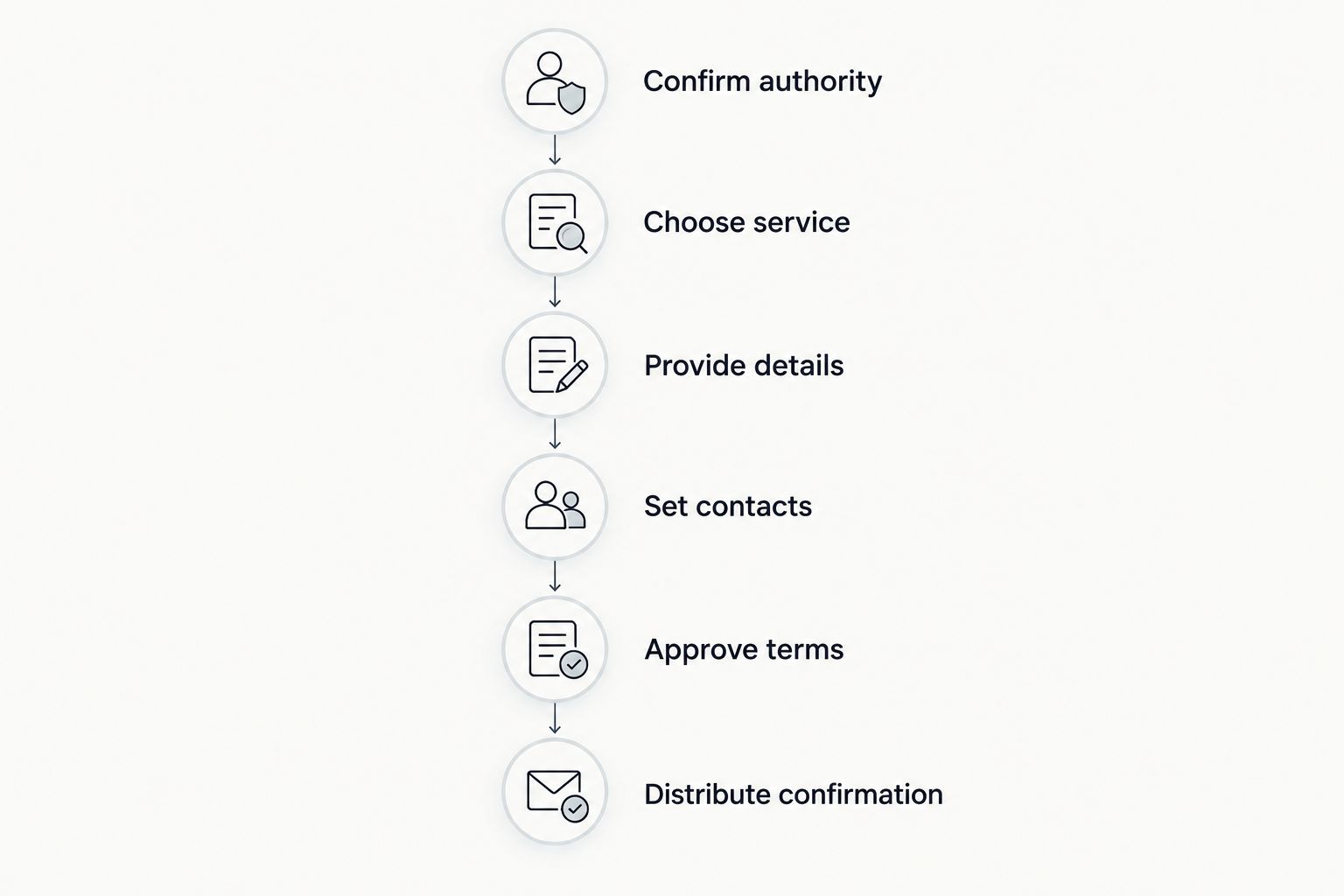
Use this sequence for a 2026 executive travel booking:
- Confirm authority. Establish who can book, approve payment and authorize itinerary changes. Check your internal travel policy before committing the organization.
- Choose the service. Match the reservation to an airport arrival, a defined journey or an itinerary requiring a vehicle between stops.
- Provide trip details. Supply the passenger name, date, local pickup time, addresses and flight details where relevant.
- Set contact roles. Identify the assistant, traveler and any local coordinator. Specify who receives confirmations and urgent updates.
- Approve the terms. Review the written scope, waiting arrangements, cancellation terms and treatment of additional stops.
- Distribute the confirmation. Give the traveler the meeting instructions and an appropriate contact route. Keep the full booking record for administration.
Ask the provider to acknowledge special instructions rather than assuming that a note entered during booking has been accepted. A request for a particular vehicle arrangement, pickup procedure or communication method is not the same as a confirmed commitment.
If another assistant takes over the trip, transfer the booking reference, latest itinerary and change authority together. Forwarding the original confirmation alone does not explain what changed afterward.
Airport transfers: best for flight-linked journeys
Choose an airport transfer when the booking centers on an arrival or departure. For arrivals, provide the flight number, arrival airport, travel date and destination. Request flight tracking and confirm how the actual pickup will be coordinated.
Flight arrival and passenger readiness are different events. Immigration, baggage collection and the walk to the agreed meeting point affect when the traveler can meet the chauffeur. Ask how waiting is handled rather than treating touchdown as the handoff.
The advantage is a journey organized around the flight. The limitation is that an airport transfer does not automatically include an open-ended schedule after arrival; confirm any onward stops before booking.
Point-to-point travel: best for a defined journey
Choose point-to-point travel when the pickup, destination and departure plan are settled. Give complete addresses, including the correct building entrance or reception instructions when needed. A venue name alone can leave the meeting location unclear.
This arrangement gives you a defined journey to confirm and circulate. It is less suited to an itinerary that keeps changing, particularly when the executive expects the vehicle to remain available between appointments.
Ask whether a return journey needs a separate reservation. Do not assume that an outbound booking includes a return, intermediate waiting or an additional passenger pickup.
Hourly charters: best for a changing itinerary
Choose an hourly or as-directed charter when the executive needs transport between appointments and the schedule remains fluid. Give the provider the planned start, expected finish and known stops, even when some details are provisional.
The advantage is a booking structured around time and itinerary control rather than one defined journey. The limitation is that flexibility still has boundaries: confirm the operating area, booked duration, extension process and treatment of changes.
An hourly booking is not permission to add any destination without discussion. If the itinerary extends beyond the agreed scope, obtain approval through the designated contact before relying on the change.
| Service | Best for | Main advantage | Limitation to confirm |
|---|---|---|---|
| Airport transfer | Flight-linked arrivals and departures | Connects the reservation to airport travel details | Meeting arrangements and waiting terms |
| Point-to-point travel | A settled pickup and destination | Defines the journey clearly | Returns, waiting and added stops are not assumed |
| Hourly charter | Appointments with a changing schedule | Supports transport between planned stops | Duration, operating area and extensions |
What information should an executive assistant provide?
Send a concise travel brief, not an entire executive calendar. Include what the provider needs to deliver the journey and route questions to the right person.
Passenger and contact details
Provide the passenger’s name, a suitable day-of-travel contact and the assistant’s contact details. If the executive should not receive routine administrative messages, say so and identify where those messages belong.
For delegation travel, identify the coordinator responsible for the passenger list. Share only information required for the transport arrangement; a chauffeur booking does not require an explanation of confidential meeting business.
Journey and vehicle requirements
List dates, local times, pickup and destination addresses, flight details, passenger count and luggage requirements. State accessibility needs or other essential vehicle requirements directly and ask the provider to confirm suitability.
Do not select a vehicle solely from its category name. Passenger numbers and luggage both affect suitability. The provider needs the actual requirements to confirm an appropriate arrangement.
Billing and approval instructions
Identify the billing entity, invoice recipient and any purchase-order or cost-center reference your organization requires. Confirm how the provider accepts payment and who can approve services outside the original scope.
Keep payment instructions within the provider’s designated process. Avoid including unnecessary financial information in an itinerary circulated to travelers, reception teams or other coordinators.
Why executive chauffeur arrangements vary
The question is not simply whether an assistant can book. It is how much coordination the journey requires. Use these factors to review your 2026 booking brief:
- Journey type. An airport arrival needs flight and meeting details; an appointment itinerary needs stop order and schedule control.
- Passenger requirements. Passenger count, luggage and accessibility needs determine what the provider must confirm about the vehicle.
- Schedule certainty. A settled departure supports a defined journey. An evolving calendar requires a clear change process.
- Contact structure. One traveler with one assistant needs a different communication plan from a delegation with local coordinators.
- Billing requirements. A corporate account, invoice reference or approval chain adds administrative instructions to the reservation.
- Local arrangements. Airport meeting procedures and venue access instructions belong in the specific booking confirmation, not in assumptions carried over from another city.
Resolve uncertainty before confirmation, not at pickup. When a detail remains open, identify who will supply it and who must receive the update. An unresolved destination should not disappear into a general notes field.
How should an assistant handle delays and itinerary changes?
Make the change process part of the booking. Name the person authorized to request amendments and confirm how urgent updates should reach the provider.
For airport arrivals, flight tracking supports coordination, but it does not communicate everything. A traveler who changes flights, misses a connection or leaves the airport by another arrangement still needs an explicit booking update.
For meetings, distinguish a revised pickup time from a request to extend the service. Ask the provider to acknowledge the amendment and explain any change to the agreed scope before you treat it as confirmed.
Use this handoff checklist when plans move:
- Send the booking reference and revised instruction together.
- State the relevant local date and time.
- Identify which earlier instruction the update replaces.
- Request acknowledgment from the provider.
- Give the traveler the current meeting instructions.
Keep one current itinerary. Parallel versions sent by the executive, assistant and local host make it harder to establish which instruction controls the journey.
Can the executive change the booking directly?
Yes, if your organization permits it and the provider accepts the instruction. Establish whether the executive can change destinations, add stops or extend the service without separate administrative approval.
The practical issue is not whether the passenger can speak to the chauffeur. It is whether a request changes the booking’s scope and who must authorize that change. Put that distinction in the brief.
Does the assistant need to travel with the executive?
No. An executive assistant can coordinate the reservation remotely while the executive travels. The provider still needs a workable passenger contact or an agreed alternative, such as a local coordinator.
Before departure, check that the traveler can access the meeting instructions independently. A confirmation sitting only in the assistant’s inbox is not a complete passenger handoff.
When a coordinated chauffeur partner fits
A coordinated service is relevant when your work extends beyond reserving a single ride. You need a contact structure, flight updates, consistent booking instructions and billing administration across the itinerary.
Chauffyr is suited to executive assistants coordinating executive chauffeur travel across airports and cities. Chauffyr is US-based and serves worldwide travel through vetted chauffeurs and affiliates; that does not mean it owns vehicles or employs every chauffeur in each destination.
Chauffyr supports travel at 120+ airports across 50+ countries, with flight tracking and one 24/7 desk. Corporate accounts offer consolidated billing. Confirm the specific route, vehicle requirements and booking terms for your trip rather than treating worldwide coverage as confirmation of an individual arrangement.
The fit is executive ground travel requiring centralized coordination. The boundary is equally important: an airport count or service description does not establish the meeting procedure, waiting allowance or vehicle suitability for your reservation. Request those details with your quote.
Arrange executive ground travel
Share the itinerary, passenger requirements and billing instructions for your trip.
FAQ
Can executive assistants book a chauffeur without being the passenger?
Yes. Executive assistants can book on another person’s behalf when authorized to arrange the travel. Identify the executive as the passenger and separate passenger contact details from booking and billing contacts.
What should I check before confirming an executive chauffeur booking?
Check the itinerary, passenger requirements, meeting instructions, payment process and booking terms. Confirm who can authorize changes and how the provider acknowledges them.
Should I book an airport transfer or an hourly chauffeur?
Book an airport transfer for a flight-linked journey and an hourly charter when the executive needs transport between appointments. Confirm waiting arrangements, stops and the scope of any requested flexibility.
Can I keep my executive’s phone number private?
Ask the provider whether an assistant or local coordinator can serve as the passenger contact. Agree on a workable day-of-travel communication method rather than leaving the contact field unresolved.
Does flight tracking replace communication with the chauffeur provider?
No. Flight tracking does not communicate every passenger decision or itinerary change. Notify the provider when the traveler changes flights, cancels the journey or makes another transport arrangement.
Can Chauffyr support corporate travel billing?
Chauffyr offers consolidated billing through corporate accounts. Confirm the account setup, invoice recipient and any internal references required for your organization’s booking.
Can I book chauffeur travel for an executive in another country?
Yes, you can coordinate international chauffeur travel remotely with a provider serving the destination. Confirm local dates, times, meeting arrangements and the contact responsible for travel-day updates.
One last thing
Add a final field to your 2026 booking checklist: Who receives the last confirmed instruction? The assistant’s approval, the provider’s acknowledgment and the traveler’s itinerary should describe the same arrangement.
Before closing the task, read the confirmation as if you were the passenger arriving without access to your own inbox. If it does not explain where to meet, whom to contact and what journey is booked, finish that handoff first.


