
Yes. A chauffeur service can support enhanced security for celebrities through controlled pickups, limited itinerary sharing, and coordination with a protection team, provided those responsibilities are explicitly agreed. For travel in 2026, distinguish transport coordination from protective security: a chauffeur booking alone does not establish close-protection training, threat assessment capability, or an emergency-response role.
- For chauffeur service enhanced security for celebrities, verify protective duties separately from transport responsibilities.
- Controlled pickups and restricted itinerary sharing support discretion; they do not guarantee safety.
- Chauffyr suits executive transport coordination; do not treat its chauffeur service as a verified close-protection service.
- Assign transport, venue access, and protective decisions before the journey.
Can a chauffeur service provide enhanced security for celebrities?
A chauffeur service supports a security plan; it does not automatically supply one. The distinction matters when a booking involves public appearances, sensitive destinations, or a principal whose movements attract attention.
Evaluate chauffeur services against the actual assignment. Ask who handles the vehicle, who authorizes movement, and who makes protective decisions. A discreet vehicle and a professional chauffeur are not evidence of specialist security qualifications.
| Arrangement | Best for | Useful contribution | Limitation to verify |
|---|---|---|---|
| Chauffeur-led transport | Planned journeys requiring coordinated pickups | Vehicle scheduling, chauffeur communication, and agreed arrival procedures | Protective training and duties are not established by the booking |
| Dedicated protection team | Assignments with defined protective requirements | Responsibility for the protective plan, within its verified qualifications and scope | Vehicle provision and transport coordination require separate confirmation |
| Coordinated transport and protection | Journeys requiring both transport and protective oversight | Explicit division of driving, access, and protective responsibilities | Both parties need an agreed communication and decision process |
These arrangements serve different purposes. Select against the principal's requirements rather than choosing a service because its description uses the word security.
Why this matters
A celebrity itinerary can involve several separate decision-makers: an assistant, publicist, venue representative, chauffeur, and protection lead. Without clear ownership, each person can assume someone else has confirmed the pickup location or approved a change.
Your booking should resolve those handoffs. The operational question is not simply whether a car will arrive; it is whether everyone knows where the principal will meet it, who can change that location, and how the update reaches the right people.
Privacy deserves the same attention. Send each participant the information needed for their task, rather than circulating the full itinerary by default. Keep sensitive personal details out of broad event or production message groups.
What can a chauffeur service contribute to celebrity security?
A chauffeur service can contribute agreed transport controls. Ask the provider to describe the process for each control before treating it as part of your plan.
Controlled pickups and drop-offs
Confirm the meeting location with both the transport provider and the venue. Establish whether the proposed entrance is permitted, accessible to the booked vehicle, and appropriate for the principal's arrival.
A less public entrance is useful only when the venue authorizes it and the chauffeur can reach it. Do not substitute a discreet-sounding address for an actual access arrangement.
Limited itinerary distribution
Specify who receives the principal's name, flight details, destinations, and live changes. Ask how instructions reach any affiliate involved in the journey.
The benefit is clearer information control. The limitation is that a confidentiality request does not establish how every participant stores, forwards, or retains those details; ask about the applicable process.
Agreed communication
Name the booking contact and the person authorized to change instructions. Establish a method for confirming unexpected requests before anyone acts on them.
This is especially relevant when an unfamiliar caller asks for a destination change or requests passenger information. The chauffeur should have an agreed escalation contact rather than needing to judge the caller's authority alone.
Coordination with protection personnel
Where a protection team is involved, ask its lead to approve the transport interface. That includes boarding arrangements, communication during movement, and the handoff at the destination.
Do not assign protective duties indirectly. Instructions such as keeping the principal safe are too broad to establish a chauffeur's qualifications, authority, or responsibilities.
What does a chauffeur booking not establish?
Do not equate discretion with close protection. A booking description should identify the services actually included, not leave your team to infer them from vehicle presentation or premium language.
Before your 2026 booking, request explicit confirmation of any requirement involving:
- Protective qualifications: identify the person performing the duty and verify the relevant credentials.
- Threat assessment: establish who evaluates the assignment and approves the protective approach.
- Specialist vehicle features: confirm the specific vehicle and documented equipment rather than assuming a black car has protective modifications.
- Medical response: clarify the assigned personnel's qualifications and the limits of their role.
- Emergency decisions: agree who directs changes when the original plan cannot continue.
If the provider does not confirm a specialist capability, keep that capability outside the transport scope. Resolve the requirement with an appropriately qualified provider rather than stretching the chauffeur's role.
How should you organize the journey?
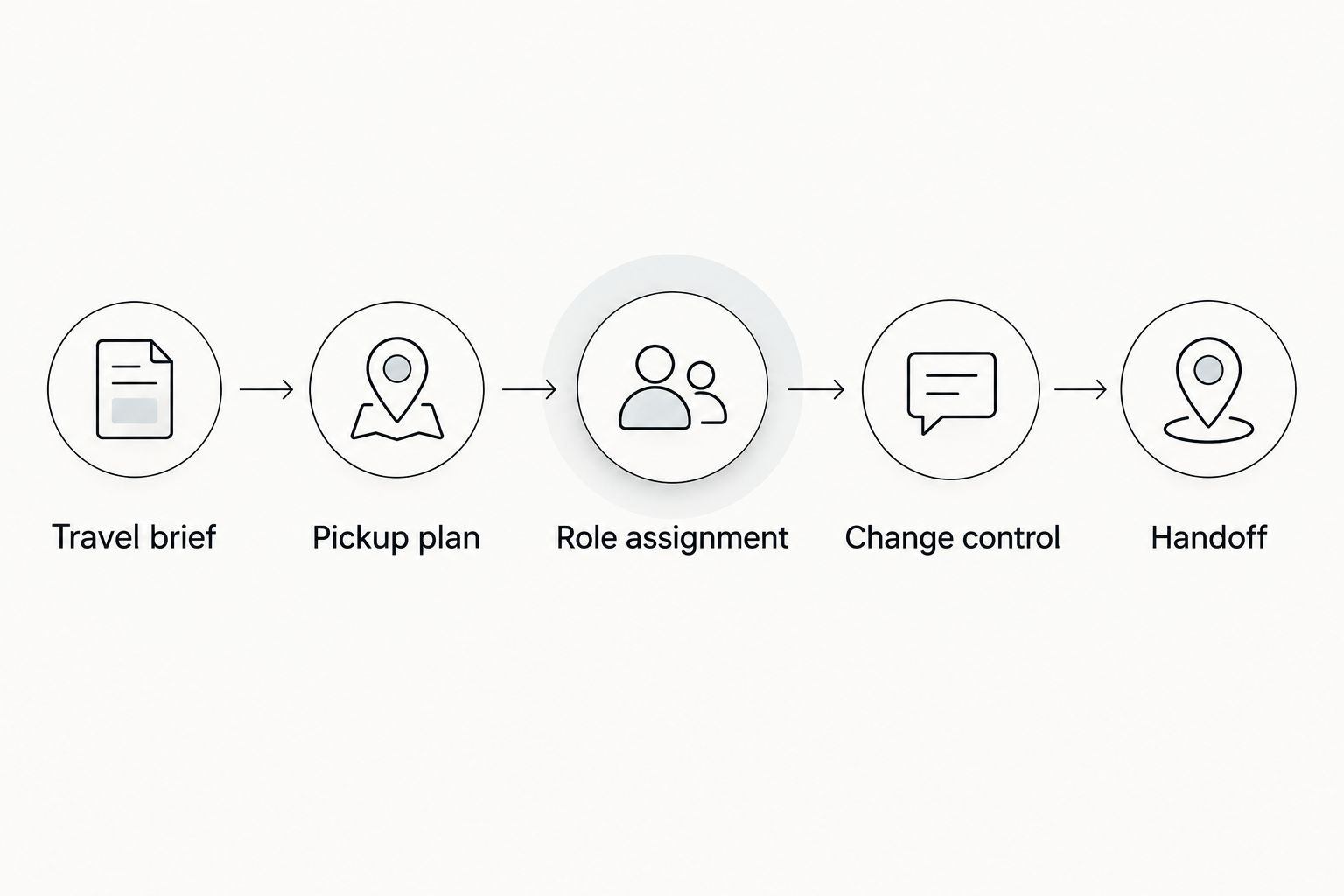
Use a written travel brief that separates routine transport instructions from protective responsibilities. Share it only with the participants who need it, and identify which version controls the journey.
Travel brief
Record the travelers, confirmed destinations, luggage requirements, accessibility needs, and authorized contacts. Include operational privacy instructions, such as who can receive arrival updates.
Avoid adding sensitive personal history merely to make the document appear thorough. Give the chauffeur information needed to carry out the agreed assignment.
Pickup plan
Confirm the meeting point, venue contact, and permitted vehicle access. Establish what the chauffeur should do if the principal is not at the agreed location.
For airport travel, distinguish flight tracking from the passenger meeting process. Tracking an aircraft does not confirm that the passenger has cleared arrival formalities or reached the meeting point.
Role assignment
Identify the transport coordinator, venue access contact, and protection lead where applicable. State who can approve destination changes and who receives escalation calls.
Keep the chauffeur's driving responsibilities explicit. Do not create an unspoken expectation that the chauffeur will simultaneously provide an unconfirmed protective service.
Change control
Agree how your team will authenticate new instructions and distribute an approved update. Tell participants which contact takes precedence when messages conflict.
For a changed venue or destination, reconfirm access and the receiving contact. An updated address alone does not complete the operational handoff.
Handoff
Define where the transport assignment ends and who receives the principal. Confirm the next movement separately if the vehicle will not remain assigned.
A completed drop-off and a completed security handoff are different milestones. Make the distinction visible in the travel brief.
Why celebrity transport requirements vary
The appropriate transport arrangement depends on the assignment. Assess these factors before selecting the vehicle or requesting specialist support:
- Public exposure: establish whether arrival details are private, publicly announced, or controlled by an event organizer.
- Venue access: confirm who authorizes entrances, vehicle access, and the receiving handoff.
- Itinerary complexity: identify where changes affect another vehicle, venue, airport transfer, or coordinator.
- Protective requirements: obtain the protection lead's transport instructions when a protection team is involved.
- Information sensitivity: decide which participants need the principal's identity and which need only operational details.
- Decision ownership: name the person authorized to approve changes when the principal is unavailable.
These factors help define the work. They do not establish a threat level or replace a qualified protective assessment.
What should you ask before confirming a booking?
Use this 2026 booking checklist to turn broad assurances into written responsibilities. Ask for answers that describe the assignment, not general statements about serving prominent passengers.
- Who performs the journey? Confirm whether the assignment uses the provider's direct operation or an affiliate.
- What has been vetted? Ask what the vetting covers without assuming it includes protective qualifications.
- Who holds the itinerary? Establish the contacts who receive travel details and approved changes.
- How is the chauffeur identified? Agree how the assistant or principal confirms the assigned chauffeur.
- Who approves the meeting point? Obtain confirmation from the relevant venue or airport contact.
- What happens after a disruption? Ask who coordinates a revised pickup, vehicle issue, or changed destination.
- What is outside scope? Identify protective, medical, and specialist vehicle requirements separately.
- How are changes documented? Agree where the current instructions are recorded and who acknowledges them.
Keep the confirmation concise enough to use during travel. Separate essential movement instructions from supporting documents so the team can find the controlling details without searching through an email chain.
Is a chauffeur the same as a bodyguard?
No. A chauffeur assignment establishes transport duties, while a bodyguard or close-protection assignment requires its own defined scope and verified qualifications. A person performing both roles needs explicit confirmation of both responsibilities.
If your principal requires protection, involve the protection lead before finalizing transport. Let that team specify its requirements instead of asking the chauffeur service to infer them.
Can flight tracking replace arrival coordination?
No. Flight tracking supports awareness of flight timing; it does not settle the meeting location, passenger readiness, or venue access. Confirm how the passenger and chauffeur connect after arrival.
For your 2026 arrival brief, name the traveler contact and the person who resolves a missed connection. Keep any protective instructions separate and available to the people responsible for them.
Where does Chauffyr fit?
Chauffyr provides executive black-car airport transfers, hourly charters, point-to-point travel, and coordinated delegation transport. Its stated coverage includes 120+ airports across 50+ countries, with US-based coordination, vetted chauffeurs and affiliates, flight tracking, and one 24/7 desk.
Chauffyr is best for executive assistants and travel managers coordinating executive ground transport, not as a substitute for verified close protection. Its stated services establish a transport role; they do not establish specialist protective qualifications or security guarantees.
Review the company background and confirm the actual assignment before booking. If a protection team is involved, provide its approved transport requirements and ask which responsibilities the transport provider accepts.
FAQ
Can a chauffeur service provide enhanced security for celebrities?
Yes, through agreed transport controls such as coordinated pickups, restricted itinerary sharing, and communication with a protection team. A chauffeur booking alone does not establish close-protection capability.
Do celebrity chauffeurs also work as bodyguards?
Do not assume a celebrity chauffeur also serves as a bodyguard. Confirm protective qualifications and duties separately if the assignment requires both roles.
Does a black car have security features?
A black car's appearance does not establish specialist security features. Request confirmation of the exact vehicle and any required protective equipment.
Can a chauffeur use a private venue entrance?
Confirm private entrance access with the venue before including it in the transport plan. The proposed entrance must be authorized and accessible to the assigned vehicle.
What should an assistant include in a celebrity travel brief?
Include confirmed locations, authorized contacts, pickup instructions, change approval, and the receiving handoff. Share sensitive itinerary details only with participants who need them.
Does Chauffyr provide close protection?
Chauffyr's stated services cover executive chauffeur transport and coordination; they do not establish close-protection services. Confirm specialist protective requirements separately.
What should I confirm for celebrity airport travel in 2026?
Confirm flight details, the passenger meeting process, authorized contacts, and responsibility for changes. Flight tracking supports timing awareness but does not replace the arrival handoff.
One last thing
Agree on how instructions are verified before agreeing on how quickly they are acted upon. For your 2026 travel brief, name the authorized contact and the method for confirming an unexpected change. A detailed itinerary is incomplete if an unfamiliar caller can redirect it without verification.


