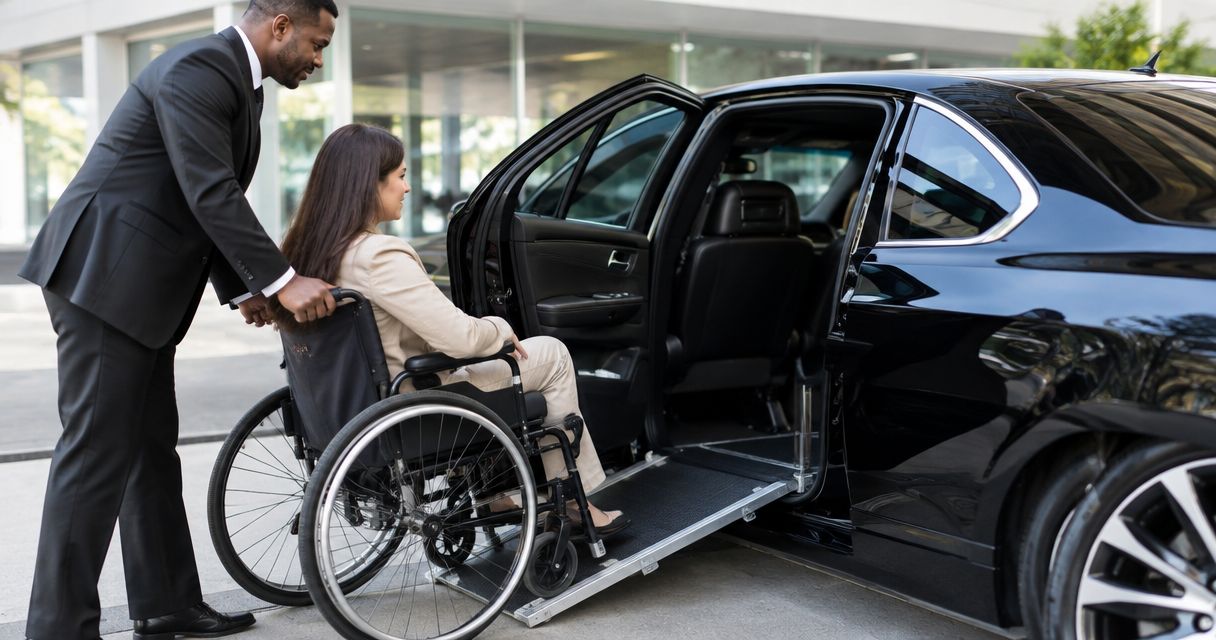
Yes, a black car service can accommodate wheelchair access needs when the assigned vehicle and assistance arrangements match the passenger’s requirements. A standard sedan or SUV is not automatically wheelchair accessible, and carrying a folded wheelchair is different from transporting someone who remains seated in it. For a 2026 booking, confirm the actual vehicle, boarding method, wheelchair fit, and assistance before accepting the trip.
- A black car service wheelchair accessible request needs vehicle-specific confirmation, not just acceptance of a booking.
- ADA compliance language does not replace confirmation of boarding, wheelchair fit, securement, and passenger restraint.
- Passengers transferring into a vehicle seat need different arrangements from passengers remaining in their wheelchair.
- Confirm the outbound trip, return journey, and replacement-vehicle requirements in writing.
Why this matters
An executive itinerary can specify the correct airport and arrival time yet still fail at the vehicle door. The deciding question is not whether the operator accepts wheelchairs. It is whether the assigned vehicle supports the passenger’s particular journey.
When reviewing chauffeur services, separate the travel category from the access requirement. Airport transfers, hourly charters, and point-to-point journeys describe how you use the service; none establishes how a passenger boards or travels safely.
Treat wheelchair access as a booking requirement, not a preference. Resolve it before confirming the itinerary, particularly when another person is arranging travel on the passenger’s behalf.
Can a black car service accommodate wheelchair access needs?
Yes, but the answer depends first on whether the passenger transfers into a vehicle seat or remains in the wheelchair. These arrangements require different vehicle features and different questions at booking.
| Travel arrangement | Best for | What to confirm | Benefit | Limitation |
|---|---|---|---|---|
| Transfer into a vehicle seat | Passengers who choose and can complete a suitable transfer | Seat access, transfer assistance, and storage for the wheelchair | Can make a conventional vehicle suitable for the journey | A suitable seat does not establish that the transfer itself is manageable |
| Remain seated in the wheelchair | Passengers who need or prefer to travel in their wheelchair | Accessible boarding, interior fit, wheelchair securement, and passenger restraint | Avoids transferring into a vehicle seat | Requires an appropriately equipped vehicle matched to the wheelchair |
Use this booking sequence:
- Confirm the passenger’s travel method. Ask the passenger directly whether they will transfer or remain in the wheelchair. Do not infer this from the chair’s appearance.
- Describe the wheelchair and assistance needs. Provide relevant dimensions, whether it folds, and any equipment that affects boarding or storage.
- Obtain vehicle-specific confirmation. Request the boarding arrangement, fit confirmation, and the assistance the chauffeur will provide.
- Confirm every leg. Apply the same requirements to the return journey, intermediate stops, and any replacement vehicle.
An operator’s general acceptance of the request is not the same as confirmation that the assigned vehicle meets it. Keep that distinction explicit in the booking record.
Transferring into a vehicle seat
Best for: passengers who can and choose to transfer into a suitable passenger seat. A conventional vehicle can work when the passenger can enter it and the wheelchair can be transported appropriately. Confirm both conditions separately.
Ask about the practical transfer, not simply the vehicle’s size. A higher vehicle is not automatically easier to enter; seat height, door opening, available space, and the passenger’s transfer method all matter.
Your booking checklist should cover:
- Whether the passenger transfers independently or needs assistance.
- Which seat the passenger will use.
- Whether the door opening and seat position suit the transfer.
- Whether the wheelchair folds or has removable components.
- Where the wheelchair and accompanying luggage will be stored.
- Who handles the wheelchair during loading and unloading.
Do not assume that a chauffeur provides lifting or personal care. Ask the operator to describe the assistance included, then confirm that it matches what the passenger needs.
This arrangement can preserve the passenger’s preferred travel format, but it introduces a transfer at each boarding and exit. Choose it only when the passenger confirms that the transfer works for them.
Remaining seated in the wheelchair
Best for: passengers who need or prefer to stay in their wheelchair during travel. This requires more than room for the chair. The vehicle needs an appropriate boarding arrangement, sufficient usable space, and suitable wheelchair securement and passenger restraint.
Ask whether entry uses a ramp or lift and request confirmation that it accommodates the passenger and wheelchair as configured. Provide the dimensions and equipment information the operator requests rather than relying on descriptions such as standard chair or large power chair.
Confirm these details:
- The wheelchair fits through the entry and into the travel position.
- Boarding equipment is suitable for the intended use.
- The wheelchair can be secured in the vehicle.
- The passenger restraint arrangement is appropriate.
- The chauffeur understands the assigned vehicle’s access equipment.
- The pickup and destination allow the boarding equipment to be used.
A ramp alone does not answer the full question. It addresses entry, not every requirement for the journey.
For your 2026 travel brief, record the confirmed arrangement in plain language. A note that the passenger remains seated in the wheelchair is more useful than a generic accessibility request.
Why wheelchair access arrangements vary
Wheelchair access depends on the passenger, equipment, vehicle, and pickup environment. Use these factors to explain the requirement to the operator without asking the passenger to repeat unnecessary personal information.
- Transfer method: A passenger transferring into a seat needs a workable transfer arrangement; a passenger remaining in the wheelchair needs appropriate in-vehicle accommodation.
- Wheelchair configuration: Width, length, height, folding capability, and attached equipment affect entry, positioning, and storage.
- Boarding location: A suitable vehicle still needs a pickup position where its boarding equipment can operate.
- Assistance scope: Handling luggage, loading a folded chair, operating boarding equipment, and assisting a passenger are distinct tasks.
- Journey structure: Airport arrivals, multiple stops, and return trips each need confirmed arrangements rather than assumptions carried over from the first leg.
Specify the access requirement before selecting the vehicle category. Choosing a sedan or SUV first can leave you trying to fit the passenger’s needs around the wrong starting point.
What should an executive assistant put in the booking brief?
A useful brief gives the operator enough information to confirm the journey without turning the booking into a medical history. Ask the passenger which practical details need to be shared and keep distribution limited to those coordinating the trip.
Organize the brief around these stages:
- Passenger requirements: Transfer method, wheelchair details, companion arrangements, and requested assistance.
- Vehicle confirmation: Boarding method, usable space, storage or securement, and passenger restraint.
- Journey handoff: Pickup instructions, operational contacts, return arrangements, and the process for changes.
Keep the passenger’s preferred communication method in the brief. The coordinator should know who receives arrival messages, who can authorize changes, and who should be contacted if the boarding location is unsuitable.
For a multi-city 2026 itinerary, repeat the confirmation for each location. A suitable arrangement in one city does not establish the vehicle or assistance arrangements in another.
How should you plan an accessible airport pickup?
Plan the handoff from the terminal to the vehicle as carefully as the vehicle itself. Flight arrival, passenger readiness, and boarding are separate events; a landing time does not establish when the passenger reaches the pickup point.
Ask the airport or airline about assistance within its scope, then confirm the ground operator’s meeting arrangement separately. Do not assume that a chauffeur can meet the passenger at the aircraft or provide assistance inside restricted areas.
Before travel, establish:
- The meeting location and who communicates it to the passenger.
- Whether the passenger travels with a companion.
- Where the vehicle can board the passenger using the confirmed arrangement.
- How the passenger or coordinator contacts the operator.
- What happens if the agreed meeting point changes.
- How a delayed exit from the terminal is communicated.
For 2026 arrivals, place those instructions in the same itinerary as the flight and destination details. Flight tracking supports arrival coordination; it does not confirm wheelchair access or replace the passenger handoff plan.
What happens if the assigned vehicle changes?
A vehicle change requires a new access check. A replacement described as an upgrade can still be unsuitable if its boarding method, seat access, interior space, or wheelchair accommodation differs from the confirmed arrangement.
Tell the operator which requirements cannot change without approval. Ask who checks a replacement against those requirements and how the passenger or travel coordinator receives confirmation.
Keep the contingency instruction direct: any replacement must meet the recorded access requirements before dispatch is accepted. This is a request to establish with the operator, not a guarantee that an alternative vehicle exists.
The same principle applies to a changed destination. A vehicle that works at the original pickup point still needs a suitable boarding and unloading location at the revised stop.
Does an SUV count as wheelchair accessible?
An SUV does not count as wheelchair accessible merely because it is large. It can be suitable for a passenger transferring into a seat when entry and wheelchair storage are confirmed, but size alone does not establish access for someone remaining in a wheelchair.
Ask about the actual vehicle configuration rather than relying on the SUV label. Vehicle category is not an accessibility specification.
Can a chauffeur help someone transfer out of a wheelchair?
A chauffeur’s transfer-assistance role must be confirmed before booking. Do not assume that driving services include lifting, personal care, or hands-on transfer assistance.
Describe the task the passenger needs help with and ask the operator to state what the chauffeur can provide. If that scope does not match the passenger’s needs, arrange the required support separately before confirming travel.
Where Chauffyr fits into the travel plan
Chauffyr is best for executive travel coordinators who want one 24/7 desk for ground travel, with wheelchair access confirmed separately. The service covers airport transfers, hourly charters, point-to-point journeys, and coordinated delegation transport.
Chauffyr is US-based and works with vetted chauffeurs and affiliates worldwide. Its stated coverage spans 120+ airports across 50+ countries; those coverage figures do not establish wheelchair access for a particular vehicle or route.
For a 2026 access request, send the passenger’s practical requirements through the contact page and request confirmation for the exact journey. The coordination model is relevant to a complex itinerary, but it does not replace vehicle-level verification.
FAQ
Can I book a wheelchair-accessible black car service?
Yes, when the operator confirms a vehicle and assistance arrangement that meet your requirements. State whether you will transfer into a passenger seat or remain in your wheelchair before the vehicle is selected.
Can I stay in my wheelchair during a black car journey?
You can remain in your wheelchair only when the vehicle is appropriately equipped and confirmed for that arrangement. Check boarding, interior fit, wheelchair securement, and passenger restraint before accepting the booking.
Will a folded wheelchair fit in a standard black car?
A folded wheelchair needs vehicle-specific storage confirmation. Provide its folded dimensions and account for luggage rather than assuming the vehicle category establishes sufficient space.
Is an accessible vehicle enough for an airport pickup?
An accessible vehicle is only part of an airport pickup plan. Confirm the terminal handoff, suitable boarding location, assistance responsibilities, and operational contact as well.
What should I ask before booking with Chauffyr?
Ask Chauffyr to confirm the exact vehicle arrangement, boarding method, wheelchair fit, and assistance scope for your journey. General service coverage does not establish that a particular trip meets your access requirements.
Does flight tracking confirm wheelchair assistance?
Flight tracking does not confirm wheelchair assistance. Vehicle access, terminal assistance, and the passenger handoff require separate arrangements.
Should I confirm wheelchair access again for the return trip?
Yes, confirm wheelchair access for the return trip separately. Record the same passenger requirements and check the assigned vehicle, pickup location, and assistance arrangements.
One last thing
The most useful final check is to ask the operator to describe the journey from curb to seat in practical terms. Who meets the passenger, how boarding happens, where the wheelchair travels, and who handles each task should all be clear.
If the arrangement cannot be explained clearly, it is not ready to put into the passenger’s itinerary. Resolve the uncertainty before travel day, not beside the vehicle.


