
Best overall: written cancellation rights with a clear cutoff. Best for airport arrivals: explicit flight-disruption protection. Best for changing meetings: written rescheduling rights. A black car service cancellation policy should tell you exactly when you can cancel, how to cancel, and what obligation remains; this 2026 guide ranks booking terms rather than making unsupported claims about individual providers.
- The best black car service cancellation policy states the cutoff, time zone, cancellation method, and remaining obligation.
- Flight tracking does not establish cancellation rights; airport transfers need written disruption terms.
- Hourly charters need separate rules for cancellations, shortened bookings, and schedule changes.
- For Chauffyr bookings, request cancellation and rescheduling terms with the written quote before approval.
Why this matters
Your executive’s meeting moves. The flight changes next. A vehicle booking becomes difficult to manage when the confirmation explains the pickup but leaves the cancellation process unclear.
Separate the transport requirement from the contractual protection. When reviewing chauffeur services, identify whether you need an airport transfer, an hourly charter, or point-to-point travel before comparing cancellation terms. Those are 3 booking types, not interchangeable instructions.
For your 2026 travel program, make cancellation terms part of booking approval. Do not leave them for the person handling a disruption to interpret at the curb.
What makes the best cancellation policy
Rank the actual booking confirmation against these criteria. A reassuring service description is not a substitute for an applicable term.
- Clear deadline: The cutoff identifies the date, local time, and relevant time zone.
- Defined exposure: The confirmation explains what remains payable after cancellation and whether separate commitments apply.
- Usable cancellation channel: You know where to submit the request and how receipt is acknowledged.
- Separate disruption rules: Delayed flights, canceled flights, missed connections, and traveler no-shows are addressed separately.
- Change rights: Rescheduling, changing the route, and shortening an hourly booking have stated conditions.
- Booking-level applicability: The terms identify the vehicle, service, location, and any separately governed journey legs.
Choose the policy you can execute under pressure, not the shortest summary. An undefined exception gives your assistant another question to resolve when the itinerary is already changing.
Cancellation flexibility at a glance
These 5 policy structures form a decision guide for 2026 bookings. They are contract features to request and compare, not claims that a named operator offers them. Several features can appear in the same agreement; the ranking prioritizes the protection each adds.
| Rank and policy structure | Best for | Standout protection | Key limitation |
|---|---|---|---|
| 1. Written cancellation window | Routine executive travel | Clear cancellation rights before a stated cutoff | Protection ends at the contractual deadline |
| 2. Flight-disruption protection | Airport arrivals | Defined treatment of specified flight events | Non-flight changes need separate terms |
| 3. Written rescheduling rights | Moving meetings and itineraries | Ability to move an eligible booking | A new date is not the same as a refund |
| 4. Capped cancellation exposure | Delegation planning | Defined limit on the cancellation obligation | A cap does not remove the obligation |
| 5. Nonrefundable commitment | Firm, approved itineraries | Clear acceptance of a committed booking | Little cancellation flexibility |
1. Written cancellation window: best for routine executive travel
A written cancellation window establishes when you can withdraw from the booking under stated conditions. The useful version names the deadline, the submission channel, and what happens after the cutoff.
Best for: Executive assistants arranging travel whose main risk is a meeting being canceled before departure. This is the default starting point because it gives the coordinator a decision deadline rather than an open-ended negotiation.
Written cancellation window pros:
- Gives the assistant a clear approval and cancellation checkpoint.
- Makes equivalent bookings easier to compare.
- Separates an early cancellation from a late cancellation.
Written cancellation window cons:
- Does not protect changes after the cutoff unless another clause applies.
- Becomes difficult to administer if the time zone is unspecified.
Ask whether receipt or submission determines timeliness. Then put the deadline in the calendar with the booking reference and cancellation channel; a calendar entry without those details is incomplete.
Verdict: Buy when the written window matches your decision schedule. Skip terms with an ambiguous cutoff.
2. Flight-disruption protection: best for airport arrivals
Flight-disruption protection defines what happens to a transfer when a specified flight event occurs. Read the treatment of a delay, cancellation, diversion, and missed connection separately rather than treating them as one event.
Best for: Airport arrivals tied to a known flight, especially when the receiving assistant is not traveling with the passenger. Flight tracking helps coordinate arrival timing; it does not, by itself, establish a right to cancel.
Flight-disruption protection pros:
- Connects the ground booking to a defined flight event.
- Gives the coordinator a process for notifying the transport contact.
- Clarifies whether the transfer moves, ends, or requires a new agreement.
Flight-disruption protection cons:
- Does not resolve a voluntarily changed meeting or destination.
- Requires precise conditions for alternative flights and airports.
Ask what happens if the traveler accepts a replacement flight. A later arrival at the original airport and an arrival at a different airport are different transport instructions; the confirmation should distinguish them.
Verdict: Buy for flight-dependent arrivals when the covered events and required actions are explicit.
3. Written rescheduling rights: best for moving meetings
Rescheduling rights let you request a different service time or date under specified conditions. They preserve an eligible booking rather than necessarily allowing you to end it without further obligation.
Best for: Executive travel where the journey remains necessary but the calendar is unsettled. For a 2026 meeting schedule with pending invitations, compare the rules for moving a booking as carefully as the cancellation deadline.
Written rescheduling rights pros:
- Match a changed itinerary without treating every adjustment as a cancellation.
- Provide a defined approval path for revised instructions.
- Separate an accepted amendment from the original booking.
Written rescheduling rights cons:
- Do not guarantee that every replacement time or vehicle can be accepted.
- Can leave unused credit or an unresolved commitment if the journey disappears.
Request written confirmation of the replacement pickup and the status of the original reservation. Also establish whether a second change receives the same treatment; do not assume the first amendment resets every deadline.
Verdict: Buy when travel is certain but timing is not. Hold if the replacement-booking conditions remain unclear.
4. Capped cancellation exposure: best for delegation planning
A cancellation cap defines the limit of the obligation under the agreement. Its value is clarity: the approving team can identify the consequence of canceling before authorizing the booking.
Best for: Government, diplomatic, and corporate coordinators managing several movements whose approval decisions are linked. The cap must identify its scope, including whether it applies to each vehicle, each journey, or the complete arrangement.
Capped cancellation exposure pros:
- Gives finance a defined basis for approval.
- Makes partial cancellations easier to evaluate when expressly addressed.
- Establishes which commitments sit inside the agreed limit.
Capped cancellation exposure cons:
- Still leaves a cancellation obligation.
- Does not explain individual vehicle changes unless the agreement addresses them.
Request a breakdown by movement. Removing an airport transfer while retaining the evening charter should have a stated contractual treatment, not an assumption that the whole itinerary has been canceled.
Verdict: Buy when the cap covers the complete agreed scope. Hold if separate commitments sit outside an undefined limit.
5. Nonrefundable commitment: best for firm, approved itineraries
A nonrefundable commitment prioritizes a firm reservation over cancellation flexibility. Treat it as a deliberate acceptance of the written obligation, not as an equivalent alternative to a flexible booking.
Best for: A settled itinerary that has the necessary internal approval. It ranks last for cancellation flexibility even when it fits the traveler’s operational plan.
Nonrefundable commitment pros:
- Makes the acceptance of a firm commitment explicit.
- Gives approvers a defined obligation to review before authorization.
- Removes ambiguity about whether a general refund right exists.
Nonrefundable commitment cons:
- Provides no general cancellation refund right under the stated structure.
- Leaves rescheduling dependent on separately agreed terms.
Do not infer an exception from the reason for cancellation. If your organization needs protection for a specific disruption, obtain that exception in writing before approval.
Verdict: Skip when the itinerary is unsettled. Buy only after the responsible approver accepts the commitment.
How the ranking works
This ranking prioritizes a clear exit right, then protection for a defined disruption, then the ability to preserve a booking through a change. A defined cancellation obligation ranks below a right to cancel, while a nonrefundable commitment ranks last for flexibility.
The criteria assess contract usability, not chauffeur quality. For 2026 procurement, compare the same service type and itinerary scope; a single transfer and a multi-vehicle delegation require different instructions even when their policy summaries sound similar.
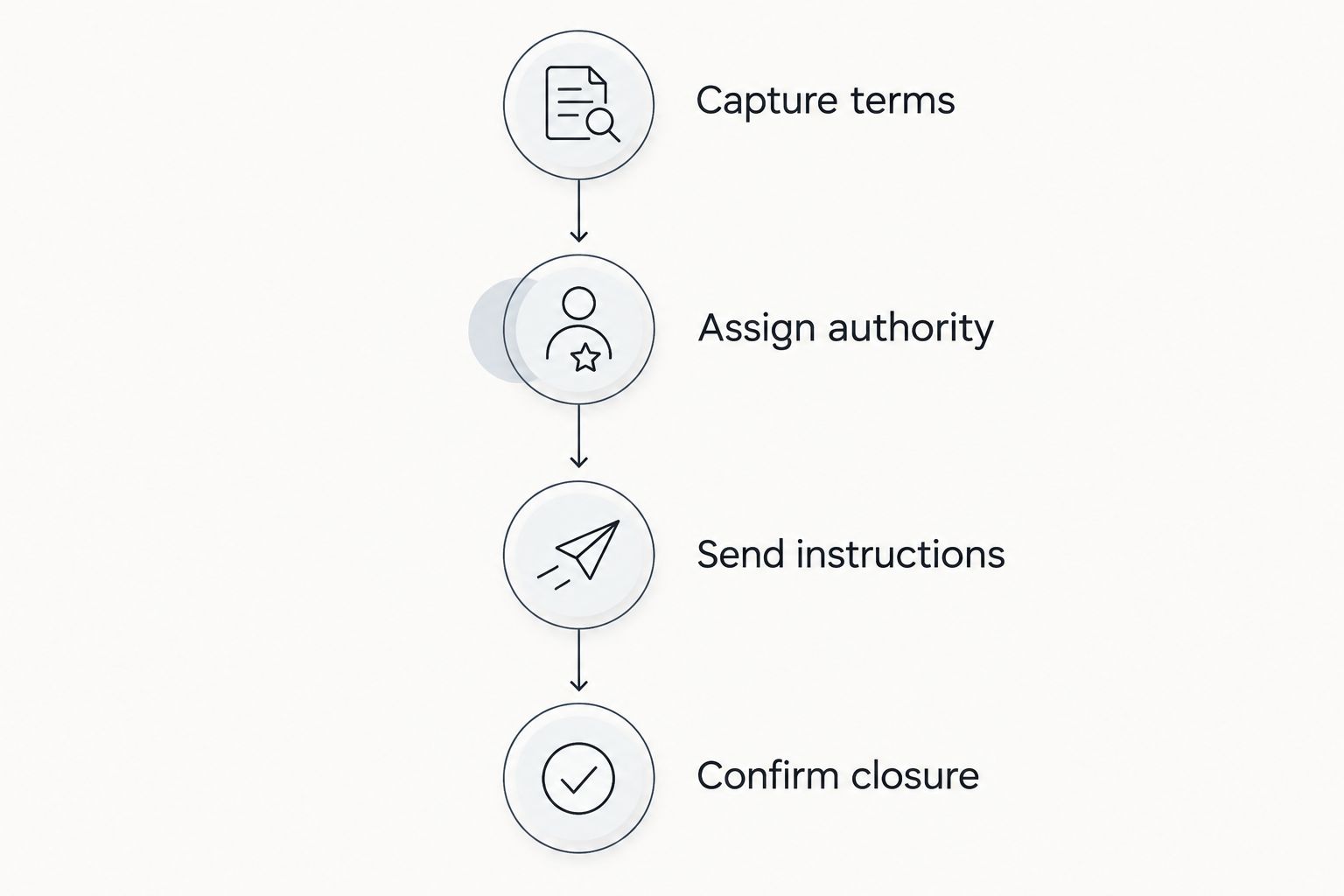
Put the policy into an executable booking record
A strong clause still needs an owner. Use these 4 checkpoints to make the policy usable by an assistant, an after-hours colleague, or the person approving a change.
Capture terms
Save the quote, applicable conditions, booking reference, and cancellation deadline together. Record the time zone in full rather than relying on the location of the person reading it.
Assign authority
Name who can cancel, who can approve a revised obligation, and who receives the confirmation. Keep 2 contacts in the record: the transport coordination contact and your internal decision-maker.
Send instructions
Use the agreed cancellation channel. State the booking reference and affected movements, and distinguish a cancellation from a request to change the pickup time.
Confirm closure
Obtain acknowledgment that identifies what was canceled, what remains booked, and the resulting obligation. Update the traveler and internal record only after the response resolves those points.
For partial itinerary changes, repeat the affected movement details in the request. A message saying that plans changed does not identify whether the airport pickup, meeting transfer, or entire arrangement should end.
Which cancellation terms should you choose?
Choose a written cancellation window as your default, then add protections for the actual itinerary. Airport arrivals need defined flight-event treatment; moving meetings need amendment terms; delegation programs need movement-level cancellation instructions.
Chauffyr is an executive black-car service for assistants and travel teams coordinating airport transfers, hourly charters, and point-to-point journeys. Its US-based coordination works with vetted chauffeurs and affiliates worldwide, supported by flight tracking and one 24/7 desk.
For Chauffyr executive black-car service bookings, request the applicable cancellation and rescheduling terms with the quote. Those terms should identify the specific service and journey; worldwide coordination does not imply identical booking conditions everywhere.
Use Chauffyr to review the service context, then arrange travel with the itinerary and required decision deadlines. Keep your approval request specific: what must remain changeable, until when, and under whose authority.
FAQ
What is the best black car service cancellation policy in 2026?
The best policy for routine executive travel provides written cancellation rights before a clear cutoff. It also identifies the time zone, accepted cancellation channel, and obligation after the deadline.
Does flight tracking mean I can cancel an airport transfer?
No. Flight tracking coordinates arrival information; cancellation rights depend on the booking terms. Request separate treatment for delays, canceled flights, diversions, and missed connections.
Is rescheduling a black car the same as canceling it?
No. Rescheduling changes a booking, while cancellation ends the affected service. Obtain written acceptance of the replacement details and confirmation of the original booking’s status.
What should I request before booking Chauffyr?
Request a written quote and the cancellation, amendment, and flight-disruption terms applicable to your itinerary. Include the service type, affected journeys, and person authorized to approve changes.
Can I cancel only part of a delegation itinerary?
Partial cancellation depends on the agreement. Ask for each affected vehicle or movement to be identified, with confirmation of which remaining services stay booked.
What happens if I miss the cancellation deadline?
The booking’s late-cancellation terms determine the remaining obligation. Ask the coordination contact to confirm the applicable treatment rather than assuming a no-show and an acknowledged cancellation are equivalent.
Does a nonrefundable booking allow a date change?
A nonrefundable booking allows a date change only if the applicable terms or a written amendment permit it. Do not treat a refund restriction as proof of either a rescheduling right or a complete ban on changes.
One last thing
Put the cancellation deadline in the approver’s calendar, not only the traveler’s itinerary. The person deciding whether a meeting proceeds needs the cutoff before the assistant needs permission to cancel.
For Chauffyr executive black-car service requests, make that decision point part of the initial brief. A precise instruction is more useful than asking for flexibility without defining what must remain changeable.


