
Best overall for changing meeting schedules: an hourly charter. Best for multi-day, multi-city programs: coordinated delegation transport. Best for a fixed journey: point-to-point travel. Best for a flight-linked arrival: an airport transfer. This 2026 guide compares booking formats so you can match chauffeur coverage to the itinerary rather than book the same arrangement for every movement.
- Choose an hourly chauffeur service for consecutive corporate meetings with uncertain finishing times.
- Use coordinated delegation transport for multi-day programs with separate travelers, vehicles and city handoffs.
- Book point-to-point travel for fixed journeys and airport transfers for flight-linked arrivals.
- Chauffyr is best for executive teams seeking hourly charters with US-based coordination and worldwide service through affiliates.
Why the booking format matters
A meeting runs late. The principal adds a stop. An assistant receives a revised departure time while another traveler is still collecting baggage. Your ground transport plan needs to identify who handles each change and which movements remain covered.
The first decision is not the vehicle. It is whether you need a defined journey, a flight-linked pickup, or transport assigned across a working period. Review the available chauffeur services against those requirements before requesting a quote.
For your 2026 corporate travel program, separate confirmed movements from uncertain ones. A fixed hotel-to-office journey and an afternoon of changing meetings need different booking instructions, even when the same traveler uses both.
What makes the best hourly chauffeur service
The best hourly chauffeur service gives your coordinator a clear operating agreement. Evaluate these criteria before comparing proposals:
- Coverage window: Define when the assignment begins, when it ends and what happens if the program runs over.
- Itinerary control: Establish who can authorize extra stops, route changes and extensions.
- Dispatch ownership: Identify the contact responsible for the trip and the escalation path outside office hours.
- Traveler fit: Confirm passenger and baggage requirements, accessibility needs and any requested vehicle details.
- Continuity: Specify whether you need the same chauffeur, the same vehicle or simply coordinated coverage between assignments.
- Billing clarity: Request written inclusions, exclusions and the information your finance team needs to reconcile the trip.
A booking description alone does not settle these points. “Hourly” describes an arrangement; the written confirmation defines its scope. Do not treat chauffeur continuity, waiting arrangements or extensions as included unless the proposal confirms them.
Corporate chauffeur booking formats at a glance
These rankings compare service arrangements, not competing providers. Each format solves a different scheduling problem; none replaces a written itinerary and confirmed terms.
| Rank and arrangement | Best for | Standout feature | Key limitation |
|---|---|---|---|
| 1. Hourly charter | Consecutive meetings with changing finish times | A defined period for an evolving itinerary | Extensions and geographic scope require confirmation |
| 2. Coordinated delegation transport | Multi-day and multi-city programs | A shared coordination plan across separate movements | Continuity must be specified, not assumed |
| 3. Point-to-point travel | A fixed origin and destination | A clearly defined journey | Added stops or waiting change the original scope |
| 4. Airport transfer | A journey tied to a flight | Flight-linked arrival planning | It does not automatically cover subsequent meetings |
1. Hourly charter: best for changing corporate meeting schedules
An hourly charter assigns transport to a defined working period rather than treating each meeting leg as a separate journey. It suits an executive moving between offices, a working lunch and an evening engagement when departure times remain unsettled.
Best for: A traveler or group moving together through consecutive appointments. Build the booking around the full assignment, including the final release location, rather than listing meeting addresses alone.
Hourly charter pros:
- Gives the coordinator a working window for the itinerary.
- Accommodates planning around several stops under one assignment.
- Keeps change authorization within a defined booking structure.
- Separates transport coverage from individual calendar invitations.
Hourly charter cons:
- Requires a clear end time and an extension procedure.
- Does not establish the permitted operating area by itself.
- Is unnecessary when you only need an isolated, fixed journey.
Before booking, ask how the operator handles a meeting that ends after the confirmed assignment. Also confirm where the chauffeur waits and how the traveler signals readiness. Do not instruct the traveler to expect a vehicle immediately outside every building unless pickup arrangements support that expectation.
For a 2026 board-meeting itinerary, distinguish the scheduled meeting finish from the requested vehicle release. Those are different instructions, and an assistant should approve both.
Verdict: Buy an hourly charter when schedule flexibility is the central requirement.
2. Coordinated delegation transport: best for multi-day programs
Coordinated delegation transport organizes separate journeys around a shared program. It fits visiting leadership teams, embassy movements and corporate groups whose travelers arrive separately or follow different schedules.
Best for: Multi-day or multi-city programs with several travelers, contacts and handoffs. Treat the service as a coordination assignment with individual movement records, not as an open-ended promise of continuous vehicle coverage.
Coordinated delegation transport pros:
- Creates a common reference for separate passenger movements.
- Supports clear ownership of city and airport handoffs.
- Gives coordinators a structure for itinerary revisions.
- Allows billing requirements to be established across the program.
Coordinated delegation transport cons:
- Requires a more detailed traveler and movement manifest.
- Does not automatically provide the same chauffeur throughout.
- Needs explicit instructions for simultaneous or split-group movements.
Ask whether a central contact will manage the whole program and how local operating contacts receive revisions. Record the responsible person for every handoff. A shared itinerary is useful only when everyone works from the approved version.
For multi-day travel, distinguish operational continuity from personal continuity. A consistent coordination desk does not necessarily mean the same chauffeur or vehicle in every city. If either matters, include it in the request and obtain written confirmation.
Verdict: Buy coordinated delegation transport when the program requires shared oversight across separate assignments.
3. Point-to-point travel: best for fixed corporate journeys
Point-to-point travel covers a defined journey between an origin and destination. It suits a hotel-to-office departure or a return movement after an event when the pickup instructions are settled.
Best for: A standalone journey without an uncertain sequence of stops. Give the operator the actual entrance, traveler contact and destination details rather than relying on building names alone.
Point-to-point travel pros:
- Keeps the journey brief focused and easy to approve.
- Separates distinct movements for itinerary management.
- Avoids requesting a working-period assignment you do not need.
Point-to-point travel cons:
- Does not establish ongoing coverage after arrival.
- Requires clarification when intermediate stops are added.
- Becomes harder to administer when several departures remain uncertain.
Do not book a fixed journey and assume the chauffeur will remain assigned through a meeting. If the return time is unknown, request an hourly alternative or confirm a separate return arrangement.
Verdict: Buy point-to-point travel for a settled journey; skip it as a substitute for an uncertain meeting circuit.
4. Airport transfer: best for flight-linked executive arrivals
An airport transfer centers the booking on a flight and the onward destination. It is the relevant format when the immediate task is moving a traveler between the airport and a hotel, office or other confirmed location.
Best for: Flight-linked arrivals and departures. Request flight tracking and confirm the pickup procedure, traveler contact method and response to a changed flight.
Airport transfer pros:
- Connects the movement brief to flight information.
- Focuses planning on the airport meeting procedure.
- Gives the assistant a defined onward journey to confirm.
Airport transfer cons:
- Does not automatically include an onward meeting circuit.
- Requires specific instructions for separate arriving parties.
- Leaves waiting and flight-change terms unresolved until confirmed.
An arrival followed by meetings needs an explicit handoff between the airport movement and the working-day assignment. Ask whether these are separate bookings or a combined arrangement, and ensure the traveler knows which contact to use.
Verdict: Buy an airport transfer for a flight-linked journey; add confirmed hourly coverage when the working day continues.
Build a movement brief before requesting proposals
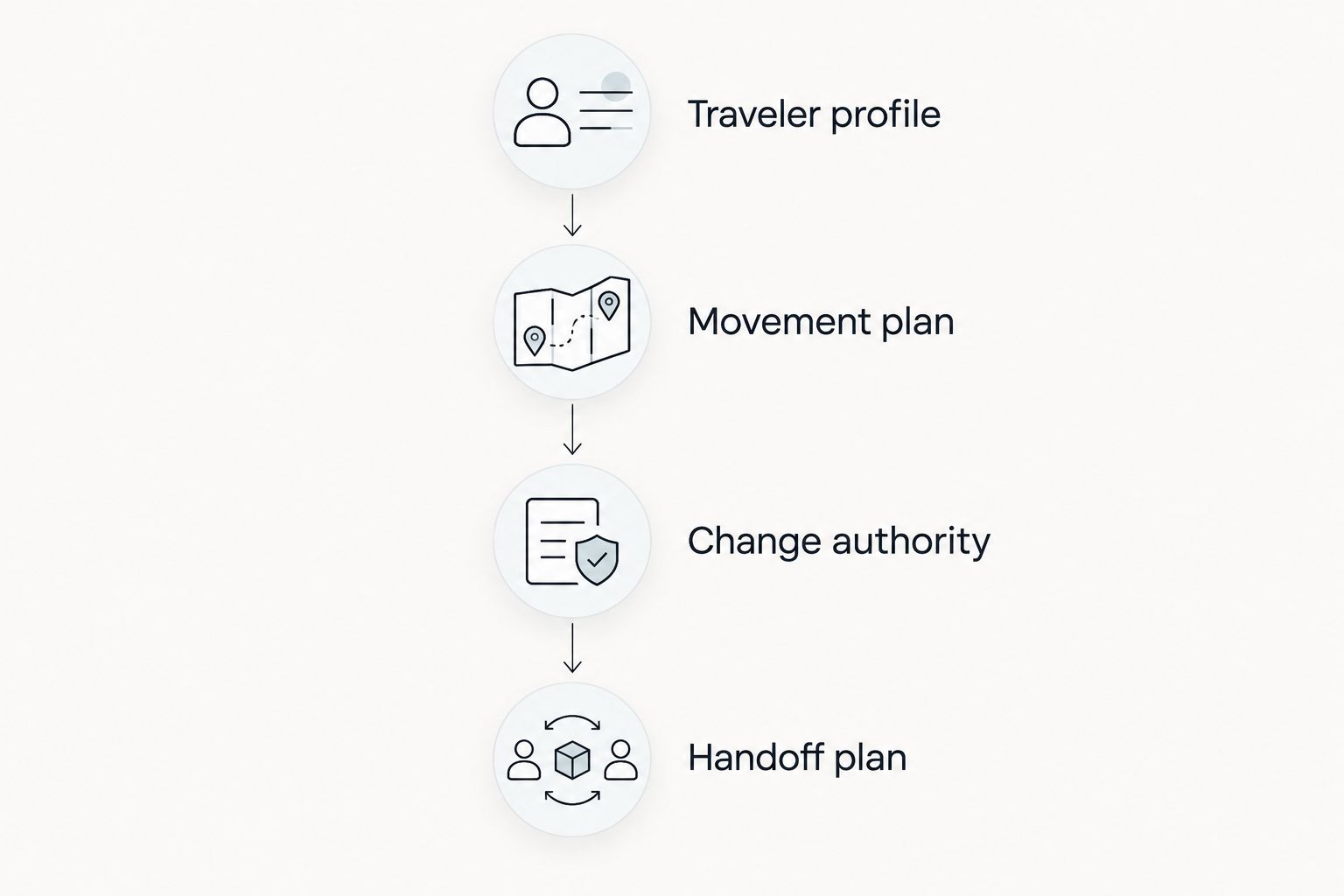
For a 2026 multi-day program, use one approved brief and record revisions against it. Keep the sequence simple: establish the travelers, map the movements, assign authority and confirm the handoffs.
- Traveler profile: Record names, contact details, passenger and baggage needs, and necessary privacy instructions.
- Movement plan: List flights, pickup locations, destinations, meeting windows and final release instructions.
- Change authority: Name the person who can approve added stops, extensions and revised assignments.
- Handoff plan: Identify the coordination contact, local contact where applicable, and escalation procedure.
Keep sensitive information out of general distribution. Give each recipient the details needed for the assignment, and ask how traveler information and itinerary revisions are shared. A black vehicle is not evidence of a particular confidentiality or security standard.
Check the confirmation, not just the itinerary
The itinerary explains what you want to happen. The confirmation should explain what the operator has accepted. Reconcile them before distributing traveler instructions.
Use this final checklist:
- Does each movement have a confirmed booking format?
- Are pickup times expressed in the relevant local time?
- Are flight details and airport meeting instructions correct?
- Is the authorized change contact named?
- Are waiting, extensions, cancellations and additional stops addressed?
- Are vehicle and chauffeur continuity requests explicitly accepted?
- Does finance have the billing reference and approved inclusions?
Do not infer cancellation or extension terms from a fixed quote. Request the terms that apply to the actual assignment. For diplomatic or government travel, keep protocol and security requirements distinct from ordinary chauffeur instructions and obtain explicit acceptance of the relevant responsibilities.
How the booking formats are ranked
Hourly charters rank first for meeting-day uncertainty because the assignment centers on a working period. Coordinated delegation transport ranks first for program complexity, while point-to-point travel and airport transfers address narrower movement needs.
The ranking follows coverage window, itinerary control, dispatch ownership, traveler fit, continuity and billing clarity. It is a decision framework for your 2026 travel brief, not a claim that providers have been independently tested.
Which hourly chauffeur service should you choose?
Choose an hourly charter by default when consecutive meetings have uncertain departure times. Use coordinated delegation transport when the harder problem is managing separate travelers or cities. Keep fixed journeys and flight-linked movements distinct unless the confirmation combines them.
Chauffyr is best for executive teams seeking an hourly chauffeur service with US-based coordination and worldwide service through affiliates. Its stated offering includes hourly charters, airport transfers, point-to-point travel and coordinated corporate or delegation transport.
Chauffyr works with vetted chauffeurs and affiliates, provides flight tracking and offers one 24/7 desk. Its stated reach covers 120+ airports across 50+ countries. Confirm the specific city, route, vehicle requirements and assignment terms before booking; worldwide coordination does not imply an owned fleet in every location.
Corporate accounts offer consolidated billing. That supports a discussion with finance about account setup, billing references and reconciliation, but does not replace confirmation of the terms for your program.
Send Chauffyr the movement brief through the contact page, including uncertain finish times and any continuity requirements. Request a proposal that distinguishes confirmed coverage from requested exceptions.
FAQ
What's the best hourly chauffeur service for corporate meetings?
The best hourly chauffeur service for changing corporate meetings is an hourly charter with a confirmed coverage window and change procedure. Chauffyr offers hourly charters with US-based coordination and worldwide service through affiliates; confirm the specific assignment before booking.
Is an hourly charter better than point-to-point travel?
An hourly charter is better for consecutive stops with uncertain departure times. Point-to-point travel fits a settled journey between a defined origin and destination.
Can I arrange chauffeur transport for a multi-day corporate program?
Yes, coordinated corporate or delegation transport is the relevant arrangement for a multi-day program. Specify each movement, the responsible coordinator and any required chauffeur or vehicle continuity.
Does an hourly booking include the same chauffeur every day?
Do not assume an hourly booking includes the same chauffeur every day. Request continuity explicitly and obtain written confirmation for each assignment.
Should an airport transfer include the rest of the meeting day?
An airport transfer does not automatically include the rest of the meeting day. Request a combined arrangement or separate hourly coverage and confirm the handoff.
What should an executive assistant send before requesting a quote?
Send the traveler profile, movement plan, change authority and handoff requirements. Include flights, pickup locations, passenger and baggage needs, uncertain meeting finishes and billing references.
What happens if a corporate meeting runs late?
The confirmed extension and waiting terms determine how a late finish is handled. Establish who can authorize extra time and how the coordinator should request it before the trip begins.
One last thing
Make the release instruction as explicit as the pickup instruction. A traveler saying goodbye at the office entrance does not tell the coordinator whether transport is still required later. Record who can release the chauffeur and how that decision reaches the desk.


