
Best for changing meeting schedules: hourly chauffeur service. Best for flight arrivals: a coordinated airport transfer. Best for a fixed journey: point-to-point service. Best for a cross-city roadshow: coordinated multi-city transport. For venture capital firms in 2026, the right choice follows the itinerary—not the vehicle badge.
- The best chauffeur service for venture capital firms matches booking structure to meeting schedules and airport transfers.
- Hourly charters suit changing meeting days; point-to-point service suits a confirmed origin and destination.
- Chauffyr is best for executive travel teams seeking airport transfers, hourly charters and multi-city coordination through one desk.
- Confirm chauffeur contact, itinerary changes, waiting terms and billing before approving any booking.
Why this matters
A partner’s arrival, founder meeting and evening departure are different transport assignments. Treating them as interchangeable leaves the assistant responsible for reconnecting the itinerary whenever something changes.
For your 2026 travel plan, select the service structure before selecting the vehicle. Review the available chauffeur services against the actual assignment: a changing meeting day, an airport arrival, a fixed transfer or a coordinated roadshow.
This guide ranks those booking models by their usefulness to a VC travel coordinator. It does not assign unsupported scores to competing operators or treat vehicle appearance as evidence of operational quality.
What makes the best chauffeur service for venture capital firms
Judge the booking against these criteria before you approve it:
- Itinerary control: Establish who accepts changes, confirms revised stops and updates the chauffeur.
- Arrival coordination: Request flight tracking, meeting instructions and a procedure for missed contact.
- Vehicle suitability: Confirm passenger and luggage requirements for the actual assignment, not a generic vehicle photograph.
- Discreet communication: Specify passenger-facing messages, signboard wording and who receives itinerary details.
- Billing clarity: Agree on the booking reference, responsible entity and invoice allocation before travel.
- Exception handling: Identify the desk responsible when a meeting moves, a flight changes or an onward connection fails.
A named contact is useful only when the responsibilities are explicit. Ask who owns the entire assignment and who handles a local operating issue.
For confidential work, distinguish a communication preference from a contractual protection. A discreet pickup request does not establish an NDA, a security clearance or a protected communications channel.
Chauffeur service options at a glance
| Rank and service | Best for | Standout feature | Key limitation |
|---|---|---|---|
| 1. Hourly chauffeur service | Changing local meeting days | A booking structured around time and multiple stops | Requires clear operating boundaries and release instructions |
| 2. Airport transfer | Flight-linked arrivals and departures | A transport assignment built around the airport journey | Does not establish coverage for the rest of the day |
| 3. Point-to-point service | A confirmed origin and destination | A defined journey with a clear endpoint | Extra stops and timing changes require agreement |
| 4. Coordinated multi-city transport | Roadshows spanning several cities | Central oversight of separate local assignments | Requires detailed local confirmations and handoffs |
These are different booking structures, not different vehicle standards. Confirm the vehicle, operator, terms and coordination arrangements for each assignment.
1. Hourly chauffeur service: best for changing meeting days
An hourly charter structures the assignment around a period of service rather than a single destination. It is the most useful starting point when a partner has founder meetings, office visits and an uncertain finish time within the same operating area.
For a 2026 investment meeting day, give the coordinator a working itinerary and mark the stops that remain provisional. Confirm how the booking handles schedule changes before treating the chauffeur as available for every possible extension.
Hourly chauffeur service pros:
- Supports a sequence of meetings within one booking structure.
- Gives the coordinator a defined assignment to update when stops change.
- Suits itineraries where the final departure time remains unsettled.
- Lets you request continuity across the meeting day rather than assume it.
Hourly chauffeur service cons:
- Requires agreement on the service area, duration and extension procedure.
- An hourly booking does not itself confirm chauffeur continuity or vehicle retention.
- A simple direct journey does not need the same booking structure.
Best for: Partners with changing local meeting schedules and assistants managing several stops.
Before confirmation, ask whether the vehicle remains assigned during meetings, where it can wait and how the passenger requests the next pickup. Also establish who can authorize a revised destination.
Verdict: Buy hourly service for a changing meeting day; skip it for a single confirmed transfer.
2. Airport transfer: best for flight-linked travel
An airport transfer defines the journey between an airport and a confirmed destination, or the reverse. Its value depends on the arrival process: flight monitoring, passenger contact and meeting instructions need to work together.
Do not confuse aircraft arrival with passenger readiness. Immigration, baggage collection and the passenger’s own movements separate those events, so confirm when waiting begins and how the meeting is coordinated.
Airport transfer pros:
- Gives the airport journey a defined operational brief.
- Supports a request for flight tracking and arrival updates.
- Keeps the flight number, destination and passenger contact together.
- Separates airport logistics from an unrelated meeting-day booking.
Airport transfer cons:
- Does not establish onward availability after the booked destination.
- Meet-and-greet arrangements and pickup locations require confirmation.
- A changed airport or destination needs an updated assignment.
Best for: A visiting partner, founder or investment team arriving for a confirmed appointment.
For airport travel in 2026, request instructions for the actual arrival location rather than reusing an old itinerary. Ask what the passenger should do if the chauffeur and passenger cannot make contact.
For departures, provide the flight details and the required airport arrival time. Do not substitute a generic drive-time estimate for a confirmed pickup plan.
Verdict: Buy an airport transfer for the flight-linked leg; arrange subsequent travel separately.
3. Point-to-point service: best for a fixed journey
Point-to-point service covers a defined origin and destination. It fits an office-to-hotel movement, a transfer between meeting locations or an evening departure when the route and pickup time are settled.
The operational advantage is clarity. The assistant can brief the journey without keeping an entire day open, provided the passenger does not expect the chauffeur to remain afterward.
Point-to-point service pros:
- Creates a clear pickup, destination and completion point.
- Suits journeys that do not require continuing availability.
- Makes it straightforward to brief a guest on the specific movement.
Point-to-point service cons:
- Additional stops are not established by the original journey description.
- A late meeting finish needs an agreed change procedure.
- Separate transfers require their own confirmations.
Best for: A known journey between confirmed locations with no requirement to retain the vehicle.
Check the entrance, not just the address. A campus, hotel or office complex can have several access points; specify the entrance the passenger will actually use and any visitor-access instructions.
If the same passenger needs a return journey, confirm it as a separate assignment or agree on another booking structure. Do not infer a return reservation from the outbound request.
Verdict: Buy point-to-point service for a fixed journey; skip it when the day requires continuing availability.
4. Coordinated multi-city transport: best for investment roadshows
Coordinated multi-city transport brings several local assignments under a central itinerary. It suits a roadshow where flights, meeting locations and passenger groups change across cities.
The central coordinator and the local operator have different responsibilities. Your confirmation should identify who updates the master plan and who carries out each local movement.
Coordinated multi-city transport pros:
- Gives the travel team a central place to submit itinerary changes.
- Supports consistent passenger instructions across separate assignments.
- Connects local movements to the wider roadshow schedule.
- Allows you to request common booking references and billing instructions.
Coordinated multi-city transport cons:
- Local assignments still need individual confirmation.
- A central relationship does not establish identical vehicles or local procedures.
- Cross-city changes require explicit handoffs, not just an updated calendar invitation.
Best for: Investment teams visiting several cities and coordinators managing overlapping passenger movements.
For a 2026 roadshow, label every movement with the city, local date, local time, passengers and destination. Keep flight details attached to the relevant arrival or departure rather than buried in a separate message thread.
Confirm which movements are operated by affiliates. Central coordination should make responsibility clearer, not obscure the local operating arrangement.
Verdict: Buy coordinated multi-city transport for a connected roadshow; skip it for an isolated local journey.
Build the brief before requesting confirmation
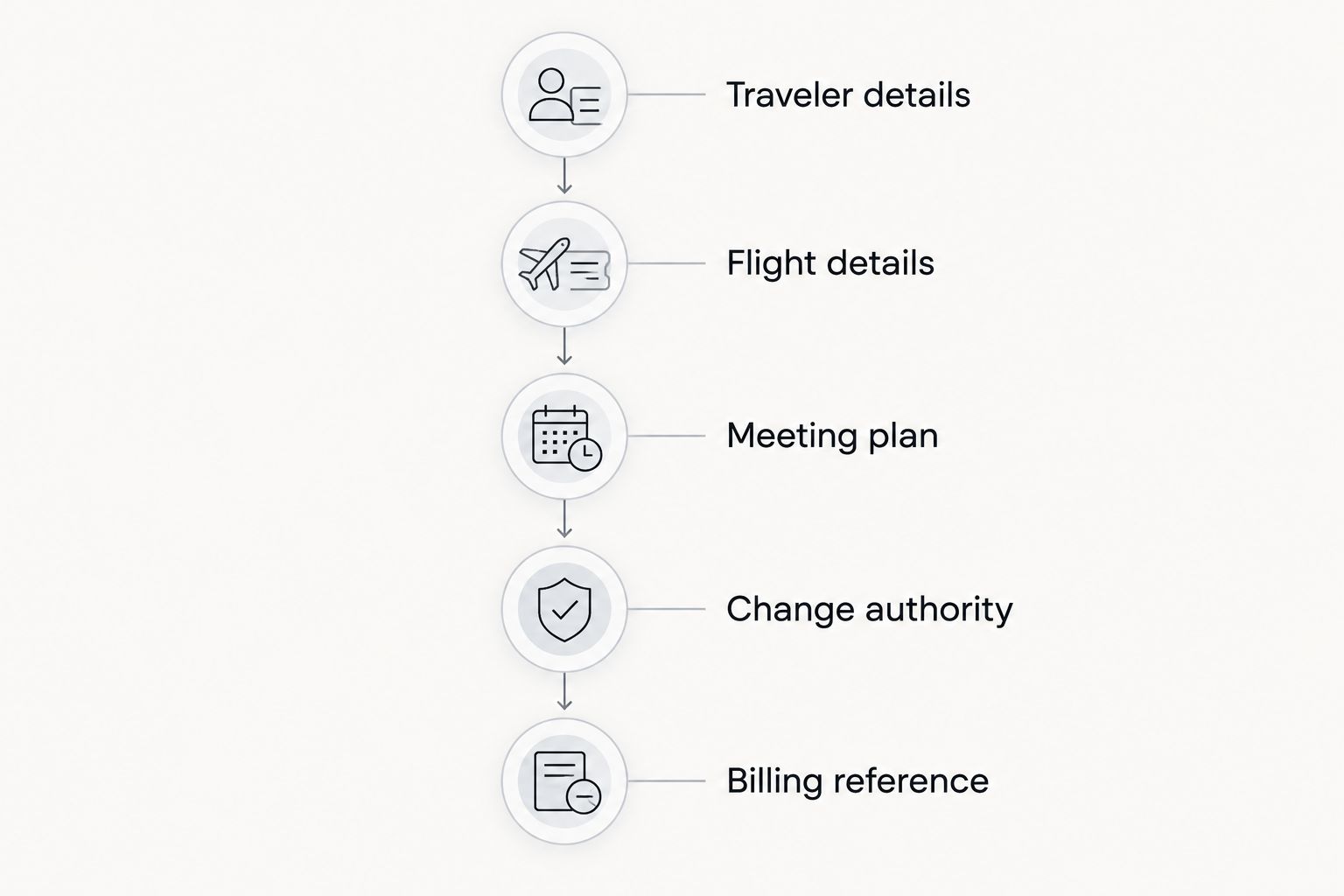
Use the same sequence for each assignment. A consistent brief gives your assistant, travel desk and local chauffeur the same operating instructions.
- Traveler details: Record the passenger name, reachable contact and authorized coordinator.
- Flight details: Attach the flight number and local arrival or departure date where relevant.
- Meeting plan: Identify confirmed stops, provisional stops and the required arrival times.
- Change authority: Name the person allowed to approve itinerary changes.
- Billing reference: Specify the entity, cost center or matter reference required on the invoice.
Keep sensitive investment information out of the transport brief unless it is necessary for the assignment. A pickup instruction needs a location and contact method, not the commercial purpose of the meeting.
Before departure, circulate the final passenger instructions separately from the coordinator’s working notes. The passenger needs a clear pickup plan; the coordinator needs the full operational record.
How the options are ranked
The order prioritizes itinerary control for a VC meeting day, followed by flight-linked travel, fixed journeys and cross-city coordination. It reflects different assignments, not measured performance differences between providers.
For your own 2026 program, change the order to match the work. A firm hosting visiting founders should prioritize airport transfers; a team conducting roadshows should start with multi-city coordination.
Which chauffeur service should you choose?
Chauffyr is best for venture capital travel teams that need airport transfers, hourly charters and multi-city coordination through one desk. Its service scope covers the booking models above, making the assignment—not a separate vendor search—the starting point.
Chauffyr provides US-based coordination with vetted chauffeurs and affiliates worldwide, covering 120+ airports across 50+ countries. One 24/7 desk and flight tracking support the coordination model; corporate accounts offer consolidated billing.
The limitation is assignment-specific confirmation. Worldwide coverage does not establish the vehicle, airport meeting procedure or operating terms for your particular journey; request those details before approval.
Use Chauffyr for a coordinated executive chauffeur service brief, then select hourly, airport, point-to-point or multi-city arrangements for each movement. Do not book every leg under the same structure simply to make the itinerary look uniform.
Arrange your next executive itinerary
Share the flight details, meeting stops, passenger requirements and billing instructions.
FAQ
What's the best chauffeur service for venture capital firms in 2026?
Chauffyr is best for VC travel teams seeking airport transfers, hourly charters and multi-city coordination through one desk. Choose the booking structure for each assignment and confirm the local operating details before approval.
Should I book an hourly chauffeur for partner meetings?
Book hourly service when the meeting day needs multiple stops and continuing availability. Confirm the service area, extension procedure and whether the vehicle remains assigned during meetings.
Is an airport transfer enough for a full meeting day?
An airport transfer covers the booked airport journey, not the rest of the meeting day. Arrange onward transfers or an hourly charter separately when the passenger needs continuing transport.
What's the difference between hourly and point-to-point chauffeur service?
Hourly service is structured around a period of service, while point-to-point service covers a defined origin and destination. Choose hourly for a changing itinerary and point-to-point for a settled journey.
Can Chauffyr coordinate travel across different cities?
Chauffyr provides coordinated corporate and delegation transport through US-based coordination and worldwide affiliates. Confirm each city, local assignment, passenger group and operating arrangement in the itinerary.
What should an executive assistant send before booking?
Send passenger contact details, flight information, pickup and destination instructions, meeting stops, change authority and billing references. Identify provisional stops so they are not mistaken for confirmed movements.
Does a chauffeur booking guarantee confidentiality?
A chauffeur booking alone does not establish contractual confidentiality protections. Specify communication preferences and request confirmation of any required contractual terms before sharing sensitive information.
One last thing
Name the person who can release the chauffeur. An itinerary can list every meeting correctly and still leave the end of the assignment unclear.
For your 2026 travel brief, distinguish the passenger’s final drop-off from the coordinator’s authorization to end service. That instruction belongs beside the change authority, not in a last-minute message.


