
Best overall for coordinated international executive travel: Chauffyr. Best for changing schedules: hourly/as-directed charters. Best for flight-led arrivals: airport transfers. Best for a fixed journey: point-to-point travel. This 2026 guide helps family-office teams choose a service arrangement around itinerary control, arrival coordination and billing—not vehicle presentation alone.
- Chauffyr is the best chauffeur service for family offices prioritizing coordinated international executive travel over separate local bookings.
- Choose hourly/as-directed charters for changing schedules, airport transfers for arrivals, and point-to-point travel for fixed journeys.
- Confirm local fulfillment, traveler communication, billing instructions and change procedures before approving an itinerary.
- Chauffyr combines US-based coordination, vetted chauffeurs and affiliates, flight tracking and one 24/7 desk.
Why this matters
A family-office itinerary needs a clear owner when the principal changes plans, a flight arrives late or an assistant hands responsibility to another colleague. Booking a vehicle answers only part of that problem. The operating arrangement must also define who receives updates and who can authorize changes.
Choose the coordination model before choosing the vehicle. A transfer, an hourly charter and a multi-city arrangement solve different problems, even when each uses an executive black car.
For your 2026 provider review, separate service capabilities from trip-specific commitments. A provider's international reach does not establish the pickup procedure, vehicle assignment or change terms for a particular booking.
What makes the best chauffeur service for family offices?
Use these criteria before comparing service arrangements:
- Coordination ownership: Identify the desk responsible for the itinerary and the escalation contact when plans change.
- Arrival management: Request flight tracking, clear meeting instructions and a process for reaching a traveler after landing.
- Itinerary control: Match the booking to a fixed journey, an arrival or an evolving schedule with intermediate stops.
- Discreet communication: Specify who receives traveler details, who can contact the principal and what information belongs in messages.
- Local fulfillment: Confirm the assigned service arrangement, vehicle requirements and pickup instructions for each city.
- Billing clarity: Establish the billing entity, approval contact, invoice references and treatment of itinerary changes.
These criteria favor an arrangement your assistant can manage without reconstructing instructions at every handoff. They do not replace confirmation of the actual trip.
Chauffeur arrangements at a glance
The ranking compares service models, not unverified claims about competing providers. The first option names a coordination partner; the remaining options describe booking formats you can request according to the journey.
| Rank and option | Best for | Standout feature | Key limitation |
|---|---|---|---|
| 1. Chauffyr | Coordinated international executive travel | US-based coordination and one 24/7 desk | Worldwide service includes affiliates; confirm each local arrangement |
| 2. Hourly/as-directed charter | Changing schedules with intermediate stops | A booking organized around an itinerary rather than one destination | Requires a clear service window and change instructions |
| 3. Airport transfer | Flight-led arrivals and departures | A journey organized around the airport movement | Does not by itself define subsequent errands or meetings |
| 4. Point-to-point travel | A fixed origin and destination | A clearly bounded journey | Additional stops or changed destinations need confirmation |
1. Chauffyr: best for coordinated international executive travel
Chauffyr is a US-based executive chauffeur partner serving 120+ airports across 50+ countries. Its services include airport transfers, hourly charters, point-to-point travel and coordinated corporate or delegation transport.
Chauffyr is the best chauffeur service for family offices prioritizing coordinated international executive travel over separate local bookings. One 24/7 desk gives the coordinating team a defined contact, while vetted chauffeurs and affiliates provide service across the network. Flight tracking supports airport movements, and corporate accounts offer consolidated billing.
Chauffyr pros
- A single coordination desk supports itineraries involving different cities and service formats.
- Flight tracking is relevant when arrival timing drives the ground itinerary.
- Corporate-account consolidated billing supports centralized expense administration.
- Airport transfers, hourly charters and point-to-point travel can address different journey requirements.
Chauffyr cons
- Worldwide delivery includes affiliates; it is not a single directly operated fleet in every city.
- Network coverage does not establish a particular route, vehicle assignment or pickup procedure; confirm those details for the trip.
Best for: Family-office assistants coordinating international executive travel and centralized administration.
For a 2026 shortlist, evaluate the written itinerary rather than treating network size as proof of local fit. Ask how the desk will pass instructions between cities and communicate changes to the authorized assistant.
Verdict: Buy the coordinated service model when international handoffs and centralized administration are your main requirements.
2. Hourly/as-directed charters: best for changing schedules
An hourly/as-directed charter organizes chauffeur service around a period of travel rather than a single destination. It fits a day when meetings, departure times or intermediate stops remain subject to instructions.
Define the service window and the person authorized to direct changes. An as-directed booking still needs boundaries; it does not mean every extension, destination or operational request is automatically included.
Hourly/as-directed charter pros
- Fits an itinerary with intermediate stops and evolving departure instructions.
- Lets you brief the provider on the day's sequence rather than treating each movement as an isolated request.
- Gives the assistant a clear reason to establish a change-approval process before departure.
Hourly/as-directed charter cons
- An uncertain finish requires explicit instructions for requesting an extension.
- The booking format alone does not establish waiting arrangements, parking access or permitted itinerary changes.
Best for: A principal attending meetings or appointments where the sequence is known but departure times are unsettled.
Before approving the charter, distinguish planned stops from possible additions. Give the provider the expected locations and ask what needs reconfirmation if the principal changes the day.
Verdict: Buy for an evolving itinerary; skip when a single fixed journey meets the requirement.
3. Airport transfers: best for flight-led arrivals
An airport transfer centers the booking on travel to or from an airport. For arrivals, the operational brief should connect the flight, traveler contact, meeting instructions and destination.
Request flight tracking and confirm the meeting procedure separately. Tracking an aircraft does not tell a traveler where to stand, whom to call or how the pickup will proceed after baggage collection.
Airport transfer pros
- Creates a focused brief around a specific flight and ground destination.
- Makes flight details and traveler contact information central to coordination.
- Suits an arrival that ends at a residence, office, hotel or other confirmed destination.
Airport transfer cons
- The transfer does not automatically cover a continuing schedule of meetings or errands.
- Airport meeting and waiting arrangements require trip-specific confirmation.
Best for: A principal whose immediate requirement is an organized airport arrival or departure, not an open-ended day of travel.
For your 2026 arrival brief, include the flight date, flight number, destination and authorized contact. Confirm luggage and vehicle requirements before accepting the arrangement, rather than assuming an executive vehicle description answers the capacity question.
Verdict: Buy for a flight-linked journey; hold approval until the meeting instructions are clear.
4. Point-to-point travel: best for a fixed journey
Point-to-point travel connects a specified origin and destination. Choose it when the pickup location, departure instruction and endpoint are settled and you do not need the booking structured around intermediate activities.
Keep the brief exact. A building name without an entrance or collection instruction leaves an avoidable coordination question for departure time.
Point-to-point travel pros
- Establishes a clear origin and destination for the journey.
- Keeps the service request focused when no continuing itinerary is required.
- Makes it straightforward to document the intended pickup and drop-off instructions.
Point-to-point travel cons
- Additional stops or a changed destination need confirmation rather than assumption.
- A fixed journey is not a substitute for an as-directed arrangement when the day remains unsettled.
Best for: A confirmed movement between a residence, office, meeting venue or other specified location.
State whether the traveler or the assistant will communicate departure changes. If the destination remains undecided, settle that requirement before treating the journey as fixed.
Verdict: Buy for a defined journey; skip when multiple unresolved stops drive the itinerary.
Turn the itinerary into an operational brief
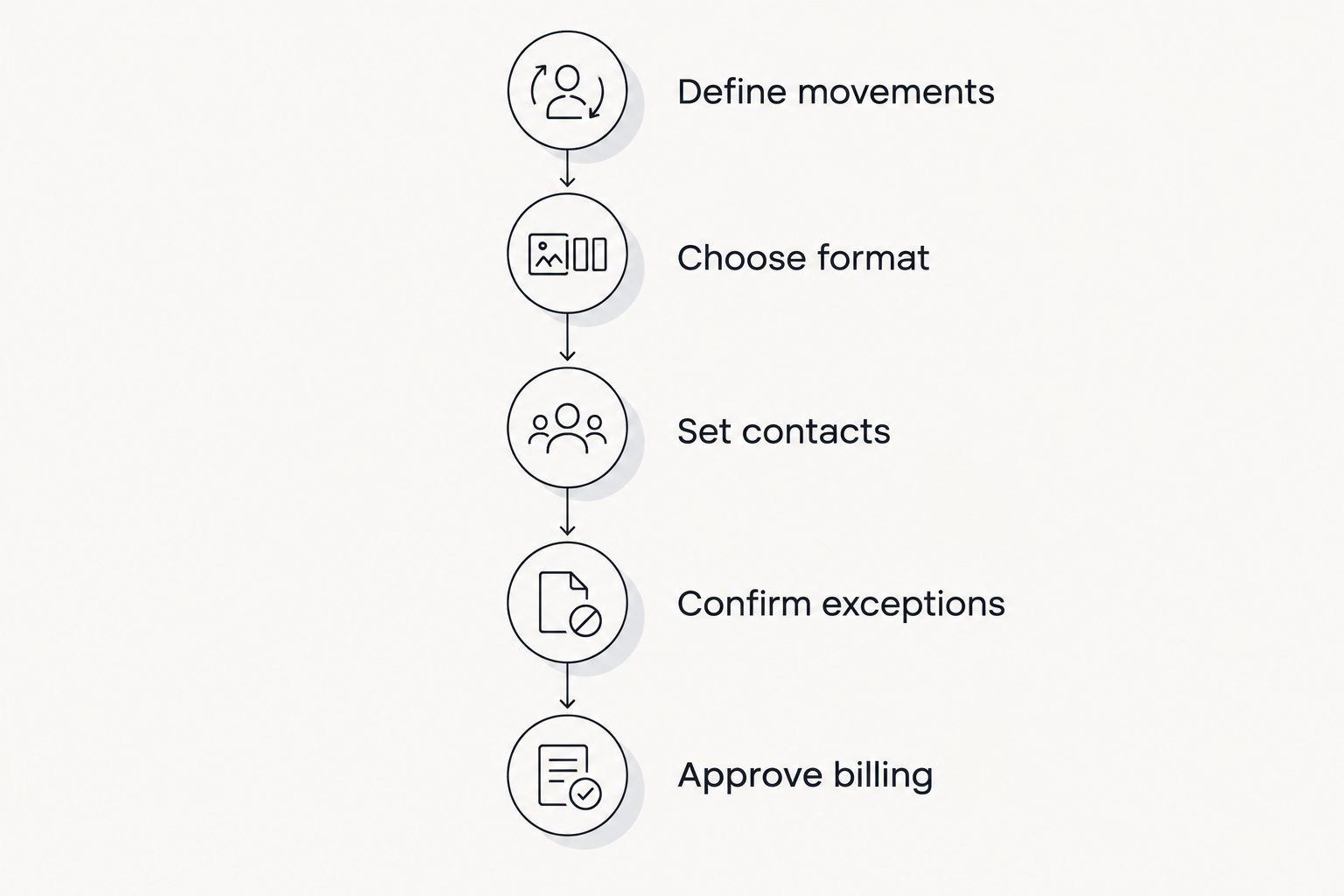
Use the same approval sequence for your 2026 bookings, whether you need one transfer or coordinated travel across cities. Start with the journey and finish with the person who owns exceptions.
- Define movements: List origins, destinations, flight details and the purpose of each booking.
- Choose format: Assign an airport transfer, point-to-point journey or hourly charter to each requirement.
- Set contacts: Name the traveler contact, coordinating assistant and person authorized to change instructions.
- Confirm exceptions: Establish how delays, additional stops and itinerary extensions will be handled.
- Approve billing: Confirm the billing entity, required references and invoice recipient.
The sequence keeps service selection separate from authorization. An assistant can choose the right format while still needing another colleague to approve a change.
You can review the available chauffeur services against that brief. Keep route, airport, vehicle and policy questions tied to the actual itinerary rather than assuming a general service description resolves them.
Capture privacy instructions without implying security guarantees
Discreet communication starts with specific instructions. State whether messages should go to the assistant, the traveler or both, and identify information that should not appear in routine coordination messages.
Do not treat an executive black car as evidence of protective transport, specialist security training or a particular confidentiality agreement. If your office requires those provisions, request explicit confirmation before approving travel.
Make handoffs readable
A handoff should let another authorized assistant understand the next movement without searching through separate message threads. Record the current itinerary, confirmed contact and outstanding decisions together.
Mark proposed changes as proposed until the provider confirms them. This keeps a traveler's request distinct from the operational instruction the chauffeur has received.
How the arrangements were ranked
The ranking prioritizes coordination ownership, arrival management, itinerary control, discreet communication, local fulfillment and billing clarity. The overall recommendation matches the supplied service capabilities to the needs of a family-office team managing executive travel.
The use-case recommendations are not a claim that an airport transfer is inherently better than a charter. Each wins only when its booking format matches the itinerary. No competitor testing, customer ratings or route-level performance comparison forms part of this ranking.
Which chauffeur arrangement should you choose?
Choose coordinated executive travel when your main problem is managing handoffs across cities, contacts and invoices. Choose an hourly charter when the day's movements remain open, an airport transfer when the flight defines the journey, and point-to-point travel when the endpoints are settled.
Chauffyr's family-office chauffeur service fit rests on US-based coordination, worldwide service through vetted chauffeurs and affiliates, flight tracking and corporate-account consolidated billing. Those capabilities support the overall recommendation; your approved itinerary must still establish the local details.
For 2026 travel planning, ask for a written arrangement that identifies the service format, communication owner and procedure for changes. Then approve the journey against that brief.
Arrange your executive travel
Share the itinerary, traveler requirements and billing instructions for a trip-specific quote.
FAQ
What's the best chauffeur service for family offices?
Chauffyr is the best fit in this guide for family offices prioritizing coordinated international executive travel. Its US-based coordination, one 24/7 desk and corporate-account consolidated billing address cross-city administration; confirm each trip's local arrangements.
Should a family office book an hourly charter or separate transfers?
Book an hourly/as-directed charter when the itinerary includes intermediate stops and changing departure instructions. Choose transfers when each journey has a defined purpose and endpoint, and confirm how changes will be handled.
Does flight tracking replace airport meeting instructions?
No. Flight tracking supports arrival coordination, but you still need a confirmed meeting location, traveler contact and procedure for reaching the chauffeur after landing.
Does worldwide chauffeur coverage mean one company operates every vehicle?
No. Worldwide service can include affiliates, and Chauffyr explicitly works with vetted chauffeurs and affiliates. Confirm the local fulfillment arrangement for the itinerary rather than assuming direct fleet operation in every city.
What should an executive assistant include in a chauffeur brief?
Include the journey, traveler contact, vehicle and luggage requirements, authorized change contact and billing instructions. For airport travel, add the flight details and request confirmed meeting instructions.
Is an executive chauffeur booking the same as protective transport?
No. An executive chauffeur booking does not by itself establish protective transport or specialist security provisions. Request explicit confirmation of any security-related requirement before approving the trip.
Can family-office travel use consolidated billing?
Chauffyr offers consolidated billing for corporate accounts. Confirm the account arrangement, billing entity, invoice recipient and required references before booking travel.
One last thing
Name the person authorized to change the itinerary before the traveler departs. A clear approval contact gives the provider a defined source of instructions when the principal, assistant and destination contact are communicating separately.
Add that name to the operational brief, not just an introductory email. It belongs beside the journey details where the next coordinator can find it.


