
Best overall for executive travel: a prebooked point-to-point chauffeur transfer. Best for changing schedules: an hourly charter. Best for delegation movements: coordinated transport. For a car service to SFO airport in 2026, choose the booking format that gives you control over departure timing, passenger communication and itinerary changes—not just the vehicle.
- For car service to SFO airport, choose a prebooked chauffeur transfer when your departure schedule is fixed.
- Choose an hourly charter when meetings, intermediate stops or release times remain unsettled.
- Coordinated transport suits delegations whose passengers, vehicles and departure instructions need a shared plan.
- Chauffyr suits executive travelers seeking US-based coordination, vetted chauffeurs and affiliates, and one 24/7 desk.
Why the booking format matters
An airport departure has several handoffs: the traveler leaves a meeting, collects luggage, meets the chauffeur and reaches the correct terminal. A booking that covers only the addresses leaves the coordinator responsible for everything between them.
Start with the itinerary, then choose the chauffeur service format that fits it. For your 2026 SFO departure, establish whether the car completes one defined journey, stays with the traveler or forms part of a coordinated group movement.
The best airport booking makes responsibility explicit before the traveler steps outside. Vehicle selection follows that decision; it does not replace it.
What makes the best car service to SFO airport
Use these criteria before comparing providers or accepting a proposal:
- Departure planning: The booking records the flight, date, pickup address and intended terminal, with responsibility assigned for checking changes.
- Chauffeur coordination: The traveler and booking contact know how pickup instructions will arrive and whom to contact if the meeting runs late.
- Itinerary control: The selected format matches the actual trip, including intermediate stops and uncertain release times.
- Vehicle suitability: Passenger count, luggage and any accessibility requirements receive explicit confirmation rather than assumptions based on a vehicle label.
- Privacy instructions: The coordinator shares only necessary passenger information and requests appropriate handling of names, conversations and documents.
- Booking clarity: Written terms explain waiting, changes, cancellation and additional stops before you authorize travel.
These criteria favor a clear operating plan over a long list of vehicle descriptions. They also give an executive assistant a practical way to compare proposals that otherwise look similar.
SFO car service options at a glance
The ranking below compares booking formats, not an independently tested league table of local operators. Each option serves a different itinerary.
| Rank and option | Best for | Standout feature | Key limitation |
|---|---|---|---|
| Prebooked point-to-point chauffeur transfer | A defined airport departure | A journey arranged around agreed pickup details | Changes and extra stops need explicit handling |
| Hourly or as-directed charter | An uncertain release time | A vehicle booking structured around a changing itinerary | Requires clear duration and extension terms |
| Coordinated delegation transport | Linked passenger and vehicle movements | A shared movement plan and named coordinator | Needs accurate manifests and change control |
| On-demand ride booking | A traveler managing a straightforward trip independently | A trip requested when the traveler is ready | Assignment and pickup details remain unresolved until booking |
1. Prebooked chauffeur transfer: best for a fixed SFO departure
A point-to-point chauffeur transfer covers a defined journey from your pickup address to the airport. It fits a traveler leaving a home, office or hotel with no planned intermediate business stops.
For a 2026 departure, put the flight details and pickup instructions in the same booking record. A street address alone does not tell the chauffeur which building entrance the traveler will use or whom to call when the traveler is unavailable.
Prebooked chauffeur transfer pros:
- Gives the coordinator a defined journey to approve and communicate.
- Lets you establish passenger, luggage and contact requirements before departure.
- Separates a straightforward airport transfer from a broader day of meetings.
- Supports a clear handoff between the booking contact and traveler.
Prebooked chauffeur transfer cons:
- A substantially changed itinerary needs reconfirmation rather than an assumption that the original instructions still apply.
- An extra office visit or extended stop does not automatically belong within the agreed journey.
- A prebooking alone does not establish waiting or cancellation terms.
Best for: An executive with a confirmed departure location and a settled plan to travel directly to SFO.
Before you approve the transfer, identify the person who can authorize a change. That person should remain reachable even if the passenger is in a meeting or cannot answer a call.
Verdict: Buy a prebooked chauffeur transfer for a defined airport journey.
2. Hourly charter: best for an uncertain departure schedule
An hourly or as-directed charter fits a working itinerary rather than a single fixed movement. Choose this format when the traveler has meetings, intermediate stops or an uncertain release time before heading to SFO.
The operational distinction is continuity. Instead of treating every movement as a separate transfer, you establish how the chauffeur receives instructions throughout the booking.
Hourly charter pros:
- Accommodates an itinerary with planned business stops before the airport.
- Gives the coordinator a format for communicating changes during the assignment.
- Keeps the airport journey within the broader ground-travel plan.
- Reduces ambiguity about whether the assignment ends at an intermediate destination.
Hourly charter cons:
- Requires explicit start, end and extension arrangements.
- Does not remove the need to protect the airport departure deadline.
- Needs clear instructions about waiting locations and passenger contact between stops.
Best for: A traveler whose final meeting or pre-airport schedule is not settled.
For 2026 travel planning, distinguish flexibility from an open-ended promise. Ask how the operator handles an assignment that runs beyond the agreed period, and who must approve the extension. Do not leave that decision to the passenger at the end of a meeting.
Verdict: Buy an hourly charter when the itinerary—not just the destination—needs active control.
3. Coordinated transport: best for delegation departures
Coordinated transport treats related passengers and vehicles as one movement plan. It suits government, diplomatic and corporate groups whose departure instructions need to remain consistent across several bookings.
The central task is information control. Passenger assignments, luggage requirements, pickup locations and authorized changes must agree across the manifest and the chauffeur instructions.
Coordinated transport pros:
- Establishes a shared plan for related airport departures.
- Gives passenger assignments and vehicle instructions a common reference.
- Makes the lead coordinator and escalation contact explicit.
- Supports separate instructions for principals, staff and accompanying travelers.
Coordinated transport cons:
- Requires an accurate manifest and a named owner for revisions.
- Last-minute passenger changes create additional coordination work.
- A transport arrangement does not establish protective security or diplomatic privileges.
Best for: A delegation or executive group whose movements depend on one another.
Ask the provider to confirm how revisions reach each assigned chauffeur. A corrected spreadsheet is not an operational update until the people carrying out the movement have received and acknowledged the relevant instructions.
Keep security arrangements separate from ordinary chauffeur coordination. If the movement requires protective personnel, access permissions or protocol handling, have the responsible team define those requirements explicitly.
Verdict: Buy coordinated transport when independent bookings would fragment the departure plan.
4. On-demand booking: best for traveler-managed trips
An on-demand ride booking starts when the traveler requests the journey. It fits a traveler who is ready to leave, can manage the booking personally and does not need a prearranged chauffeur handoff.
This is a different operating model from a confirmed executive transfer. The traveler handles the assignment and pickup instructions when requesting the ride rather than delegating those steps in advance.
On-demand booking pros:
- Lets the traveler initiate the trip when ready.
- Fits a straightforward journey without a broader movement plan.
- Keeps immediate booking communication with the person taking the ride.
On-demand booking cons:
- Leaves the vehicle assignment unresolved until the request is made.
- Places pickup coordination on the traveler at departure time.
- Requires the traveler to assess passenger and luggage suitability within the available booking choices.
Best for: An independent traveler who can handle departure logistics directly.
Do not treat an unrequested ride as a confirmed contingency. If the airport departure cannot tolerate unresolved pickup arrangements, establish a specific alternative before the meeting begins.
Verdict: Skip on-demand booking when the itinerary requires an advance, named coordination plan.
Build the departure brief before booking
For an SFO transfer in 2026, send one usable brief rather than scattered messages. The brief should separate the confirmed plan from the decisions that remain open.
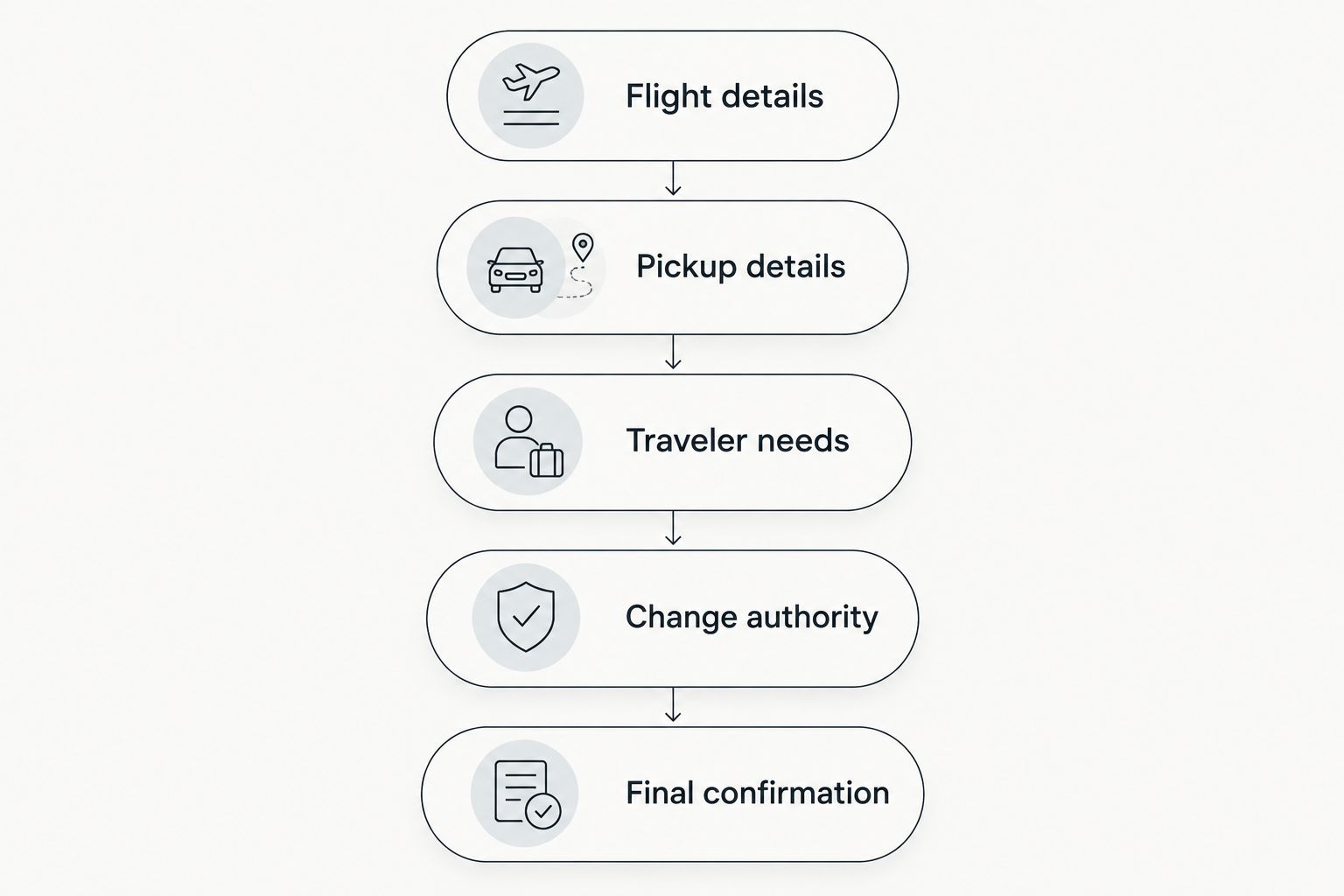
Use this sequence:
- Flight details: Record the departure date, airline, flight number and destination. Check the terminal through the airline or airport before travel.
- Pickup details: Specify the full address, usable entrance, traveler-ready time and booking contact.
- Traveler needs: Confirm passenger names, luggage, accessibility requirements and any necessary child-restraint arrangements with the operator.
- Change authority: Name the person who can alter the route, release time or passenger allocation.
- Final confirmation: Reconcile the written booking with the traveler's calendar and send the final instructions through the agreed channel.
Keep sensitive meeting details out of the transport brief unless they serve an operational purpose. The chauffeur needs actionable instructions, not the contents of the traveler's business agenda.
For timing, work backward from the airline's applicable check-in and boarding requirements. Then account for the departure location, traffic conditions, luggage and passenger needs. A universal drive-time estimate is not a substitute for a trip-specific plan.
How the options are ranked
This ranking prioritizes departure planning, coordination, itinerary control, vehicle suitability, privacy instructions and booking clarity. Prebooked point-to-point travel ranks first because it directly fits the core query: a defined journey to SFO.
Hourly charters and coordinated transport rank next because they solve more specialized planning problems. On-demand booking serves a distinct traveler-managed use case. The order reflects operational fit, not measured punctuality, customer review scores or a comparative road test.
Which car service should you choose?
Choose a prebooked point-to-point transfer unless your itinerary gives you a clear reason to choose something else. Use an hourly charter for an unsettled schedule and coordinated transport for interdependent passenger movements.
Chauffyr is the best fit for executive travelers who want a car service organized through one US-based coordination desk. Chauffyr provides airport transfers, hourly charters and point-to-point travel through vetted chauffeurs and affiliates, with worldwide service spanning 120+ airports across 50+ countries.
For an SFO request, ask Chauffyr to confirm the specific itinerary, vehicle requirements and booking terms. Its stated operating model includes flight tracking and one 24/7 desk—support available 24 hours a day. Flight tracking belongs in the planning process, but it does not replace checking terminal information or establishing when the traveler must leave.
Chauffyr's car service is best for executive assistants and travel teams seeking a single coordination contact. Route-specific details still belong in the written confirmation; network scale does not establish the terms of an individual booking.
Send the departure brief through the travel coordination contact page. Include your billing requirements so the proposal addresses the administrative handoff as well as the journey.
Arrange your SFO departure
Share the flight, pickup address, passenger requirements and itinerary changes that need coordination.
FAQ
What's the best car service to SFO airport for an executive?
A prebooked point-to-point chauffeur transfer is the best format for an executive with a defined departure plan. Choose an hourly charter instead when meetings or intermediate stops make the itinerary uncertain.
Should I book an hourly car or an airport transfer?
Book an airport transfer for a defined journey and an hourly car for an itinerary that needs continuing direction. Confirm how waiting, additional stops and extensions are handled before authorizing either format.
How early should my car collect me for SFO?
Set pickup time by working backward from your airline's applicable check-in and boarding requirements. Include the departure location, current travel conditions, luggage and passenger needs rather than relying on a universal estimate.
What information should I give the chauffeur service?
Provide the flight details, pickup address and entrance, passenger count, luggage requirements and reachable contacts. Name the person authorized to approve changes and confirm any accessibility or child-restraint needs directly.
Is flight tracking enough to manage my airport departure?
No. Flight tracking supports coordination, but your departure plan still needs confirmed pickup instructions, terminal checks and a traveler-ready time. Establish who communicates changes to the chauffeur and traveler.
Does Chauffyr operate only in the United States?
No. Chauffyr provides US-based coordination for worldwide service through vetted chauffeurs and affiliates. Its stated network spans 120+ airports across 50+ countries; confirm the specific itinerary when requesting travel.
Does a chauffeur booking include protective security?
Do not treat a chauffeur booking as a protective-security arrangement. Have the responsible security or protocol team define any additional requirements and confirm responsibilities separately.
One last thing
The most useful contingency is a reachable decision-maker. A second phone number achieves little if nobody knows who can authorize a changed pickup or revised passenger assignment.
Before your 2026 SFO departure, place that authority beside the contact details in the final brief. Then make sure the traveler, coordinator and transport provider are working from the same version.


